This guide is written for Amazon private label sellers who’ve already gone through the basics — you know what BSR is, you’ve heard of Jungle Scout, and you’ve probably already lost money on at least one product. This is the stuff nobody explains clearly.
Why Smart Sellers Still Pick Losing Products
Here’s something that doesn’t get talked about enough: most Amazon sellers who do product research feel like they’re being rigorous. They pull up a research tool, enter a keyword, stare at color-coded dashboards, and make a decision with genuine confidence.
Then six months later, they’re sitting on 500 units of something that nobody’s buying.
This isn’t a story about lazy sellers. It’s a story about misleading metrics — data points that look like signals but behave like noise. Amazon product research tools are genuinely useful, but they were also designed to give you the experience of certainty, not the reality of it.
In 2026, the gap between sellers who win consistently and those who break even (or worse) almost always comes down to this: which metrics are they actually trusting?
This guide breaks down exactly that. No fluff, no affiliate agenda — just a clear-eyed look at what data actually predicts success and what data has been quietly burning seller budgets for years.
What Amazon Product Research Actually Is (And What It Isn’t)
Amazon product research is the process of evaluating a product opportunity before committing capital — specifically before manufacturing, importing, or placing inventory orders.
Most guides — including the popular breakdowns from tools like Jungle Scout — define this as finding products with high search volume, low competition, and good profit margins. That’s not wrong, exactly. But it’s dangerously incomplete.
Here’s the more accurate definition: Amazon product research is the process of identifying markets where real demand exists, where existing sellers are underperforming, and where you can enter at a price point that leaves room to grow.
That requires understanding customer psychology, not just keyword volume. It requires reading listing quality with a trained eye, not just trusting a competition score. And it requires knowing the difference between a hot product and a durable one.
The tools help. But the judgment is what decides.
The 5 Metrics That Actually Predict Amazon Success
1. Demand Consistency — The Most Underrated Metric in Product Research
Most sellers look at a product’s monthly sales and call it a day. If the number looks good, they move forward.
The problem: a single month’s sales figure tells you almost nothing.
What actually matters is whether demand is consistent across 12 months. A product that sells 4,000 units in December and 200 units every other month isn’t an opportunity — it’s a seasonal trap. You’ll order inventory based on the high month, spend money on PPC trying to maintain velocity, and slowly watch your margins disappear in the off-season.
Run the sales history over a full year. You’re looking for a relatively flat or gradually rising line. Small fluctuations are fine. What you want to avoid: sharp single-month spikes with flat performance either side, products that go dead for 4–5 months annually, and sales volumes that dropped significantly year-over-year (a sign the niche is saturating).
Products with genuinely consistent demand look almost boring in the tools. That’s usually a good sign.
Practical test: If you remove the best 2 months from the trailing 12, does the average still justify your investment? If the answer is no, move on.
2. Revenue Distribution Across Sellers — Who’s Actually Winning This Market?
Here’s a question that most research tools don’t help you answer well: within this niche, is there room for another seller to win?
The answer lives in how revenue is distributed across the top listings. Pull up the top 10–15 sellers for your target keyword and look at their estimated monthly revenue side by side. Three very different pictures can emerge.
Pattern 1 — One seller dominates. One listing pulls in $80,000/month while everyone else does $5,000–$10,000. This usually means the dominant seller has a moat: an established brand, a massive review count, a patented feature, or an advertising budget that will bury you. Entry is possible but expensive.
Pattern 2 — The top 3 control everything. Three sellers split most of the revenue, and everyone else fights over scraps. This is a maturing niche. You’ll spend a lot to compete for a small slice.
Pattern 3 — Revenue is spread across many sellers. Multiple listings each do $15,000–$40,000/month with no single dominant player. This is the pattern you’re looking for. It tells you the market rewards good products and execution, not just whoever got there first.
A “low competition” score from a tool might still reflect Pattern 1 if the tool calculates based on average review counts. Revenue distribution gives you the actual economic reality.
3. Review Velocity — Momentum Beats History Every Time
When sellers look at reviews, they focus on the total count. A listing with 4,800 reviews looks intimidating. A listing with 300 reviews looks approachable.
But total review count is a historical artifact. It tells you where a listing has been, not where it’s going.
Review velocity — how many new reviews a listing is accumulating per month — tells you the current story.
A listing with 4,800 total reviews but only 15–20 new ones per month is stagnating. Sales are flat, and the seller likely isn’t aggressively pushing the product. A listing with 300 total reviews that’s adding 80–100 new ones per month is a different animal. That seller is actively investing in PPC, experiencing real sales growth, and probably doing aggressive follow-up sequences. That’s the listing you actually need to worry about — not the old giant.
Check review date distributions, not just totals. Consistently high velocity across multiple competing listings signals a market that customers are actively engaging with — good for demand, but harder for entry.
4. Listing Quality Gaps — This Is Where Real Opportunity Hides
No tool scores this. You have to do it manually. And it is consistently one of the most valuable things you can do in product research.
Open the top 10 listings in your niche and audit them honestly, the way a first-time buyer would. Ask: Are the images actually good — professional lifestyle shots, clear hero images, infographics that explain features? Or are they blurry and generic? Are the titles readable, or keyword-stuffed to the point of incoherence? Do the bullet points speak to what customers actually care about, or do they just list specs? Is A+ content present and compelling, or is it a copy-paste afterthought?
If the top sellers have mediocre listings, a well-executed launch with strong creative assets will convert better — even with fewer reviews. Customers make purchase decisions based on how much they trust a listing. If every listing looks average, being above average is a real competitive advantage.
This is particularly valuable for sellers who can’t win a price war or who don’t have the PPC budget to outbid established players. Better listings are one of the few places where effort outweighs spend.
5. Price Flexibility — Your Signal for Margin Potential
Look at the price distribution across the top sellers. If every competitive listing is priced within $1–$2 of each other — say $19.99 to $21.99 — you’re looking at a price-compressed market.
Price compression happens when the product is perceived as a commodity, sellers are in a race to the bottom on PPC, and there’s no meaningful differentiation between listings. You’re entering a fight where the winner is usually whoever has the lowest manufacturing cost and the highest ad spend tolerance. That’s a game where margins disappear.
What you want to see instead is pricing range flexibility — where the market has listings ranging from $18 to $35 or $40, with higher-priced listings still generating solid sales. This tells you customers will pay more for quality, there’s room to position as a premium option, and margins can support advertising while still leaving profit.
Price flexibility is also a signal of market maturity. Young, growing markets tend to have wider price spreads. Saturated markets compress around a consensus price point.
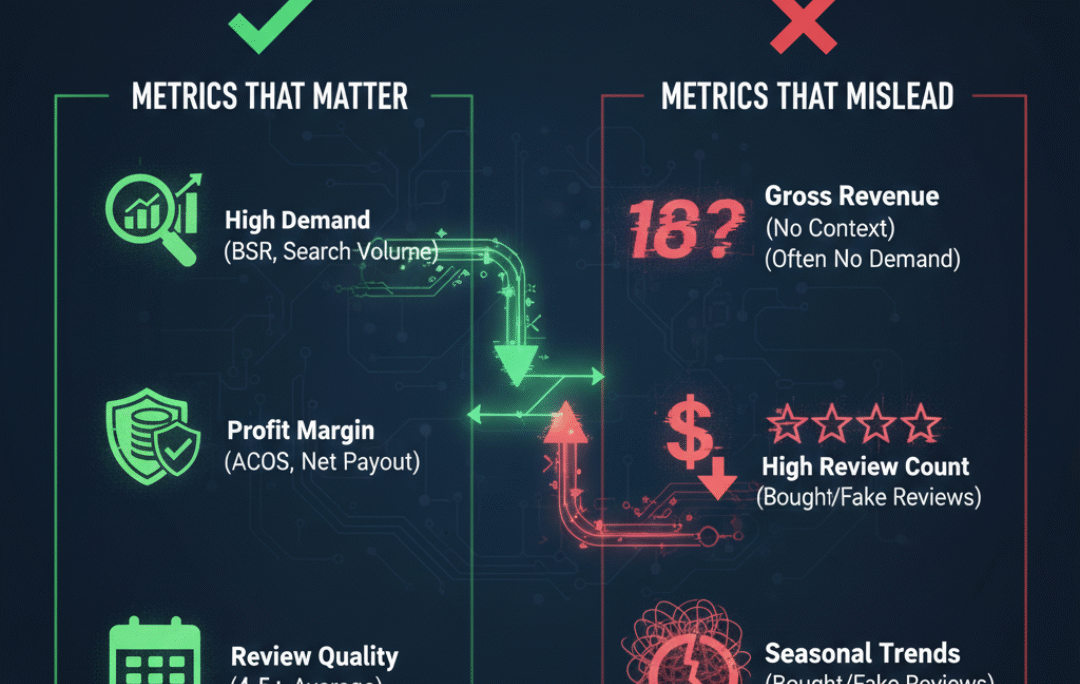
The Metrics That Are Quietly Losing You Money
Search Volume Without Context
Search volume is the most seductive metric in Amazon research and one of the least reliable predictors of your actual sales potential.
High search volume tells you that people are entering a keyword — but not whether those people are buying or browsing, not how much of that volume converts versus just driving up PPC costs, and not whether the conversion rate supports the ad spend needed to rank.
A keyword with 50,000 monthly searches and 200 sellers fighting for page one isn’t an opportunity just because the number is large. A better approach: look at estimated sales volume for the niche, not just keyword search volume. If the top 15 sellers are collectively moving 3,000 units per month, that market produces a specific amount of revenue. Your question is whether you can realistically capture a slice of it — and at what cost.
Opportunity Scores from Research Tools
This deserves to be said plainly: opportunity scores are a UX feature, not an analytical insight.
Tools generate these scores to make decision-making feel simple. They aggregate multiple signals into a single number or color code, creating the feeling of certainty. But that simplification is exactly where the danger lives. Opportunity scores can’t assess how defensible the category leader’s position is, whether the price range allows for real margins, how much PPC spend you’d need to reach page one visibility, or whether the customer base is loyal to existing brands.
Use them as a conversation starter, not a conclusion.
Revenue Screenshots as Proof of Opportunity
“This niche is making $300,000 a month” is a statement that means far less than it sounds. That figure tells you nothing about how much is profit after COGS, PPC, storage, and returns — or whether that revenue is concentrated in one dominant seller you can’t realistically displace.
High-revenue niches attract high competition and high ad costs. The most profitable private label businesses are frequently found in niches that look modest — $50,000–$150,000 monthly market size — where real margins exist and sellers aren’t spending $40,000 in PPC every month just to maintain position.
BSR Obsession
Best Seller Rank is a useful at-a-glance signal. It is not a strategy.
BSR fluctuates significantly based on recent sales velocity, meaning it can look great and crash within days. It also varies enormously by category — a BSR of #2,000 in Kitchen & Dining means something completely different from #2,000 in Sports & Outdoors. If you’re making product decisions based primarily on BSR, you’re reading the speedometer and ignoring the road.
The Metric Nobody Talks About: Customer Psychology in Reviews
This is one of the most valuable research activities a private label seller can do, and it doesn’t require any tool beyond the Amazon listing itself.
Read the one-, two-, and three-star reviews for the top sellers in your niche. Not to understand the product’s weaknesses — to understand what customers expected and didn’t get. Reviews reveal unmet expectations, consistent complaints, real usage contexts, and the exact language customers use to describe this product category (which is gold for PPC keyword research).
A pattern of recurring complaints about quality, confusing instructions, or missing features is essentially a product brief. It tells you exactly what a better version of that product would look like. If you can solve those problems and communicate that clearly in your listing, you have a meaningful advantage — regardless of your review count.
This research cannot be automated. It requires human judgment. That’s also precisely why so few sellers do it thoroughly — which means it’s a genuine competitive advantage for those who do.
What a Real Opportunity Actually Looks Like
When you combine all of these signals, the products that tend to succeed share a common profile: stable, consistent demand with no seasonal collapse; a fragmented competitive landscape where no single seller controls the category; real listing quality gaps that creative and content work can exploit; pricing flexibility that allows for a premium positioning; and a customer complaint pattern you know how to solve.
These products rarely look exciting in a research tool. They don’t have the viral appeal of a trending item or the headline revenue of a massive category. What they have is durability — they produce profit consistently and withstand the inevitable pressures of competition and rising ad costs.
A Realistic Research Process That Holds Up
Start with demand consistency, not search volume. Pull 12 months of sales data before anything else. Map the competitive landscape by revenue, not listing count — understand who the real winners are and whether their position is defensible. Audit every top listing manually, the way a buyer would. Check price distribution across the category. Read 50–100 reviews across the top sellers and document recurring complaints and customer language. Then validate your manufacturing cost against realistic price positioning.
Only after doing all of this should you make a go/no-go decision. The research takes longer. That time is what separates a calculated bet from a gamble.
Common Questions About Amazon Product Research
How long should product research take? For a serious private label evaluation, 8–15 hours per niche is reasonable. Sellers who spend 30 minutes and press launch are taking on enormous, avoidable risk.
Do I need an expensive tool? No. The core research can be done with a basic tool subscription and manual work. More expensive tools provide faster data access and more features, but they don’t replace judgment. Some of the most valuable insights come from reading customer reviews, which is free.
Is private label still viable in 2026? Yes, though the margin for error has narrowed. Sellers who succeed today are more rigorous in research, more patient in launch, and more focused on differentiation than speed-to-market. The opportunity is real; the execution bar is higher.
How do I know when I’ve found a genuinely good opportunity? When data and manual research align — consistent demand, fragmented competition, real listing quality gaps, flexible pricing, and a complaint pattern you know how to solve. You won’t feel certainty. You’ll feel informed confidence. That’s the goal.
Final Thought: Data Guides, Judgment Decides
The sellers who navigate Amazon product research well aren’t the ones who found the best tool. They’re the ones who understand what the tools can and can’t tell them, who complement quantitative data with qualitative research, and who have developed enough pattern recognition to know a real opportunity from a convincing-looking trap.
That kind of judgment takes time — and often takes losing money along the way. But it can be accelerated significantly by working with people who’ve already made those mistakes on your behalf.
If you want your product research approached strategically rather than mechanically, you can learn more about how we work with private label brands at ecommate.co.uk.
This article reflects direct experience working with Amazon private label brands. Metric estimates and market dynamics are based on observed patterns as of 2026 and are subject to change as the marketplace evolves.