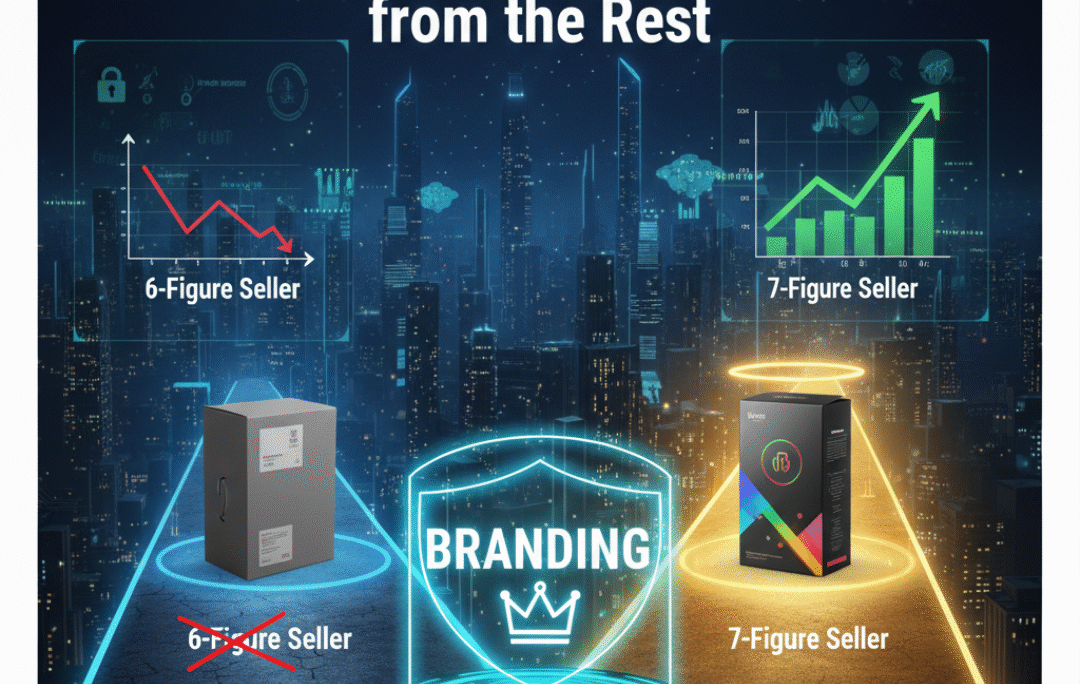
This isn’t about logos and color palettes. This is about why two sellers can list virtually the same product at the same price — and one quietly builds a business while the other grinds themselves into irrelevance.
The Pattern Every Amazon Seller Eventually Notices
Spend enough time on Amazon and something starts to feel off.
You’re looking at a category. Ten, fifteen, twenty listings. Same factory, clearly. Same feature set. Same price range, give or take a dollar. The products are, for all practical purposes, identical.
And yet one seller is doing $80,000 a month. The others are scrapping over coupons and refreshing their dashboards hoping something changes.
That gap isn’t luck. It isn’t Amazon’s algorithm playing favorites. It isn’t even PPC skill, though that plays a role.
It’s branding. And not in the vague, hand-wavy way that word usually gets thrown around.
This piece is about what branding actually means in the context of an Amazon private label business — what it does mechanically, why most sellers skip it, and why the ones who don’t tend to pull so far ahead that catching them becomes genuinely difficult.
The Uncomfortable Reality Most Gurus Skip Over
Here’s something worth saying plainly: most Amazon private label sellers are not building brands. They are operating customized reseller operations — finding products, sourcing them cheaply, optimizing keywords, running ads, and hoping margins hold.
That model works. For a while.
The moment competition increases — and on Amazon, it always does — the economics collapse. Ad costs rise. A copycat appears with a lower price. Conversion rates drop. Suddenly the entire business is held together by ever-increasing PPC spend and ever-thinner margins.
Six-figure sellers aren’t immune to competition. They just have something that makes competition harder to win against: customers remember them. Customers return to them. Customers choose them even when a cheaper alternative is sitting right there on the same page.
That’s not luck. That’s what a brand does.
What Branding on Amazon Actually Means
Let’s get specific, because the word “branding” gets used so loosely it’s almost lost meaning.
Branding on Amazon is not a nice logo. It’s not a premium price tag. It’s not a brand name generated by an AI tool that sounds vaguely Scandinavian.
This is consistent with how brand identity works across e-commerce broadly — Shopify’s breakdown of brand identity covers the foundational principles well — but on Amazon the stakes are compressed into a three-second window rather than a full browsing session.
When someone lands on a listing, they’re not running a spreadsheet analysis. They’re answering unconscious questions in about three seconds: Can I trust this? Does this feel legitimate? Will this solve my problem without making me feel stupid for buying it?
Six-figure sellers understand this intuitively, even when they can’t articulate it explicitly. Their listings don’t feel like a gamble. They feel like the obvious, safe choice. And that feeling — not the feature list, not the keyword density — is what drives conversion.
Why Generic Sellers Always Hit a Ceiling
The typical private label journey looks like this: find a product, source it cheaply, optimize keywords, run ads, watch early sales come in. It feels like it’s working.
Then the ceiling appears.
Competitors flood in. PPC costs double. Reviews plateau. Margins shrink. The product that felt like an opportunity six months ago now feels like a treadmill — you have to run faster just to stay in place.
The root cause is almost always the same: there’s nothing distinguishing the listing except price. And when price is your only differentiator, Amazon turns you into a number in a grid. Price wars follow, and price wars have no winners — just survivors with progressively worse economics.
Branding is how you escape that trap. It shifts the question from “how do I rank higher?” to “why should someone choose me?” — and those are completely different questions with completely different answers.
The Role of Search Data in Building a Brand That Converts
Here’s where many sellers go wrong even after they commit to branding: they build the brand around what they think customers want rather than what the data actually shows.
Branding decisions — positioning, messaging, which features to emphasize — should be grounded in real search and purchase behavior. Tools like Amazon’s Search Query Performance report, when analyzed properly, show you not just what people are searching but which searches are actually converting to sales. That distinction matters enormously. A keyword with huge search volume but low purchase intent should shape your PPC strategy differently than it shapes your brand messaging.
Understanding which searches bring in buyers — not just traffic — is what lets you build a brand that speaks to people who are actually ready to purchase, rather than people who are browsing.
Visual Branding: The Silent Salesman
On Amazon, customers make decisions in seconds. Before they read your bullet points. Before they scroll to your description. Before any logical evaluation begins.
Your visuals do the talking.
Six-figure sellers are obsessive about image quality, consistency, and intentionality. Their main image doesn’t look like a factory photograph — it looks considered. Their lifestyle images feel relatable rather than staged. Their infographics explain features without overwhelming the viewer.
This isn’t aesthetics for its own sake. It’s conversion psychology. People buy what feels clear and familiar. A listing that looks polished signals competence. A listing that looks thrown together signals risk — and customers avoid risk instinctively.
Color consistency, visual hierarchy, image sequencing — these aren’t details. They’re the difference between a listing that builds confidence and one that raises questions.
Packaging: The Most Overlooked Profit Lever
Most sellers treat packaging as a logistical necessity — something to protect the product in transit and satisfy Amazon’s requirements.
Six-figure sellers treat it as a marketing touchpoint.
Think about what packaging actually is: the only physical interaction a customer has with your brand. It arrives in their home. It sits on their shelf or desk. It gets seen again when they go to use the product. It might get photographed and posted somewhere.
Cheap, generic packaging communicates exactly that — cheap and generic. It primes the customer to look for problems, to feel less confident in their purchase, to be more likely to leave a neutral or negative review.
Thoughtful packaging does the opposite. It reinforces the purchase decision. It says: this company put thought into this. That shift in perception affects reviews, repeat purchase rates, brand recall, and word of mouth — none of which show up directly in your PPC dashboard, but all of which compound over time.
Customers don’t review products. They review experiences. Packaging is part of the experience.
Brand Voice: Why Copy Converts Better Than Keywords
Search optimization matters. Of course it does — without visibility, nothing else works. But six-figure sellers understand something that keyword-focused sellers miss: keywords get clicks, copy gets conversions.
The difference between a generic listing and a branded one is almost always most visible in the copy. Generic listings read like spec sheets. Branded listings read like a knowledgeable friend explaining why something is worth buying.
“Made with high-quality materials” tells the customer nothing. “Built to survive daily use without falling apart after a month” tells them something they actually care about.
“Ergonomic design” is a feature. “Designed so your hands don’t ache after ten minutes of use” is an outcome. People buy outcomes.
This kind of copy also builds trust faster than any review count can. When a listing sounds human and specific, it signals that a real company with real knowledge is behind the product. That trust converts — and it converts in ways that are hard for competitors to copy, because copying a feature set is easy, but copying a voice and a point of view is much harder.
How Branding Changes the Way Reviews Land
Here’s something subtle that doesn’t get discussed enough: two products can have identical star ratings and review counts, and one will feel risky while the other feels safe. The difference is branding.
When a brand feels legitimate and established, customers interpret reviews generously. Minor complaints get forgiven. Positive aspects get emphasized. The customer extends good faith — they assume the company is competent and cares about quality.
When a brand feels generic, the opposite happens. Customers nitpick. Minor flaws become major concerns. Neutral reviews tip toward negative in the reader’s mind.
Same reviews. Different perception. That’s branding operating quietly in the background, shaping how every piece of social proof gets interpreted.
Brand Registry Is a Tool. It Is Not a Brand.
A common mistake: sellers enroll in Amazon Brand Registry and feel like they’ve done the branding work. They haven’t.
Brand Registry gives you access to A+ content, a storefront, enhanced reporting, and intellectual property protections. These are valuable. But they’re vehicles — what matters is what you put in them.
Low-level sellers treat A+ content as a checkbox. High-level sellers use it to reinforce their positioning, answer the questions that bullet points can’t, and tell a coherent story about who the brand is and who it’s for.
The same distinction applies to storefronts. A storefront can be a glorified category page, or it can be a brand experience that increases cross-sell, builds loyalty, and creates the impression of an actual company rather than a listing. The tool is the same. The intent behind it is completely different.
How Strong Branding Reduces Dependence on Ads
This is one of the most practically significant benefits of building a real brand, and it’s underappreciated.
Generic sellers are dependent on PPC the way a patient is dependent on life support — the moment it stops, everything collapses. They need constant ad spend to generate any organic velocity because they have no brand recognition, no repeat customers, no branded search volume to fall back on.
Branded sellers still run ads — often significant ones — but the relationship is different. Higher conversion rates mean lower ACOS. Repeat customers reduce the need to constantly acquire new ones through paid channels. Branded keyword searches grow organically as more customers remember the name and search for it directly. Organic rank stabilizes because conversion signals are stronger.
Ads become fuel rather than life support. That’s both a financial and a psychological difference — and sellers who’ve made the transition will tell you the difference in day-to-day stress alone is significant.
The Long Game: Amazon Brands as Sellable Assets
Here’s the destination that most sellers don’t think about until much later than they should: branded Amazon businesses sell. Generic Amazon stores largely don’t — or they sell at multiples so low they’re barely worth the process.
Acquirers aren’t buying listings or SKUs. They’re buying brands — the recognition, the repeat purchase behavior, the defensible positioning, the consistent visual identity and messaging. These are the things that make a business’s revenue durable rather than fragile, and durability is what acquirers pay for.
Sellers who build genuine brands have exited at 5x, 6x, even 8x multiples. The product itself is often unremarkable. The brand built around it is not.
If you have any intention of eventually selling your Amazon business — or even just creating something that could survive you stepping away from daily operations — branding isn’t optional. It’s the thing that determines whether you’ve built an asset or just a job.
Why Most Sellers Avoid This (The Real Reason)
Branding requires commitment, and commitment is uncomfortable.
To build a brand, you have to choose a direction. You have to define a specific customer and say no to everyone outside that definition. You have to think beyond the next payout cycle. You have to accept that some of the work you’re doing now won’t show measurable results for months.
It’s much easier to chase the next product. To stay in the mode of finding, sourcing, launching, and repeating — always moving, never building. That pattern feels productive. It generates activity. It produces short-term revenue spikes that feel like progress.
Six-figure sellers accepted the discomfort of commitment early. They chose a direction, built around it patiently, and then watched the compounding effects kick in. The sellers still cycling through products are often working just as hard — sometimes harder — and going nowhere durable.
Branding Isn’t Optional Anymore
A few years ago, a well-optimized listing with decent reviews could win on Amazon without much else. That era is gone.
The marketplace is crowded in a way it hasn’t been before. Customers have become more discerning because they’ve been burned enough times by generic products that looked fine in a listing and disappointed in person. Copycats are faster and more sophisticated. Differentiation through product features alone is increasingly difficult to maintain.
Branding is now the separator. Not in a soft, aspirational sense — in a practical, mechanical sense. It’s what determines conversion rate, review quality, repeat purchase behavior, organic rank stability, and ultimately whether the business is worth anything beyond its next 30 days of revenue.
The sellers treating Amazon like a short-term hustle keep cycling. The sellers treating it like a brand-building platform pull ahead — and the gap between them compounds faster than most people realize.
Where to Go from Here
If you’re serious about building an Amazon business that lasts beyond a single product cycle, branding isn’t something to figure out later. It’s the foundation that determines how fast you scale, how stable your profits are, and whether your store eventually becomes a real asset.
The work involved — product positioning, visual identity, listing copy, packaging, A+ content strategy — is learnable. But it’s also the kind of work where having experienced outside perspective tends to accelerate things significantly, because the mistakes in this area are expensive and slow to reverse.
If you want to understand how this translates into an actual execution plan for your specific business, you can see how we approach it at ecommate.co.uk.
This article is based on direct experience working with Amazon private label sellers across multiple categories. Examples reflect observed patterns as of 2026.