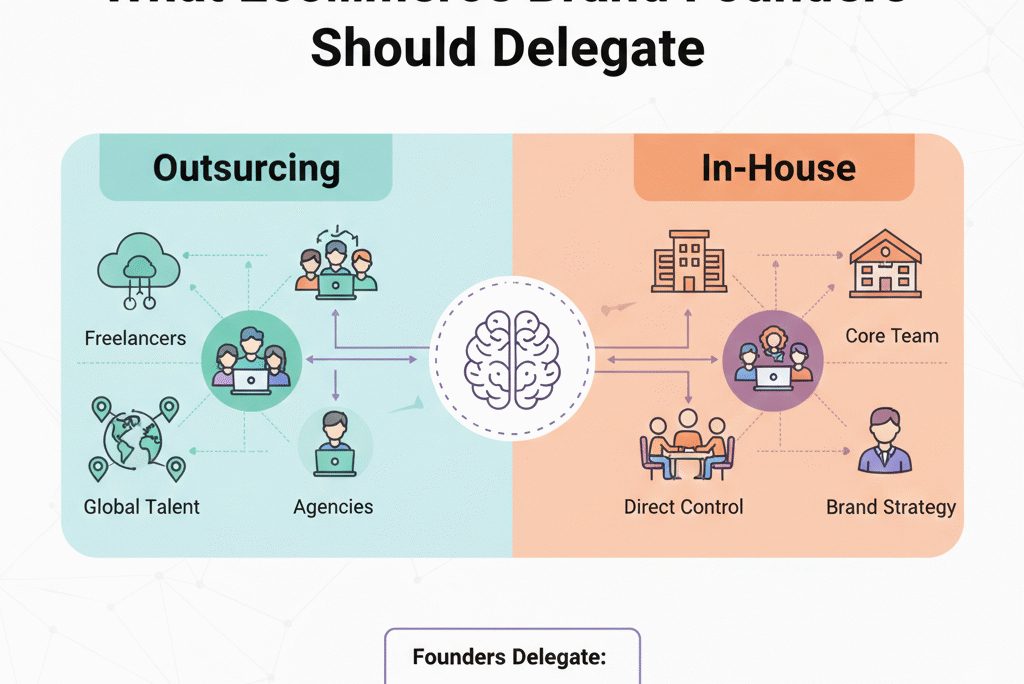
Outsourcing vs in-house is one of the important choices an ecommerce brand founder will make. And most get it wrong not because they choose the wrong option but because they choose at the wrong time. Running an ecommerce brand enough will eventually teach you a lesson nobody warns you about at the start: the skills that got you to your first £10,000 month are almost certainly not the skills that will get you to £100,000 a month.
The hustle, the hands-on involvement in every decision the tendency to treat every task as your responsibility. These are assets in the launch phase and liabilities in the growth phase. The founders who don’t recognize this shift keep running on a treadmill that isn’t moving forward. The ones who do start building something different: a system of delegation that turns their time into a multiplier rather than a constraint.
This guide is about that system. Not at the level of “delegate more ” but at the specific practical level of which functions to outsource which to keep in-house at what stage how to structure the relationships and how to avoid the delegation failures that consistently cost founders more than the tasks they were trying to escape.
Why the “I’ll Just Do It Myself” Phase Eventually Becomes the Problem
There’s a period in every ecommerce brands life where doing everything yourself is not just practical. It’s genuinely valuable. You’re learning how Amazons listing quality signals work and why they matter. You’re understanding through experience how product photography affects conversion rate. You’re discovering what a healthy PPC campaign looks like and what a broken one costs you. This firsthand education is irreplaceable. Founders who skip it by outsourcing too early consistently find themselves at the mercy of agencies they can’t evaluate. Paying for activity instead of results because they have no framework to tell the difference.
The education phase has a natural endpoint and missing it is one of the most common and costly mistakes growing brands make. The endpoint isn’t a revenue figure. It’s a shift in what you’re doing with your time. You know you’ve crossed from education into maintenance when you’re doing tasks not because you’re learning something from them. Simply because they need to be done and you’re the only one available to do them.
Maintenance is insidious because it doesn’t feel like failure. You’re busy you’re productive you’re getting things done.. The businesss growth becomes contingent on your personal output capacity. And your personal output capacity has a ceiling that no amount of hustle can lift. When you’re spending twelve hours a week managing supplier communications reformatting product images monitoring ad spend and scheduling social media posts you’re not spending those twelve hours on the decisions that actually determine whether the business grows or plateaus: product strategy, competitive positioning, margin improvement, new market entry. Those decisions don’t get made in the gaps between tasks. They require strategic attention that task-heavy schedules systematically eliminate.
The opportunity cost is real but invisible which is precisely why many founders miss it. A decision not made doesn’t show up as an expense on a profit and loss statement. A competitor advantage not built doesn’t appear as a line item.. These invisible costs compound in exactly the way genuine expenses do. And over a twelve-month period the cumulative cost of strategic decisions not made because a founder was too consumed by execution is often far larger than the cost of the agency retainer that would have freed up the time.
The Framework: Separating Direction from Execution
The useful way to think about the outsourcing versus in-house question isn’t to categorise tasks as “outsourceable” or “not outsourceable”. It’s to categorise them by whether they require your specific strategic knowledge or whether they primarily require a skill that a competent specialist could apply equally well with the right brief.
Direction. The category of decisions that requires your knowledge. Includes everything that depends on insight you uniquely hold. Which product to launch next requires your understanding of your customer relationships your supply chain access, your read on where competitorsre vulnerable and your judgment about where your brand has genuine defensible advantages. How to position the brand against a competitor requires your understanding of what makes your customer base loyal and what they value most. What pricing architecture to adopt requires your grasp of your cost stack your margin targets and your long-term brand positioning goals. No outsourcing partner, capable can make these decisions as well as you can. They don’t have the information the context or the accountability.
Execution. The category of work that requires skill than your specific strategic knowledge. Includes everything downstream of those direction decisions. Implementing the keyword architecture that supports the listing strategy you’ve decided on requires specialist skill, but not your specific knowledge. Building the PPC campaigns that drive traffic to the positioning you’ve defined requires expertise. Not your unique insight. Designing the identity that communicates the brand personality you’ve articulated requires craft, but not your specific strategic awareness. These tasks require excellence to be done well. Excellence can come from a specialist who doesn’t know your brand as deeply as you do provided they’re given a sufficiently clear brief.
The practical filter this creates is simple: before spending time on any task ask whether your specific involvement adds value that a briefed specialist couldn’t provide. If the answer is yes own it. If the answer is no build the system to move it off your plate.
When In-House Is the Right Answer
Outsourcing isn’t universally better than in-house hiring. There are conditions under which an internal resource outperforms an external one and being honest about these prevents over-outsourcing. Which has real costs of its own.
Time integrated functions at scale. Some functions are closely intertwined with moment-to-moment decisions across the business that the information lag of external management creates meaningful cost. Amazon PPC management at scale is the example. A performance marketer sitting within your team hears in time that a supplier has delayed a shipment and can adjust campaign spend before stockout damages ranking.
They know a new product is launching in six weeks and can begin building campaign history in advance. An agency managing your account alongside 40 others works with the information you proactively send them. Which’s rarely as complete or as timely as the information that flows organically within an integrated team. The value of internal integration scales with the velocity of the decisions it enables.
Rapid creative iteration for heavy brands. If your competitive strategy requires creative refreshes. New product photography, updated ad creatives, seasonal packaging variants. The coordination overhead of an external agency can genuinely slow you down. The brief-review-revision-approval cycle thats perfectly acceptable for deliverables becomes a bottleneck when you need new creative every few days. An in-house designer who understands your brand style deeply and can act on direction without formal briefs removes that bottleneck.
Proprietary process management. If your competitive advantage is partially embedded in a manufacturing process, a formula or a supplier relationship thats genuinely difficult to replicate the security argument for in-house management is real. Every external party you bring into operational areas is an additional risk vector. Not from malice but from the inevitable imperfection of confidentiality in commercial contexts.
The honest cost accounting. The common error in outsourcing decisions is comparing agency fees to the headline salary of a potential hire rather than to the true cost of employment. For a UK ecommerce brand a £35,000 salary hire actually costs £42,000–45,000 when employer National Insurance contributions, statutory pension minimum and holiday pay are included. Before adding software, equipment and the significant time cost of recruitment (job advertising, interview cycles, referencing) onboarding and management.
New hires typically reach productivity in their role after three to six months not immediately. Factor in the risk of a hire not working out after three months requiring you to restart the process. When the true cost comparison is made accurately external agencies are cheaper than they appear at headline rate and internal hires are more expensive than they appear at headline salary.
Where Outsourcing Consistently Outperforms In-House
Amazon private label execution. Amazons marketplace operates on logic that changes continuously and rewards accumulated expertise. The A9/A10 ranking algorithm considers listing quality score, conversion rate history session-to-sales ratio, search term relevance and review velocity in ways that interact with each other in -obvious ways. A PPC campaign structure thats excellent in isolation can actively suppress ranking if it drives irrelevant traffic that lowers the products conversion rate below the category average. Keyword architecture that looks complete misses volume if it doesn’t account for how Amazonians search for your category differently than general Google users search for it.
An agency that manages Amazon accounts across brands in multiple categories builds pattern recognition from that breadth in a way thats simply not achievable by a founder managing a single account. They’ve seen what a healthy account looks like versus a struggling one in your category. They’ve lived through algorithm updates. Know how to reorient when the rules change. They’ve made the mistakes on other clients accounts. Which means you don’t have to pay the tuition on yours.
What to outsource within Amazon management: keyword research and full listing architecture (requires tools like Helium 10 or Data Dive. Experience interpreting category-specific data patterns) PPC campaign structure and systematic ongoing optimisation A+ Content development and review strategy, within Amazons compliance framework. What to keep internal: the product selection decision, supplier relationships and negotiation pricing strategy and financial performance oversight.
Graphic design and brand identity. The link between how a brand looks and how well it sells online is stronger and easier to track than most people realize until they see the numbers. Your main product image on an Amazon or Etsy page is the first. And often the only. Thing a customer looks at before deciding to click. When there are similar products shown at once your image is being compared to others in real time. A product that looks quality than others in the thumbnail view is already at a disadvantage before anyone reads the title.
The skills that really matter for sales. Knowing how color shows what kind of product it is and how good it is knowing how to use fonts to guide attention on a page knowing how packaging needs to look different at 200 pixels versus full size and being able to keep the brand looking the same across many different formats. Take years of working with many brands to develop. A founder using Canva to create brand images isn’t building these skills. They’re making designs that look like they were made with a template, which buyers can tell and don’t trust.
Website. Conversion infrastructure. A direct-to-consumer website is essential for an ecommerce brand that wants to grow and sell for a price. Relying on marketplaces limits how much the business is worth because investors and buyers see the risk of depending on a platform as a big problem. A brand that has its website. Which collects customer data builds customer relationships gets traffic without paying for ads and sells without paying marketplace fees. Is worth a lot more than a brand that only exists on Amazon or eBay.
Creating a website that actually makes money needs a mix of skills that’re hard to find in one person. This includes making the site fast and meeting web standards designing it to get sales setting up the website to work well with tools like Shopify or WooCommerce making sure the site appears in search results and linking it to systems for inventory, shipping, payments and analytics. Founders who build their sites beyond basic templates often don’t realize how complicated this is. Not because they can’t learn it but because the time it takes is better spent on other important decisions.
Organic search authority. The difference between knowing what SEO is and being good at it is huge. At the level good ecommerce SEO needs technical skills. Fixing problems with how search engines see the site fixing issues with how pages are linked making sure the site is fast and works well and using special code to help show more information in search results. At the content level it means knowing how to write for stages of a customers journey not just trying to get traffic that doesn’t lead to sales. At the authority level it means building value through links from other websites not just getting many links from low-quality sites.
Each of these areas is a field that takes years to get good at. Trying to handle all three without being an expert while also running a business usually leads to doing each part which can be worse than doing nothing at all because some bad SEO can actually hurt your rankings.
Inventory performance affects how traffic you get from search engines. If a product is out of stock when a blog or category page is getting the traffic it not only loses sales but also tells search engines that the site doesn’t convert well which hurts the rankings you’ve worked hard to build. Keeping track of inventory levels and how fast they sell using tools like Days of Stock Tracker is the kind of setup that helps protect the money you’ve spent on SEO.
The Real Cost of Doing It Yourself: Outsourcing vs In-House
The idea that outsourcing is expensive is wrong because it compares the cost of hiring a company to the hidden cost of your own time.. Your time isn’t free. It has a cost that’s often much higher than the fee you are trying to avoid.
Imagine a founder who’s worth £150 per hour. Someone who creates real advantages for the business when they focus on big decisions. Spending fifteen hours a week on tasks that could be done by someone else for £40 to £70 an hour. The apparent savings of not outsourcing is £600 to £1,050 a week. The real cost of not outsourcing is £2,250 a week in lost time that could be used for decisions. The real cost of saving money is £1,200 to £1,650 a week.
Over a year that’s a six-figure loss in what could have been done with that time. Not shown on the profit and loss statement but in the form of products not tested, markets not explored profits not increased and relationships not built. The brands that grow the fastest are the ones where the founder is doing the £150-per-hour work, not the ones where the founder is doing the £40-per-hour work to avoid fees.
This changes as the business grows. At the start the founders value per hour might be lower because there are big decisions to make. When the business grows, their value increases because there are important decisions to make. The point at which it makes sense to outsource a task gets lower as the business grows not because outsourcing is cheaper. Because not outsourcing costs more.
What Should Stay Internal. At Least in the Early Stages
Product strategy and market choice. Deciding which product to sell, which market signal to follow and which category to expand into. These decisions need to be made by you. No one else can know all the information you have: your understanding of your customers your sense of how reliable your supply chain’s your read on where competitors are really weak versus where they seem weak. Agencies can help with research and data.. The final decision about what to do with that data needs to be yours.
Brand. Personality. How your brand sounds. Not how it looks, but the personality and beliefs it shows in every message to customers. Is a key part of your brand that needs to be defined before you can have someone else make it. If you let someone else define your brand voice before you know what it is you’ll get something that sounds like every brand they’ve worked with. Define it yourself write it down clearly and then let others do the work.
Supplier. Supply chain quality. The strength of your relationships with suppliers. How trust you have how well you can explain what you want and whether you can get good payment terms instead of just low prices. Are real advantages that take years of working with them to build. If you let a third party handle all of this you miss out on building that trust and credibility. You don’t need to handle every email. You should be the one who manages the relationship even if someone else handles the daily details.
Financial performance. Knowing the profit from each product how cash you have compared to what you plan to spend on inventory and the real cost of each item including returns, storage and fees. These numbers need to be in your head not in a report from a company. Agencies only see part of your finances. You need to know everything to make decisions about money. Letting someone else handle your understanding is one of the biggest risks you can take no matter how good your accountant is.
Customer insights. Reading your reviews watching support tickets and understanding the language customers use to talk about their problems and what they like about your product. This is a key function that should stay close to the founder as long as possible. The insights you get from customer feedback are different from a summary report and the decisions you can make from them are often the most important. Giving up this insight early means making decisions based on secondhand knowledge of your customers.
The Hybrid Model: A Real Way to Grow
The idea that a business has to choose between being outsourced or fully in-house is not right. Most growing ecommerce brands don’t face this choice. The best way to grow is usually a mix. And building it on purpose not by accident is what makes the difference between a system that works and one that causes problems.
A good mix for a brand making £50,000–500,000 a year might look like this: an outside expert or company handles Amazon page setup and ads working with a plan that is reviewed every two to four weeks. A part-time person inside handles checking, talking to suppliers and making quick decisions. A design company handles the brands look. Logo, packaging, guidelines and photos. While someone inside does the work. The founder makes decisions about products manages supplier relationships watches the money and handles growth questions.
This setup can work with a team. Maybe two or three people inside plus the founder with outside experts covering the tough parts. The number of people isn’t the goal. Matching each job to the person for it at a cost the business can handle is the goal.
Making external partnerships work. The common reason outsourcing fails isn’t because the company is bad. It’s because the way the work is set up stops them from doing their best. Agencies work best when they have goals decided before they start regular check-ins, with the data they need to understand their results and a good understanding of what the business is doing that could affect their work (like new product launches, inventory limits or price changes).
Vague KPIs. “Improve performance ” “grow the brand ” “drive traffic”. Are not success metrics. They’re invitations to measure whatever happens to look good. Specific KPIs. “Reduce ACoS from 28% to below 20% while maintaining or growing total attributed sales ” or “achieve first-page organic ranking for three specific target keywords within six months”. Create the accountability structure that separates agencies that perform from agencies that produce activity and invoice for it.
The reporting relationship matters too. You should be reviewing the performance data, not the agencys interpretation of it. An agency that prepares a report showing only the metrics that look good is providing PR, not management information. The baseline practice is: define the metrics that matter have access to the platforms where they’re measured and review them yourself. Treating the agencys narrative as context rather than as the primary source of truth.
Vetting Outsourcing Partners: Green Flags and Red Flags
Because the quality variance in ecommerce service agencies is enormous the due diligence process for selecting an outsourcing partner deserves systematic attention than most founders give it.
Green flags that suggest a partner engaging. They can point to results in your specific marketplace or category. Not “we grew a clients revenue by 40%” but “we took a kitchenware brand from an ACoS of 35% to 22% over four months by restructuring campaign types and implementing negative keyword strategy while maintaining total sales volume.” Specificity signals that they understand what they did and why it worked.
They can explain their methodology clearly in terms you can evaluate without deep expertise in their function. They ask questions about your business before proposing anything. They have references from clients at a stage to yours and those clients are willing to speak candidly about their experience. They define success metrics explicitly. Agree to reporting schedules with direct data access.
Red flags that warrant caution. They lead with case studies that’re vague about methodology and specific only about topline results. They can’t clearly explain what they’d do differently from what you’re doing or why. They’re reluctant to put deliverables and performance benchmarks in writing. They propose minimum contract terms before demonstrating results. They describe their service in terms of activities (“we’ll post on social media ” “we’ll run weekly bid reviews”) rather than outcomes (“we’ll reduce ACoS while maintaining volume within 90 days or we’ll escalate our approach”). They’re evasive about client references. Can only provide testimonials rather than contacts you can speak with directly.
Sequencing the Delegation Journey
The order in which you outsource functions matters much as the decision to outsource them. Delegating in the sequence can leave you with well-executed components of a strategy that doesn’t hang together. Or outsourcing overhead that the businesss economics can’t yet support.
The priority first outsourcing decisions are typically the ones where poor execution is actively costing you money or where the expertise gap is creating a measurable drag on results. If your listings are unoptimised and you’re running PPC with campaign structure you’re paying for traffic that converts at a lower rate than it should. Which suppresses organic ranking and wastes ad spend simultaneously. Getting listing and PPC to a standard before adding volume of any kind is the correct sequence.
Brand identity is the second-priority outsourcing category for brands because poor brand presentation is a continuous conversion drag that worsens in impact as you scale traffic. Spending money on advertising to drive traffic to a listing with packaging photography is a self-limiting strategy. You’re paying to expose more people to a first impression that works against you.
SEO and content become the third-priority category once the commercial infrastructure is in shape because organic search is a long-game investment that compounds over time. The earlier you start building the authority the earlier the compounding returns begin.
Website development is priority if your growth strategy includes a direct-to-consumer channel and timing it depends on when that channel becomes a meaningful strategic priority.
Frequently Asked Questions
How early is too early to outsource?
The meaningful early limit is your ability to evaluate the work. If you can’t assess whether the output of an outsourcing relationship is genuinely good you’re exposed to receiving sounding mediocrity without knowing it. The practical threshold is developing baseline understanding in each function. Through your own early experience, targeted reading and asking probing questions. To know what good looks like even if you can’t do it yourself. This is achievable in functions within a few months of direct engagement. Once you can evaluate quality reasonably outsourcing becomes viable.
What’s a reasonable budget allocation for outsourcing for a brand in growth stage?
There’s no answer but a practical framework is to allocate outsourcing budget against specific revenue improvement expectations rather than as a fixed percentage of revenue. A listing optimisation investment that demonstrably improves conversion rate by two percentage points on a product generating £20,000 monthly generates £400 in monthly margin. Which sets a clear ceiling for what that optimisation is worth on an ongoing basis. Tie outsourcing investment to measurable outcomes. The budget allocation follows from the return expectation rather than from an arbitrary percentage.
How do I handle the transition when outsourcing something I’ve been doing myself?
The effective transitions include a structured handoff period during which you document your current approach. What you’re doing, whats working, what you’ve tried that didn’t work. And share it with the incoming specialist. Treating this documentation as a brief rather than a verbal overview ensures the specialist has the context they need and gives you a record of what was handed over. The 30 days after a handoff should include closer-than-usual oversight to verify the specialist has interpreted the brief correctly and is moving in the right direction before you step back to a more periodic review cadence.
What protections should I have in place when outsourcing?
At minimum: a clear scope of work document defining deliverables and whats excluded, agreed performance metrics and review periods data ownership clauses confirming you retain ownership of all accounts campaigns, creative assets and performance data a termination clause with reasonable notice period (30–60 days is standard longer than that warrants scrutiny) and IP assignment if the agency creates any brand assets on your behalf. Avoid contracts that require lock-in periods before performance is demonstrated. Reputable agencies are confident enough in their results to accept shorter initial commitments with renewal options contingent on performance.
What happens when an outsourcing relationship isn’t working?
Address underperformance in the monthly review it becomes apparent. Not after six months of hoping it will improve. The conversation should be specific: “We agreed an ACoS reduction to below 22% within 90 days. We’re at 90 days and ACoS is 29%. What specifically is the plan from here?” Agencies that respond to performance conversations with a clear revised approach and accountability deserve a second chance. Agencies that respond with excuses, scope-creep arguments or vague reassurances are telling you what they’ll do the next time performance is challenged. Trust that information.
Final Thoughts: Building the Leverage Engine
The outsourcing vs in-house question is ultimately about one thing: how do you build a business that grows based on the quality of strategic decisions rather than the hours available for execution? The founders who crack this build leverage. The ones who don’t build personal capacity ceilings they spend years trying to outwork.
The shift from doing everything to directing an integrated team of internal and external resources doesn’t happen overnight. It’s sequential — identify the highest-cost bottleneck, delegate it effectively, redirect that time to strategy, repeat. Done well, each cycle of delegation increases the quality and speed of the next cycle, because freed strategic time enables better decisions about what to outsource next and how to structure it.
Ecommerce brands at growth stage have more leverage available to them than at any prior point in the industry’s history. The specialist knowledge that used to require building an internal team of ten is now accessible through focused outsourcing relationships with specialists who’ve developed that knowledge across many brands. The tools that used to require enterprise budgets are accessible at small business pricing. The competitive advantage is not in access to these resources — it’s in having the strategic clarity to use them in the right sequence, with the right accountability structures, at the right time in the business’s development.
The founders who build that clarity early build the brands that scale.
If you’re building an ecommerce brand and ready to delegate with structural clarity — across Amazon, eBay, Etsy, branding, website development, SEO, GEO, and social media — explore how Ecom Mate supports founders at every stage of the growth journey.
For broader context on how ecommerce businesses globally approach this decision, the DSers breakdown of in-house vs outsourcing strategies provides a useful comparative framework — covering where specialised expertise, cost efficiency, and operational flexibility make outsourcing the stronger choice, and where real-time integration and cultural alignment make in-house the better investment.