Quick Answer: A brand moat is a structural advantage that makes your ecommerce business difficult to copy — even when competitors can replicate your product. The most effective moats in ecommerce are built from brand perception, direct customer relationships, community, review history, content authority, and operational consistency. Products can be cloned in weeks. A brand with loyal customers, a recognisable identity, and deep content roots takes years to replicate — if it can be replicated at all.
The Moment Every Growing Ecommerce Seller Dreads
There’s a specific moment that hits sellers who are building something real. Sales are consistent, reviews are accumulating, your product is ranking on page one, and the daily revenue screenshot has finally become something you’re proud to look at.
Then you search your category and see it.
A listing with your exact angle, your colour palette, your benefit structure — priced three pounds or dollars lower. Same product images, almost. Same bullet point logic. A different brand name that nobody has heard of, attached to a product that’s clearly sourced from the same factory or one very close to it.
Welcome to ecommerce at scale.
Copycats aren’t a risk you might face if you succeed — they’re a certainty once you do. On platforms like Amazon, eBay, and Etsy, where finding a supplier is a Google search away and the data showing which products are performing is largely public, imitation is the most predictable response to someone else’s success. The question isn’t whether competitors will show up once you start winning. It’s whether you’ve built something they can’t actually kill when they do.
That’s what a brand moat is. And building one is the difference between an ecommerce business that compounds over years and one that gets commoditised as soon as it finds its footing.
What a Brand Moat Actually Is
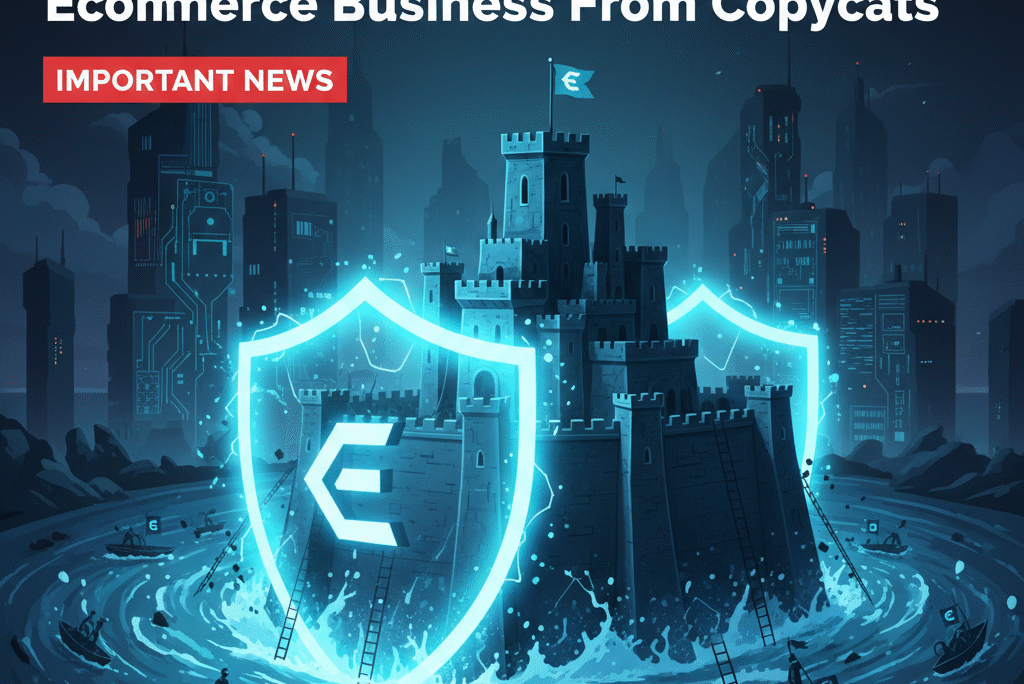
The concept of an economic moat was popularised by Warren Buffett, who described great businesses as castles protected by wide, defensible moats — competitive advantages so structural that competitors struggle to erode them even when they try directly. In investing, moats come from cost advantages, network effects, switching costs, intangible assets, and efficient scale.
In ecommerce, the same logic applies but the specific moats look different. Your castle isn’t just your product. Your product is one room in the castle, and it’s probably the easiest room for someone else to build a copy of. The moat is everything around it — the brand identity that customers recognise and trust, the community that has formed around your positioning, the review history that took years to build, the content that ranks outside marketplace search, the customer relationships you own directly, and the operational consistency that has quietly built your reputation for reliability.
None of those things are easy to copy. Some of them are essentially impossible to copy from scratch in the short term. That’s the point.
The concept of an economic moat has a precise definition in investment and business strategy that’s worth understanding fully before applying it to your own brand. The Wikipedia entry on economic moats covers the five main types of competitive advantage that Buffett and other investors look for — and reading it through the lens of your ecommerce brand reveals which of those advantages you already have and which ones you haven’t built yet.
The Uncomfortable Truth About Products
Your supplier is not your moat. Your product idea is not your moat. Your packaging design, on its own, is not your moat.
If you found your supplier through Alibaba or a trade show, someone else can find the same factory. If you identified your product through keyword research and BSR analysis, someone else is running the same tools on the same data. Even patents, which sellers often reach for as a first-line defence, are expensive, jurisdiction-specific, and genuinely difficult to enforce across international supply chains. For most ecommerce sellers who aren’t operating in deep-tech categories, a patent is a speed bump, not a wall.
The sellers who discovered this the hard way — who built what they thought was a solid product business and watched it get commoditised as soon as it showed up in competitor research tools — tend to describe the experience similarly. They were competing on product quality and listing optimisation while assuming the brand would handle itself. It didn’t, because they hadn’t built one.
The game in ecommerce has shifted from product-first to brand-first. Not because products don’t matter — they do, fundamentally — but because products without brand context are always vulnerable to someone who will make the same thing for less and price accordingly. Brand is what allows you to hold your price, retain your customers, and grow your position even when cheaper alternatives appear in the same category.
Branding Is Not a Logo. It’s a Position.
Most sellers think about branding as a visual exercise — a logo, a colour palette, a packaging design. Those things matter, but they’re the surface expression of something deeper, and they’re also the easiest part for a copycat to approximate.
Real branding is a position in the customer’s mind. It’s the specific way your audience thinks about you, talks about you, and chooses you — or doesn’t. It’s what makes a customer search your brand name directly rather than a generic category term. It’s what makes them recommend you to a friend with specific language rather than just saying “I got this thing on Amazon.” It’s what allows you to charge more than the category average and still win the sale.
Building that position requires consistency over time. A consistent visual identity, yes — but more importantly, a consistent tone of voice, a clear understanding of exactly who you’re speaking to and what matters to them, and messaging that reflects your brand’s specific point of view rather than the generic benefit language every other listing in your category is using.
Think about the brands you recognise outside of ecommerce — the ones you could identify by voice alone without a logo in sight. That level of recognition is power. In a marketplace environment where most listings are visually and linguistically interchangeable, it’s also a significant competitive advantage. A copycat can approximate your product. They cannot approximate a brand that has been communicating consistently with a specific audience for two or three years.
Own the Customer Relationship, Not Just the Transaction
Marketplaces are among the best traffic generation tools in commercial history. They are also, structurally, a mechanism for separating sellers from their customers. When you sell on Amazon, Amazon owns the data — the email address, the purchase history, the behavioural patterns that make targeted marketing possible. You get the revenue from that sale. Amazon gets the relationship.
That arrangement is fine while it works in your favour. The problem is that it creates a dependency that becomes visible the moment something changes — a policy update, a fee increase, a competitor who outbids you on your own branded terms, a listing suspension. Sellers who have built their entire business inside the marketplace have no floor beneath them when the marketplace’s terms shift.
A moat forms when you build direct access to your customers outside the platform. A branded website that captures email at checkout. A post-purchase email flow that turns a first-time buyer into a repeat customer. A loyalty mechanism that rewards customers for returning directly rather than searching generically. A product insert that invites buyers into a community or a conversation that doesn’t run through Amazon’s interface.
None of this is complicated to set up. What it requires is the decision to treat customer ownership as a strategic priority rather than a nice-to-have. When customers are coming back to your website by name — not to Amazon to search your category — you’ve moved from commodity to brand. That’s a moat that copycats, who are almost always operating entirely within the marketplace, cannot access.
Community Is the Most Undervalued Moat in Ecommerce
Most sellers building private label businesses think about community as a marketing channel. It’s more accurately described as a defensive structure.
A brand with an engaged audience — people who follow voluntarily, who tag the brand in their own content, who participate in a group or a conversation the brand has created — has built something that no competitor can replicate directly. Community creates belonging, and belonging is a purchasing signal that operates entirely outside the normal price-comparison logic of a marketplace.
The clearest examples of this show up in categories that are objectively undifferentiated at the product level. Candles, for instance. Supplements. Apparel basics. In any of these categories, the products themselves are technically interchangeable. The brands that command loyal audiences and premium pricing in those categories have built them through storytelling, aesthetic consistency, personality, and the sense that buying from them means something more than acquiring a product. Customers aren’t just buying the candle. They’re participating in something.
Copycats cannot fake community. They cannot manufacture trust that has been built through two years of consistent engagement, genuine customer conversation, and a brand presence that people have chosen to follow. That trust is the product of time and consistency — two things that a reactive imitator, by definition, hasn’t invested.
Reviews as Infrastructure, Not Just Social Proof
Reviews on Amazon or Etsy are typically discussed as a conversion tool. That’s true — they are. But their strategic function as a defensive barrier is at least as important.
A seller entering your category with a similar product and a comparable price faces a conversion gap that is immediately visible to every customer who sees both listings. If you have 1,400 reviews with a 4.6-star average and they have 23 reviews with a 4.3-star average, the customer doesn’t need to do analysis. The answer is obvious. Reviews are a form of social infrastructure that takes time and consistent product quality to build — and cannot be shortcut by any compliant means on any major marketplace.
This is why the sellers who build long-term positions on Amazon tend to concentrate effort on improving existing products rather than constantly launching new ones. Each product improvement that generates positive review language strengthens the moat. Each customer service interaction handled well that turns a potential negative review into a resolved experience builds it further. Five years of that kind of consistent attention produces a review profile that is functionally impossible for a new entrant to replicate quickly, regardless of how closely they’ve copied the product.
Operational Consistency Is a Moat Nobody Talks About
The most visible moats — brand identity, community, content authority — get most of the attention in strategic discussions. The quieter moat that often separates sustainable businesses from ones that eventually fail is operational discipline.
Fast, reliable fulfilment. Consistently low defect rates. Accurate inventory management that prevents stock-outs at critical moments. Customer service that resolves problems before they become reviews. These don’t generate shareable content or brand recognition in any obvious way. But they build the reputation for reliability that becomes a purchasing signal over time.
Copycats who enter a market competing on price almost always cut operational corners to reach that price. The savings come from somewhere — lower quality control, slower shipping, less responsive support. When customers have a negative experience with the copycat and compare it to a positive experience with your brand, that comparison is doing moat-building work on your behalf. Operational excellence is boring. It compounds quietly. Over time, it becomes a significant reason why customers return to you rather than taking a chance on whoever appeared cheaper in their last search.
Content Authority as a Long-Term Shield
One of the most consistent missed opportunities in ecommerce brand building is the failure to build content outside the marketplace. Sellers who operate entirely within Amazon or Etsy are competing entirely within those ecosystems — fighting for the same algorithmic positions against the same competitors, with the same tools available to both sides.
Sellers who invest in SEO content, educational resources, buying guides, comparison articles, and category-specific authority-building are competing on a second front where most of their marketplace competitors aren’t present at all. A brand that ranks on Google for research-phase queries in its category is capturing customers before they’ve even opened Amazon. Those customers arrive with a brand preference already formed, which changes the entire dynamic of the sale.
One practical consideration for brands building content at scale: if multiple pages on your site target overlapping keywords, they compete with each other rather than reinforcing each other, which dilutes the ranking potential of all of them. The Duplicate Keyword Analyzer at ecommate.co.uk/tool-box/duplicate-keyword-analyzer identifies exactly those overlaps so your content works as a coordinated strategy rather than a collection of competing pages.
A competitor can copy your listing in an afternoon. They cannot replicate fifty well-structured, genuinely useful articles that have been accumulating authority and backlinks over three years. That’s the asymmetry that makes content investment so valuable as a moat-building strategy.
Innovation as a Competitive Posture
Copycats are, by definition, reactive. They respond to what already exists. They don’t originate — they imitate. That reactive posture is actually a structural weakness you can exploit, if you build your brand around a system of continuous improvement rather than a fixed product.
If your brand releases meaningful product updates every six to twelve months — improved materials, refined packaging, expanded accessory offerings, enhanced features based on customer feedback — then the copycat who entered your category is always chasing the version of your product that existed when they arrived. By the time they’ve matched it, you’ve moved again. The gap might be small in any given cycle. But it compounds in your favour over time, because you’re always building towards something and they’re always catching up to something that no longer represents you fully.
This requires treating customer feedback, review mining, and market research as ongoing activities rather than pre-launch exercises. The product that launches is version one. The business is built on what happens to it over the following years.
Legal Protection: The Barrier That Raises the Cost of Copying
Legal protections in ecommerce are often either over-relied on — treated as the primary defence against copycats — or dismissed as not worth the investment. The truth sits between those positions.
Trademarks protect your brand name and logo from direct misuse. Brand Registry on Amazon gives enrolled brands access to tools for reporting intellectual property violations, which can remove lazy imitators quickly and efficiently. Design protections cover the specific aesthetic of a product in ways that a close copy may infringe. None of these are impenetrable — sufficiently motivated competitors, particularly those operating from jurisdictions where enforcement is difficult, will find ways around them. But most copycats are opportunistic rather than determined. Legal protections raise the effort required to copy you, and for opportunistic imitators, that increase in effort is enough to redirect their attention to someone else.
Amazon Brand Registry is the most practical first step for marketplace sellers looking to formalise their brand protection. It’s free to enroll if you have a registered trademark, and it unlocks reporting tools, enhanced content features, and access to Amazon’s internal intellectual property enforcement mechanisms — all of which make it meaningfully harder for imitators to operate against you on the platform.
The Real Moat: Brand Perception
Everything in this article — the community, the content, the customer relationships, the operational consistency, the legal protections, the innovation cadence — feeds into the same fundamental outcome: the way your customers perceive your brand relative to the alternatives.
If customers experience your product as interchangeable with others in the category, you have no moat. They’ll buy from whoever is cheapest or most convenient in the moment. There’s no loyalty, no preference, no premium. You’re competing on margin and ad spend, and someone will always be willing to do that more aggressively than you are.
If customers experience your brand as distinct — as the one they recognise, trust, and would specifically seek out rather than settling for an alternative — you’re protected in a way that no listing optimisation or advertising strategy can replicate. That’s the outcome every moat-building activity is working towards: a brand that people choose, not just a product that people find.
The distinction between those two things is the difference between a business that compounds and one that’s always under threat. One is transactional. The other is relational. Transactions are easy to compete with. Relationships are not.
The Strategic Shift That Changes Everything
Most ecommerce entrepreneurs spend the majority of their time asking one question: “What should I launch next?” The thinking is understandable — new products feel like growth, and the platforms reward new listings with visibility boosts and early ranking opportunities.
The question that builds sustainable businesses is different: “How do I make this brand irreplaceable?”
That question leads to different decisions. It focuses attention on deepening customer relationships rather than diversifying the product catalogue. It prioritises brand coherence over opportunistic category expansion. It treats every customer touchpoint — the listing, the packaging, the insert, the post-purchase email, the support interaction — as an opportunity to reinforce the brand identity rather than just complete a transaction.
Copycats thrive in shallow waters. They find a product that’s working, replicate it quickly, undercut the price, and move on when the margin compresses. They can only operate in environments where the competition is primarily about the product itself.
When you’ve built depth — genuine community, content authority, customer relationships, review infrastructure, operational reputation — the competitive environment changes. Copycats can still show up. They often do. But their arrival barely registers against a brand that has spent years building things they cannot replicate in weeks.
That’s the business worth building. Not the one that’s fastest to launch, but the one that’s hardest to displace once it’s established.
If you’re ready to move from product thinking to brand thinking — and build the kind of ecommerce business that compounds rather than commoditises — explore how Ecom Mate approaches brand-led private label strategy here: ecommate.co.uk/services