Scroll through any ecommerce marketplace long enough and you’ll notice something strange. Tons of brands look… fine. Clean. Modern. Trendy. And yet, most of them don’t sell particularly well.
That’s not because their products are bad. It’s because their branding—especially their logo design—is doing absolutely nothing to earn trust.
A logo isn’t decoration. In ecommerce, it’s a signal. It whispers (or shouts) whether a brand is legit, forgettable, premium, cheap, serious, playful, or “this store will disappear in six months.”
Here’s the uncomfortable truth:
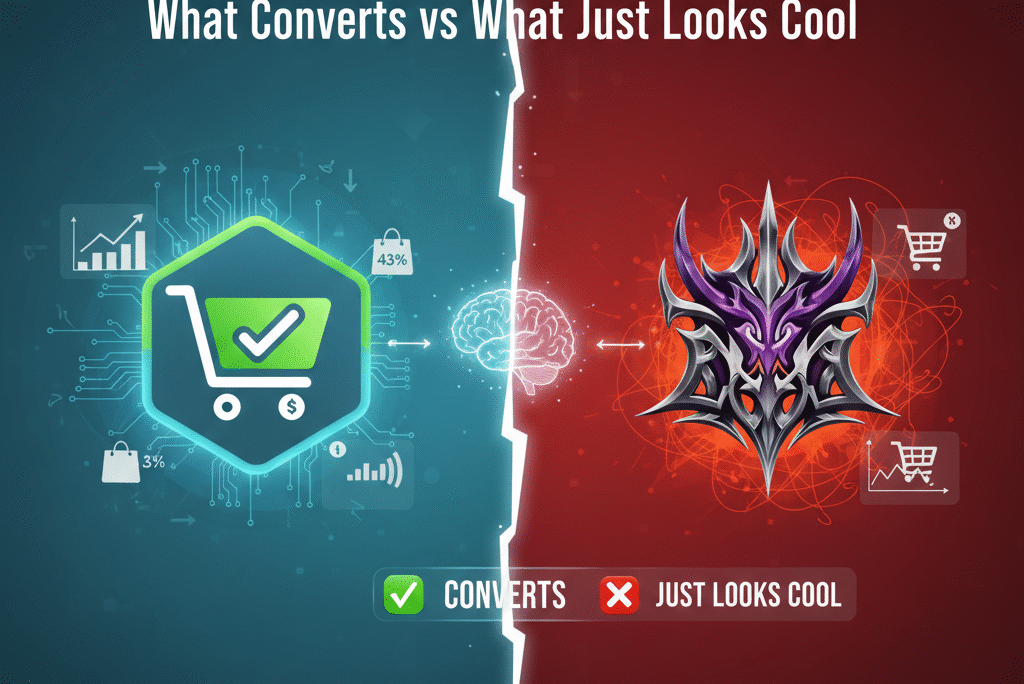
Many ecommerce logos are designed to look cool in a designer’s portfolio, not to convert real humans who are deciding whether to spend money.
Let’s talk about the difference.
Why Logo Designs Matter More in Ecommerce Than Almost Anywhere Else
In physical retail, people can touch products, feel weight, read packaging, ask questions, and look around a store. Online? You get seconds. Sometimes fractions of seconds.
Your logo often appears before:
- Your product is understood
- Your reviews are read
- Your copy has a chance to persuade
On Amazon, Etsy, eBay, or your own website, your logo becomes a shorthand for trust. It’s a visual promise. And humans are disturbingly good at making snap judgments based on visual cues.
That judgment isn’t conscious. Nobody says, “Ah yes, the kerning suggests operational maturity.” But the brain absolutely notices whether something feels established or slapped together.
Logos don’t sell products directly. They lower resistance. And lowering resistance is half of conversion.
“Looks Cool” Logos: Where Things Go Wrong
Let’s start with the kind of logos that win design awards and lose sales.
These usually fall into a few familiar traps.
First, trend-chasing. Ultra-minimal sans-serif fonts. Abstract shapes that could mean anything or nothing. Logos that look identical to ten other brands launched the same year. They photograph nicely on Dribbble. They vanish in a crowded marketplace.
Second, over-clever concepts. Hidden arrows, visual puns, negative space tricks. These are fun to explain during a presentation. Customers don’t get the presentation. They get a tiny logo next to a price tag.
Third, personality mismatch. A playful logo for a serious product. A hyper-premium aesthetic for a budget item. Or worse: a “luxury” logo slapped onto something that screams mass-produced. That gap creates distrust faster than bad reviews.
Fourth, scale blindness. Logos that look great on a 27-inch monitor but turn into unreadable smudges on mobile, packaging, thumbnails, or favicons. Ecommerce lives in small spaces. Your logo must survive them.
The common theme? These logos prioritize aesthetics over function. And ecommerce is a function-first environment, whether we like it or not.
What a Converting Ecommerce Logo Actually Does
A converting logo doesn’t try to impress other designers. It does something much simpler and much harder.
It answers three questions instantly:
Is this brand legitimate?
Is this product category appropriate for this brand?
Does this feel like something I can trust with my money?
That’s it. Everything else is secondary.
Let’s break down how good logos accomplish that.
Clarity Beats Cleverness Every Time
The best ecommerce logos are easy to understand. Not boring—clear.
Clear type. Clear shapes. Clear intent.
If someone can’t read your brand name at a glance, your logo is failing. If the symbol needs explanation, it’s decorative, not functional.
This matters because ecommerce buyers are usually multitasking, scrolling fast, and comparing options. Your logo should reduce cognitive load, not add to it.
Clear logos are remembered more easily. They reproduce better. They scale cleanly. And they feel more confident because they aren’t trying too hard.
Confidence converts.
Typography Does More Work Than You Think
Fonts carry personality whether you want them to or not.
Sharp, geometric fonts feel modern and tech-driven. Rounded fonts feel friendly and accessible. Serif fonts often signal tradition, authority, or premium quality.
None of these are inherently better. The mistake is choosing based on what’s trendy instead of what fits the product and audience.
Selling supplements? Trust and cleanliness matter.
Selling home decor? Warmth and taste matter.
Selling tools or gear? Strength and reliability matter.
A converting logo uses typography that matches the emotional promise of the product. A cool-looking logo might ignore that entirely.
Color Psychology Is Real (But Not Magic)
Colors don’t hypnotize people into buying, but they absolutely influence perception.
Black and gold often imply premium or luxury. Blue tends to feel safe and dependable. Green suggests health or sustainability. Red grabs attention but can feel aggressive if misused.
The mistake brands make is choosing colors based on personal preference instead of category expectations.
If every serious competitor in your niche uses restrained, neutral colors and you show up neon purple, you won’t stand out as bold. You’ll stand out as suspicious.
Converting logos usually live comfortably inside category norms, with just enough differentiation to be recognizable without breaking trust.
Simplicity Is a Conversion Strategy, Not a Style Choice
Simple logos aren’t lazy. They’re disciplined.
Ecommerce logos have to:
- Fit on packaging
- Work in black and white
- Scale to thumbnails
- Sit next to prices, ratings, and buttons
- Look acceptable on marketplaces you don’t control
Complex logos collapse under these demands.
Simple logos survive them.
When a logo works everywhere, it feels established. When it breaks in small sizes or looks inconsistent, it feels amateur. Customers notice, even if they can’t articulate why.
Brand Consistency Multiplies Logo Power
A logo alone doesn’t convert. A logo plus consistency does.
The fastest way to kill trust is visual chaos. Different styles on your website, packaging, listings, and social media. A logo that feels premium paired with cheap graphics. Or a clean logo surrounded by cluttered design.
When everything aligns—logo, colors, fonts, imagery—the brand feels intentional. Intentional brands feel safer to buy from.
This is where many ecommerce sellers sabotage themselves. They treat the logo as a one-time task instead of the anchor for everything else.
Marketplace Reality Check: Amazon, Etsy, eBay
Marketplaces are brutal. You don’t control the layout. Your brand sits inches away from competitors. Often cheaper ones.
Here, logos need to work even harder.
On Amazon, logos are small and often secondary to product images. That means clarity and contrast matter more than detail.
On Etsy, logos often appear as shop icons. They need personality without sacrificing readability.
On eBay, logos sit in a more utilitarian environment. Overdesigned logos look out of place and untrustworthy.
A converting ecommerce logo is designed with these environments in mind, not retrofitted after the fact.
“Cool” vs “Converts” in One Sentence
A cool logo asks, “Does this look impressive?”
A converting logo asks, “Does this make buying easier?”
That difference seems subtle. It’s everything.
The goal isn’t to suppress creativity. It’s to aim creativity at the right problem. Conversion is a design constraint, not a limitation.
The best ecommerce logos sit at that sweet spot where they look good, feel right, and quietly remove friction from the buying decision.
Final Thought: Logos Are Silent Salespeople
Your logo won’t close the sale by itself. But it sets the tone for everything that follows.
If it feels amateur, your copy works harder.
If it feels inconsistent, your reviews carry more weight.
If it feels untrustworthy, price becomes the only lever left.
A logo that converts doesn’t scream for attention. It earns confidence.
And in ecommerce, confidence is the currency that turns clicks into customers.
If you’re serious about building an ecommerce brand that people trust at first glance—not one that just looks good on a mood board—your logo can’t live in isolation. It has to work with your packaging, listings, website, and overall brand identity. That’s exactly what we focus on. Our team helps ecommerce sellers design logos and brand systems built for real marketplaces, real customers, and real conversions. You can explore our full Graphic Design & Brand Identity services here and see how we turn visuals into revenue, not just aesthetics.
Design research consistently shows that a logo isn’t just a pretty mark — it’s a trust anchor. According to recent insights on how logos influence brand perception in multivendor marketplaces, a thoughtful logo helps establish credibility and emotional connection with shoppers, laying the foundation for recognition and confidence before a customer even reads your product description or sees a review. Strong logos aren’t just decorative; they play a measurable role in how shoppers perceive and remember brands in crowded online environments like Amazon, Etsy or your own ecommerce site.