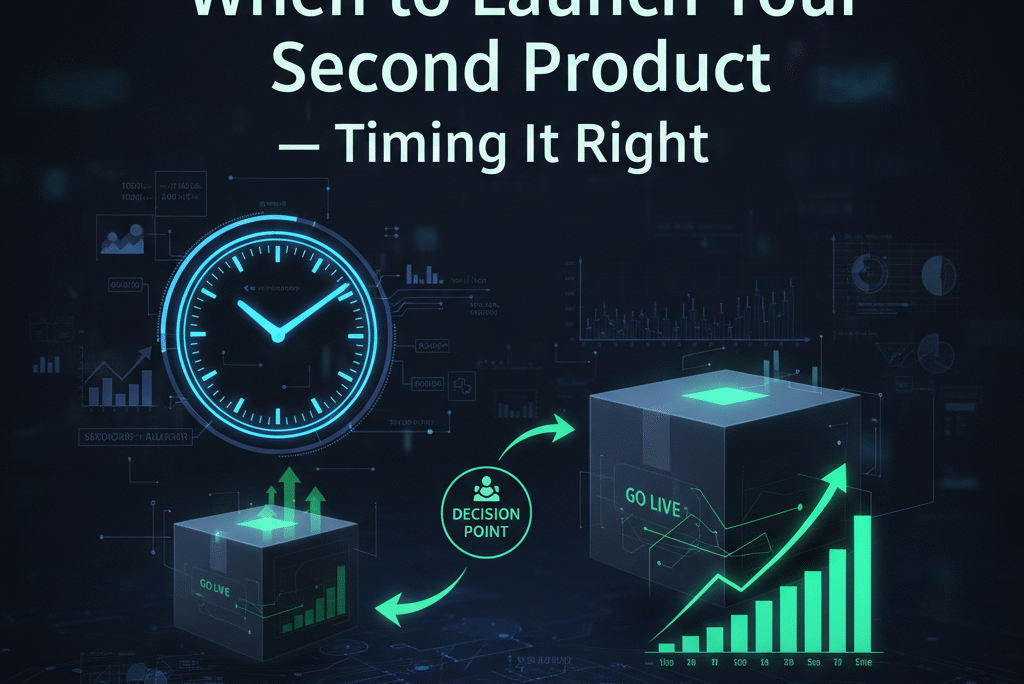
Quick Answer: When to launch your Second Product? You’re ready to launch a second product when your first is genuinely stable, meaning consistent monthly revenue, predictable margins, reliable supplier performance, and at least 60–90 days of stable PPC data. Beyond timing, the second product should serve the same customer and strengthen the same brand. Launching too early multiplies complexity without multiplying revenue. Launching from a stable foundation turns you from a product seller into a brand builder.
This is for private label sellers who have a working first product and are feeling the pull toward expansion. That pull is real and valid — but the timing and alignment of the second launch matter more than most guides acknowledge, and getting either wrong is one of the most reliable ways to turn a promising start into an expensive stall.
The Moment That Separates Brand Builders from Catalog Collectors
There’s a specific turning point in every private label business where a single decision has outsized consequences for everything that follows. The first product is working. Revenue is coming in at a level that feels meaningful. PPC has settled into something manageable. Reviews are accumulating. The listing is performing well enough that the daily anxiety of early launch has faded into something more like steady monitoring.
And then the thought arrives: should I launch a second product?
This question, and how it gets answered, tends to separate sellers who build genuinely valuable, scalable brands from sellers who build sprawling, fragile catalogs that require constant firefighting and never quite deliver the growth they promised.
The seductive logic is simple: if one product generates revenue, two products generate more revenue. The relationship between product count and business success isn’t that linear, but the logic is compelling enough that it pushes many sellers into expansion before their foundation supports it.
What follows is a framework for answering the timing question honestly — not based on how long it’s been since the first launch or how excited you are about a new opportunity, but based on the specific conditions that make a second launch more likely to build than to disrupt.
Why the “More Products = More Revenue” Logic Fails in Practice
The mathematical case for launching a second product is straightforward: two revenue streams are better than one, diversification reduces risk, and more products mean more chances to have a winner. All of that is true in the abstract. In practice, the relationship between product count and business performance is more complicated, and understanding why is important before any expansion decision.
Your first product isn’t just a revenue source — it’s a demonstration of how well you can execute the full private label process. Every element of the business is visible in that product’s performance: how accurately you forecasted demand and managed inventory, how well you understand the relationship between PPC spend and organic ranking, how effectively your listing converts the traffic you’re driving, how reliable your supplier relationship is, how well your brand translates into customer satisfaction as measured through reviews and returns.
When that first product is genuinely performing well, the underlying answer to all of those questions is “pretty well.” When it’s performing adequately but isn’t truly optimized — when there are still meaningful improvements available in the listing, the PPC structure, the inventory management, the branding — the underlying answer is “well enough but not really.”
Launching a second product before the first is genuinely optimized is operationally equivalent to opening a second restaurant while the first one still has service and quality problems.
Harvard Business Review’s research on premature scaling identifies exactly this pattern as one of the most consistent causes of business failure among otherwise promising ventures — the evidence that expanding before the foundation is solid amplifies weakness rather than strength is well-documented across industries, not just ecommerce.
The second location doesn’t fix the first — it just ensures that two operations are struggling instead of one, with the same management bandwidth spread across twice the complexity.
The complexity multiplication that comes with a second product is real and often underestimated. Every product in a catalog represents its own supplier relationship to manage, its own inventory position to monitor, its own PPC campaigns to optimize, its own listing to improve, its own review profile to build and maintain, its own customer service interactions to handle. When any of those elements encounters a problem — a supplier delay, a sudden review issue, a PPC campaign that stops performing, a listing suppression — it requires attention and decision-making that pulls from the same finite pool of focus and time.
Two products don’t just double revenue potential. They double the surface area on which problems can appear, at exactly the point where the business’s systems for handling problems are being tested for the first time.
What “Stabilized” Actually Means — And Why It’s Harder to Define Than to Describe
The standard advice for timing a second product launch is to wait until the first product is “stable” — which sounds clear but often gets interpreted as “has been running for a few months without catastrophe.” That’s a low bar and frequently produces premature launches.
Genuine stability has several specific characteristics, each of which matters for different reasons.
Consistent monthly revenue without dramatic volatility means the product is generating predictable income that you can plan around, not revenue that spikes when advertising spend increases and collapses when it decreases. A product that only performs well when aggressively pushed isn’t stable — it’s dependent, and dependent products don’t provide the reliable cash flow foundation that a second launch requires.
Clear, documented profit margins that account for every real cost means knowing the actual net margin per unit after FBA fees, PPC spend at sustainable levels, return rates, storage fees, and the cost of any promotions or coupons used to maintain velocity. Many sellers know their gross margin but haven’t done the fully-loaded calculation that includes all of these. Not knowing your true net margin isn’t just an accounting issue — it’s an indication that the business’s financial picture isn’t understood clearly enough to make the investment decisions a second launch requires.
At least 60 to 90 days of stable advertising performance means PPC campaigns that are generating predictable results — not results that require constant intervention, daily bid adjustments, and significant weekly variation in performance. Stable PPC performance indicates that the keyword targeting, bidding structure, and budget allocation are in a configuration that works, rather than a configuration that’s constantly being troubleshot. When advertising is stable, the skill and attention required to manage it decreases, freeing capacity for a second product.
Reliable supplier performance across multiple order cycles means the supplier has delivered on time, at consistent quality, with predictable communication, across enough reorders to establish a pattern rather than just a promising first impression. Supply chain problems are among the most disruptive events in a private label business, and discovering that a supplier is unreliable during the period when you’re also launching a second product is particularly damaging.
Inventory forecasting that’s accurate enough to feel routine means being able to predict stock coverage reliably enough that reorders happen before stockouts rather than in response to them. Stockouts are damaging to organic ranking at any time, but they’re especially costly during a period of divided attention, when the signals of an approaching stockout might be missed because focus is on the new launch.
If any of these elements isn’t in place, the first product isn’t stable regardless of how long it’s been running or how the revenue numbers look on the surface. Each one represents a category of problem that will compete for attention with a second launch — and problems that compete with a launch tend to either undermine the launch or let the underlying problem worsen.
The Cash Flow Reality That Most Expansion Guides Skip Over
One of the most consistently underdiscussed aspects of second product launches is the cash flow picture — specifically the reality that two products in different phases of their lifecycle simultaneously drain capital in ways that can create genuine financial pressure even when both are technically performing.
Consider a concrete scenario: a first product that requires roughly $8,000 in inventory to maintain adequate stock coverage is running smoothly. The decision is made to launch a second product, which also requires approximately $8,000 in initial inventory plus the associated launch costs — photography, design updates, sample acquisition, and initial PPC investment of perhaps another $2,000 to $3,000 in the first 90 days.
In this scenario, the business is now running $18,000 to $20,000 of circulating capital simultaneously across two products, with the first product’s cash being tied up in inventory at the same time the second product is generating PPC costs without yet generating meaningful revenue. If the first product has an unexpected slowdown — seasonal softening, an algorithm adjustment, a competitor promotion that temporarily takes market share — the cash available to sustain the second product’s launch becomes constrained at exactly the moment the second product needs consistent investment.
This scenario plays out more often than the expansion guides suggest, and it’s the direct cause of a disproportionate number of “second product failures” that get attributed to bad product selection or poor market timing when the actual cause was launching before the financial foundation was strong enough to support the overlap.
The honest question to ask before committing to a second launch isn’t “can I afford to start the second launch” but “can I comfortably fund both products for 90 days if the first product’s performance softens by 30 percent from current levels.” If the answer requires significant financial stress, the timing isn’t right regardless of how appealing the second product opportunity looks.
The related consideration is what a second product launch costs in terms of founder time and attention, which is a real cost even if it doesn’t show up in a spreadsheet. Every hour spent on product research, supplier negotiation, listing creation, and launch management for a second product is an hour not spent optimizing the first product — and the optimization potential remaining in an established product that hasn’t been fully refined is typically higher-returning than equivalent time spent on a new launch.
The Brand Alignment Question: More Important Than Timing
Even if the timing is right — even if the first product is genuinely stable, the cash position is solid, and the operational bandwidth exists — the most important question about a second product isn’t when but what.
The distinction between building a brand and building a catalog comes down entirely to this question. A catalog is a collection of products that happen to share a seller account. A brand is a collection of products that serve a recognizable audience, reinforce a coherent value proposition, and create the kind of compounding trust that makes the whole worth more than the sum of its parts.
Shopify’s guidance on product line strategy articulates this distinction in detail — the difference between building a coherent product line and accumulating unrelated SKUs is the difference between brand equity that compounds and a catalog that just gets bigger without getting stronger.
The specific criteria that distinguish a brand-building second product from a catalog-expanding one are straightforward to describe and sometimes uncomfortable to apply honestly.
A brand-building second product solves a related problem for the same customer. The buyer who purchased the first product should, when they encounter the second product, have an immediate sense of “of course — this comes from the same brand, and it makes sense that they’d make this too.” That intuition only exists when the second product genuinely fits within the same world as the first. An ergonomic desk accessory brand that launches a kitchen gadget because the margin looked good isn’t extending a brand — it’s starting an unrelated product from the position of a known brand, which doesn’t actually help much, because the brand recognition built in one category doesn’t transfer to an unrelated one.
A brand-building second product leverages existing customer trust rather than requiring it to be rebuilt from scratch. When a seller has established real brand recognition in a specific niche — when buyers know the brand by name, when there’s positive review momentum that associated with the brand rather than just the product — a second product that fits within the same brand space can benefit from that recognition immediately. The launch starts from a position of credibility rather than anonymity.
A brand-building second product increases the value of the first product. This is the most sophisticated version of the brand alignment test, and it’s the one that most clearly separates genuine brand thinking from product accumulation. Apple’s iPod made the Mac more relevant. The iPhone made the entire Apple ecosystem more valuable. At a dramatically smaller scale, the same principle applies to private label brands — the best second products don’t just add revenue, they reinforce the identity of the first product and make the overall brand more coherent and recognizable than either product would be alone.
When a second product opportunity doesn’t pass this test — when it’s a separate product serving a different customer in a different category selected primarily because the margin metrics looked good — it isn’t extending a brand. It’s starting a second brand with a fractured foundation.
The Three Signals That Indicate You’re Ready
Moving from principle to practice, three specific, observable conditions consistently indicate that a seller is positioned to launch a second product successfully rather than prematurely.
Signal One: The First Product Has Been Optimized, Not Just Launched
There’s a meaningful difference between having launched a product and having optimized one. Launch is a starting point — getting the product live, generating initial sales velocity, establishing a baseline. Optimization is the ongoing work of improving every element of the listing and the advertising based on actual performance data.
Most products have significant optimization potential remaining well beyond the launch period. The main image has never been A/B tested against an alternative. The bullet points were written for launch and haven’t been updated based on what the most common customer questions and complaints reveal about what information buyers actually needed. The PPC campaigns are generating the search term data that would allow for precise negative keyword management and exact-match campaign structure, but that data hasn’t been fully analyzed and acted on. The A+ content was a first pass and hasn’t been refined based on what objections it fails to address.
All of this work — the optimization that turns a launched product into a genuinely refined one — produces returns that are typically higher per hour invested than equivalent time spent researching and launching a new product. Launching a second product before this optimization work is complete forfeits those returns and distributes attention to a new challenge rather than extracting the full value from the existing one.
The practical test: has the conversion rate improved since launch? Has ACOS decreased from its initial launch levels? Has the main image been tested against at least one meaningful alternative? Have the bullet points been updated based on what the first 50 reviews reveal? If the answer to these questions is no, there’s optimization work available that should precede expansion.
Signal Two: You Understand the Customer Well Enough to Know What They Need Next
Understanding the customer who buys the first product at the level required to identify the right second product requires more than demographic data or keyword research. It requires understanding why they buy, what they’re trying to accomplish, what frustrates them about the alternatives they considered before purchasing, and what they’re likely to need next in the context where the first product serves them.
This understanding develops over time, primarily through careful attention to the reviews and questions that accumulate around the product. Reviews, particularly the two and three-star reviews that describe genuine but non-catastrophic disappointments, reveal the gap between what buyers expected and what they received — and that gap is where the most valuable product development and launch opportunities live.
When a seller can look at their customer base and clearly articulate “this customer buys this product because they’re trying to solve X, and in that same context they also need Y, which nobody is currently serving well” — that’s the moment the second product opportunity is genuinely understood rather than just attractive. The product selection process from that foundation is fundamentally different from identifying products through keyword tool metrics, and the results tend to be fundamentally different as well.
Signal Three: The Business Can Survive 90 Days of Uneven Performance
Every product goes through an uneven early period. Organic ranking builds slowly. PPC generates early performance data but at inefficient costs before that data allows for targeting refinement. Sales velocity is inconsistent in a way that doesn’t clearly signal whether a product will reach the performance targets it needs to reach. Manufacturing and logistics sometimes produce delays that affect the launch timeline.
A second product launch is financially survivable if the business can sustain 90 days of this uneven performance on the new product without requiring the new product to generate meaningful revenue to fund other operational costs. When a second product needs to work quickly — needs to generate significant revenue within 30 to 60 days to cover costs or maintain cash position — the pressure on the launch is high enough to force bad decisions: spending on PPC before the listing is conversion-ready, accepting inventory from a supplier whose quality hasn’t been fully verified, cutting corners on photography because the launch can’t wait.
The sellers who successfully execute second launches almost always have a cash position that allows them to be patient during the launch period — to wait for organic ranking to build, to learn from early PPC data before scaling spend, to address listing improvements as they’re identified rather than under the pressure of urgency. That patience is a function of financial cushion, and that cushion is a lagging indicator of how well the first product has been optimized before expansion began.
The Emotional Trap: Boredom Dressed as Ambition
Something worth naming honestly, because it drives more premature second launches than most sellers would admit: the discomfort of a first product that’s in maintenance mode.
Once a product is genuinely stable — generating consistent revenue without requiring constant intervention — the day-to-day work of running it becomes routine. Monitoring inventory levels, reviewing PPC performance, responding to customer questions, placing reorders. These activities are valuable. They’re not exciting. And sellers who were drawn to private label partly by the energy of building something new often find that stable equals boring in a way that makes launch mode feel like relief rather than risk.
The impulse to launch a second product isn’t always about business strategy. Sometimes it’s about escaping the relative tedium of maintenance. The problem is that this kind of launch — driven by the need for novelty rather than the existence of a genuine opportunity — tends to produce launches that weren’t prepared for, selected for the wrong reasons, and resourced from a business that wasn’t ready to support them.
The honest antidote to product-stability boredom is optimization rather than expansion. A product that’s generating stable revenue almost always has meaningful performance improvement available — conversion rate gains, ACOS reductions, review quality improvements, packaging updates, off-Amazon brand building. The returns from these optimization activities, compounded over the life of the product, are typically higher than the returns from a premature second launch. But they require sustained focus on something already built rather than the excitement of building something new.
When Waiting Too Long Becomes Its Own Problem
Having argued throughout this piece for the importance of timing and preparation, it’s worth acknowledging the opposite failure mode: indefinitely deferring expansion in the name of further preparation, when the first product is objectively ready and the delay is being driven by risk aversion rather than genuine readiness concerns.
A first product that has been stable for six or more months, has generated 100 or more reviews at a strong average rating, has consistent and predictable reorder cycles, and is generating surplus cash each month is not a product that benefits from continued single-product focus. The incremental returns from further optimization at this stage are genuinely diminishing, and the opportunity cost of not expanding — not building the catalog depth and brand coherence that a second well-aligned product would provide — is real.
The platform also creates genuine incentive to expand thoughtfully: on Amazon specifically, brands with multiple complementary products benefit from cross-selling opportunities, shared brand equity, and the kind of storefront depth that signals to buyers and to the algorithm that this is an established, serious brand rather than a single-product operation.
The internal question worth asking honestly at this stage: is the hesitation to expand driven by a genuine assessment that the conditions for success aren’t in place, or is it driven by the comfort of a known, predictable situation and the discomfort of introducing new risk? The first type of hesitation protects the business. The second type stalls it.
Platform-Specific Considerations for Second Product Timing
The principles above apply broadly, but the specific dynamics of expansion timing differ meaningfully across platforms in ways worth acknowledging.
On Amazon, the ecosystem actively rewards brand depth in several ways. A+ content and brand storefronts allow multi-product brands to create coherent brand experiences that single-product sellers can’t access in the same way. Cross-selling mechanics — “Frequently Bought Together,” brand storefront browsing, brand-targeted advertising — become meaningfully more valuable when there are multiple products to benefit from them. Amazon’s algorithm also tends to reward brands that demonstrate consistent quality across their catalog, with the positive review history of a well-established first product potentially providing a modest trust signal for a complementary second.
On Etsy, brand cohesion matters even more centrally than on Amazon, because Etsy’s discovery mechanisms are more aesthetic and story-driven than keyword-driven. A second product that doesn’t fit within the established aesthetic of the shop and brand can actively undermine the shop’s appeal to the audience the first product built, because Etsy buyers tend to browse brand storefronts more than Amazon buyers do and have stronger expectations of internal consistency.
On eBay, the dynamics are somewhat different — eBay’s category-specific performance metrics and pricing competition mean that a second product strategy is often better approached through category depth (multiple products within the same category) rather than brand breadth, at least until enough seller history and feedback have accumulated to make brand recognition a meaningful factor.
Frequently Asked Questions About When to Launch a Second Product
How long after the first launch should I wait before launching a second product?
There’s no universal timeline, but 12 months is a reasonable minimum for most sellers in most categories. This allows enough time for the first product to fully stabilize, for the seller to develop genuine customer understanding through review accumulation, for cash position to build, and for the optimization work that extracts full value from the first launch to be completed. Sellers who hit all of the stability and readiness criteria in less time can move earlier; those who haven’t hit them after 12 months should focus on why rather than expanding anyway.
Should the second product be in the same category as the first?
The most reliable second products are in the same category or an adjacent one, serving the same buyer. This maximizes brand equity leverage, simplifies inventory management (often the same supplier relationships), and reduces the marketing investment required to reach the existing customer base. Category adjacency — a kitchen storage brand expanding to pantry organization, a desk accessory brand expanding to cable management — tends to produce better outcomes than category diversification.
What’s the biggest mistake sellers make with a second product launch?
Selecting the second product based primarily on keyword and margin metrics rather than customer alignment. A product that looks excellent on a product research dashboard but doesn’t serve the same customer or reinforce the same brand is likely to perform below expectations regardless of how good the metrics looked, because it doesn’t benefit from the brand equity built by the first product and requires building an entirely new audience from scratch.
Should I launch on all my existing platforms simultaneously or one at a time?
Starting with the platform where the first product performed best typically produces the most efficient second launch. The operational experience, the advertising platform familiarity, and any existing customer recognition are all most concentrated there. Adding platforms after the second product is stable on the primary one is almost always more efficient than attempting simultaneous multi-platform launches.
Final Thought: Sequencing Beats Speed
The sellers who look back on their private label journey and identify the second product launch as a turning point toward genuine brand building almost always describe a process that was deliberate — where the first product was genuinely stable, where the second product clearly served the same customer, where the cash position supported a patient launch, and where the expansion felt like extension rather than new beginning.
The sellers who look back and identify the second product as the beginning of a period of stress and fragmentation almost always describe the opposite — a launch driven by excitement about a new opportunity before the foundation supported it, a product that was selected for its metrics rather than its brand fit, and a cash position that made the launch feel urgent in ways that compromised the decisions it required.
The sequence that consistently works is: stability before optimization, optimization before expansion, expansion in service of the brand rather than the catalog. Each element of that sequence protects the one that follows, and skipping any of it tends to produce the fragility that makes ecommerce businesses feel like constant firefighting rather than compound growth.
Launching smarter rather than faster is, in the long run, the faster path.
If you’re building an Amazon private label business and want strategic support in timing your expansion and selecting the right second product for your brand, you can explore how we work with sellers at ecommate.co.uk.