There’s a strange myth floating around ecommerce.
“If I sell on Amazon, I don’t need a blog.”
On the surface, it sounds logical. Amazon already has traffic. Millions of buyers. Built-in search. You upload your product, optimize the listing, maybe run some ads, and boom — done.
Except… that’s not how durable businesses are built.
Amazon gives you traffic. It does not give you authority.
It gives you exposure. It does not give you ownership.
It gives you customers. It does not give you a brand.
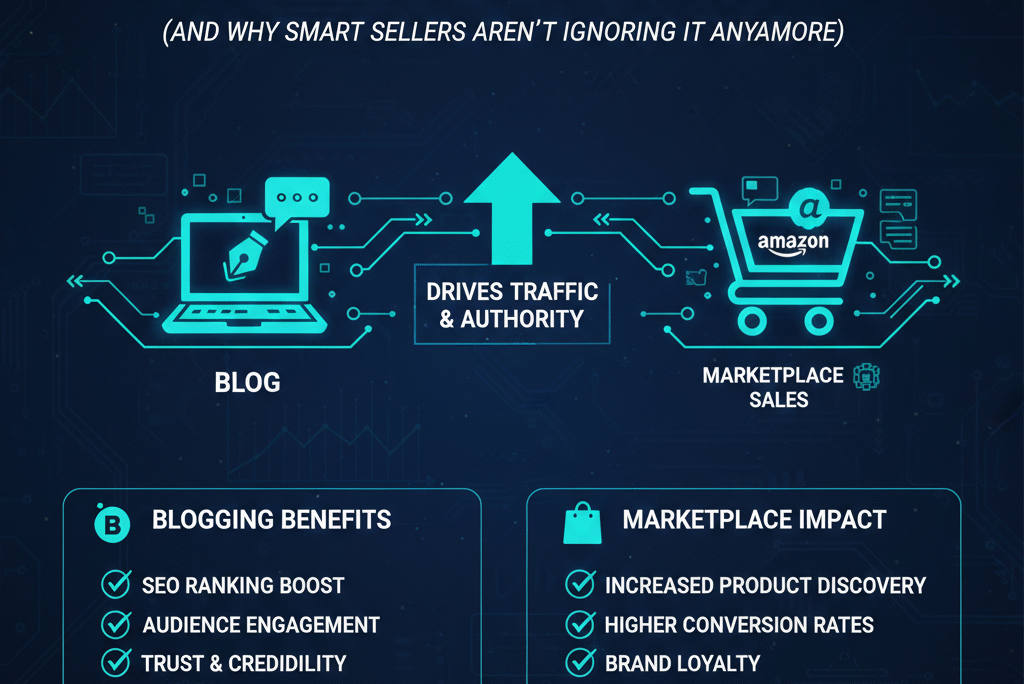
And this is exactly where blogging becomes powerful — not as a side hobby, but as a strategic asset that quietly feeds your marketplace sales.
Let’s break this down in a practical way.
Amazon Traffic Is Transactional. Blogs Build Intent.
When someone searches on Amazon, they’re already in buying mode.
“Best stainless steel water bottle.”
“LED desk lamp adjustable.”
“Minimalist wall clock.”
They want a product. Now.
But here’s the reality most sellers ignore: the buying decision often begins before Amazon.
People Google things like:
- “How to choose the right desk lamp for eye strain”
- “Are stainless steel water bottles safe?”
- “Best home office setup for productivity”
- “Minimalist bedroom design ideas”
That’s early-stage intent. That’s education. That’s curiosity.
And if your brand shows up there — not with a sales pitch, but with helpful, well-written content — you intercept the buyer before they ever open Amazon.
You become the guide.
By the time they reach your product listing, you’re not just another seller in a grid of 20 options. You’re familiar. Trusted. Recognized.
Trust reduces friction.
Reduced friction increases conversion.
That’s not theory. That’s basic human psychology.
Blogging Builds Brand Authority (Which Marketplaces Don’t Give You)
Amazon doesn’t care about your brand story.
Your product detail page gives you limited space. Even with A+ content, you’re boxed inside a template.
A blog is where your brand breathes.
You can:
- Explain your philosophy
- Show how your product solves a real-world problem
- Educate customers about materials, durability, usage
- Compare alternatives honestly
- Share behind-the-scenes development stories
This shifts you from “seller” to “specialist.”
And here’s the subtle advantage: authority spills over.
When customers see a brand that publishes thoughtful content, it signals:
- They understand their niche
- They’re invested long-term
- They’re not a random importer flipping a trend
Authority creates perceived value. Perceived value supports pricing power. Pricing power protects margins.
Margins keep businesses alive.
SEO Creates a Traffic Source You Actually Own
Let’s talk control.
Amazon traffic can disappear overnight.
Algorithm shift.
Policy change.
Account suspension.
Increased ad competition.
When all your sales depend on a marketplace, you’re building on rented land.
A blog, optimized for search engines (SEO), creates an independent stream of organic traffic.
SEO means structuring content so search engines understand it and rank it for relevant queries.
For example, if you sell ergonomic office products, your blog might rank for:
- “How to reduce back pain while working from home”
- “Best desk height for posture”
- “Home office setup checklist”
Those visitors land on your website. Not Amazon’s.
From there, you can:
- Link to your Amazon listing
- Offer a buying guide
- Capture emails
- Retarget them with ads
- Build long-term brand loyalty
You are no longer just reacting to marketplace changes. You are building assets.
Blogging Improves Conversion — Even on Amazon
Here’s something most sellers don’t realize:
Content doesn’t just bring traffic. It improves conversion rates.
When customers research your brand and find:
- In-depth guides
- Real explanations
- Educational content
- Strong visual branding
They arrive at your Amazon listing with higher confidence.
Higher confidence means:
- Less comparison shopping
- Fewer doubts
- Faster purchasing decisions
You’re not competing purely on price anymore. You’re competing on clarity and trust.
And trust wins.
Content Supports PPC and Paid Ads
Let’s say you’re running Amazon PPC.
Most sellers send paid traffic directly to a product listing.
That works — but it’s cold.
Now imagine a different flow:
Ad → Educational blog post → Product recommendation → Amazon listing
Instead of “Buy this now,” the message becomes:
“Here’s how to solve your problem. And here’s the product we designed to fix it.”
That sequence warms up the buyer.
The result?
Lower resistance. Higher intent.
Blog content also gives you material for:
- Facebook and Instagram posts
- Pinterest content
- LinkedIn thought leadership
- Email marketing
- Retargeting campaigns
One well-written article can fuel weeks of marketing.
That’s leverage.
Blogging Strengthens Multi-Platform Selling
If you’re selling on Amazon, eBay, and Etsy, blogging becomes even more strategic.
Each marketplace has different search behavior. Different buyer psychology.
Your blog acts as a central hub.
You can create content like:
- “Which platform is best for buying handmade décor?”
- “Amazon vs Etsy for eco-friendly products”
- “How to spot high-quality materials when shopping online”
Then internally guide users toward whichever marketplace fits their preference.
Instead of depending on one ecosystem, you become platform-agnostic.
You’re building a brand that travels.
Blogging Builds Long-Term Brand Equity
There’s a difference between a product that sells and a brand that lasts.
Products are replaceable.
Brands are memorable.
Blogging builds memory.
When customers repeatedly encounter your brand through helpful content, something subtle happens:
Familiarity grows.
Familiarity creates comfort.
Comfort creates repeat purchases.
Repeat purchases create lifetime value.
Marketplace sellers often obsess over launch tactics, keyword tools, and short-term hacks. Very few invest in brand infrastructure.
Blogging is infrastructure.
It compounds over time.
An article written today can still bring traffic two years from now — without ongoing ad spend.
That’s compounding attention. And attention is currency in digital business.
Blogging Helps You Rank in AI and Generative Search
Search is evolving.
People now ask AI tools and generative search engines for product recommendations, comparisons, and buying advice.
If your brand publishes detailed, helpful content, you increase the likelihood of being referenced or surfaced in these responses.
This is sometimes called Generative Engine Optimization (GEO).
It’s not about stuffing keywords. It’s about creating structured, authoritative, human-first content that algorithms recognize as useful.
The brands that start now will benefit as AI-driven discovery becomes more dominant.
Waiting means playing catch-up later.
What Blogging Is Not
Let’s clear something up.
Blogging is not:
- Publishing 500-word keyword-stuffed articles
- Copying competitor content
- Writing robotic SEO paragraphs
- Posting once every six months
That’s noise.
Effective blogging requires:
- Clear positioning
- Consistent publishing
- Real insight
- Strategic internal linking
- Conversion pathways
It should support your service pages, your product pages, and your marketplace listings.
It’s a system — not a hobby.
The Bigger Picture
Think about this.
If Amazon disappeared tomorrow, would your business survive?
If ad costs doubled, would you still be profitable?
If a competitor copied your product, would customers still choose you?
Blogging doesn’t solve everything.
But it strengthens the one thing marketplaces cannot guarantee: brand independence.
It gives you:
- Visibility outside marketplaces
- Authority in your niche
- SEO traffic you control
- Content to power marketing
- Trust that increases conversions
In the short term, blogging feels slower than ads.
In the long term, it’s more durable.
And durable businesses win.
The smartest marketplace sellers are no longer just optimizing listings. They’re building ecosystems.
Amazon is one channel.
eBay is one channel.
Etsy is one channel.
Your brand — and the content that supports it — is the foundation.
When blogging is done strategically, it doesn’t compete with marketplace sales.
It feeds them.
And that shift — from dependency to strategy — is where real growth begins.
Blogging is powerful — but only when it’s connected to a real growth strategy. If you’re serious about building a brand that sells on Amazon, eBay, or Etsy while also creating long-term traffic through SEO and content, the right structure matters. At Ecommate, we help businesses build scalable private label brands supported by professional design, optimized websites, and data-driven marketplace strategies. Explore our full range of ecommerce services here
A lot of experts in ecommerce SEO reinforce this idea: blogging isn’t just a nice-to-have, it’s essential for driving organic traffic and building long-term authority online. According to a detailed resource from Digital Authority Partners, regularly publishing blog content helps ecommerce sites target more keywords, engage users with valuable information, and improve overall search visibility — all of which support higher rankings and more conversions over time. This means your blog isn’t just educating customers, it’s actively feeding organic discovery and reinforcing your brand’s presence outside of marketplace walls.