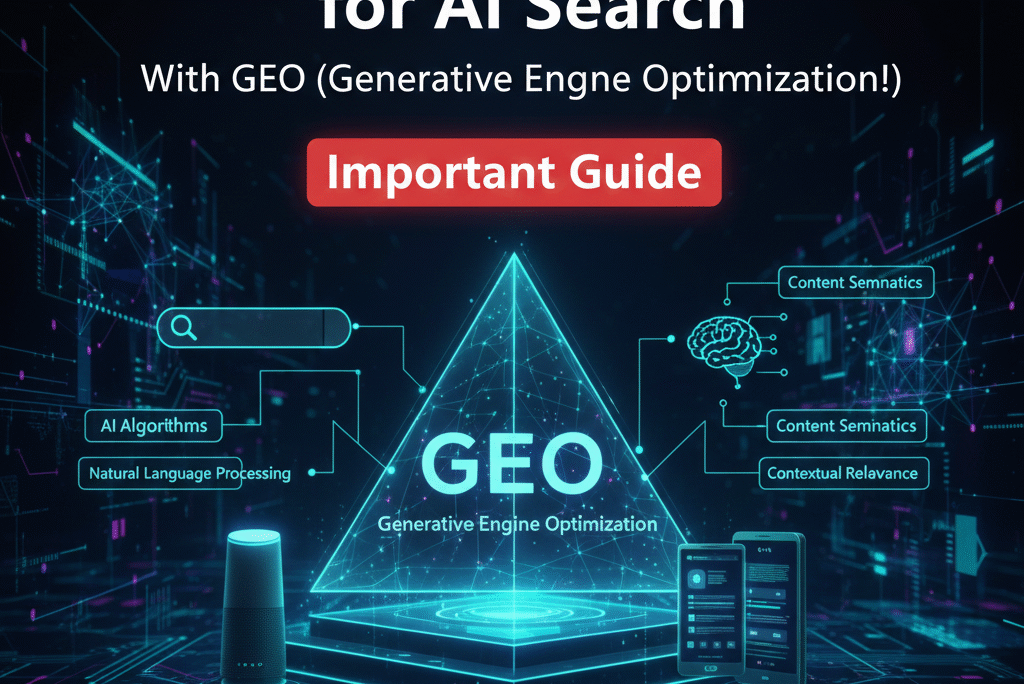
GEO — Generative Engine Optimization — is the practice of structuring your brand’s content, authority signals, and digital presence so that AI-powered search systems can accurately understand, trust, and surface your brand when generating answers for your target buyers. It’s one of the most consequential shifts in search marketing since Google’s introduction of PageRank, and most ecommerce brands are not yet taking it seriously enough to be prepared for what’s already happening.
Search engine behaviour has been shifting for years, but what’s happened in the last 24 months is qualitatively different from anything that came before. It’s not that the algorithm changed. The paradigm changed. The way buyers discover services, compare options, validate decisions, and build their shortlists has moved in a direction that makes traditional SEO necessary but no longer sufficient. People aren’t just searching for links anymore — they’re asking questions and receiving synthesised answers. The click to a website sometimes happens after. Sometimes it doesn’t happen at all.
This guide explains what GEO actually involves in practice, why it’s already affecting how ecommerce service brands are discovered, and exactly what you need to do to build meaningful AI search visibility — not through manipulation or shortcuts, but through the kind of genuine authority that compounds over time.
Why This Is a Different Kind of Shift
To understand why GEO deserves serious strategic attention rather than a wait-and-see posture, it helps to look at the adoption curve honestly.
Google’s AI Overviews — the AI-generated summaries that appear above standard search results for a substantial and growing proportion of queries — reached over a billion monthly users within months of launch. Perplexity AI, which positions itself as a direct AI-powered alternative to traditional search, crossed 15 million monthly active users by mid-2024 and has continued growing as users discover that conversational, synthesised answers often serve research needs more efficiently than a ranked list of links. ChatGPT’s web browsing capability has redirected a portion of the queries that would previously have gone to Google — particularly complex, multi-part research questions — into a conversational interface that generates its own synthesis rather than returning a list for the user to evaluate.
These platforms haven’t replaced Google. Traditional search remains the dominant discovery mechanism and will continue to be for the foreseeable future. But the framing of “replacement” misses what’s actually happening. What’s changing is the profile of who uses AI search and for what. The buyers disproportionately represented among early AI search adopters are research-intensive, comparison-focused, and making significant considered purchase decisions — exactly the buyers an ecommerce services company most wants to reach. When someone is spending weeks researching whether to hire an Amazon private label agency and how to evaluate whether one is any good, they’re asking those research questions in AI interfaces, not just typing fragments into a search bar.
A Princeton and Columbia University study examining GEO as a formal academic discipline found that content specifically optimised for generative AI retrieval — through structural clarity, factual specificity, and cross-web authority signals — achieved substantially higher citation rates in AI-generated responses compared to unoptimised content covering the same topics. The implication is significant: the signals that determine whether your brand appears in an AI-generated answer are identifiable, they’re within your control, and they can be systematically built.
What GEO Is — Precisely
GEO is the practice of structuring your brand’s content and authority presence so that AI systems — ChatGPT, Perplexity, Google’s AI Overviews, Microsoft Copilot, and the platforms that will follow them — can accurately represent what your brand does, trust the information you publish, and surface you as a credible reference when generating answers to queries your target buyers are asking.
The mechanics work differently from traditional search in a way that’s worth understanding precisely.
Traditional search engines crawl and index web pages, evaluate them through algorithmic signals, and return a ranked list of links. The user then decides which links to visit. Your optimisation target is ranking position — being in the list, as high as possible.
AI search systems do something fundamentally different. When a user asks a question, the system either draws on patterns in its training data or actively queries the live web (depending on whether it’s a static model or a retrieval-augmented generation system). It synthesises information from multiple sources, generates a coherent answer in natural language, and — depending on the platform — may or may not attribute that answer to specific sources with links. Your optimisation target is not position in a list. It’s inclusion in the synthesis — being among the sources the system draws from, being represented accurately in what it says, and ideally being cited explicitly.
The distinction has practical consequences. For traditional SEO, a technically well-optimised page on a relatively new domain can sometimes rank quickly for the right query. For GEO, there’s no shortcut equivalent — inclusion in AI-generated answers depends on the depth of authority signals built across time, across multiple content pieces, and across multiple platforms beyond your own website. It is, in a structural sense, more like reputation than ranking.
GEO vs SEO: The Differences That Matter Operationally
The relationship between GEO and SEO is complementary, not competitive. Strong SEO is a prerequisite for serious GEO — not because they’re the same thing, but because the authority built through SEO directly feeds GEO visibility. High-authority domains are more likely to be included in AI training data. High-ranking pages are more likely to be retrieved by RAG-based systems. The investment is shared. But the disciplines optimise for different objectives through different mechanisms, and understanding the differences changes what you prioritise.
What you’re optimising for. SEO optimises for ranking position in a list of results. GEO optimises for inclusion and accuracy in a synthesised answer. These require overlapping but distinct inputs.
What signals matter most. SEO gives significant weight to keyword signals — the presence of relevant terms in specific positions in your HTML and content. GEO gives weight to semantic authority — does your content demonstrate comprehensive, accurate, specific understanding of a topic across multiple pieces of content, from multiple angles? AI systems don’t count keyword occurrences. They evaluate whether your content actually knows what it’s talking about.
What the performance metric is. SEO performance is measured in rankings, clicks, and traffic. GEO performance is measured in citation rate — how often AI systems reference your content when generating answers in your domain. This is currently harder to measure precisely (the measurement landscape is improving), but it’s the operative metric that determines AI search visibility.
Where the authority signals come from. SEO depends substantially on on-page optimisation and backlinks. GEO depends additionally on cross-web credibility — how your brand is represented, discussed, and referenced across the full web, not just through hyperlinks. A brand that is mentioned specifically and accurately in fifteen separate credible sources signals genuine authority to an AI system, even if some of those mentions don’t include hyperlinks.
The correct strategic stance is to build excellent SEO (which builds the domain authority and content quality that support GEO) while layering GEO-specific optimisations on top. Neither replaces the other.
The Five AI Platforms and What Each Requires
GEO is not a single-platform discipline. The major AI search platforms each work differently and reward different signals, which means effective GEO involves understanding the specific optimisation requirements of each.
Google AI Overviews appear at the top of search results for an expanding range of queries, particularly informational and comparison-focused ones. The critical thing to understand about Google AI Overviews is that Google has been explicit that there is no separate optimisation path for them — if your page would rank well for a given query through traditional Google ranking signals, it has a reasonable probability of being included in the AI Overview for that query. This means E-E-A-T signals, content comprehensiveness, and structured data are the primary GEO levers for Google. Strong traditional SEO is the gateway.
Perplexity operates as a retrieval-augmented generation system that actively queries the live web when answering questions. It typically surfaces sources that are highly specific to the query, clearly structured for content extraction, and from domains with reasonable authority signals. Perplexity’s user base skews towards professional researchers, academics, and sophisticated commercial buyers — precisely the profile of someone evaluating a significant service purchase. For ecommerce service brands, being the most comprehensive, clearly structured, and credibly authoritative source for questions in your service domain directly improves Perplexity citation probability.
ChatGPT with web browse fetches live web content when users activate the search feature. It shows strong preference for content from authoritative domains, well-structured pages with clean extraction-friendly HTML, and sources that other credible content references. The implication is consistent with Perplexity: genuine authority, well-structured content, and cross-web references win.
Microsoft Copilot (Bing-powered) combines Bing’s search infrastructure with GPT-4 generation capabilities. Bing follows broadly similar ranking principles to Google but weights social signals and content freshness somewhat differently. Ranking well in Bing — which most brands treat as an afterthought — is a meaningful contribution to Copilot visibility.
Voice assistants (Google Assistant, Siri, Amazon Alexa) increasingly generate answers rather than reading search result snippets. The format that performs best for voice-mediated AI retrieval is concise, complete answers to specific questions — the FAQ format in particular. If your content clearly and completely answers “What does Amazon private label management cost?” in a single, well-formed paragraph, it has a meaningfully higher probability of surfacing in voice AI responses to that query.
Topical Authority: The Foundation GEO Is Built On
The single most important concept for ecommerce service brands approaching GEO is topical authority — the degree to which your brand is understood by AI systems as a genuinely comprehensive and credible source of information within a specific domain.
AI systems don’t evaluate individual pages in isolation. They develop an understanding of which sources are authoritative on which topics based on the breadth, depth, and consistency of content across an entire brand’s publishing history. A brand that has published one blog post about Amazon private label has not established topical authority on Amazon private label. A brand that has published genuinely comprehensive coverage of every meaningful aspect of Amazon private label — product research methodology, supplier sourcing and qualification, listing optimisation, PPC campaign structure and ongoing management, brand development, review strategy, account health management, and scaling decisions — has begun to signal the kind of deep expertise that AI systems recognise and draw on.
This has a structural implication that reverses the content production logic most brands use. More content is not better. More comprehensive content on fewer topics is significantly better. A brand that produces ten pieces of shallow content across ten loosely related topics builds authority in none of them. A brand that produces five genuinely comprehensive pieces — each the most thorough, specific, and useful treatment of its topic available — begins building the topical authority that drives GEO visibility.
The practical question is: for each topic in your service domain, is your content demonstrably more comprehensive, specific, and useful than any competitor’s content on that topic? If the answer is no, that’s where GEO content investment should go — not producing more content, but producing better content on the specific topics where you need to establish authority.
To understand which queries are genuinely driving research and purchase intent in your category — the specific questions buyers are asking before they hire an ecommerce services company — tools like the SQP-STR Combo Analyzer connect search behaviour with performance data, so you’re building content around actual buyer intent rather than assumed intent.
Writing for AI Extraction: The Paradox at the Centre of GEO
The most counterintuitive aspect of GEO content strategy is that the best content for AI extraction is content written entirely for human readers. This isn’t a coincidence or a happy accident — it follows directly from how AI systems evaluate quality.
AI language models are trained on human-generated text. They evaluate content quality partly by how well it resembles high-quality human writing — writing that is clear, specific, logically structured, and genuinely informative. Content written to satisfy algorithmic patterns rather than human readers registers as lower quality by the same systems it’s trying to impress. The brands that try to “optimise for AI” by producing template-heavy, keyword-stuffed, formulaic content are making their content less extractable, not more.
The writing practices that produce the best GEO signals are indistinguishable from the practices that produce genuinely good content:
Define terms with specificity. When you write about Amazon PPC, define it precisely in the context of your content. Not “Amazon PPC means pay-per-click advertising” but “Amazon Sponsored Products campaigns operate on a cost-per-click model where bids compete in a second-price auction — meaning you pay £0.01 above the second-highest bid, not your maximum bid. Understanding this changes how you set bid ceilings.” A specific, accurate definition is directly extractable by AI systems in a way that a vague general description isn’t.
Make your claims specific and evidence-grounded. “Branding matters for ecommerce” is not a citable claim — it’s a truism that any source could have produced. “Main product images on Amazon marketplaces drive click-through rate decisions in under 200 milliseconds, before most buyers have processed the title text — which means packaging design is a conversion variable, not an aesthetic one” is a citable claim with a specific, attributable perspective. Every time you write a general statement, ask what the specific, evidence-grounded, distinctive version of that claim would be.
Complete the answer within each section. AI systems performing retrieval look for sections of content that contain a complete answer to the relevant query. A section that builds toward an answer across multiple subsequent sections, or that requires context from an earlier article, is harder to extract cleanly. Structure each section of your content to answer a specific question completely — so that the section, lifted in isolation, provides the full answer to the question its heading implies.
Match headings to how buyers phrase questions. “What does Amazon private label agency management cost in 2026?” as a heading gives an AI system retrieving content for that exact query a clear signal that this section contains the answer. “Pricing” or “Our Costs” provides almost no signal. Headings that mirror natural question phrasing are both good UX and strong GEO signals simultaneously.
Use the before/after framing for complex topics. When explaining how something works, structuring the explanation as “the common misconception vs the reality” or “what most brands do vs what actually works” produces more specific, opinionated, attributable content than neutral descriptions. AI systems extract and cite perspectives that are distinctive and specific; they don’t cite content that merely restates what every other source says.
Structured Data and Technical GEO Implementation
The technical infrastructure of GEO overlaps substantially with technical SEO, with specific additions relevant to AI retrieval. These are not optional for brands serious about AI search visibility.
Schema markup as AI-readable metadata. Structured data — JSON-LD markup embedded in your page’s HTML — tells search engines and AI systems machine-readable facts about your content that they would otherwise have to infer from natural language. For GEO purposes, the most important schema types are: FAQPage schema (which structures question-and-answer content in a format directly extractable by both Google AI Overviews and RAG-based systems), Organisation schema (which gives AI systems structured information about what your brand is, what it does, and where it exists online), Service schema (which describes your specific services with structured detail about what’s included), and Article schema (which attributes content to named authors and establishes publication and modification dates). Implementing these correctly makes your content explicitly machine-readable rather than requiring AI systems to parse it from natural language — reducing ambiguity and improving citation accuracy.
llms.txt for AI crawler guidance. A growing standard for AI-accessible websites is the llms.txt file — a plain-text document placed at the root of your domain that provides AI systems with structured information about your site: what it covers, how its content is organised, what your brand does, and which pages are most relevant for different categories of query. Perplexity has explicitly recognised llms.txt as a useful signal for content retrieval decisions. Implementation is technically straightforward — it requires writing a structured text file, not complex development — and it’s one of the clearer current opportunities for direct GEO technical advantage.
Entity consistency and Knowledge Graph presence. AI systems build “entity graphs” — structured representations of who or what a brand is, what it does, who it serves, and how it relates to other entities in its domain. The accuracy and comprehensiveness of your brand’s entity representation in these graphs affects how confidently AI systems can reference you. Factors that build entity clarity: consistent business descriptions across all platforms (Google Business Profile, LinkedIn, Crunchbase, industry directories), Wikipedia or Wikidata entries if your brand meets notability thresholds, mentions in credible third-party content that accurately describe what you do, and structured schema markup that provides explicit entity information to crawlers.
Page speed and HTML structure for efficient extraction. When RAG-based AI systems fetch live pages to extract content for a query response, they encounter the same technical conditions human visitors do — but with less tolerance for slow loading or JavaScript-dependent content. Pages where important content is rendered client-side (loaded via JavaScript after the initial HTML response) may not be extracted efficiently by AI crawlers that don’t execute JavaScript. Ensuring your most important content is present in the initial HTML response — server-side rendered — is both a Core Web Vitals improvement and a GEO technical improvement.
Cross-Web Authority: The GEO Signal Most Brands Underinvest In
Traditional SEO optimisation focuses heavily on what’s on your own website. GEO requires an equal or greater investment in how your brand is represented across the web beyond your own site.
AI systems don’t just evaluate individual pages — they build understanding of which brands are credible and authoritative in which domains based on how those brands are discussed, referenced, and described across multiple independent sources. A brand mentioned accurately and specifically in fifteen separate credible contexts has a qualitatively different authority signal than a brand with a well-optimised website but minimal external presence. The AI system’s confidence in surfacing the well-referenced brand is meaningfully higher because multiple independent sources have confirmed what it does and for whom.
Named author attribution. Content published under a named author with verifiable credentials — a LinkedIn profile showing relevant experience, an author bio on your site, guest articles attributed to the same person on credible publications — creates the authorship signals that AI systems use to evaluate genuine expertise. Anonymous content from “the Ecom Mate team” doesn’t produce these signals. Named expert content does. This is one of the most consistently underimplemented E-E-A-T and GEO improvements available to ecommerce service brands.
Guest content on credible industry publications. Articles published on established ecommerce industry publications, business media, or relevant trade blogs are third-party authority signals — independent sources confirming that your brand’s expertise is worth publishing. These create the kind of cross-web references that AI systems interpret as authority validation. The content needs to be genuinely insightful and specific to be accepted by credible publications, which is a useful quality filter — the same specificity that makes content publishable makes it GEO-valuable.
Podcast appearances with transcripts. Podcast transcripts create indexed content — often on authoritative podcast platform domains — that represents your brand’s expertise in formats AI systems can draw on. A detailed, specific conversation about Amazon PPC strategy on an established ecommerce podcast is a GEO asset: it creates additional indexed content representing your expertise, it creates mentions of your brand name in a credible context, and it may generate backlinks from the podcast show notes.
Consistent entity information across platforms. Your brand’s name, description, service categories, and contact information should be identical across every platform where you have a presence — Google Business Profile, LinkedIn company page, Companies House information, any industry directory listings. Inconsistency creates ambiguity that AI systems resolve by being less confident about what your brand is and does. Resolving that inconsistency is a low-effort, high-return GEO hygiene task.
The Specific GEO Opportunity for Ecommerce Service Brands
The competitive context for GEO among ecommerce service brands is currently more favourable than it will be in two or three years. Most agencies and consultancies in this space are publishing basic blog content without a coherent GEO strategy — which means the gap between the current baseline and genuine topical authority is wide enough to be closed with focused investment.
The buyers researching ecommerce services — someone evaluating whether to hire an Amazon private label agency, comparing PPC management approaches, or trying to understand what a realistic brand launch budget looks like — are asking increasingly specific, research-intensive questions. They’re asking these questions in AI interfaces. The brands that produce the most credible, specific, and comprehensive answers to those questions are shaping the AI-generated summaries that these buyers receive. The brands that don’t are absent from a conversation that is actively influencing purchase decisions.
Mapping the buyer research journey to content. Buyers of ecommerce services don’t arrive at a purchase decision in a single step. They move through distinct research stages, asking different questions at each stage. At the awareness stage, they’re asking “what is Amazon private label?” and “is private label still worth doing in 2026?” At the consideration stage, they’re asking “how do I evaluate an Amazon agency?” and “what results should I realistically expect from professional listing optimisation?” At the decision stage, they’re asking “what does Amazon private label management typically cost?” and “what should an agency contract include?” Content that specifically and completely answers questions at each stage creates a GEO presence across the full buyer journey — not just at the top of the funnel where most brands concentrate their content investment.
Competitive intelligence as content strategy. The questions buyers ask when comparing ecommerce service agencies — “what’s the difference between managing Amazon vs eBay vs Etsy?” “is it worth having one agency manage all platforms?” “what does a bad Amazon agency do that I should watch out for?” — are exactly the questions that AI systems receive and synthesise answers for. A brand that produces honest, specific, knowledgeable content addressing these questions shapes the answer framework that AI systems use when buyers ask them. This is not about promoting your own services — it’s about being the most knowledgeable, honest, and useful voice on the questions buyers have. That’s what drives citation.
Common GEO Mistakes — and the Specific Damage They Do
Mass-producing AI-written content. The strategic error here is assuming that AI search rewards AI-generated content. It doesn’t. AI language models are trained on high-quality human-generated text and have developed sophisticated pattern recognition for low-quality formulaic content — including the specific patterns characteristic of mass-produced AI output. Content produced without genuine human expertise and editorial judgment tends to use correct vocabulary without specific insight, original perspective, or the kind of direct experience that constitutes real expertise. More importantly, AI-generated content at scale tends to be topically similar across the industry — producing nothing that differentiates your brand from competitors, and nothing that provides AI systems with a reason to cite you specifically rather than any other source covering the same ground in the same way.
Adding FAQ sections without genuine answers. FAQ content has become a recognised GEO signal, which has produced a pattern of brands adding FAQ sections to pages with formulaic, thin answers — restating the question, providing a single vague sentence, and moving on. This is no more effective than keyword stuffing was in early SEO: it’s gaming a pattern that the systems quickly learn to discount. FAQ content that actually helps — that answers real buyer questions with the specificity and completeness that makes the answer genuinely useful — is a strong GEO signal. FAQ content that performs the form of answering without providing real information is worse than nothing, because it adds content that signals low quality.
Inconsistent brand positioning across platforms. If your LinkedIn company description describes your services differently from your website About page, which describes them differently from your Google Business Profile, AI systems receive conflicting signals and become uncertain about what your brand actually does. They resolve uncertainty by reducing confidence — which means being less likely to surface you as a definitive reference. Auditing and harmonising your brand description across every platform where you have a presence is a specific, actionable GEO task with measurable impact.
Treating GEO as a one-time optimisation. AI search is evolving faster than any prior development in the search landscape. The major platforms are updating their retrieval systems, their citation standards, and their content quality assessments on accelerated timescales. GEO is an ongoing investment in authority infrastructure — not a campaign with a defined end date. Brands that treat it as a one-time project find themselves optimised for how AI search worked six months ago rather than how it works now.
Ignoring the measurement function. Many brands implementing GEO do so without establishing baseline measurements, which means they can’t evaluate whether their investments are producing results or identify which elements of their strategy are working. Manual testing — asking AI platforms the questions your buyers ask and recording whether and how your brand appears in the answers — is time-consuming but provides qualitative data that quantitative tools can’t yet fully replace. Establishing a regular testing cadence alongside monitoring referral traffic from AI platforms through analytics creates the feedback loop that lets you refine your approach based on evidence rather than assumption.
Measuring GEO: The Practical Approach for Now
The measurement landscape for GEO is still developing, but practical approaches are available.
Direct query testing across platforms. The most immediate method is manually querying ChatGPT, Perplexity, Google AI Overviews, and Microsoft Copilot with the questions your target buyers would ask. Record whether your brand is referenced or cited, how accurately it’s described when it does appear, and whether the framing of the topic reflects your content’s perspective. This isn’t statistically robust at small sample sizes, but consistent testing across a defined query set over time gives qualitative visibility into your AI search presence that is difficult to get any other way.
Referral traffic from AI platforms in analytics. Perplexity and ChatGPT’s browse mode generate referral traffic that appears as distinct traffic sources in GA4 and other analytics platforms. Tracking this traffic over time gives a quantitative signal of GEO visibility — as your authority grows and your content gets cited more frequently, AI platform referral traffic should increase. Setting up specific segments for AI platform referral traffic in your analytics is a straightforward implementation that many brands haven’t done.
Brand mention monitoring including unlinked mentions. Tools that track brand mentions across the web — including mentions that don’t include hyperlinks — capture references in the kind of third-party content that AI training and retrieval systems draw on. An increase in specific, accurate unlinked brand mentions across credible sources in your domain is a GEO signal building in real time.
Google Search Console for AI Overview data. Google Search Console is beginning to surface data specifically related to AI Overview appearances — how often your content is included in AI Overviews, for which queries, and with what impression and click data. This data will become increasingly important as AI Overviews expand their coverage, and setting up monitoring now builds the historical baseline that makes trend analysis meaningful.
Frequently Asked Questions
Is GEO achievable for smaller ecommerce service brands without large content teams?
Yes — and in some respects smaller, more specialised brands have an advantage. Topical authority within a specific niche is achievable with focused investment. An ecommerce services agency with genuinely comprehensive coverage of Amazon private label — more thorough, specific, and useful than any competitor’s coverage of that specific topic — can build strong GEO visibility in that domain without the content budget required to cover every aspect of digital marketing broadly. The requirement is depth within your specific domain, not breadth across many domains. A focused library of ten comprehensive pieces on specific topics you actually know deeply outperforms a broad library of forty thin pieces on loosely related topics.
Does GEO require technical implementation skills, or can it be done through content alone?
Both content and technical implementation matter, but they’re not equally urgent. Content quality and topical authority are the primary drivers of GEO visibility. Schema markup, llms.txt, and HTML structure optimisation amplify good content — they don’t compensate for weak content. The correct sequencing is: establish content quality and topical authority first, then layer technical GEO implementation on top. If you’re choosing where to invest limited resources, content investment produces more GEO return than technical implementation for brands that don’t yet have strong topical authority.
What’s the relationship between E-E-A-T and GEO?
They’re mutually reinforcing to the point where building one builds the other. E-E-A-T — Experience, Expertise, Authoritativeness, and Trustworthiness — is Google’s framework for evaluating content quality, and the signals that demonstrate E-E-A-T are substantially the same signals that drive GEO visibility. Named author attribution with verifiable credentials, citation of specific evidence, accurate and consistent information across sources, and genuine expert-level depth within a topic all improve both E-E-A-T scores for traditional SEO and AI citation probability for GEO. Investing in E-E-A-T is investing in GEO simultaneously.
How long before GEO investment produces visible results?
Retrieval-augmented systems like Perplexity and ChatGPT browse can begin referencing new content relatively quickly after it’s indexed on an authoritative domain — sometimes within weeks of publication for well-structured content that clearly answers a specific query. Effects on AI model training data, where your content influences what the model “knows” at a fundamental level, operate on longer timescales governed by the cadence of model updates, which varies by platform and isn’t publicly disclosed. The practical approach: treat GEO as an investment with a 6–18 month ROI horizon, expect some early signals (referral traffic, occasional citations) within the first few months of focused implementation, and plan for compounding returns as authority accumulates.
Should GEO change how we write all our content, or just specific pieces?
Ideally all of it, because the writing practices that support GEO — specificity, complete answers within sections, descriptive headings, named authorship — are the same practices that produce better content for human readers. GEO optimisation isn’t a checklist you apply to finished content; it’s a set of writing standards that produce better content across every piece you publish. Retrofitting existing content to meet these standards is valuable — a content audit that identifies which existing pieces can be improved with more specific claims, more complete answers, and better heading structure is often a higher-priority GEO investment than producing new content.
Conclusion: Authority Built Now Compounds in the AI Era
GEO is not a replacement for SEO. It’s not a temporary trend. It’s the extension of search optimisation into the AI-mediated discovery landscape that is already shaping how buyers in the ecommerce services space research and make purchasing decisions.
The brands that will have the strongest AI search visibility in two and three years are building it now — not because the returns are immediate, but because authority compounds over time. The topical authority built through genuinely comprehensive content published today will influence AI training data as models update. The cross-web authority built through expert bylines, guest publications, and consistent brand representation will be part of the entity graphs that AI systems draw on when deciding which brands are credible enough to surface. The structural improvements made to existing content today will improve the accuracy and confidence with which AI systems represent the brand in generated answers tomorrow.
The competitive advantage in this space currently belongs to the brands that move before the discipline becomes standard practice. Most ecommerce service brands are still at the stage of basic blog content without a coherent GEO strategy. The window to establish a meaningful authority lead before the market catches up is open — but it won’t stay open indefinitely.
For ecommerce brands serious about building this kind of systematic, compounding visibility — across Amazon, eBay, Etsy, branding, web development, and AI search including GEO — Ecom Mate’s SEO, GEO, and digital marketing services are built around long-term authority building rather than short-term tactical fixes.
For a detailed technical treatment of how GEO functions across the major AI platforms — including how ChatGPT, Gemini, and Perplexity each handle content retrieval and what specific optimisations influence inclusion — BrandRadar’s comprehensive GEO guide is one of the more thorough technical resources currently available on the subject.