This is for ecommerce sellers who are posting consistently, watching their follower count grow, and wondering why none of it seems to move revenue. The problem is almost never the content itself. It’s the objective behind it.
The Pattern That’s Quietly Draining Ecommerce Budgets
Here’s a situation that’s more common than most sellers admit publicly.
The brand has a social media presence. Posts go out regularly — product shots, lifestyle content, the occasional trending audio, motivational captions that get decent engagement. The follower count climbs steadily. Some posts get shared. Comments come in. By the metrics most people look at, things appear to be working.
Revenue is flat.
Not declining dramatically, not growing meaningfully — just flat. The social media activity feels productive. The business results don’t reflect it. And the longer this goes on, the more confusing it becomes, because the conventional wisdom says that social media presence drives brand awareness, and brand awareness drives sales.
The conventional wisdom isn’t wrong, exactly. It’s just missing a critical distinction that determines whether social media investment compounds into real business growth or just generates increasingly impressive screenshots of engagement numbers that don’t pay suppliers.
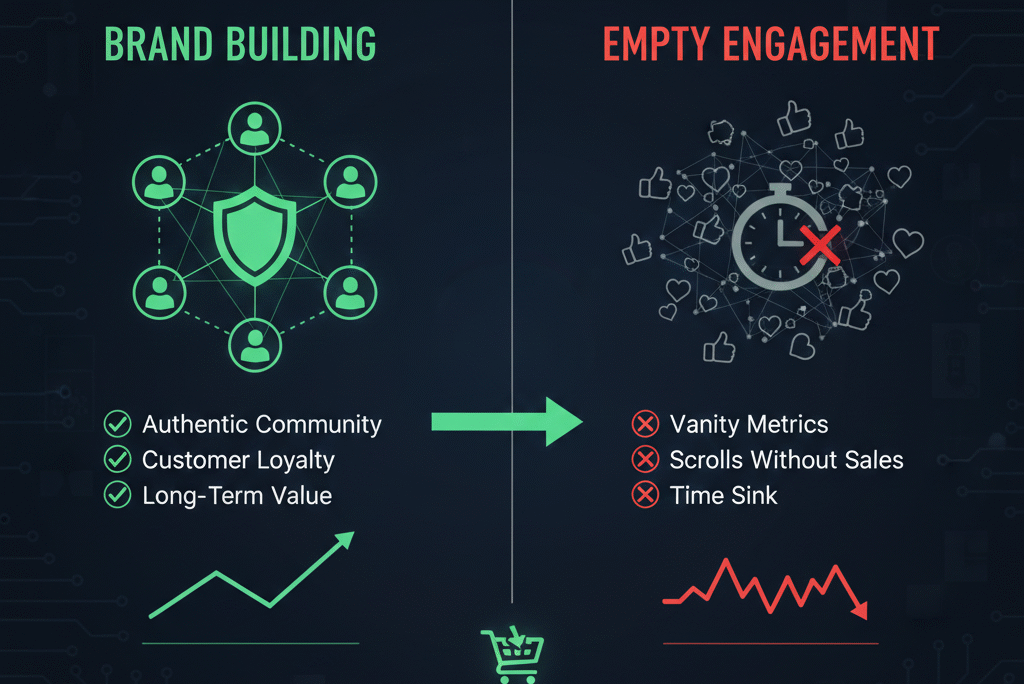
That distinction is the difference between content that builds a brand and content that generates empty engagement. Understanding the mechanical difference — not just the conceptual one — is what allows ecommerce sellers to restructure their social media approach in ways that actually move the business forward.
What Empty Engagement Actually Is (And Why It Feels Like Progress)
Empty engagement is any social media activity that generates responses — likes, shares, comments, follows — without building the specific perceptions that make someone more likely to buy your product.
The reason it feels like progress is that it triggers the same psychological responses as real progress. Notifications arrive. Numbers go up. The platform’s own metrics look favorable. There’s genuine dopamine involved in watching a post perform. Telling yourself “we’re growing” feels accurate when the follower count is climbing.
But growth in audience size is not the same as growth in buyer trust. These are fundamentally different things, and ecommerce brands that conflate them spend enormous amounts of time and creative energy on content that generates reactions without building the specific confidence that converts a browser into a customer.
Empty engagement typically comes from three patterns.
Trend-chasing without positioning — creating content that participates in viral formats, trending sounds, or popular meme structures without connecting any of it back to what makes the brand worth buying. The content is entertaining. It has nothing to do with the product. Buyers who encounter it have no better understanding of why they should choose this brand over any alternative.
Entertainment without authority — posting content that makes people feel something (amused, inspired, motivated) without teaching them anything about the product, the category, or the brand’s specific approach to quality. Feelings without information don’t convert. Buyers need to feel confident, not just entertained.
Audience accumulation without buyer development — optimizing for follower count by posting content that appeals to the broadest possible audience rather than content that speaks directly to the specific buyer who would actually purchase. A skincare brand with 50,000 followers who are there for the motivational quotes has a vanity metric. A skincare brand with 8,000 followers who understand the formulation philosophy, the sourcing standards, and the specific skin concerns the products address has a buyer community.
The test for empty engagement is simple: if your social media content disappeared tomorrow, would any potential buyer’s decision-making process change? If the honest answer is no — if the content exists parallel to the purchase decision rather than influencing it — it’s empty engagement regardless of how well it performs by platform metrics.
What Brand Building Actually Looks Like on Social Media
Real brand building on social media is less exciting to look at than viral content. It’s repetitive, focused, and strategic. It answers the same question in slightly different ways across many posts over an extended period: why should someone choose this brand specifically?
That question — why you, not the competitor, not the cheaper listing, not the category leader with thousands of reviews — is the one that every meaningful piece of social content should be working to answer. Not explicitly, not as a sales pitch in every post, but cumulatively, through consistent messaging that builds a coherent picture of what the brand stands for and why that matters to the specific buyer it serves.
For private label sellers, this is especially important because the product itself is rarely the differentiator. In most Amazon categories, multiple sellers are sourcing similar or identical products from similar factories. The differentiation that justifies choosing one over another doesn’t live in the product features — it lives in the brand. In the perceived quality, the trust signals, the authority the brand has built around the category, the sense that this company knows what it’s doing and stands behind what it sells.
Social media is one of the primary places where that differentiation gets built. Not through ads, not through Amazon listings, but through the accumulated impression created by months of consistent, positioned content that gradually answers every question a potential buyer might have about whether this brand is worth trusting.
The Real Job Social Media Does for Ecommerce
The mistake most ecommerce sellers make about social media is treating it as a direct revenue channel. They expect content to drive traffic that converts to sales, measure success by how directly that link can be traced, and conclude that social media doesn’t work when the attribution is unclear.
Social media’s primary job in ecommerce is different from that, and understanding the actual mechanism changes how it should be measured.
When someone discovers a product on Amazon — through search, through PPC, through a recommendation — and becomes genuinely interested, a significant proportion of them don’t immediately buy. They investigate. They search the brand name. They check Instagram or TikTok. They look for evidence that the brand is legitimate, established, and trustworthy. They’re not looking for entertainment. They’re conducting a trust audit.
What they find during that trust audit is what determines whether the purchase happens. A social media presence that looks coherent, professional, and consistent with the brand’s positioning on Amazon — same visual identity, same brand voice, same messaging about quality and values — gives the buyer confidence. It confirms that a real company with real standards is behind the product. That confirmation is often the final step before purchase.
A social media presence that looks chaotic, trend-chasing, and disconnected from the product does the opposite. It introduces doubt. And ecommerce runs on the elimination of doubt.
The direct attribution from social media to sale is often invisible in analytics. But the mechanism is real and consequential. Social media is a trust accelerator — it compresses the time it takes for a potential buyer to move from awareness to confidence. Brands that understand this build their social presence around trust signals rather than engagement metrics, and their conversion rates reflect the difference.
Research on how social media influences consumer purchase decisions consistently shows that buyers use brand social presence as a legitimacy signal before committing to purchase — particularly for brands they haven’t bought from before.”
Authority Converts. Entertainment Doesn’t.
There’s nothing wrong with entertaining content. Entertainment is one way to create the repeated exposure that builds familiarity, and familiarity reduces purchase resistance. But entertainment without authority is just noise in the context of ecommerce.
Authority is what makes a buyer feel that the brand knows what it’s talking about, that the product was designed by people who understand the problem it solves, and that buying from this brand is a lower-risk decision than buying from a competitor with cheaper prices and less apparent expertise.
Content that builds authority looks different from content that generates engagement. It educates buyers about the specific problem the product solves — not in a generic way, but with the specificity that signals genuine expertise. It explains the brand’s approach to quality, sourcing, or design in ways that a buyer couldn’t encounter from a competitor. It addresses the objections that prevent purchase directly and honestly. It shows the product being used in realistic contexts by people whose situations the target buyer recognizes.
This content often performs more modestly by platform metrics than entertainment content. It gets fewer shares from people outside the target audience because it’s specifically designed to be relevant to that audience rather than broadly appealing. But its effect on conversion rate — on moving the specific people it’s designed to reach from curious to confident — is measurably stronger.
The question worth asking about every piece of social content isn’t “will this perform well?” It’s “does this make the right buyer more likely to trust us?” These questions sometimes have the same answer. Often they don’t.
Why the Algorithm Isn’t the Strategy
There’s a persistent belief in ecommerce that cracking the social media algorithm is the path to growth. Find the format it rewards, post at the optimal time, use the right hashtags, and the algorithm sends traffic that converts to revenue.
The algorithm rewards attention. Businesses need intention. These are not the same thing.
A post that generates 100,000 views from people who have no interest in buying the product, who are in the wrong geography, at the wrong price point, or in the wrong stage of any relevant purchase journey, generates zero business value. The number looks impressive in a report and means nothing to the actual business.
A post that generates 2,000 views from buyers who are actively considering a purchase in the category, who are encountering the brand for the second or third time because of consistent posting, and who needed one more trust signal to feel confident — that post might generate more revenue than the viral one, even though its metrics look modest by comparison.
Algorithms also change. Platform reach changes. What works on Instagram this year doesn’t work the same way next year. TikTok’s algorithm rewards different content in 2026 than it did in 2023. Brands that build their strategy around cracking the current algorithm are perpetually chasing something that moves.
Brands that build their strategy around consistently communicating their positioning — who they’re for, what makes them worth choosing, why they can be trusted — create something that platform algorithm changes can’t easily disrupt. The content format adapts. The message remains consistent. And consistent messaging is what builds the kind of brand recall that generates direct search, repeat purchases, and word-of-mouth — none of which depend on the algorithm at all.
What Consistency Actually Does to Buyer Psychology
The compounding effect of consistent brand messaging is real and it’s documented in how buyers actually make decisions. Buyers don’t typically encounter a brand once and make an immediate purchase decision. They encounter it multiple times, across multiple touchpoints, and each encounter either adds to or subtracts from their cumulative confidence in the brand.
A buyer who has seen the same brand consistently communicating the same values, the same quality standards, and the same positioning across fifteen posts over three months is in a completely different psychological state than a buyer encountering the brand for the first time. They have familiarity. They have a sense of what the brand stands for. They’ve accumulated small trust deposits with each exposure.
When that buyer finally needs the product the brand sells, they don’t start their decision process from zero. They already have a relationship with the brand — a shallow one, built entirely from social content, but a real one. They’re more likely to search the brand name specifically rather than the generic category. They’re more likely to convert without extensive comparison shopping. They’re more likely to be willing to pay a premium because the brand feels established and trustworthy rather than anonymous.
This is the compounding effect that brand building creates over time, and it’s invisible in short-term engagement metrics. It doesn’t show up in likes or follower count. It shows up in conversion rate trends, in branded search volume growth, in repeat purchase rates, and in the premium pricing power that brands develop relative to unbranded competitors in the same category.
Mature ecommerce brands measure social media success through these indicators rather than engagement rate. The shift in measurement framework is often the most important change in how social media strategy gets built and evaluated.
Visual Consistency: The Mechanism Nobody Talks About Enough
There’s a specific mechanism in brand building that gets less attention than content strategy but has an outsized effect on buyer perception: visual consistency across every touchpoint the buyer encounters.
When a buyer finds a brand on Instagram and the visual identity — color palette, typography, image style, compositional approach — is immediately recognizable from the brand’s Amazon listing, something specific happens in their psychology. The brand feels established. It feels like a real company rather than an individual seller. It feels like the kind of business that has put thought into its presentation, which signals that it puts thought into its products.
This effect is subtle enough that most buyers can’t articulate it, but it’s strong enough to measurably affect purchase decisions. The consistency itself is the signal — it communicates that the brand has a coherent identity, that the visual language was designed rather than assembled from random choices, and that the same intentionality presumably extends to the product itself.
For Amazon and eBay sellers who operate primarily on third-party platforms, this visual consistency across social media and their marketplace listings is one of the few tools available for creating a brand impression that exists outside the platform’s control. The platform controls the listing format, the category positioning, the competitive environment. The brand controls its visual identity, and that identity can create recognition and trust that transcends any individual platform.
Practically, this means the color palette, logo usage, image style, and tonal register used in social content should be deliberately aligned with the packaging, listing images, and any other brand touchpoints. This isn’t a design exercise — it’s a trust-building strategy that pays dividends in conversion rate over time.
Content That Reduces Buyer Hesitation vs Content That Generates Reactions
The most useful reframe for ecommerce social media strategy is shifting the central question from “how do we get more engagement?” to “how do we reduce buyer hesitation?”
These questions lead to completely different content strategies. Engagement-optimized content is designed to generate reactions from the broadest possible audience — it’s entertaining, broadly relatable, and platform-native in format. Hesitation-reduction content is designed to answer the specific questions and address the specific objections that prevent the target buyer from committing to purchase.
Hesitation-reduction content explains materials, sourcing, and manufacturing in ways that communicate quality without feeling like a marketing claim. It demonstrates durability or performance in realistic conditions that buyers recognize from their own experience. It answers the frequently asked questions that show up in Amazon’s Q&A section and in customer service inquiries — the questions that represent real uncertainty in real buyers’ minds. It compares the product to common alternatives honestly, explaining specifically why it’s the better choice for the specific buyer it’s designed for. It shows real customer experiences, not polished testimonials, but genuine before-and-after situations that buyers can see themselves in.
None of this content is likely to go viral. It won’t generate the kind of broad engagement that makes a social media manager’s metrics look impressive. But it moves the specific buyers it’s designed to reach significantly closer to purchase, and over time, the cumulative effect on conversion rate and repeat purchase behavior is substantial.
The buyers who consume this content and then convert become the brand’s most valuable customers — they bought with accurate expectations, they’re satisfied because the product delivered what the content promised, and they’re the most likely source of the genuinely useful reviews and word-of-mouth that compound brand growth over time.
Social Media Strategy for Marketplace Sellers Specifically
Sellers operating primarily on Amazon, eBay, or Etsy face a specific challenge that makes social media strategy more important, not less: they don’t control the platform they sell on.
Amazon changes its algorithm. eBay changes its fee structure. Etsy changes its search ranking factors. Any of these changes can significantly affect a seller’s visibility and revenue overnight, with no recourse beyond adapting to the new rules. Sellers whose entire business exists within a single marketplace are entirely exposed to this risk.
Social media is one of the primary tools available for building something outside that exposure. A brand with a genuine social presence — one where buyers follow because they’re interested in the brand, not just in the product category — has a relationship with its customers that exists independently of any marketplace. If Amazon visibility drops, the brand can communicate directly with followers. If an eBay listing loses ranking, the brand has a channel for re-engaging customers without depending on the platform’s algorithm to surface them.
This isn’t a theoretical benefit. Sellers who built genuine social brand presence before experiencing marketplace disruptions consistently report faster recovery than sellers who had no off-platform presence. The brand existed somewhere the platform couldn’t touch, and that existence created resilience.
For marketplace sellers specifically, social media should be understood as insurance as much as marketing — insurance against the platform risk that every marketplace seller carries, built through consistent brand communication that creates customer relationships that belong to the brand rather than to the platform.
When Engagement Does Matter — And What It Should Look Like
This isn’t an argument that engagement is irrelevant. It’s an argument that the type of engagement matters as much as the quantity, and that optimizing for quantity at the expense of quality is where most ecommerce social media strategy goes wrong.
Engagement that signals genuine buyer interest is valuable. Comments asking about specific product attributes, questions about sizing, materials, or shipping, requests for restock information, comparisons to alternatives that the buyer is evaluating — this is the engagement that tells you your content is reaching the right people and moving them toward purchase. It’s worth far more per instance than a thousand emoji comments from an unrelated audience.
Engagement from existing customers — reviews of recent purchases shared as comments, recommendations to friends mentioned in replies, photos of the product in use — is even more valuable because it provides social proof at the moment when other potential buyers are conducting their trust audit. This engagement doesn’t require going viral. It requires creating a brand that customers feel connected enough to to share their experience publicly.
Building toward this kind of engagement means posting content that’s specifically designed to prompt it — content that invites genuine questions, that creates the kind of curiosity that real buyers express, and that gives existing customers something worth sharing. That’s a different brief than “create content that performs well on the platform,” and it produces different results.
The Three Pillars of Social Media Strategy That Actually Compounds
Reducing all of this to a practical framework: social media strategy that builds real ecommerce brand equity consistently operates across three dimensions.
For a tactical breakdown of how to execute this across specific platforms, Later’s ecommerce social media strategy guide covers the platform-specific mechanics well — what follows here focuses on the strategic framework that should sit underneath any platform-specific execution.
Clarity in messaging means that anyone who encounters any piece of brand content should immediately understand what the brand sells, who it’s for, and what makes it worth choosing. Not in an elevator-pitch way — not a rehearsed statement in every caption — but in the cumulative impression created by content that consistently communicates the same core positioning. If the messaging varies so much that the brand feels different from one post to the next, clarity is absent and trust-building slows significantly.
Authority in expertise means that the content communicates genuine knowledge of the category, the product, and the specific problems the target buyer faces. This doesn’t require academic credentials or formal expertise — it requires showing up consistently with specific, accurate, useful information that a buyer couldn’t find as easily anywhere else. Brands that build authority are the ones buyers instinctively think of when they need what the brand sells.
Consistency in execution means that visual identity, tonal register, posting cadence, and content focus remain stable enough over time to create the familiarity that builds trust. Consistency doesn’t mean monotony — it means that variation happens within a coherent framework rather than randomly. Every departure from the established visual or tonal identity dilutes the recognition that consistent presence builds.
When these three pillars are functioning together, social media stops being a cost center that generates impressive metrics without business impact. It becomes a compounding asset — one that makes every other marketing channel more effective by providing the trust foundation that converts curious buyers into confident ones.
Frequently Asked Questions
How much time should an ecommerce brand spend on social media?
Less than most people think, but more strategically than most people do it. Three to four focused, well-crafted posts per week that consistently communicate brand positioning will outperform daily posting without strategic intent. The quantity matters far less than the consistency of messaging and the quality of trust-building per post.
Which platform is best for ecommerce brands?
It depends almost entirely on where the specific target buyer spends time. Instagram remains strong for visually-driven products with a lifestyle component. TikTok is effective for products that demonstrate well in short video. Pinterest drives significant purchase intent in home, fashion, and craft categories. The right platform is the one where the brand’s specific buyer is actively seeking information and inspiration — not the one with the highest overall user count.
Should ecommerce brands invest in paid social alongside organic content?
Paid social amplifies what organic content has already built. Running paid ads for a brand with weak organic positioning tends to generate expensive traffic that doesn’t convert, because the ad might drive the click but the brand presence doesn’t provide the trust confirmation that converts the click into a purchase. Building organic brand presence first, then amplifying it with paid promotion, consistently outperforms running paid ads without the organic foundation.
How long before social media brand building shows measurable results?
Meaningful conversion rate impact from social brand building typically appears over three to six months of consistent, positioned content. Branded search growth — people searching the brand name specifically rather than just the category — usually takes six to twelve months to become statistically significant. The compounding effects on repeat purchase rate and word-of-mouth take longer still. This timeline is why most ecommerce brands abandon the strategy before it works, and why the ones who persist past it tend to pull ahead permanently.
Is it worth building social media presence if the brand sells exclusively on Amazon?
Yes, for two reasons. First, potential buyers regularly check social media during the trust audit that precedes Amazon purchases — a coherent social presence improves conversion rate on the Amazon listing indirectly. Second, exclusive dependence on Amazon creates platform risk that social brand building helps mitigate. Building an audience that belongs to the brand rather than to the marketplace is one of the most valuable things an Amazon seller can do for the long-term resilience of their business.
Final Thought: Quiet Consistency Scales. Loud Virality Doesn’t.
The brands that win in ecommerce over the long term aren’t the loudest. They aren’t the most entertaining. They aren’t the ones who’ve cracked the algorithm most recently.
They’re the clearest. The most consistent. The ones whose buyers, after months of accumulated exposure, feel like they already know the brand before they ever hit the buy button.
Social media built around that objective — trust acceleration rather than engagement accumulation — is one of the most powerful compounding assets an ecommerce brand can build. It doesn’t pay off quickly. It doesn’t look viral while it’s working. But it creates something that aggressive pricing and keyword optimization alone can’t: a relationship between brand and buyer that exists independently of any platform, any algorithm, and any competitor’s attempt to undercut on price.
That relationship is the moat. And in ecommerce, moats compound.
If you’re building an ecommerce brand and want your social media strategy aligned with your broader brand positioning and marketplace performance, you can see how we approach it at ecommate.co.uk.
This article reflects direct experience working with ecommerce and private label brands across Amazon, eBay, and direct-to-consumer channels. Strategic observations are based on patterns observed as of 2026.