Amazon Brand Registry is the single most important administrative step between sourcing a product and launching it — and it’s the one most new private label sellers either don’t know about, leave too late, or misunderstand well enough to cause themselves serious problems. If you’re planning a launch on Amazon and Brand Registry isn’t already in progress, you’re building on an unstable foundation. Not because the listing will fail immediately, but because everything that makes an Amazon private label business durable — your listing content, your advertising options, your protection against copycats and hijackers, your access to the analytics that tell you what’s actually happening in your account — depends on Brand Registry in ways that only become clear when you’re missing it.
This guide explains what Amazon Brand Registry is, what it requires, what it unlocks, and why the timing of the application matters more than most sellers realise.
What Amazon Brand Registry Actually Is
Amazon Brand Registry is Amazon’s programme for brand owners to formally register their brand on the platform, verify their identity as the brand owner, and gain access to a set of tools and protections that are unavailable to unregistered sellers.
The most important word in that description is “verify.” Amazon’s default marketplace model is open — anyone can create a listing for any product under any brand name, because Amazon doesn’t check whether sellers are actually the brand owners they claim to be. This creates a predictable set of problems: unauthorised sellers listing under your brand name, competitors making changes to your listing content because they have listing contributions on the same ASIN, counterfeit products being sold under your brand, and your carefully crafted product presentation being overwritten by someone else’s version of your listing without your knowledge or consent.
Brand Registry exists to close those vulnerabilities. Once you enrol, Amazon formally recognises you as the verified owner of your brand on the platform. Your listing content is given priority over contributions from other sellers. You gain access to intellectual property infringement reporting tools. And you unlock a set of marketing and analytics features that are simply not available to unregistered sellers — features that directly affect your conversion rate, your advertising capability, and your ability to understand how buyers are interacting with your product.
The full list of what Brand Registry unlocks is worth going through in detail, because understanding each element changes how urgently you’ll approach the application.
Why the Timing Matters — The “Before You Launch” Problem
Most sellers approach Brand Registry the wrong way around. They launch, start generating sales, and then either discover Brand Registry exists or decide to register “when things are more settled.” This sequence creates a gap — sometimes weeks, sometimes months — during which the listing is unprotected, the seller is shut out of key features, and any investment in the listing’s quality is at risk of being overwritten.
The timing problem runs deeper than most sellers realise, because Amazon Brand Registry requires a registered trademark — not a pending trademark, not a claimed brand name, but a completed registration from a recognised intellectual property office. And trademark registration takes time. In the UK, the standard examination process at the Intellectual Property Office typically runs two to four months from application to registration, assuming no objections are raised. In the United States, the USPTO trademark process runs eight to fourteen months or longer. In the EU through EUIPO, the timeline is typically four to six months.
If you start the trademark process after your product has arrived in Amazon’s fulfilment centres, you are launching without Brand Registry for a period of at minimum several months. During that window, everything listed in the section below — A+ Content, Brand Analytics, Sponsored Brands, the Storefront, the IP protection tools — is unavailable. You’re running a public listing with no formal protection and significantly reduced marketing capability.
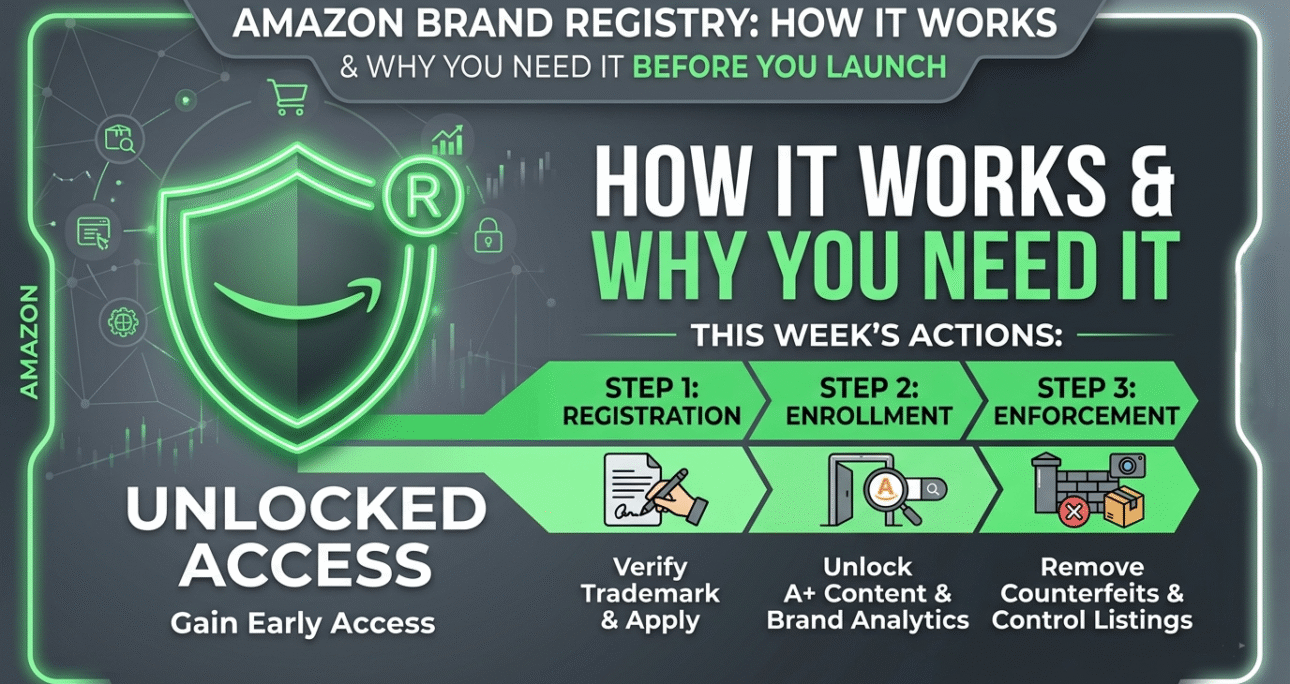
The correct sequence is straightforward: begin the trademark application at the same time you begin serious product sourcing. By the time your inventory has been manufactured, shipped, and received at FBA, your trademark should be registered or close to it, and your Brand Registry application can be submitted immediately.
What You Need to Enrol: The Prerequisites
Amazon Brand Registry has specific eligibility requirements that cannot be bypassed.
A registered trademark. The primary requirement is a registered trademark — not a trademark application, not an intent-to-use filing, but a completed registration — from a trademark office that Amazon recognises. The list of accepted offices covers all major markets, including the UK Intellectual Property Office, the United States Patent and Trademark Office, the European Union Intellectual Property Office, and a significant number of national offices worldwide. Amazon publishes the complete list, which is worth checking for your specific target market before beginning the trademark process.
The trademark must be in the form of the brand name that appears on your products. An image trademark using a logo design works, but a text trademark using your brand name typically provides the broadest coverage and is the most straightforward for Brand Registry purposes.
A brand name that appears on your products. Your enrolled brand name must actually be on the products you’re selling under that name — on the product itself, on the packaging, or on both. This means the brand name needs to be incorporated into the product or packaging design before the product is manufactured, not added after. This is one of the reasons Brand Registry needs to be initiated early in the product development process, not after inventory has been produced.
An active Amazon seller or vendor account. You need an existing Amazon Seller Central or Vendor Central account to enrol in Brand Registry. The Brand Registry account is separate from your selling account but linked to it.
The ability to verify ownership. Amazon will verify your brand ownership during the application process through a combination of trademark documentation and, in some cases, direct contact with the trademark’s registered holder.
The Amazon IP Accelerator: What to Do While Your Trademark Is Pending
If you’re at the stage where you’re reading this and you haven’t started a trademark application yet, the Amazon IP Accelerator is worth knowing about. This is Amazon’s programme connecting sellers with a network of pre-vetted intellectual property law firms who assist with trademark applications — and more relevantly, whose pending applications Amazon sometimes accepts for provisional Brand Registry access before the trademark is fully registered.
The practical benefit is that you may be able to access some Brand Registry features while your trademark application is still in progress, rather than waiting for the full registration period. This doesn’t apply to all features or in all circumstances, and the provisional access is contingent on the trademark ultimately being successfully registered. But for sellers who are already in the sourcing or launch phase without an existing trademark, the IP Accelerator route is the most direct path to partial Brand Registry access.
The IP Accelerator firms don’t work for free — trademark legal costs are a real line item in your launch budget — but the cost is predictable and the outcome (a registered trademark that protects your brand both on and off Amazon) has value independent of Brand Registry. A registered trademark is an intellectual property asset that increases your brand’s valuation and provides legal recourse against infringers that brand names without registration don’t have.
What Brand Registry Unlocks: The Full Picture
This section is the commercial case for Brand Registry — the specific capabilities that become available once you’re enrolled, and why each one matters for a private label business.
A+ Content (formerly Enhanced Brand Content). A+ Content is the expanded product description module that allows enrolled brands to replace the standard product description with rich media — custom layouts, additional images, comparison charts, brand story sections, and formatted text that standard sellers can’t access. Amazon’s internal data suggests A+ Content can improve conversion rates by 3 to 10 percent compared to standard descriptions, and independent seller data consistently shows meaningful lift in both conversion and session-to-purchase rate when high-quality A+ Content is added to a listing.
The mechanism is straightforward: most buyers don’t read standard product descriptions. They’re text blocks with minimal formatting that appear below the fold of most listing views. A+ Content is visually engaging, can incorporate lifestyle imagery alongside product photography, and can communicate the brand’s positioning and product’s benefits in a format that buyers actually interact with. For a private label listing competing against multiple similar products, this conversion advantage is significant — and it’s entirely unavailable to unregistered sellers.
Amazon Brand Analytics. Brand Analytics is the analytics dashboard that gives enrolled brands access to data that doesn’t appear anywhere in the standard Seller Central reports. The most commercially significant elements: Search Frequency Rank shows you where specific search terms rank in Amazon’s total search volume — not your estimated volume, but Amazon’s actual ranking of how often a term is searched across the platform. Click Share and Conversion Share data show you which products are capturing the clicks and purchases on searches where your product appears, and how your share compares to competitors. This tells you not just whether you’re ranking for a keyword, but whether buyers who see your listing are clicking on it and buying it.
Market Basket Analysis shows you what products buyers frequently purchase alongside yours — which has direct implications for bundle strategy, cross-selling, and identifying complementary products for your brand’s next launch. Repeat Purchase behaviour shows you your returning customer rate, which is one of the most important metrics for assessing whether your brand is building genuine customer loyalty or just converting first-time buyers.
None of this data is available without Brand Registry. Sellers making decisions about which keywords to target, which product to launch next, and whether their brand is building sustainable repeat business are operating blind without it.
Amazon Storefront (Brand Store). The Amazon Storefront is a multi-page branded space within Amazon — essentially a mini-website hosted on Amazon’s platform — that displays your full product range in a curated, brand-controlled environment. Storefronts have custom URLs (amazon.co.uk/brand-name), support internal navigation between product categories, and can incorporate brand content including videos and brand story elements.
The commercial importance of a Storefront goes beyond aesthetics. When you run Sponsored Brands ads — the banner-format advertising at the top of search results — you can direct traffic to your Storefront rather than to a single listing. This means a buyer clicking your Sponsored Brands ad arrives in a branded space displaying your full product range, rather than on a single product page. For brands with multiple products, this dramatically increases the probability of a purchase even if the buyer doesn’t convert on the specific product advertised. It also builds brand recognition in a way that individual listing visits don’t.
Sponsored Brands and Sponsored Display advertising. The Sponsored Products ad format — the standard product listing ads that appear throughout Amazon search results — is available to all sellers. Sponsored Brands (the banner ads at the top of search results featuring your brand name, logo, and headline) and Sponsored Display (ads that appear on and off Amazon targeting audiences rather than just keywords) are available only to Brand Registry enrolled sellers.
Sponsored Brands ads at the top of search results are visually prominent in a way that standard Sponsored Products ads aren’t. They display your brand name and logo alongside product images, which builds brand recognition over time in addition to driving clicks. For competitive categories where multiple sellers are bidding on the same keywords, the ability to appear at the top of search results in a branded format — rather than competing for individual sponsored product positions — is a significant advertising advantage.
Vine Programme access. Amazon Vine is the programme through which enrolled brands can enrol new ASINs for review generation from Amazon’s Vine reviewer community. Vine reviewers receive free units of the product and provide verified purchase reviews in exchange. For new product launches, the ability to generate a body of genuine, verified reviews in the early weeks of a listing’s life — before the product has had time to accumulate organic reviews — is one of the most significant launch advantages available.
Launching with zero reviews is a conversion problem: buyers use review count as a quality proxy, and a listing with no reviews converts significantly worse than an identical listing with even ten or fifteen reviews. The review accumulation period under organic conditions (waiting for buyers to leave reviews naturally) can take weeks to months, during which time the listing’s conversion rate is suppressed and its PPC costs are higher than they need to be. Vine compresses this timeline.
The programme is not free — Amazon charges an enrolment fee per ASIN — but for most private label launches, the cost is easily justified by the conversion improvement from having a review baseline versus launching with none.
Brand protection and IP infringement tools. The IP infringement reporting tools available through Brand Registry are the mechanism through which you can report and request removal of counterfeit products, listings that infringe your trademark, and intellectual property violations by other sellers. Without Brand Registry, your ability to take action against counterfeiters or listing hijackers is limited to the standard Amazon dispute process, which is slower, less direct, and gives you significantly less control.
With Brand Registry, you can submit infringement reports directly through the Brand Registry portal, which routes them to a team specifically tasked with IP violations. The resolution process is faster, and you have access to the IP Infringement Dashboard where you can track the status of your reports. For any brand operating in a category with copycat activity — which is most commercially successful Amazon categories — this capability is not optional.
Project Zero and Transparency. Project Zero is an additional counterfeit protection programme available to Brand Registry enrolled brands. It allows brands to directly remove counterfeit listings without submitting individual infringement reports, provided they have the evidence of the infringement. It also includes serialisation, which allows your brand to add a scannable code to each unit that buyers can verify is authentic.
Amazon Transparency is a separate but related programme that applies serialised codes to individual product units, allowing Amazon and buyers to verify the authenticity of a specific unit. This is particularly valuable for categories where counterfeiting is common and buyers are making purchase decisions partly on authenticity guarantees. While both Project Zero and Transparency have additional enrollment requirements and costs beyond base Brand Registry, they represent the highest level of counterfeit protection available on the platform.
Customer Engagement (MYCE) and Posts. The Manage Your Customer Engagement tool allows enrolled brands to send marketing emails to buyers who follow their brand or have purchased their products. This is significant because Amazon normally prohibits direct seller-to-buyer communication for marketing purposes — MYCE creates a compliant channel for announcing new product launches, running promotions, and communicating with an existing customer base. Building and using this capability compounds over time as your brand accumulates followers.
Amazon Posts is a social-media-adjacent content feature that allows brands to post image and text content that appears on your product listings and Storefront, in a feed format. Posts are organic (no paid distribution) and appear on competitor listings as well as your own, potentially capturing attention from buyers browsing similar products. While Posts aren’t a primary marketing channel, they’re a zero-additional-cost capability that builds brand visibility — and they’re Brand Registry exclusive.
What’s at Risk Without Brand Registry
The capabilities section above describes what you’re missing. This section describes what you’re actively exposed to.
Listing hijacking and content overwriting. Without Brand Registry, your listing content — title, bullet points, product description, main image — is subject to being overwritten by any other seller who contributes to the listing. On Amazon, listing content is theoretically controlled by the party with the most relevant contribution, but in practice, other sellers can make edits that override your carefully written copy and replace it with their version. This happens more often than sellers expect, and the consequences range from minor (your carefully written bullet points replaced by generic copy) to severe (your main image changed in ways that violate category requirements and trigger suppression).
Brand Registry locks your content. Your brand’s version of the title, bullets, description, and images is given priority. Other sellers can still appear on your listing (if they’re selling the same product), but they cannot change the content.
Hijacker vulnerability. Listing hijackers find your ASIN, source a counterfeit or similar product, and add themselves to your listing as additional sellers. Buyers then purchase from the hijacker thinking they’re buying your product. If the hijacker’s product is inferior, reviews suffer. If they’re selling counterfeit units, your brand takes a reputation hit for quality problems you didn’t create. Without Brand Registry’s IP tools, removing hijackers is a slow, manual process. With Brand Registry, you have direct, faster-acting removal tools.
Competitive and conversion disadvantage. All other factors being equal, a listing with A+ Content converts better than one without. A brand with Sponsored Brands ads gets more prominent search result placement than one running only Sponsored Products. A launch with Vine reviews establishes a review baseline faster than one waiting for organic reviews. These aren’t theoretical advantages — they’re measurable commercial edges that compound over the life of the listing. Operating without them means accepting worse performance by default.
The Application Process: Step by Step
Once you have a registered trademark, the Brand Registry application process itself is relatively straightforward.
Navigate to brandregistry.amazon.com and sign in with your Seller Central credentials. Select “Enrol a new brand” and provide your brand name exactly as it appears on your trademark registration. Enter your trademark registration number and select the issuing trademark office from the dropdown menu. Provide your product categories, a list of the countries where your products are manufactured and sold, and image evidence showing your brand name on the product or packaging.
Amazon will review the application and, in most cases, send a verification code to the trademark registrant (the person or company listed as the trademark owner). This verification step confirms that the person applying for Brand Registry is actually the trademark owner. Once the code is entered and the application is confirmed, Amazon typically processes the enrollment within two to four weeks, after which your brand appears as enrolled in the Brand Registry portal and the associated Seller Central account gains access to the brand-exclusive features.
If the trademark is registered to a company or legal entity rather than to you personally, ensure the Seller Central account is in the correct name or that you have documentation establishing your authority to act on behalf of the trademark owner.
Common Mistakes That Delay or Prevent Enrollment
Starting the trademark application too late. The most common and most costly mistake. Starting a trademark application after inventory is ordered means launching without Brand Registry, without A+ Content, without Sponsored Brands — during the period when the listing needs those capabilities most to establish market position. The trademark process should begin at the same time as serious product sourcing.
Brand name inconsistency. If the brand name on your trademark registration is even slightly different from the brand name on your product (different spelling, different capitalisation, addition or removal of a word), Amazon may reject the Brand Registry application on the grounds that the trademark doesn’t match the brand. Ensure the brand name is settled and consistent before beginning the trademark application.
Trademark in the wrong jurisdiction. A UK trademark supports Brand Registry for amazon.co.uk but may not be accepted for amazon.com without a corresponding US trademark, or vice versa. If you’re planning to sell in multiple Amazon markets, you need trademark coverage in the relevant jurisdictions — either separate national applications or broader regional registrations (like the EU trademark that covers multiple EU markets simultaneously through EUIPO).
Product or packaging without the brand name. If your products arrive at Amazon’s fulfilment centres without your brand name physically on the product or packaging, you technically don’t meet Brand Registry’s enrollment requirements — which state that the brand name must appear on your products. This needs to be built into the packaging brief sent to your supplier, not added as an afterthought.
Seller Central account in the wrong name. Brand Registry enrollment links to a specific Seller Central account. If the trademark is registered to one legal entity and the Seller Central account operates under a different entity, the verification process can be complicated. Ensure your business structure is aligned before applying.
Frequently Asked Questions
Can I enrol in Brand Registry without a registered trademark?
Standard Brand Registry enrollment requires a fully registered trademark. However, if you’re in the process of applying for a trademark through one of Amazon’s IP Accelerator partner law firms, you may be able to access provisional Brand Registry features before the registration is complete. This is not guaranteed for all features or all circumstances, but it’s the best available option for sellers who haven’t yet completed trademark registration.
How long does Brand Registry enrollment take once I apply?
After submitting a complete application with all required documentation, Amazon typically takes two to four weeks to complete the review and verification process. The total timeline from starting a trademark application to having active Brand Registry enrollment is dominated by the trademark registration process, not the Amazon review process — which is why starting the trademark application early is so important.
Does Brand Registry prevent all hijacking?
Brand Registry significantly reduces hijacking vulnerability and gives you faster, more direct tools to remove hijackers when they appear. It does not make your listing technically impossible for other sellers to join — any seller with the product’s ASIN can still add themselves as a seller on the listing. What Brand Registry does is give you effective tools to remove unauthorized sellers quickly, control your listing content so hijackers can’t change your presentation, and report intellectual property violations through a dedicated portal with faster resolution times.
Can I have Brand Registry on multiple brands?
Yes. Each brand requires its own trademark registration and its own Brand Registry enrollment, but there’s no limit to the number of brands a single Seller Central account can have enrolled. Brands managing multiple private label product lines typically enrol each under a separate brand identity, each with its own trademark.
Does Brand Registry affect my eligibility for any Amazon programmes?
Brand Registry is a prerequisite for several Amazon programmes beyond the features listed above. Amazon Launchpad (for innovative products), the Brand Referral Bonus programme (which provides rewards for traffic you drive to Amazon from external sources), and certain Amazon advertising formats all require Brand Registry enrollment. The Brand Referral Bonus in particular — which credits enrolled brands a percentage of sales generated from external traffic you drove — can meaningfully reduce your effective cost of off-platform marketing.
What happens to my Brand Registry if my trademark expires or is cancelled?
Amazon periodically checks the status of the trademarks associated with Brand Registry enrollments. If a trademark lapses or is cancelled, Brand Registry enrollment for the associated brand may be suspended. Maintaining an active trademark registration is not just a one-time requirement — it’s an ongoing obligation if you want to maintain Brand Registry status.
Is Brand Registry worth it for a brand with only one product?
Yes, unambiguously. The listing protection alone justifies it — the risk of having a single product’s listing content hijacked or overwritten is high enough that Brand Registry’s protection has real value regardless of how many products you have. The A+ Content conversion improvement applies equally to single-product brands as to multi-product ones. And the analytics access — particularly Brand Analytics data that shows you how buyers are finding and converting on your product — is foundational information that informs every subsequent business decision, whether you have one product or twenty.
Final Thoughts: Brand Registry Is Infrastructure, Not a Feature
The way to think about Amazon Brand Registry isn’t as a nice-to-have add-on that you’ll get to eventually. It’s the infrastructure layer on which the rest of your Amazon private label business runs. The protection, the analytics, the advertising capabilities, the conversion tools — all of it depends on being enrolled. Launching without it is building on an unprotected foundation that becomes progressively harder to secure as your listing accumulates history.
The two things that control the timing are the trademark registration process and your awareness that it needs to start early. If you know about Brand Registry, understand what the trademark requirement means for your launch timeline, and start the application at the right point in your product development process — alongside sourcing, not after launch — you arrive at launch day with the full toolkit available and your listing protected from day one.
If you’re planning an Amazon private label launch and want to ensure Brand Registry, listing strategy, and your account’s full toolkit are set up correctly from the start — rather than pieced together after the fact — our Amazon Private Label Services cover the end-to-end process, including Brand Registry setup, listing optimisation, and the advertising infrastructure that Brand Registry unlocks.
For sellers who’ve already launched and are optimising an existing listing, the principles of what makes an Amazon listing convert — including how A+ Content fits into the conversion structure — are covered in detail in our listing optimisation guide.