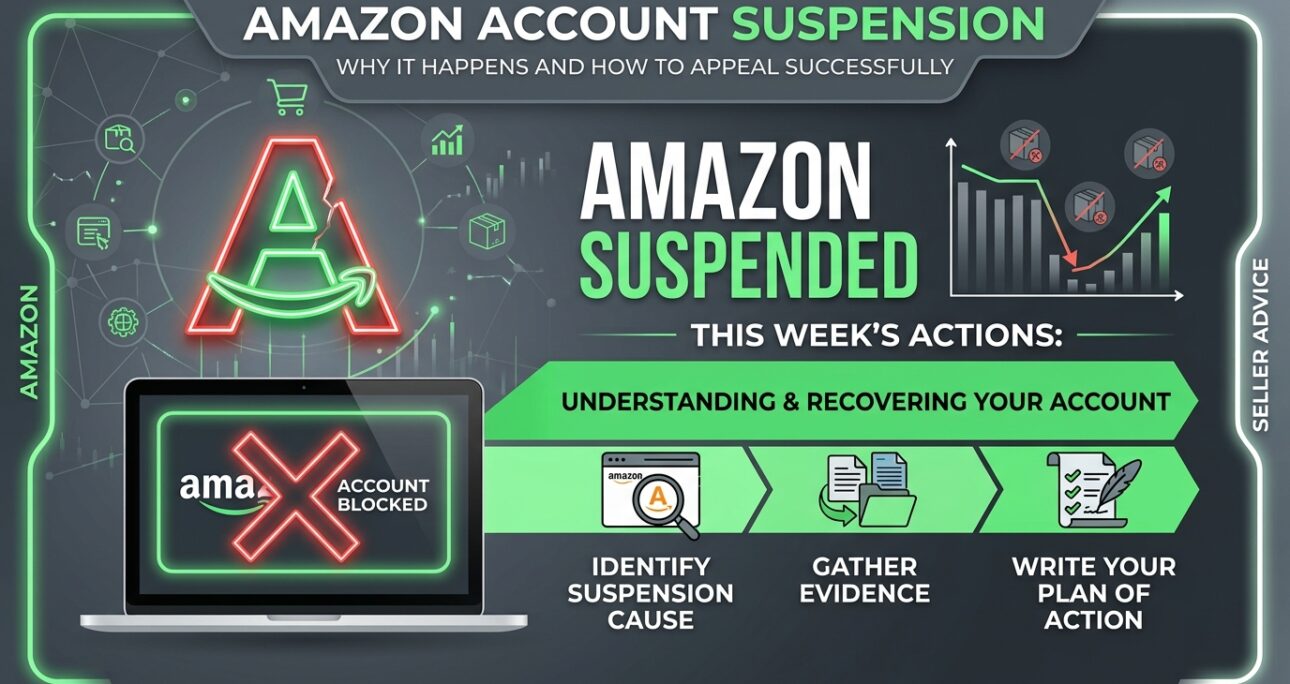
Amazon account suspension is one of the most commercially devastating events that can happen to a private label seller — and one of the least understood until it actually occurs. One morning your account is running normally. The next, you receive an email from Seller Performance informing you that your account has been suspended, your listings are no longer active, and your funds are on hold. No phone number to call, no escalation path immediately apparent, and a business that may generate thousands of pounds a day suddenly generating nothing.
This happens to a significant number of Amazon sellers every year. The reasons range from straightforward performance failures to complex policy violations to third-party complaints that arrive without warning. What determines whether a suspension becomes a temporary disruption or a permanent loss of the business is almost entirely how well you understand what triggered it and how effectively you respond.
This guide covers the main reasons Amazon suspends accounts, how the appeal process works, how to write a Plan of Action that actually gets accounts reinstated, and what sellers consistently do wrong in appeals that turn a fixable suspension into a permanent one.
Understanding the Different Types of Account Actions
Before covering why suspensions happen, it’s worth being precise about what Amazon account actions actually are — because sellers often conflate terms that have different implications for how you respond.
ASIN or listing suspension is the removal of a specific product listing rather than your entire account. An individual ASIN can be removed for a policy violation, a safety complaint, an intellectual property claim, or a performance issue specific to that product. Your other listings remain active. The appeal process for a listing suspension is typically more contained than a full account suspension — it’s focused on the specific ASIN and the specific reason it was removed.
Account suspension is the deactivation of your entire Seller Central account. All listings are removed from search, you cannot sell new inventory, and any existing orders cannot be fulfilled (in FBA, Amazon may still ship pending orders, but new orders stop). Your funds are held pending resolution. Account suspension comes with a notification from Seller Performance specifying the reason for the action.
Account deactivation and account hold are terms Amazon uses in specific contexts — a hold typically applies to your disbursements (funds are held) while an investigation is ongoing, while deactivation is the formal term for what most sellers call suspension.
Permanent suspension (account termination) is the most severe outcome — Amazon’s determination that your account cannot be reinstated. This occurs when the violation is considered severe enough (such as fraud, serious safety issues, or repeated policy violations after prior reinstatement) that Amazon will not consider further appeals. Understanding this distinction matters because the appeals process for a standard suspension operates differently than the route available once Amazon has communicated that the account has been permanently terminated.
Why Amazon Suspends Accounts: The Main Categories
Amazon’s seller agreement and policies are extensive, and the reasons for account suspension span everything from measurable performance failures to complaints received from buyers or third parties. These are the categories that generate the majority of suspensions.
Performance Metric Violations
Amazon publishes the thresholds and targets for each metric in Seller Central’s help documentation. These are visible in your Account Health dashboard, and Amazon publishes the thresholds at which action is taken.
The Order Defect Rate (ODR) measures the percentage of orders that result in a negative experience — specifically, orders that generate an A-to-Z Guarantee claim, a chargeback, or a negative feedback rating. Amazon’s target is below 1%. Exceeding 1% consistently — particularly in a short measurement window — triggers account-level concern, and extended periods above threshold result in suspension.
The Late Shipment Rate applies primarily to Merchant Fulfilled (MFN) sellers and measures the percentage of orders shipped after the expected ship date. Amazon’s threshold is below 4%. FBA sellers are largely insulated from this metric since Amazon controls the fulfilment, but hybrid sellers managing any MFN volume need to monitor it closely.
The Pre-fulfilment Cancellation Rate measures the percentage of orders you cancel before shipping. The threshold is below 2.5%. Cancelling orders because you’ve run out of stock, priced items incorrectly, or can’t fulfil them is a direct signal to Amazon that your operational reliability is insufficient for the platform.
Performance metric suspensions are in one sense the most straightforward type to understand and appeal, because the data is objective. The harder question is why the metrics deteriorated — and the appeal process will require you to explain that root cause and demonstrate what you’ve changed.
Policy Violations
Amazon’s seller policies cover an extensive range of behaviours, and violations can result in either listing-level or account-level actions depending on severity and frequency. The most common policy-related suspension triggers include:
Selling restricted or prohibited products. Amazon maintains category-specific and product-specific restrictions, some requiring prior approval to sell, others prohibited entirely. Inadvertently listing a product in a restricted category, listing something that violates safety standards, or selling a product on Amazon’s prohibited items list (which covers everything from certain weapon accessories to specific chemical formulations) can trigger immediate listing removal and, for serious cases, account suspension.
Listing violations. These include keyword stuffing in listing titles or backend search fields that violates Amazon’s style guidelines, making prohibited claims in listing copy (such as making drug-like efficacy claims for supplements, or safety certifications you don’t hold), listing inaccurate product information, or misrepresenting product condition.
Intellectual property violations. If your listing infringes a third party’s trademark or uses copyrighted images without permission, the IP rights owner can file a complaint through Amazon’s report infringement process. These complaints are taken seriously and acted on quickly. A single IP complaint can suspend the relevant ASIN; multiple complaints or a severe violation can trigger account-level action.
Authenticity and Section 3 Violations
Section 3 of the Amazon Business Solutions Agreement — the provision relating to product authenticity, supply chain documentation, and related seller obligations — is the basis for one of the most common and most complex categories of account suspension. When Amazon receives a complaint suggesting that products sold through your account are inauthentic, counterfeit, or inconsistent with what they’re represented as being, Seller Performance may suspend the account under Section 3 and request documentation proving the authenticity of your supply chain.
This typically requires invoices from suppliers, Letters of Authorisation from brands whose products you’re selling (for resellers), or other supply chain documentation. For private label sellers, this means being able to demonstrate that your products are manufactured by verifiable suppliers and that you hold the rights to sell under your brand name.
Section 3 suspensions frequently catch sellers off guard because the trigger isn’t always a genuine counterfeit issue — sometimes it’s a competitor filing a false complaint, a buyer who received a damaged item and assumed it was fake, or a miscommunication about product specifications. The suspension arrives regardless of whether the allegation is accurate, and the documentation requirement can be challenging for sellers who haven’t maintained rigorous supply chain records.
Review Manipulation
Amazon’s prohibition on manipulated reviews is absolute and the consequences for violation are among the most severe available under the platform’s enforcement framework. Review manipulation includes: incentivising buyers to leave positive reviews in exchange for refunds, free products, or other benefits; asking family members or employees to leave reviews; purchasing reviews through third-party services; and using tactics designed to artificially inflate review ratings.
Accounts suspended for review manipulation face difficult reinstatement odds because Amazon treats it as fundamental dishonesty toward buyers — not simply a procedural error. Appeals require demonstrating genuine root cause acknowledgement and credible preventive measures, and in repeated cases, Amazon often declines to reinstate.
Linked Account Violations
Amazon enforces a one-account-per-seller policy strictly. If you have a second Seller Central account — whether opened deliberately or accidentally (such as by a family member using the same household banking details) — and either account has a suspension history, Amazon may suspend both accounts. This can also happen when an employee who previously worked for a suspended seller joins your business and Amazon’s systems detect the connection.
Linked account suspensions are particularly difficult because you need to demonstrate that the accounts are genuinely separate businesses, that you had no knowledge of the other account’s violation, or that the linking was accidental rather than deliberate. In cases where you genuinely do have two accounts without Amazon’s permission, the appeal path requires acknowledging this and consolidating into a single account going forward.
Safety Complaints
Product safety complaints — whether from buyers, regulatory bodies, or Amazon’s own testing — are actioned quickly and can result in immediate listing or account suspension without prior warning. This category includes: products that fail safety testing, products recalled by manufacturers or regulatory authorities, products that generate multiple safety-related A-to-Z claims, and products that pose genuine hazards. Safety suspensions require substantive documentation — test reports from accredited testing laboratories, proof of regulatory compliance, and in serious cases, a product recall and destruction process.
The Account Health Rating System
Amazon introduced the Account Health Rating (AHR) as a centralised dashboard metric that aggregates your performance across all policy compliance areas into a single score from 0 to 1,000. Accounts rated 200 and above are in good standing. Accounts that fall below 200 are at risk and subject to monitoring. Accounts that fall below 100 face immediate deactivation risk.
The AHR incorporates a weighted combination of product compliance issues, intellectual property violations, customer product reviews (specifically safety-related issues), and other policy adherence signals. Individual policy violations are assigned point deductions proportionate to their severity, and the AHR updates as violations are acknowledged, resolved, or appealed.
Understanding the AHR matters for proactive account management because it gives you advance warning. An account trending downward toward the risk threshold has time to resolve issues before deactivation occurs. Monitoring the Account Health dashboard regularly — and actioning any issues that appear before they compound — is the primary prevention strategy for avoiding suspensions triggered by accumulating policy concerns.
How Amazon’s Appeal Process Works
When your account is suspended, Amazon will send a notification email specifying the reason for the suspension and, in most cases, inviting you to submit an appeal. The appeal is reviewed by Amazon’s Seller Performance team — a team that processes an extremely high volume of appeals and makes decisions largely based on the written documentation you submit.
The core appeal document is called a Plan of Action (POA). This is the document Amazon expects you to submit as your appeal, and it is the single most important determinant of whether your appeal succeeds. Amazon does not want to hear an argument about whether the suspension was justified. They want a structured acknowledgement of what went wrong and a credible account of how you’ve fixed it and will prevent recurrence.
The timeline for appeal responses varies significantly. Standard appeals can receive a response within two to four business days. Complex cases — particularly Section 3 violations requiring document review — can take two to three weeks or longer. During this period, your account remains suspended and your funds remain on hold.
You can monitor appeal status through Seller Central’s Performance Notification section and respond to any requests for additional information through the same interface.
Writing a Plan of Action That Works
The POA is where most appeals succeed or fail. Amazon’s Seller Performance team receives appeals from sellers across an enormous range of situations and sophistication levels. The appeals that succeed share a common structural logic; the ones that fail make predictable, avoidable mistakes.
The three-part structure of an effective POA:
Every POA should follow this framework: Root Cause — Corrective Actions — Preventive Measures. This isn’t just a formatting convention; it reflects how Amazon’s team evaluates appeals. They want to know that you understand specifically what caused the problem (not a vague acknowledgement, but the precise failure), what you have already done to fix it (past tense — actions taken, not plans to take), and how your business is structured going forward to prevent recurrence.
Root Cause. This section needs to be specific. “We had customer service issues” is not a root cause. “A supplier change in March resulted in a batch of units arriving with incorrect product dimensions, generating five A-to-Z claims from buyers who received items that did not match the listing specifications” is a root cause. Amazon’s team is evaluating whether you’ve understood the actual mechanism of the problem. Vague root causes signal that you don’t really know what happened — or that you’re not being honest about it.
Corrective Actions. This section should document actions you have already taken, not future intentions. “We will implement quality control checks” is weaker than “We have implemented a pre-shipment inspection process with our supplier, conducted a quality audit of our current FBA inventory, and removed the affected batch from sale pending review.” Past tense carries more weight because it demonstrates that you’ve actually done something rather than promising to do it.
Preventive Measures. This section describes the systemic changes you’ve made to prevent the same issue from recurring. This is where you demonstrate operational maturity — not just that you fixed this specific problem, but that your business has the structures in place to catch similar problems before they escalate.
Keep it factual and free of emotion. Amazon’s Seller Performance team does not respond to appeals that argue the unfairness of the suspension, threaten legal action, express frustration, or include emotional appeals about the impact on your business or livelihood. These approaches not only fail to help — they can actively harm your case by suggesting you’re not engaging with the substance of the issue. The tone of an effective POA is calm, factual, and solution-focused throughout.
Length and format. The POA should be detailed enough to be credible but not so long that the key information is buried. Three to five paragraphs per section — root cause, corrective actions, preventive measures — is a reasonable structure. Use plain prose rather than bullet points where possible, and make every sentence earn its place by advancing the case for reinstatement.
Section 3 Appeals: Documentation-First
Section 3 suspensions require a different emphasis than performance metric suspensions. The appeal still uses the POA structure, but the critical element is the documentation package, not just the written narrative.
Amazon will typically specify what documentation they’re requesting: supplier invoices, Letters of Authorisation, manufacturing certificates, or other supply chain evidence. These documents need to be authentic, complete, and clearly traceable to the products in question. Invoices should show your business name, the supplier’s name and contact details, the product names and quantities, and a date that aligns with your sales history. Redacted or incomplete invoices are frequently rejected.
For private label sellers who manufacture their own products, the documentation requirements are different from resellers. You need to demonstrate that your brand owns the products it’s selling — through factory agreements, purchase orders, or brand ownership documentation — and that the products are manufactured by an identifiable, verifiable supplier. If your products pass through an agent or freight forwarder rather than being purchased directly from the factory, the documentation chain needs to reflect each link clearly.
If Amazon rejects your initial documentation, the follow-up response is critical. Rather than resubmitting the same documents with a different cover note, analyse why the documents were rejected (Amazon usually provides a reason), address that specific gap, and resubmit with the corrected or supplemented documentation. Repeated document submissions that don’t address the specific concern Amazon raised are a common reason appeals stall.
Common Mistakes That Kill Appeals
Submitting too quickly without fully understanding the reason for suspension. The notification email specifying why Amazon suspended your account is the starting point for your appeal. Submitting a generic POA before carefully reading and understanding the specific reason cited often results in an appeal that doesn’t address the actual issue — and a rejection that’s harder to recover from than if you’d taken an extra day to understand the situation fully.
Disputing whether the suspension was deserved. Even if you believe the suspension was unjust — a false complaint from a competitor, an inaccurate Amazon classification, or a technical error — the effective appeal strategy addresses the substance of the complaint rather than primarily arguing the complaint was wrong. If there was a mistake on Amazon’s part, you can note this, but the bulk of your appeal should still demonstrate proactive resolution of the underlying issue.
Using a generic template. Amazon’s Seller Performance team reviews appeals all day. A generic POA that reads like a template — vague root causes, generic corrective actions, boilerplate preventive measures — is immediately recognisable and generates rejection at a higher rate than a specific, situation-specific appeal. Every element of the POA should be specific to your account and the specific issue cited.
Submitting multiple appeals too quickly. If your first appeal is rejected, you typically have the ability to submit a revised appeal. Submitting a second appeal within hours of the rejection, or submitting multiple revised appeals in quick succession without materially changing the content, signals to Amazon’s team that you’re not engaging seriously with their feedback. Give each appeal proper consideration, address the feedback from the rejection notice, and allow a reasonable time before resubmitting.
Threatening legal action in the appeal. This almost invariably escalates the situation. Amazon’s Seller Performance team is not a legal department, and threats of legal action in an appeal document typically result in the appeal being closed and the account being escalated to Amazon’s legal team — a slower path than the standard appeal process, not a faster one.
Failing to address all the reasons cited. Sometimes a suspension notice will list multiple violation types. An appeal that thoroughly addresses one and glosses over others will typically result in a rejection that references the unaddressed issues. Every specific concern Amazon raises needs to be addressed in the POA.
When and How to Escalate
If the standard appeal process has been exhausted — your appeals have been reviewed and rejected, and you believe your account deserves reinstatement — there are escalation paths available, though they should be used carefully.
The Amazon Seller Performance escalation team. Some accounts have the option to request a phone call or video appointment with Seller Performance. This option appears in the Performance Notification section when available and allows you to present your case verbally, which some sellers find more effective than purely written appeals for complex situations.
The executive seller relations email. A well-documented appeal submitted to Amazon’s executive team (commonly via the address used in what sellers refer to as the “Jeff Bezos email,” though this should be understood as routing to a specialist team rather than personally reaching Jeff Bezos) can sometimes receive attention on cases that have stalled in the standard process. This approach works best when the suspension appears to involve an error or exceptional circumstance — it is not a shortcut for cases where the standard appeals have been rejected because the appeal content was inadequate.
Amazon’s new Account Health Support team. Amazon has significantly expanded its Account Health Support service, which connects sellers with specialised advisors who can provide guidance on appeal strategy and the documentation requirements for specific suspension types. This is available within Seller Central’s Account Health section and represents a legitimate escalation path before resorting to external escalation.
Professional appeal services and solicitors. For complex cases — particularly those involving significant business impact, potential legal dimensions, or documentation challenges — engaging a professional with expertise in Amazon seller appeals is worth considering. This is not a commentary on whether you can write your own appeal; many sellers successfully appeal without help. It’s a recognition that for high-stakes situations, professional experience with how Amazon’s Seller Performance team responds to specific appeal types has material value.
Prevention: Keeping Your Account in Good Health
The best approach to Amazon account suspension is avoiding it. This sounds obvious, but in practice it means actively monitoring the signals Amazon provides and resolving issues before they compound.
Monitor your Account Health dashboard daily. The AHR score, the individual policy issue trackers, and the performance metric dashboards are all available in real time. Issues that appear on the dashboard — even minor ones — should be addressed immediately, because unresolved issues accumulate into AHR score deterioration and because Amazon’s enforcement team monitors accounts with unresolved issues more closely.
Respond to buyer messages and A-to-Z claims promptly. A-to-Z claims that go unresponded to within the required timeframe are automatically decided in the buyer’s favour and counted against your ODR. Keeping response times within policy and proactively resolving buyer issues (through refunds, replacements, or direct resolution) before they escalate to formal claims is one of the most effective ODR management strategies available.
Maintain rigorous supply chain documentation. For all products you sell, maintain records of: supplier invoices, purchase orders, quality testing certifications, and any brand authorisation documents. These should be organised, complete, and readily accessible. If a Section 3 complaint arrives, your ability to respond quickly with complete documentation is the difference between a rapid reinstatement and a prolonged suspension.
Review your listings against current Amazon policies periodically. Amazon updates its policies regularly, and a listing that was compliant when it was created may have become non-compliant following a policy change. Periodic review — especially for listings in categories with active regulatory or policy developments, such as supplements, children’s products, or electronics — catches potential issues before Amazon flags them.
Never engage in review manipulation. This bears repeating as a standalone point because the consequences are severe and the temptation, particularly during launches when you need early reviews, can be significant. Amazon’s detection mechanisms for review manipulation are sophisticated, and the consequences — account suspension and often permanent termination — are disproportionate to whatever short-term benefit manipulated reviews might provide. The legitimate review generation routes (Vine, the Request a Review button, Amazon’s own buyer follow-up systems) are the only ones that don’t carry this risk.
Frequently Asked Questions
How long does Amazon hold funds during a suspension?
Amazon typically holds disbursements for at least 90 days following account suspension. If the account is reinstated before 90 days, disbursements may resume sooner. If the account is not reinstated, Amazon will typically release funds (after deducting any outstanding customer claims or fees) following the 90-day holding period, though in cases of serious fraud or policy violations this timeline can be extended.
Can I open a new Amazon account while my account is suspended?
Opening a new account while your original account is suspended — without Amazon’s permission — is a violation of Amazon’s one-account policy and constitutes the linked account violation discussed above. If Amazon detects the connection, the new account will also be suspended, and your appeal for the original account will be more complicated. If there is a legitimate business reason to operate a second account, this requires prior written approval from Amazon Seller Performance — not something you do unilaterally while an appeal is pending.
Does hiring a professional appeal service guarantee reinstatement?
No, and any service that guarantees reinstatement should be approached with significant scepticism. The appeal outcome depends on the specific nature of the suspension, the quality of the documentation, the credibility of the root cause analysis, and ultimately Amazon’s evaluation of your case. Professional services can meaningfully improve the quality and structure of your appeal and bring experience of what works for specific suspension types — but reinstatement is not and cannot be guaranteed by any third party.
How many times can I appeal?
Amazon does not publish a formal limit on the number of appeal submissions. However, in practice, submitting multiple materially identical appeals has diminishing returns and can result in Amazon closing the appeal with a determination that the case has been decided. The correct approach after a rejection is to understand specifically why the appeal failed, substantially revise the content to address those points, and submit a genuinely improved appeal — not to resubmit the same content hoping for a different outcome.
What if I receive a counterfeit complaint but my products are genuine?
This is a common situation, particularly for private label sellers whose products are targeted by competitors filing false complaints. The appeal process is the same: a POA acknowledging the complaint, providing documentation demonstrating the authenticity of your supply chain, and addressing the specific concern raised. You can additionally report the false complaint through Amazon’s report abuse mechanism, though this is a separate process from the appeal and should be pursued in parallel rather than instead of the substantive appeal.
Can Amazon reinstate a permanently suspended account?
Amazon’s position on permanently suspended accounts is that the decision is final. However, there are limited cases where sellers have successfully challenged permanent suspensions through escalated appeals or legal processes. These situations are exceptional rather than standard, and the correct first step is exhausting the formal appeal process thoroughly before exploring other routes.
How does a suspended account affect Amazon Brand Registry enrollment?
If your account is suspended, your Brand Registry enrollment is also affected — Brand Registry features are inaccessible while the associated seller account is suspended. Reinstatement of the seller account typically restores Brand Registry access. If the Brand Registry enrollment itself was the subject of a violation (such as a trademark-related dispute), that may need to be resolved separately.
Final Thoughts: Recovery Is Possible — If You Approach It Correctly
Amazon account suspension is serious, but for the vast majority of cases involving genuine sellers who have violated a policy — rather than cases involving fraud or severe safety failures — reinstatement is achievable through a well-executed appeal. The sellers who recover quickly are those who take the time to understand precisely what Amazon is asking them to address, respond with specific documentation and a credible Plan of Action, and avoid the common mistakes that turn fixable situations into prolonged disputes.
What makes the difference is preparation before the appeal and precision within it. Understanding Amazon’s enforcement framework, maintaining the supply chain documentation that Section 3 appeals require, and knowing what a compliant POA looks like removes most of the panic from the process if it ever happens to your account.
If you’re running or planning an Amazon private label business and want your account structure, listing compliance, and documentation processes set up to minimise suspension risk from the start — rather than addressing it after the fact — our Amazon Private Label Services cover the full operating model, including the compliance and account management practices that keep accounts in good standing.