Customer Trust is fragile. In ecommerce and service businesses, it’s not built slowly over years anymore—it’s judged in seconds. Someone lands on your website, sees your logo, your colors, your words, your vibe… and their brain quietly asks one brutal question:
“Is this legit, or am I about to regret this?”
Brand identity is what answers that question. And when it’s done wrong, it doesn’t just look bad—it actively scares customers away. No angry emails. No complaints. Just silent exits, closed tabs, and conversions that never happen.
Let’s talk about the brand identity mistakes that quietly kill trust, why they matter more than most people realize, and how to fix them without turning your brand into a soulless corporate clone.
Mistake #1: Looking Like Everyone Else (a.k.a. Template Syndrome)
You’ve seen it.
Generic sans-serif logo. Blue-and-black color palette. Stock photos of people laughing at laptops. A brand that could be literally anyone.
Here’s the problem: familiarity isn’t the same as trust. When your brand looks interchangeable, customers subconsciously assume your service is interchangeable too. And interchangeable brands get compared on price alone—which is a race to the bottom nobody wins.
Humans trust specificity. A brand that feels intentional, opinionated, and distinct signals effort. Effort signals competence. Competence builds trust.
Fix it:
You don’t need to be loud or weird. You need to be recognizable. That might be a distinctive color combination, a unique logo mark, a consistent tone of voice, or a visual style that feels deliberate instead of default. The goal isn’t originality for its own sake—it’s memorability with purpose.
Mistake #2: Inconsistent Visuals Across Platforms
Your Instagram looks modern.
Your website looks like it’s from 2014.
Your proposal PDFs use a completely different logo version.
Your email signature is doing its own thing.
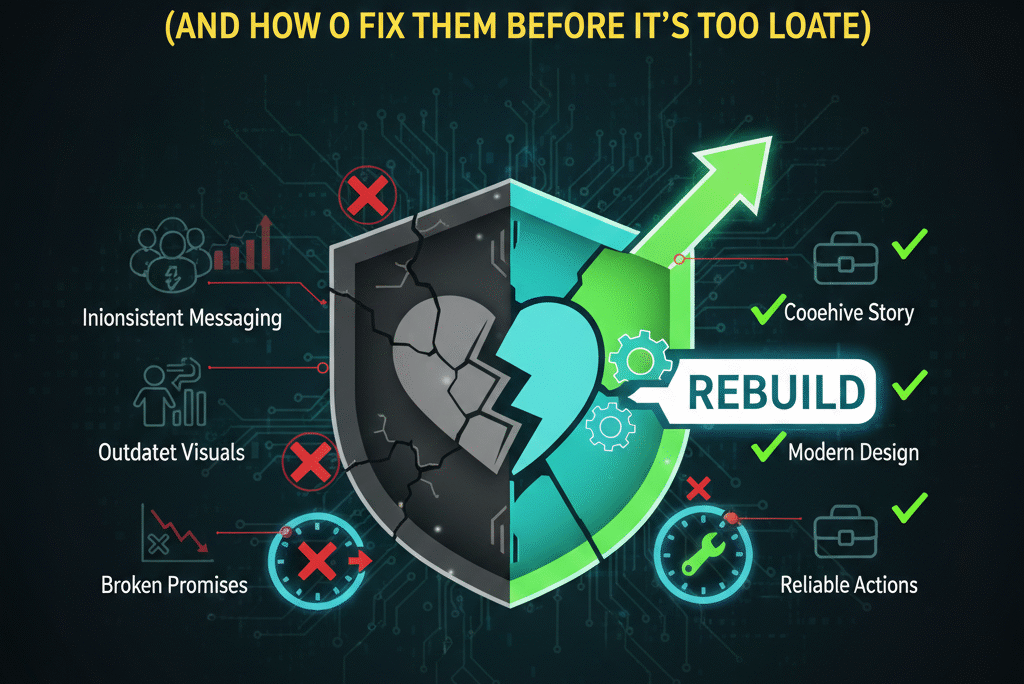
This creates cognitive friction. Customers may not consciously notice what’s wrong, but their brain does. Inconsistency signals chaos. Chaos doesn’t feel safe. And people don’t trust brands that feel disorganized.
Strong brands feel like a single, unified entity—no matter where you encounter them.
Fix it:
Create a clear brand system, not just a logo. That means defined colors, fonts, logo usage rules, imagery style, and tone of voice. Then actually follow it everywhere. Consistency isn’t boring—it’s reassuring.
Mistake #3: A Logo That Tries to Say Everything (and Ends Up Saying Nothing)
Some logos try way too hard.
Icons inside icons. Multiple meanings. Abstract shapes that need a TED Talk to explain.
A logo’s job is not to explain your business model. It’s to identify your brand quickly and confidently. Overcomplicated logos feel insecure—like the brand doesn’t know what it is yet.
If your logo needs explanation, it’s already failed at trust-building.
Fix it:
Aim for clarity over cleverness. A good logo works at tiny sizes, in black and white, and without context. Simplicity communicates confidence. Confidence builds trust.
Mistake #4: Cheap Design Signals (Even If Your Service Isn’t Cheap)
This one hurts because it’s common.
Low-quality visuals, mismatched fonts, pixelated images, awkward spacing—these things scream “cut corners.” And customers assume that if you cut corners on your brand, you probably cut corners on your work too.
Your brand identity sets expectations. If it looks cheap, people expect cheap results—even if your service is excellent.
Fix it:
Professional design is not an expense; it’s a trust multiplier. Clean layouts, intentional typography, high-quality visuals, and proper spacing go a long way. You don’t need extravagance. You need polish.
Mistake #5: No Clear Personality or Voice
Some brands sound like they were written by a legal department that fears emotion.
Vague statements. Buzzwords. Empty promises. No point of view.
People don’t trust faceless entities. They trust humans, or at least brands that feel human. A brand without personality feels evasive, like it’s hiding behind generic language to avoid accountability.
Fix it:
Decide how your brand speaks. Are you direct? Calm? Bold? Educational? Friendly but firm? Then write everything—from headlines to emails—in that voice. A consistent tone creates familiarity. Familiarity breeds trust.
Mistake #6: Overpromising and Underdelivering Visually
If your brand identity screams “premium,” but your experience doesn’t match, trust collapses instantly.
Luxury visuals paired with sloppy onboarding.
High-end language paired with unclear processes.
Bold claims with no proof.
Customers feel tricked. And once trust is broken, it’s nearly impossible to recover.
Fix it:
Align your branding with reality. Strong branding doesn’t exaggerate—it clarifies. Let your visuals reflect what you actually deliver, then slowly elevate both together as your service improves.
Mistake #7: Ignoring Cultural and Platform Context
What works on Etsy doesn’t always work on Amazon.
What works on LinkedIn doesn’t work on Instagram.
What works globally may not work locally.
Brands that ignore context feel tone-deaf. And tone-deaf brands feel untrustworthy, especially in international or diverse markets.
Fix it:
Your core brand should stay consistent, but your execution should adapt. Same identity, different expressions. Respect the platform. Respect the audience. Trust grows when people feel understood.
Mistake #8: No Social Proof Built Into the Brand
Trust loves evidence.
If your brand identity doesn’t visually integrate testimonials, reviews, certifications, case studies, or results, customers have to search for reassurance. Most won’t bother.
A brand without visible proof feels like it’s asking for blind faith—and modern customers don’t give that freely.
Fix it:
Bake credibility into your design. Highlight real results. Show real clients. Use authentic language. Let your brand quietly say, “Others trusted us—and it worked.”
Mistake #9: DIY Branding That Outgrew the Business
What worked when you started may not work now.
A DIY logo, Canva visuals, or inconsistent branding might be fine at the beginning. But as your prices rise and your audience becomes more sophisticated, outdated branding creates friction.
Customers compare you to competitors at your current level, not your past.
Fix it:
Audit your brand honestly. Does it match where your business is today—and where you want it to go? Rebranding isn’t failure. It’s evolution. Strong brands grow up on purpose.
Mistake #10: Treating Brand Identity as Decoration, Not Strategy
This is the big one.
Brand identity isn’t about “making things look nice.” It’s about signaling trust, clarity, competence, and consistency—before a word is spoken.
When branding is treated as an afterthought, it shows. When it’s treated as strategy, it works quietly in the background, turning visitors into customers without force.
Fix it:
Start with strategy. Who are you serving? What problem do you solve? Why should someone trust you? Then design everything to reinforce those answers visually and verbally.
Final Thoughts: Customer Trust Is Designed, Not Accidentally Earned
Customers don’t read your mind. They read your brand.
Every color choice, font decision, layout, and sentence either builds trust or chips away at it. And the scary part? Most damage happens silently. No feedback. No warning. Just lost opportunities.
A strong brand identity doesn’t shout. It reassures.
It doesn’t convince. It confirms.
It doesn’t beg for trust. It earns it visually, consistently, and honestly.
When brand identity is done right, customers don’t question you. They lean in.
And in a crowded digital world, that quiet confidence is everything.
If your brand feels inconsistent, forgettable, or not quite trusted yet, it’s usually not a “small design issue”—it’s a brand identity problem. At Ecommate.com, we help businesses build brand identities that actually inspire confidence, from logos and visuals to complete brand systems that scale with your growth. If you want your brand to look as professional as the service you provide, explore our Brand Identity & Design Services and see how we help brands earn trust before a word is spoken.
Brand trust isn’t just a nice-to-have — it’s a strategic differentiator. According to research by Qualtrics, brand trust reflects a customer’s confidence that a business will deliver on its promises, and it plays a major role in loyalty, repeat purchases, and long-term relationships with customers. When brands consistently align their actions with what they communicate, trust grows, which can meaningfully impact customer decisions and competitive advantage in crowded markets.