Scroll through Amazon long enough and you’ll notice something strange.
Hundreds of listings.
Same factories.
Same features.
Same price range.
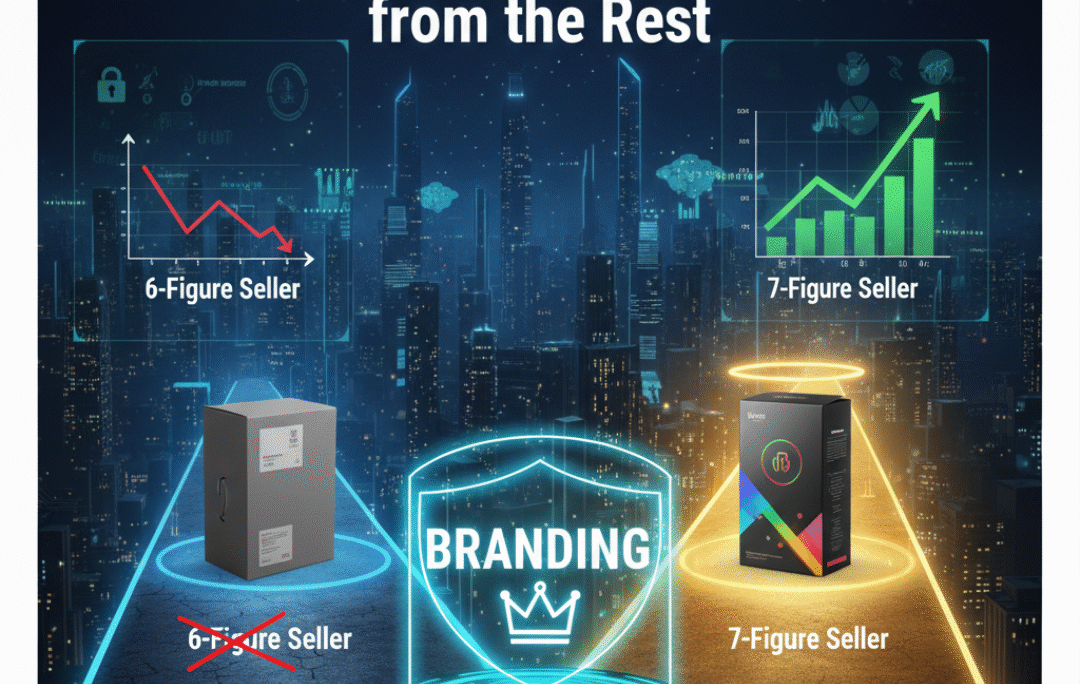
Yet somehow… one seller is doing six figures (sometimes seven), while the rest are fighting over coupons and praying for reviews.
That gap isn’t luck.
It isn’t “Amazon favoring them.”
It isn’t even just PPC skill.
It’s branding.
And no, branding is not just a logo slapped on a box.
Branding is the difference between selling a product and building a business. Most sellers never cross that line.
Let’s talk about why.
The uncomfortable truth about Amazon sellers
Here’s a reality most gurus won’t say out loud:
Most Amazon sellers are not brands.
They are resellers with slightly customized inventory.
They compete on:
- Price
- Discounts
- Aggressive PPC
- Short-term hacks
That works… until it doesn’t.
The moment competition increases, ad costs rise, or a copycat shows up, margins collapse. Suddenly you’re refreshing Helium 10 like it owes you money.
Six-figure sellers play a different game.
They don’t win because their product is wildly unique.
They win because customers remember them.
What branding actually means on Amazon (not the fluffy version)
Let’s kill a myth quickly.
Branding on Amazon is not:
- A fancy logo alone
- A premium price tag
- A random brand name from a generator
Real branding on Amazon is about perception.
Perception answers questions the buyer never consciously asks:
- Can I trust this?
- Does this feel legit?
- Will this solve my problem without regret?
- Will I feel dumb if I buy this?
Every 6-figure seller understands this intuitively, even if they can’t articulate it.
Their listing doesn’t feel like a gamble.
It feels like the safe choice.
Why generic sellers always hit a ceiling
Generic sellers usually follow this path:
They find a product.
They source it cheaply.
They optimize keywords.
They run ads.
Early sales come in. Dopamine hits. Life feels good.
Then reality arrives.
Competitors flood in.
PPC costs double.
Reviews stagnate.
Margins shrink.
Why?
Because nothing distinguishes them.
When the product is the only thing you’re selling, Amazon reduces you to a number in a grid. Price becomes the weapon, and price wars have no winners.
Branding is how you escape that trap.
Branding turns products into choices, not commodities
Here’s the shift six-figure sellers make:
They stop asking:
“How do I rank higher?”
And start asking:
“Why should someone choose me?”
That changes everything.
A branded listing doesn’t scream features.
It tells a story.
Not a fairy tale. A practical one.
It communicates:
- Who this product is for
- What problem it actually solves
- Why it exists in the first place
Suddenly, you’re not just another option.
You’re the option.
Visual branding: the silent salesman
On Amazon, customers decide in seconds.
Before they read bullets.
Before they scroll.
Before logic kicks in.
Your visuals do most of the talking.
Six-figure sellers obsess over:
- Image consistency
- Color psychology
- Packaging design
- Visual hierarchy
Their main image doesn’t look like a factory photo.
It looks intentional.
Their lifestyle images feel relatable, not staged.
Their infographics explain without overwhelming.
This isn’t art.
It’s conversion psychology.
People buy what feels clear and familiar.
Packaging: the most ignored profit lever
Most sellers treat packaging as an afterthought.
Six-figure sellers treat it as marketing.
Think about it.
Packaging is the only physical touchpoint you have with the customer. It shows up in their home. It sits on their desk or shelf. It gets seen again.
Bad packaging says:
“This was cheap.”
Good packaging says:
“This company knows what it’s doing.”
That difference affects:
- Reviews
- Repeat purchases
- Brand recall
- Word of mouth
Customers don’t review products.
They review experiences.
Brand voice: why copy matters more than keywords
SEO matters. Of course it does.
But six-figure sellers know something critical:
Keywords get clicks. Copy gets conversions.
Their listings sound human.
They don’t list features like a spec sheet.
They translate features into outcomes.
Instead of:
“Made with high-quality materials”
They explain:
“Built to survive daily use without falling apart after a month.”
Instead of:
“Ergonomic design”
They show:
“Designed so your hands don’t ache after 10 minutes.”
This builds trust fast.
Trust converts faster than any keyword.
Reviews hit differently when branding is strong
Two products can have the same star rating.
One feels risky.
The other feels safe.
Why?
Branding shapes how reviews are interpreted.
When a brand feels legitimate, customers:
- Forgive minor issues
- Focus on positives
- Assume good intent
When a brand feels generic, customers:
- Nitpick
- Overemphasize flaws
- Assume poor quality
Same reviews.
Different perception.
That’s branding working quietly in the background.
Brand Registry is a tool, not the brand
A lot of sellers think Brand Registry equals branding.
It doesn’t.
Brand Registry gives you:
- A+ content
- Storefronts
- Protection
Six-figure sellers use these features strategically.
Their A+ content reinforces positioning.
Their storefront tells a cohesive story.
Their brand assets feel unified.
Low-level sellers treat these as boxes to tick.
High-level sellers treat them as narrative tools.
Branding reduces dependence on ads
Here’s a big one.
The stronger the brand, the less desperate you are with PPC.
Why?
Because:
- Conversion rates improve
- Repeat customers increase
- Branded search grows
- Organic sales stabilize
Ads stop being life support.
They become fuel.
Six-figure sellers still run ads.
They’re just not enslaved by them.
That’s a huge psychological and financial difference.
The long game: why Amazon brands become real assets
Here’s where things get interesting.
Generic Amazon stores are hard to sell.
Branded Amazon businesses are valuable.
Acquirers don’t buy listings.
They buy brands.
They look for:
- Brand recognition
- Repeat purchase behavior
- Consistent visuals and messaging
- Defensible positioning
This is how some sellers exit for 5x, 6x, even 8x multiples.
Not because the product is magic.
Because the brand is.
The real reason most sellers avoid branding
Let’s be honest.
Branding forces commitment.
You have to:
- Choose a direction
- Define a customer
- Say no to “everyone”
- Think beyond the next payout
That’s uncomfortable.
It’s easier to chase the next product than to build an identity.
But six-figure sellers accept the discomfort early so they can scale calmly later.
Branding is not optional anymore
A few years ago, you could get away without it.
That era is gone.
Amazon is crowded.
Customers are smarter.
Copycats are faster.
Branding is no longer a “nice to have.”
It’s the separator.
The sellers who treat Amazon like a short-term hustle keep cycling through products.
The sellers who treat it like a brand-building platform quietly pull ahead.
Same marketplace.
Different mindset.
And that difference compounds faster than most people realize.
If you’re serious about building an Amazon business that lasts longer than a single product cycle, branding isn’t something to “figure out later.” It’s the foundation that determines how fast you scale, how stable your profits are, and whether your store becomes an asset or just another listing. On our Services page, we break down how we help sellers move from generic products to real brands — from product research and branding to listing optimization and long-term growth strategy. It’s the same framework we use to help sellers cross from surviving on Amazon to actually thriving on it.