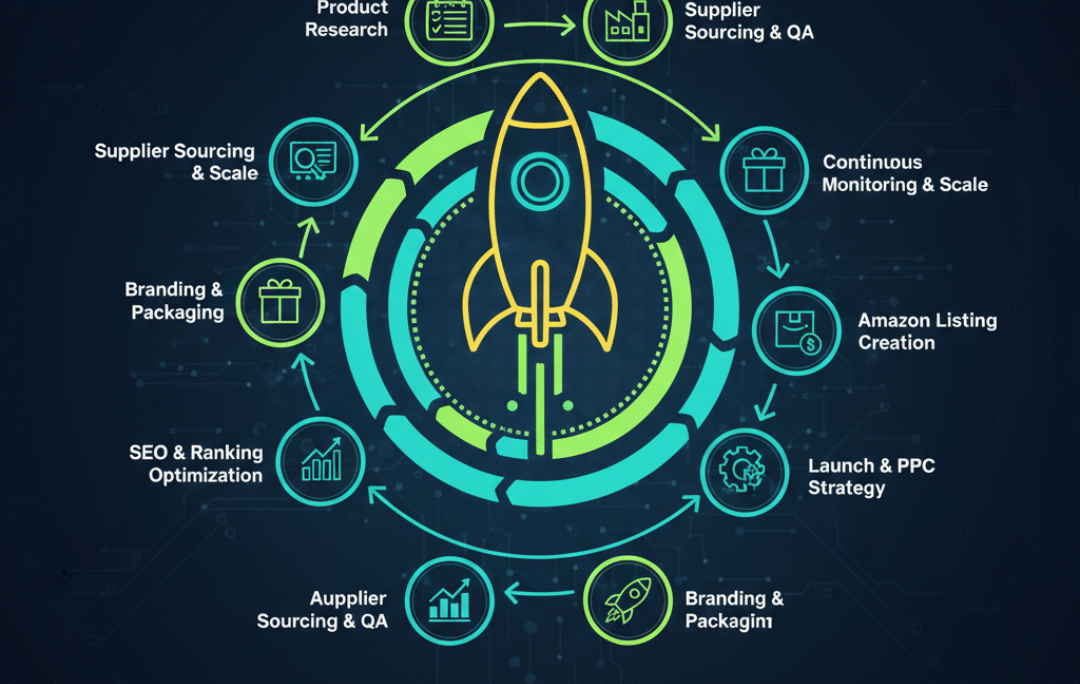
This is for sellers who are serious about private label — not the lottery-ticket version that gets sold in YouTube ads, but the actual process that produces durable, profitable businesses. No shortcuts are described here because the shortcuts are what kill most private label businesses before they have a chance to work.
Why Most Private Label Advice Gets People Into Trouble: A Step by Step Breakdown
Amazon private label gets marketed in a specific way that sets up the people who follow the advice for predictable failure.
The marketing version goes something like this: find a product with good search volume and manageable competition, source it from Alibaba, put your logo on it, launch it with some PPC, and watch the passive income arrive. The implication is that the process is straightforward, the results are reliable, and the main barrier is just getting started.
The reality is different in almost every specific. Products that look good in a research tool frequently look terrible once the full economics are modeled. Sourcing from the cheapest available supplier produces quality control problems that show up in reviews and returns six months after launch. Logos and generic branding provide no competitive protection whatsoever against the next seller who finds the same niche. And PPC without conversion-optimized listings is just an expensive way to generate traffic that doesn’t buy.
What actually works in Amazon private label is slower, more methodical, and more demanding than the marketed version — and it’s also significantly more durable when it’s done correctly. The process described here is the one that produces businesses with real margins, real brand equity, and real defensibility. It’s intentionally unglamorous. That’s a feature, not a bug.
Step 1: Start With the Market, Not the Product
The most common mistake private label sellers make happens before they’ve spent a single dollar: they fall in love with a product idea and then try to build a business case around it afterward.
This is backwards. Emotional attachment to a product idea is one of the most expensive biases in Amazon selling because it leads sellers to rationalize away warning signs that should be disqualifying. The product becomes the anchor and the research becomes the justification rather than the guide.
The correct starting point is the market — the category, the buyer behavior, the competitive dynamics, and the economic reality — evaluated before any specific product is committed to.
What does that evaluation actually involve? It means looking at sales velocity across the category over twelve months, not just a recent month’s numbers that might reflect a seasonal spike. It means understanding whether demand is stable and recurring or whether it’s driven by a trend that has a short half-life. It means examining the price distribution across top sellers to understand whether the market supports premium positioning or whether it’s compressed into a commodity price range where margins are thin and shrinking.
It means asking whether buyers in this category are primarily price-sensitive or quality-sensitive — because those two buyer profiles require completely different strategies and produce completely different economics. And it means honestly assessing whether the top listings are genuinely entrenched — supported by massive review counts, strong brand recognition, and defensive moats — or whether they’re generic sellers who happened to get there first and are vulnerable to a better-executed competitor.
If the market analysis doesn’t produce a clear and compelling answer to the question of why this category represents a real opportunity, the product idea gets set aside. There is no emotional negotiation at this stage. Amazon punishes optimism that isn’t grounded in evidence, and the time to discover a market doesn’t work is before inventory has been ordered, not after.
For a thorough breakdown of the data points worth examining during market evaluation, Jungle Scout’s product research guide covers the foundational metrics well — what this process adds is the judgment layer that determines what to do with those metrics once you have them.
Step 2: Product Validation Before Any Capital Commitment
A product can sell consistently on Amazon and still be a terrible private label opportunity. These are not the same thing, and conflating them is where a lot of sellers make expensive mistakes.
The validation process at this stage is about identifying specific disqualifying factors that make a product unsuitable for private label regardless of its sales volume.
Fragile products are a structural problem in the Amazon fulfillment ecosystem. They generate returns at above-average rates, those returns generate negative reviews, and those reviews generate ranking decline. The cost of fragility shows up not in a single line item but scattered across multiple cost centers simultaneously.
Products with high complexity — multiple components, technical assembly requirements, precision-dependent functionality — invite customer complaints and support contacts at volumes that erode margins. Amazon’s seller metrics track these contacts, and deteriorating metrics affect ranking indirectly over time.
Oversized products carry FBA fee structures that frequently surprise sellers who modeled their economics on standard-size assumptions. The margin calculations that looked reasonable at standard size often collapse when the actual dimensional weight and storage fees are applied.
Restricted categories carry account risk that can’t be fully modeled in advance. An approval that exists today can be revoked. A category that’s open to new sellers this quarter may require additional documentation next quarter. Selling in restricted categories is manageable, but the risk profile needs to be explicitly included in the decision rather than overlooked.
Beyond disqualifying factors, validation needs to assess differentiation potential — whether the product can be meaningfully improved, repositioned, or presented in ways that create a genuine reason for buyers to choose it over existing alternatives. Private label isn’t about duplicating what already exists. It’s about finding specific dimensions where the existing offerings are falling short and building something that closes those gaps. If no credible differentiation path exists, the product isn’t a private label opportunity — it’s a reselling opportunity with worse economics.
Step 3: Competitive Intelligence Done Properly
Competitive analysis in private label is not about counting competitors or assessing average review scores. Those metrics exist in every research tool and produce the same surface-level analysis that every other seller in the category is doing.
Genuine competitive intelligence goes deeper and extracts information that standard metrics don’t surface.
The most valuable information in any competitive analysis comes from reviews — specifically the two, three, and four-star reviews that represent buyers who had a real experience with the product and have specific, nuanced things to say about it. Five-star reviews tell you what the product does well. One-star reviews tell you about catastrophic failures. The middle reviews tell you about the gap between expectation and reality — what buyers wanted but didn’t quite get, what feature they wish worked differently, what aspect of the product creates friction in their actual use experience.
These are product development notes, written by the target buyer, available for free, completely ignored by most sellers who are looking at sales volume and BSR instead.
Listing image analysis reveals what existing sellers consider their strongest selling points — which features they lead with, which use cases they emphasize, which objections they preemptively address through infographics. It also reveals what they’re not showing — which aspects of the product they’re visually de-emphasizing, what the product looks like in use versus in isolation, where the photography is weak or generic.
Branding assessment across the top listings tells you how seriously existing sellers have invested in brand development and how much white space exists for a well-branded entrant to differentiate on presentation alone. Categories where most top sellers have generic, clearly supplier-provided visual identities are categories where a brand-first approach can create meaningful perception differentiation even with a comparable product.
A+ content and storefront analysis shows how sellers are communicating their value proposition beyond the listing itself — whether they’re building brand stories, addressing buyer concerns systematically, or simply populating required fields with minimal effort.
The synthesis of this analysis produces something no research tool generates: a specific brief for what a better version of this product would look like, how it would be positioned differently, and what aspects of the existing competitive landscape are genuinely vulnerable to a well-executed challenger.
Step 4: Supplier Sourcing and Quality Control
The supplier relationship is one of the most consequential decisions in private label, and it’s consistently undervalued by sellers who are focused on finding the lowest unit cost.
Supplier selection should never optimize primarily for price. It should optimize for quality consistency, communication reliability, and the supplier’s demonstrated ability and willingness to support the specific customization requirements that the private label product demands.
Alibaba’s own supplier verification framework outlines the baseline checks worth running on any prospective supplier — what the process described here builds on top of that is the product-specific quality control that platform verification alone doesn’t cover.
Quality consistency is the variable that determines whether the product that arrives in Amazon’s fulfillment centers matches the product that was approved during sampling. Inconsistency between samples and production runs is common, and the consequences arrive months after the inventory commitment — in the form of reviews that mention quality decline, return rates that increase, and ranking that erodes as negative behavioral signals accumulate.
Communication reliability matters more than most sellers realize until they’ve experienced the alternative. A supplier that responds slowly, provides vague answers to specific questions, or communicates primarily through language that obscures rather than clarifies creates compounding problems throughout the relationship. Product development takes longer. Quality issues take longer to resolve. Customization requests get implemented incorrectly or incompletely.
The sampling process deserves more rigor than it typically receives. Ordering samples and confirming they look acceptable is not adequate quality control. Samples need to be tested for functional performance over time, not just inspected visually. Packaging needs to be tested for durability through the specific handling conditions of Amazon’s fulfillment process. Claims made about the product need to be verified against the sample’s actual performance.
Consistency across multiple samples matters as much as the quality of any single sample. If three units of the same product have noticeable variation between them, the production run will have more. That variation shows up in customer experience and in reviews.
The time investment in getting supplier selection right before committing to a production order is one of the highest-leverage activities in private label. Problems identified at the sample stage cost almost nothing to address. Problems discovered after inventory arrives in Amazon’s fulfillment centers cost significantly more in every possible dimension.
Step 5: Brand Strategy Before Any Design Work Begins
Brand strategy is the step that most private label sellers skip entirely or compress into a logo decision. This is one of the most expensive omissions in the process, because every design decision, packaging decision, and copy decision downstream from this point should be guided by the brand strategy — and without it, those decisions get made arbitrarily.
Brand strategy at this stage means answering four specific questions before any design brief is written.
Who is this product specifically for? Not a demographic description but a behavioral and psychological profile — what situation is the buyer in when they’re making this purchase, what have they probably tried before, what made those alternatives unsatisfying, what does getting this right mean for their actual life? The more specifically this is defined, the more precisely every subsequent decision can be aimed at the right target.
What emotional job does this product do beyond its functional job? Every product that gets purchased regularly does an emotional job alongside its functional one. Understanding the emotional job — the feeling the buyer is seeking, the identity statement the purchase makes, the anxiety it relieves — is what determines the brand’s emotional register and the tone of every piece of copy and visual communication.
What should the brand feel like in a single word? Not a list of attributes. A single anchor word that can function as a filter for every design decision. When two options are on the table, the question is always which one is more consistent with the anchor word. This constraint produces more coherent brand identities than mood boards and adjective lists, because it forces a level of specificity that generates real decisions rather than vague preferences.
Where does this product fit in a future product line? Single-product Amazon businesses are among the most fragile structures in ecommerce. A product that’s launched as the first of something — the opening entry in a coherent product family, building toward a brand that means something specific in its category — has a fundamentally different trajectory than a product launched as a standalone bet. This question should be answered before the first product launches, not after the second one is being planned.
Step 6: Visual Identity and Packaging Design
Design enters the process here, but constrained by the brand strategy document rather than by aesthetic preference or trend observation.
Amazon is a visual decision environment. Buyers make initial judgments in seconds, based primarily on visual signals, before they’ve read a word of copy. The main image in search results determines whether the listing gets a click. The packaging determines whether the unboxing experience confirms or undermines the purchase decision. Every visual element contributes to the cumulative impression that determines whether the brand feels like a legitimate, trustworthy company or like a generic product with a logo.
Packaging design for Amazon private label has specific constraints that packaging design in other contexts doesn’t face. The product arrives in an Amazon-branded box and competes for attention in an unboxing moment when the buyer’s expectations are already established. Packaging that creates a genuinely positive surprise — through thoughtful design, appropriate material quality, and visual coherence — consistently generates reviews that mention the brand’s quality and attention to detail. Packaging that looks like it was selected from a supplier’s standard options generates no particular impression at all.
Logo design for Amazon-first brands needs to prioritize functionality at small sizes. A logo that looks impressive on a packaging mock-up but becomes unrecognizable at the dimensions of an Amazon thumbnail is not serving its primary purpose. Simplicity that communicates personality clearly at small scales is more valuable than visual complexity that only reads at full size.
Color selection should be informed by the category’s existing visual language — not to replicate what existing sellers are doing, but to understand the norms well enough to make deliberate decisions about where to align and where to differentiate. In highly competitive categories, differentiation through color can create meaningful recognition even before any brand equity has accumulated through customer experience.
Inserts and packaging elements beyond the outer box provide the opportunity to extend the brand experience into the customer’s physical environment. A thoughtfully designed insert — human in tone, consistent with the brand’s visual identity, genuinely useful rather than purely promotional — creates a brand moment that standard-issue packaging simply doesn’t. This moment is what buyers remember and sometimes share, and what separates a product transaction from a brand experience.
Step 7: Listing Optimization That Serves Both the Algorithm and the Human
Amazon listing optimization is the step that gets the most attention in private label education and the most mechanical execution in practice. The result is listings that are technically optimized — indexed for the right keywords, structured according to best practices — and convert at average rates because they’re written for search engines rather than for the buyers who actually make the purchase decision.
The frame that produces listings that perform strongly is: keywords create the opportunity to be found; everything else determines whether the buyer who finds the listing buys.
Title construction should balance keyword presence with immediate clarity. The title is the first text element a buyer reads after clicking through from search results, and if it doesn’t immediately communicate what the product is and why it might be right for them, the buyer’s attention starts to drift before they’ve seen the images or read a bullet. Mobile truncation is a real constraint — the majority of Amazon searches happen on mobile devices, and a title that makes sense on desktop but loses its most important information to truncation on mobile is underperforming for the majority of its audience.
Bullet points are the element of listing optimization where the gap between good and mediocre execution is most visible and most consequential. Generic bullets — the kind that describe product attributes without explaining what those attributes mean for the buyer’s actual experience — are ubiquitous across Amazon and contribute almost nothing to conversion rate. Specific bullets that translate features into outcomes, address the specific objections that the competitive analysis identified, and communicate the differentiation that makes this product worth choosing over cheaper alternatives consistently outperform generic ones.
A+ content should be built around a persuasion framework rather than a branding showcase. By the time a buyer reaches A+ content, they’ve already expressed significant interest — they’ve clicked through, read the title and bullets, and kept scrolling. The job at this stage is to resolve the remaining uncertainty that’s preventing purchase. What objection hasn’t been addressed yet? What use case needs to be shown more specifically? What quality signal would give a hesitant buyer the confidence to commit? A+ content that answers these questions converts browser sessions into sales at measurably higher rates than A+ content that presents brand imagery and product lifestyle photography without a conversion strategy.
Step 8: Launch Strategy Built Around Clean Data
The launch period is when Amazon forms its initial impression of a new listing’s relationship with buyers, and that impression — formed through the behavioral signals generated by early traffic and sales — influences organic ranking for months afterward.
A launch strategy built around feeding the algorithm clean, genuine conversion data produces a different trajectory than a launch built around manipulating early metrics. The manipulated launch might show better numbers in the first few weeks. The clean launch builds the kind of algorithmic trust that compounds into stable organic rankings over the following months.
Initial pricing strategy during launch deserves careful thought. The instinct to launch at a steep discount to drive volume is understandable but creates problems. Discounted traffic often attracts buyers who are primarily price-motivated rather than product-motivated, and those buyers convert poorly at full price and sometimes don’t convert at all — which generates poor conversion signals during the critical early period. Pricing that’s competitive but not artificially suppressed tends to attract buyers whose intent more accurately reflects the long-term buyer profile, generating conversion data that’s more relevant to the listing’s actual competitive position.
PPC structure from launch day needs to be aligned with keyword research from the optimization phase. Advertising on keywords that aren’t reflected in the listing’s organic targeting generates sales data that doesn’t build the keyword-to-sale alignment that organic ranking rewards. Coordinated PPC and SEO — targeting the same keywords through both channels — generates the kind of conversion signal on specific search terms that strengthens organic ranking for those terms over time.
Inventory management during launch requires balancing the need for consistent availability — stockouts during the launch period generate negative velocity signals that can take months to recover from — against the risk of over-ordering before the product’s actual sell-through rate is established.
Step 9: Post-Launch Optimization — Where Most Sellers Stop Paying Attention
The launch is not the finish line. It’s the starting point for an ongoing optimization process that determines whether the listing’s early performance becomes a stable long-term asset or a temporary spike followed by ranking decline.
Post-launch data tells a story that pre-launch research can only approximate. Click-through rate data from search results reveals whether the main image is winning the visual comparison against competing thumbnails. Conversion rate data reveals whether buyers who click through are finding what they expected or encountering something that doesn’t match the impression created by the search result. The gap between click-through and conversion rate is one of the most useful diagnostic signals available — it tells you specifically where in the buyer journey the listing is losing people.
PPC performance by keyword reveals which search terms are generating purchases and which are generating clicks without conversion — a distinction that keyword research tools can estimate but only real buyer behavior can confirm. Keywords that consistently generate clicks without conversion are candidates for bid reduction or elimination, because they’re generating traffic that costs money and sends poor conversion signals to the algorithm.
Return reasons are among the most brutally honest feedback available to a private label seller. Buyers who return a product and provide a reason are describing the specific gap between expectation and reality that the listing created. Patterns in return reasons point directly to listing problems — images that don’t accurately represent the product, copy that overpromises performance, size or dimension information that’s unclear — that can be fixed to reduce future returns and improve the review quality that results from accurate buyer expectations.
Review content analysis in the post-launch period identifies emerging themes that weren’t visible in the pre-launch competitive analysis. Buyers of the specific product, in its actual form, surfacing concerns or praise that the competitive research couldn’t fully predict. This information feeds back into listing refinement, into potential product improvement for future orders, and into the brand’s understanding of what its specific buyers actually value.
Step 10: Scaling With Brand Logic, Not Just Budget
Scaling a private label business is where the difference between a brand and a product becomes most consequential. Products scale through increased ad spend and inventory investment. Brands scale through accumulated equity — recognition, trust, and loyalty that reduce the marginal cost of each incremental sale.
Keyword coverage expansion during the scaling phase should follow the same logic as the initial keyword strategy — prioritizing terms where the listing can generate strong conversion performance rather than maximizing indexing breadth. Ranking for more keywords only creates value when those keywords generate purchase-intent traffic that converts.
Supplier renegotiation becomes relevant at scale in ways it wasn’t at initial order quantities. Volume creates leverage, and leverage should be used to improve margins, quality, or both rather than simply to reduce unit cost. A reduction in unit cost that comes with a corresponding reduction in quality is not a margin improvement — it’s a delayed cost that arrives in the form of review decline and return rate increase.
Complementary product planning should be built around the brand strategy established before the first product launched. New products that make sense within the existing brand’s positioning — that feel like natural extensions of what the brand is already known for — benefit from the equity the first product has accumulated. New products that represent departures from the established positioning require starting the trust-building process from scratch.
The long-term endgame that most private label sellers don’t plan for until too late: a well-built Amazon private label brand is a sellable asset. Acquirers in the Amazon brand aggregator space evaluate businesses based on revenue consistency, brand defensibility, review profile, and scalability. Brands that have been built methodically — with strong review history, coherent visual identity, established supplier relationships, and documented processes — command meaningfully better multiples than listings that happen to generate revenue without the surrounding brand infrastructure.
Building with the exit in mind doesn’t require planning to sell. It requires building the kind of business that could be sold — which is also, not coincidentally, the kind of business that’s most resilient, most profitable, and most satisfying to operate day to day.
Frequently Asked Questions About Amazon Private Label
How long does the full process take from market research to launch?
Done properly, three to five months is a realistic timeline for the first product. Market research and validation take two to four weeks. Supplier identification, sampling, and quality confirmation take four to eight weeks, sometimes longer if multiple sample iterations are needed. Brand strategy and design take two to four weeks. Listing creation and pre-launch preparation take one to two weeks. Sellers who compress this timeline significantly are almost always skipping steps that will cost them later.
How much capital is required to launch a private label product?
It varies enormously by category, product complexity, and order quantity. A realistic minimum for a first product — covering inventory, photography, design, launch PPC, and operational costs — is typically in the range of $5,000 to $15,000. Products with higher unit costs, larger minimum order quantities, or more complex branding requirements can require significantly more. Sellers who launch with less than this often find themselves unable to maintain the PPC spend necessary to generate early sales velocity or to reorder before a stockout disrupts momentum.
What’s the biggest mistake sellers make in private label?
Rushing the validation and sourcing steps to get to launch faster. The steps that feel slow — thorough market analysis, rigorous supplier evaluation, multiple sample iterations — are the ones that prevent the expensive mistakes that show up six months into selling. A product launched on solid foundations recovers from early setbacks. A product launched on shaky foundations typically doesn’t.
Is Amazon private label still viable in 2026?
Yes, but the execution bar is higher than it was in 2019 or 2020. The sellers who are entering categories today and winning are doing more thorough research, investing more in brand development, and operating more systematically than most of the sellers who succeeded in the earlier period. The opportunity is real. The margin for casual execution is significantly smaller.
How do you know when a product is ready to scale?
When conversion rate is stable and above category average, when PPC is generating profitable returns at current spend levels, when review velocity is consistent and the review quality reflects accurate buyer expectations, and when the organic ranking on primary keywords is stable rather than fluctuating. All four of these conditions together indicate that the listing has generated enough algorithmic trust to support increased investment without the instability that comes from scaling prematurely.
Final Thought: The Process Is the Competitive Advantage
There’s nothing in this process that’s secret or proprietary. Every step described here is knowable by any seller who invests the time in learning how Amazon private label actually works.
The competitive advantage isn’t the knowledge. It’s the discipline to execute every step fully, without skipping the slow parts because they feel like delays rather than investments, and without allowing optimism about a product idea to override what the market research is actually showing.
Amazon private label isn’t dead. Rushed, poorly-researched, generically-branded private label is dead — or at least dying, squeezed by competition from sellers who are doing the work properly.
The opportunity that remains is significant, and it belongs to sellers who are willing to treat it as the brand-building exercise it actually is rather than the product-launching lottery it gets marketed as.
If you want to understand what this process looks like applied to your specific situation — your category, your budget, your timeline, and your long-term objectives — you can explore how we approach Amazon private label at ecommate.co.uk.
This article reflects direct experience managing Amazon private label projects across multiple categories. Process timelines and capital requirements described represent typical ranges as of 2026 and vary based on specific product and market conditions.