Quick Answer: Amazon private label means selling a product manufactured by a third party under your own brand name — where you control the branding, positioning, listing, pricing, and customer experience end to end. It is not a product model. It is a business model. The mistake most sellers make is treating private label as a product-sourcing shortcut when it is actually a brand-building discipline. Sellers who understand that distinction build scalable, defensible businesses. Sellers who don’t build expensive, fragile knockoffs that collapse the moment a cheaper competitor arrives.
The Two-Word Phrase That Launched a Thousand Failing Businesses
Private label might be the most misunderstood term in Amazon ecommerce. It gets thrown around in YouTube thumbnails, course landing pages, and seller forums as though it describes a single simple thing — a method, a model, a move you can learn and execute in a weekend.
It doesn’t describe any of those things. And the gap between what sellers think private label means and what it actually requires is where most of the disappointment in this space lives.
This isn’t a post designed to discourage anyone. The opposite, actually. Amazon private label, done correctly, is one of the most viable and scalable ecommerce models available to individual sellers right now. US private label retail sales reached $271 billion in 2024 — growing at 3.9% in a year where discretionary spending was under pressure across most categories. The model works. The model is not dying.
But it requires understanding what it actually is before attempting to execute it. And most sellers never get that clarity before spending their first thousand pounds on a supplier quote.
What Private Label Actually Means — No Jargon, No Hype
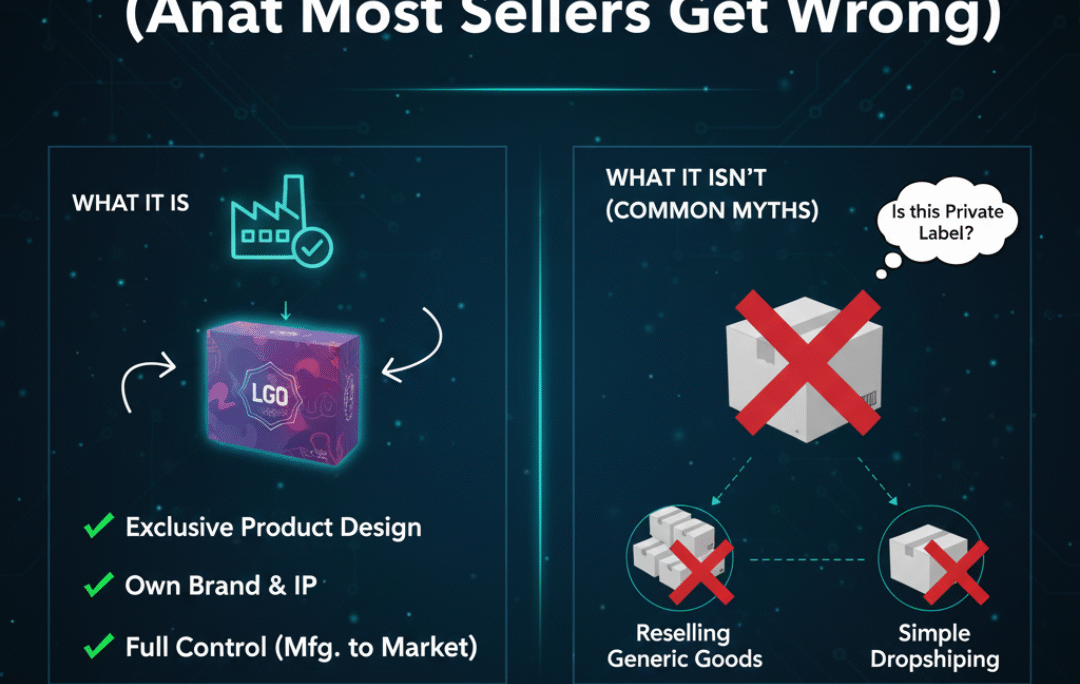
Stripped of everything, Amazon private label means this: you sell a product manufactured by someone else, under your own brand name, and you take responsibility for the entire lifecycle of that product. The brand on the packaging is yours. The listing is yours. The customer experience is yours. The reputation, positive or negative, is yours.
What you control:
The branding and visual identity. The positioning — who this product is for, why it exists, what it’s not. The listing copy and imagery. The pricing strategy. The customer service experience. The long-term catalog direction.
What you don’t control, and never fully will: the manufacturing process, the platform you sell on, or the behaviours of your competitors.
That last point is worth sitting with. Private label sellers don’t own their suppliers and they don’t own Amazon. What they do own — the only real asset in this model — is the brand they build on top of those relationships. The sellers who internalise that early make better decisions at every stage. The sellers who treat the product as the asset and the brand as decoration consistently find themselves in price wars they can’t win.
Private Label Is Not What Most People Think It Is
Before getting into what private label requires, it’s worth being specific about what it isn’t — because the misconceptions are doing real damage to real sellers.
It isn’t dropshipping with a logo. Dropshipping means you never touch inventory. Private label means you own inventory, typically in bulk, and fulfil it through Amazon’s FBA network or your own logistics. The capital exposure is fundamentally different, and so is the margin structure and the time horizon.
It isn’t wholesale with a custom box. Wholesale means you buy a branded product from a manufacturer and resell it. Private label means the brand on the product is yours — you’re not reselling someone else’s brand, you’re building your own.
It isn’t a passive income machine. This one deserves its own section, and we’ll get to it. But the “set it and forget it” framing that surrounds private label in most free content is one of the most expensive misconceptions in ecommerce.
It isn’t a product hunt. The mental model most new sellers carry is: find the right product, find the right supplier, upload the listing, wait for money. Private label is not a product hunt. It’s a brand-building exercise that happens to start with choosing a product.
The Core Mistake: Treating Product and Brand as the Same Thing
If there’s one error that explains most private label failures, it’s this: sellers conflate the product with the brand.
They spend weeks on supplier negotiations, product tweaks, and feature comparisons. They spend hours deciding between a weight of 200g and 250g, or whether to add a carrying pouch. And then they spend two days on the brand — a logo from Fiverr, a colour scheme pulled from a competitor’s listing, a brand name that means nothing to anyone.
The result is a product that might be functionally adequate and a brand that creates no confidence, no recognition, and no reason to choose this listing over the seventeen others sitting in the same search results.
Here’s what the research on consumer behaviour consistently shows: buyers on Amazon aren’t primarily evaluating products. They’re evaluating confidence. Does this brand look legitimate? Does this product look like it will arrive intact and perform as described? Does this feel like a purchase I’ll regret?
A strong brand answers all of those questions before the buyer reads a single bullet point. Weak branding — the logo-on-a-generic-package approach — leaves every question open and pushes the buyer back to the search results to find a listing that creates more certainty.
Two sellers can source the same product from the same factory, list it at the same price, and produce conversion rates that differ by 8 to 12 percentage points. The difference is almost never the product. It’s the brand signal the listing creates.
What Most Sellers Get Wrong: A Closer Look
Mistake one: chasing metrics instead of buyers.
New sellers learn to hunt for products using keyword volume, competition scores, and review counts. Those metrics are useful starting inputs, but they tell you nothing about why people buy the product, what frustrates them, what they wish existed, or what unmet expectation sits in the one-star reviews waiting to be answered.
Private label works when a seller understands a buyer well enough to speak to them specifically. “High quality, fast shipping” is not a brand positioning. “The only insulated bottle that fits in a standard car cupholder” is a brand positioning. One speaks to everyone and therefore no one. The other speaks to a specific frustration that a specific buyer has felt in a specific moment — and it converts because it’s precise.
Getting that kind of specificity requires studying real buyer behaviour, not just software dashboards. Actual customer search terms — the exact language buyers use when they’re looking for a solution — are one of the most reliable sources of insight available to a private label seller. The Search Term Harvester pulls real buyer queries from Amazon search data, which is far more useful for brand positioning than estimated keyword volumes alone. Understanding how buyers describe their own problems is the foundation of positioning that actually resonates.
Mistake two: thinking the logo makes the brand.
A logo is not a brand. It’s the beginning of a visual identity, and even that only if it’s consistent, intentional, and applied coherently across every buyer touchpoint.
Branding, in the real sense, is the accumulation of consistent signals across time. It’s the same colour palette in the listing hero image, the A+ content, the packaging, and the review photos customers upload after receiving the product. It’s copy that sounds like a single human voice rather than a collection of keyword-stuffed fragments. It’s a product name the buyer remembers. It’s packaging that photographs well in customer review images and reinforces the visual promise the listing made.
Most Amazon sellers have a logo and a cluster of inconsistent visual decisions they’ve made at different stages. That’s not a brand. It’s a branding attempt that hasn’t been carried through.
Mistake three: treating private label as passive.
The word “passive” gets attached to private label so frequently that it’s become almost impossible to discuss the model without it. And it’s technically not wrong that private label can generate revenue without constant active intervention — once it’s working.
The emphasis belongs on “once it’s working.” Getting to that point requires meaningful active work: product research, brand development, supplier negotiation, listing production, launch strategy, PPC management, inventory planning, review cultivation, and ongoing optimisation. None of that is passive. All of it is necessary.
Private label can become semi-passive in mature stages — when rankings are stable, ad efficiency is dialled in, and inventory runs predictably. But that outcome is the result of months of active, often unglamorous work. Sellers who enter the model expecting passivity from day one consistently underinvest in the early stages that determine whether the later stages ever arrive.
Mistake four: building for Amazon instead of building a brand.
Amazon is not your business. Amazon is the channel your business operates through. It’s the mall your brand rents space in.
Sellers who treat Amazon as the business rather than the channel build something that looks like a business from the outside but is actually a rented position. They become completely exposed to algorithm changes, policy shifts, and competitor pressure in a way that sellers who think in terms of brand assets do not.
The practical implications: your brand should have a coherent identity that would make sense on your own website, on social media, and in a retail environment — not just on an Amazon listing page. Your packaging should look like something a customer would recognise and choose again, not just a functional container for your FBA inventory. Your positioning should give a buyer a reason to search for your brand specifically rather than just landing on your listing from a generic keyword search.
That broader brand thinking is what creates long-term defensibility. It’s also what makes a private label business sellable — a brand that exists only as an Amazon listing is worth significantly less than a brand that has demonstrated recognition and customer loyalty beyond the platform.
Private Label vs White Label: Not the Same Thing
This distinction causes genuine confusion and it matters more than most sellers realise.
White label means selling a generic, off-the-shelf product as-is, with little or no customisation, often competing primarily on price. The product is identical to what dozens of other sellers are listing. The only differentiator is price, and price competition is a race to the margin floor.
Private label means taking a product — even a similar or identical physical product — and wrapping it in a brand that creates differentiation through positioning, visual identity, and customer experience. You might source the same item as ten competitors. What you’re building is a brand around it that makes it feel different, speak to a specific buyer, and create trust signals those competitors aren’t creating.
Most Amazon sellers think they’re private labelling. They’re white labelling with a logo on it. They’re competing on price and calling it brand strategy.
The economic consequences are significant. White label sellers face constant margin pressure because they have no differentiating value to defend. Private label sellers who build genuine brands can hold pricing, defend reviews, and convert at higher rates — because the brand itself carries value the product alone doesn’t.
For a clear explanation of how private label functions as a brand model — and how it differs from other product ownership structures — the Investopedia overview of private brand strategy is a solid, non-commercial reference that frames the broader business context well.
Why Private Label Businesses Fail in Year One
Private label is not saturated. That’s the wrong diagnosis for why most of these businesses don’t survive their first year.
The real reasons are more specific and more addressable.
Capital is underestimated. Most sellers calculate the cost of their first inventory run and treat that as the startup budget. They don’t account for PPC spend during launch, professional listing production, packaging design, photography, brand registration, and the likelihood of at least one iteration on the product or brand before they’re converting at target rates. Undercapitalised launches run out of runway before they produce data worth acting on.
Expectations misalign with timelines. A realistic private label timeline looks something like this: months one and two for research, branding, and supplier development; month three for manufacturing and listing preparation; month four for launch and early PPC; months five and six for data-driven optimisation; months seven through nine for stabilisation; and month nine or beyond for scaling. Sellers who expect profitability in thirty days consistently make premature decisions — pulling products, abandoning launches, or pivoting before they have enough data to know whether the model is working.
Branding gets treated as a launch checklist item rather than an ongoing discipline. A brand isn’t finished when the listing goes live. It evolves as you understand your buyers better, as you collect review data, as you see which search terms are actually converting, and as you expand the product catalog. Sellers who treat branding as a one-time task rather than a continuous refinement process build listings that drift out of coherence over time.
Sellers copy competitors instead of studying customers. Imitation feels safe because it reduces the uncertainty of product selection. But copying a competitor’s positioning means fighting for the same buyer with the same argument — and whoever arrived first and has more reviews wins that fight. The better play is understanding what the existing listings aren’t saying and building positioning around the gap.
Branding Is the Multiplier, Not the Decoration
The clearest way to understand the economic role of branding in private label is to compare two identical products with different brand presentations and watch what happens to their numbers.
Higher conversion rate. A listing that creates immediate trust and speaks precisely to the right buyer converts at a higher rate from the same traffic. That higher conversion rate means better organic ranking because Amazon treats conversion as evidence that a listing is the best result for a given search query. Better organic ranking means more traffic without additional ad spend. More traffic at higher conversion means more revenue. More revenue enables more inventory, better product development, and stronger brand investment.
Lower ad dependency. Sellers who rely on brand recognition rather than purely purchased traffic pay lower effective CPCs because their listings convert better when traffic arrives. Better conversion from PPC also improves organic ranking, compounding the effect.
Reduced return rate. Listings that set accurate buyer expectations through clear, honest, brand-coherent copy and imagery generate fewer returns — because the product arrives matching what the buyer anticipated. Fewer returns mean better account health metrics, which Amazon factors into listing visibility.
Review quality. Buyers who feel like they received something from a real brand tend to leave more detailed and more positive reviews than buyers who feel like they received a generic Amazon product. Those reviews compound over time into social proof that does conversion work independently of anything the seller actively manages.
Branding isn’t decoration added after the commercial decisions are made. It is a commercial decision, and ignoring it is one of the most expensive ways to underinvest in a private label business.
The Question Every Private Label Seller Should Be Asking
Most sellers ask: “What product should I sell?”
The more useful question is: “Who am I building this brand for, and what do they believe about the category that isn’t being said clearly by anyone currently selling in it?”
That reframe changes every downstream decision. Product selection, supplier requirements, packaging brief, listing copy, main image, A+ content, pricing strategy — all of it flows from a clear answer to who the brand exists for and why.
Sellers who start with that question build more coherent brands, produce better listings, and make better decisions when the market changes around them. Because they’re not chasing a product — they’re building something specific for someone specific.
Amazon private label still works. It works particularly well for sellers who approach it as a brand-building discipline rather than a product-sourcing shortcut. The model rewards clarity, consistency, and patience in ways that most shorter-term ecommerce plays don’t.
Building It Right from the Start
If there’s a single practical takeaway from everything above, it’s this: start the brand conversation before you finalise the product.
Most sellers sequence it the wrong way. They find a product, order samples, negotiate pricing, and then — once everything is committed — think about the logo and the packaging. By that point the brand is retrofitted onto a product decision that was made without it, and the two rarely fit together as well as they should.
The sellers who build the strongest private label brands design the brand alongside the product, not after it. They decide who the brand is for before they decide what features the product has. They brief the packaging designer with a target customer profile, not just a colour preference. They write the listing copy before the product arrives at FBA, so the brand story is already coherent before a single sale is made.
Amazon Brand Registry is where the platform-level protection for your brand lives — and if you’re building a private label brand seriously, enrolling your trademark in Brand Registry is one of the earliest infrastructure decisions worth making. It unlocks A+ Content, Brand Analytics, Sponsored Brands ads, and a set of tools for defending your listing against unauthorised sellers and listing hijackers.
Private label works best when every element — research, branding, sourcing, listing, launch, and scaling — is treated as part of the same system rather than separate tasks handled in isolation. If you want to go deeper on how the full model works end to end, our how does private label work guide breaks it down in detail, and our post on the biggest mistakes sellers make in their first 90 days covers the most expensive errors to avoid during launch.
For sellers who want a team that manages the full process — from product research and brand development through to listing optimisation and growth — our Amazon Private Label Services page covers exactly how we approach it.