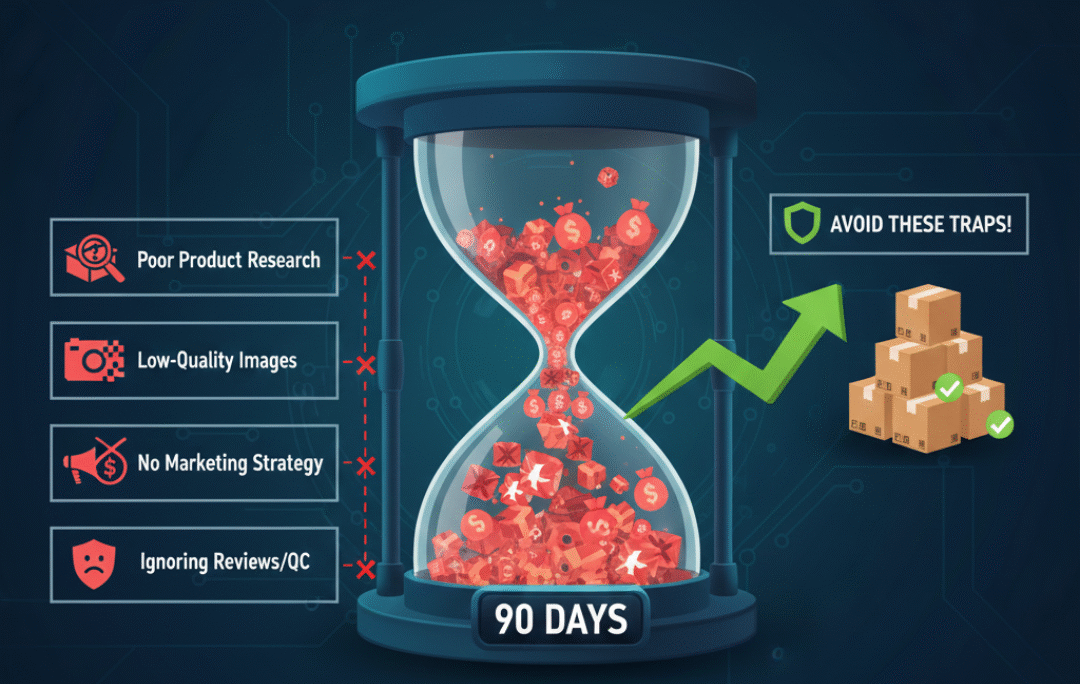
Quick Answer: The biggest private label mistakes new sellers make in their first 90 days are: chasing trending products instead of validating stable demand, confusing revenue with actual profit, ordering large inventory before testing whether the product converts, treating branding as a cosmetic decision rather than a trust system, writing listings for algorithms instead of the buyer, using ads to compensate for a weak product, ignoring early review signals, trying to manage every function alone, and expecting the first product to be a permanent success. Most of these mistakes don’t announce themselves as mistakes — they look like normal business activity until the damage is already done.
The First 90 Days of Private Label Are Not About Winning — They’re About Not Losing
The version of private label that circulates on social media is a specific, curated one. Screenshots of £40,000 launch months. Income claims with no cost visibility. Stories that start with “I found a product” and jump immediately to “now I work from anywhere.” The messy middle — the 90-day crucible where most private label businesses succeed or fail — doesn’t make good content, so it mostly goes unshown.
What actually happens in the first 90 days of a private label business is a concentrated sequence of decisions, each one carrying more weight than it appears to at the time. Product selection, inventory commitment, listing quality, advertising structure, branding investment — these decisions compound. The good ones create momentum. The bad ones create drag that takes months to overcome, if it can be overcome at all.
Most new sellers don’t fail because their product idea was wrong or because the market didn’t exist. They fail because of execution mistakes that were entirely avoidable — mistakes that experienced operators have made before them and learned from, but which aren’t widely documented in enough detail to be genuinely preventative.
This is the documentation. Not a highlight reel. A realistic accounting of the nine mistakes that consistently end private label businesses in their first quarter — and what it actually takes to avoid each one.
Mistake #1: Choosing a Product Because It’s Trending
This is the most common first mistake, and it’s understandable. Someone sees a product gaining traction on TikTok, watches a YouTube video about an “untapped opportunity,” or opens a product research tool and finds something with a dramatic upward graph. The combination of social validation and data-backed optimism is genuinely compelling. It feels like certainty in an environment that’s otherwise full of uncertainty.
Here’s the problem with trending products that most guides don’t explain clearly enough: by the time you can see the trend, you’re already late.
The timeline of a trending product on Amazon moves faster than most new sellers realise. A product starts gaining search volume. Data tools like Helium 10 and Jungle Scout detect the movement and surface it in their filters. Sellers at scale — operators with existing manufacturing relationships, capital reserves, and established FBA experience — move within days of seeing the signal. They source product, fly it in via air freight if necessary, and are live on Amazon while the trend is still building. New sellers, working through the same research process for the first time, find the same product weeks later, negotiate with suppliers who have now raised their prices in response to increased demand, wait for sea freight, receive inventory, and list — often at the moment the trend has already peaked.
The category is now populated with sellers who arrived before you, have more reviews than you, and have already optimised their listings through real conversion data you don’t have yet. The advertising costs are higher than they were when the trend was discovered, because multiple sellers are now competing for the same sponsored placements. The margins that looked strong in the original research have thinned because supplier prices rose and ad costs increased simultaneously.
What works in private label — consistently, across sellers who build lasting businesses — is stable demand. Not exciting demand. Not viral demand. Stable demand: products that people have been searching for and buying at consistent rates for several years, in categories where the competitive landscape has clear gaps, and where the demand base is wide enough to support multiple successful sellers simultaneously.
Those products look boring. They have steady, unglamorous search volume graphs. They don’t feature in “top trending products” roundups. And they build reliable businesses because the demand is predictable enough to plan supply chains around, the competitive field is navigable, and the margin structure holds because no one is panic-ordering them.
Instead of guessing what’s trending, validating demand based on actual buyer behaviour over time is a significantly more reliable approach. The Search Term Harvester at ecommate.co.uk/tool-box/search-term-harvester/ extracts real customer search queries so you can see what buyers are consistently looking for — not what’s spiking this week, but what has durable, documented search behaviour behind it. The distinction matters enormously in product selection.
Mistake #2: Confusing Revenue With Profit
A £30,000 first-month sales figure is a compelling number. It’s the kind of number that appears in screenshots shared on Instagram. It’s also a number that tells you almost nothing about whether the business is succeeding.
Revenue is what comes in before costs. Profit is what remains after every cost has been paid. The gap between those two numbers, for a new private label seller in their first 90 days, is frequently much larger than expected — and the specific costs that widen the gap are the ones most new sellers fail to model correctly before launch.
Amazon’s referral fees come off the top — typically 8% to 15% of the selling price depending on category. FBA fulfilment fees are charged per unit based on size and weight, and they’re higher than most first estimates because new sellers use approximate fee figures rather than running the actual dimensions and weight through Amazon’s calculator. Storage fees accumulate for inventory that doesn’t sell quickly, and they escalate significantly for stock held longer than 365 days. PPC costs during the launch phase — when bid costs are highest and conversion rates are lowest because the listing hasn’t built organic rank or review density — are substantial, and most new sellers underestimate them by a factor of two or three.
Add to this the cash flow timing problem: Amazon holds payment for 14 days after the end of a settlement period, which means the money you earned from a sale made on day one of the month may not appear in your account until week six or seven. Meanwhile, you’ve paid for the next inventory order, the ongoing advertising, and the storage fees that continued accumulating while you waited. Sellers who model revenue without modelling cash flow timing discover that a “profitable” business can create a genuine cash crisis during growth phases.
The correction isn’t complicated but it requires discipline: build the full cost model before ordering, run it against real Amazon fee data rather than estimates, model PPC costs at their launch-phase levels rather than their mature steady-state levels, and include a cash flow timing projection that accounts for the gap between earning and receiving. A product that still shows healthy margins after that honest treatment is worth pursuing. A product that only looks profitable under optimistic assumptions needs a harder look before committing capital to it.
Mistake #3: Racing to Order Inventory Before Validation
The impulse behind over-ordering at launch is understandable: it feels like commitment. Large inventory orders feel like taking the business seriously — like signalling to yourself and to suppliers that this is a real undertaking rather than a tentative experiment. Combined with supplier minimum order quantities and the desire to avoid running out of stock during what sellers hope will be a successful launch, the pressure to order heavily before having any conversion data is significant.
It’s also one of the most expensive mistakes in early-stage private label.
The first inventory order is not a commitment to a product. It’s a research investment. The purpose of the first batch is to answer the question that no amount of pre-launch research can definitively answer: when real buyers with real purchase intent encounter this specific product, at this specific price, in this specific category, do they buy it?
Everything else — the keyword research, the competitor analysis, the review mining, the profit modelling — is preliminary evidence. Useful, important, and capable of filtering out bad product ideas before they cost money. But none of it replaces the market intelligence generated by a live listing with real traffic. Some products that looked excellent in research convert at half the expected rate when they encounter actual buyers. Others that seemed marginal in research convert strongly because the listing communicates something the research couldn’t capture. The only way to know which situation you’re in is to test at manageable scale first.
A small initial order — enough to run targeted advertising, gather real conversion data, generate first reviews, and identify any product quality issues before they become a reputation problem — costs a fraction of a full commitment and provides the data needed to make the scale-up decision with evidence rather than optimism. If the validation data is strong, the full order is a risk-managed investment backed by demonstrated market performance. If the validation data reveals problems — in the listing, the product, the pricing, or the market — those problems are identified and addressed when fixing them is still cheap, rather than after the warehouse is full.
The sellers who scale fastest are almost always the ones who moved most cautiously at this stage. Not because caution is inherently virtuous, but because early validation produces the evidence that makes subsequent decisions fast and confident rather than anxious and speculative.
Mistake #4: Treating Branding as Decoration
The mental model most new sellers bring to branding is specific and consistently wrong: branding is a logo, a colour palette, and packaging that looks professional. Once those three elements are in place, branding is done, and attention can move to the things that “actually” drive sales.
This model misunderstands what branding is for and therefore underestimates what it costs not to do it properly.
Branding is a trust communication system. Every visual element, every word, every packaging choice is sending a signal to a potential buyer about whether this product and this brand are worth the risk of a purchase. On Amazon specifically — where buyers cannot touch the product, where seller reputation is limited to star ratings and review counts, and where the buyer’s only basis for trust is what the listing communicates — branding does a substantial share of the conversion work before a single bullet point is read.
The specific mechanisms are worth understanding. Consistent, professional visual identity signals that the seller is organised and attentive — which buyers transfer to assumptions about product quality and fulfilment reliability. Packaging that photographs well produces better listing images, which produce higher click-through rates from search results, which drive more traffic to the listing at the same ad spend level. Brand coherence — a product that looks and feels like it belongs to a considered brand rather than a random catalogue of items — signals that the seller stands behind what they’re selling, which reduces buyer anxiety and increases conversion rate.
Poor branding produces the inverse of all of these effects. Low-quality visuals suggest low-quality products. Inconsistent or generic presentation makes the listing feel interchangeable with every other entry-level offer in the category, which forces price competition. Packaging that photographs poorly produces listing images that don’t build trust, which suppresses click-through and conversion simultaneously. The seller compensates by spending more on advertising to generate the volume that their weak conversion rate prevents them from achieving organically — and pays significantly more per sale than a seller with equivalent product quality and stronger brand presentation.
Real branding for private label means: packaging that communicates the product’s value proposition clearly and photographs compellingly; a visual identity that is consistent across every customer-facing touchpoint; product imagery that builds trust through quality, clarity, and lifestyle context; and copy — in the listing and beyond — that speaks to a specific customer’s specific concern rather than describing the product generically. These are commercial decisions with measurable outcomes in conversion rate, review quality, and cost per acquisition. Treating them as optional aesthetic choices is a decision that shows up in the margin data.
Mistake #5: Writing Listings for Algorithms Instead of Humans
SEO matters on Amazon. Keywords determine whether a listing appears on relevant search results pages, and a listing that doesn’t appear can’t convert. New sellers understand this, which is why most first listings are keyword-heavy: titles stuffed with search terms, bullets that repeat core phrases, descriptions that read like keyword density exercises.
The problem is not the keywords. The problem is forgetting that the purpose of appearing in search results is to be chosen by a human buyer — and human buyers do not make purchase decisions based on keyword frequency.
What actually happens when a buyer lands on a listing is a rapid trust and relevance evaluation. The main image gets a fraction of a second of attention. If it passes, the buyer looks at the title — not for keywords, but for evidence that this product is what they were looking for. If the title holds, they look at the price. If the price is acceptable, they read the first bullet point. Each of these steps is an opportunity to lose the buyer by failing to answer an implicit question: is this right for me, is it worth the money, and will it actually solve the problem I have?
A listing written for algorithms answers a different set of questions: does this keyword appear in the title? How many times does this phrase appear in the bullets? Is the backend keyword field fully populated? Those are indexing questions, and indexing matters. But indexing determines who sees the listing. Conversion copy determines who buys from it.
The best Amazon listings work on both levels simultaneously — they include the keywords that determine relevance in Amazon’s algorithm, but they deploy those keywords in sentences that speak to a buyer’s actual concern. “Leakproof travel water bottle with insulated double-wall design” achieves indexing for the relevant search terms while communicating, in six words of the buyer’s language, the two things a travel water bottle buyer most cares about: leaks and temperature retention. That’s not a keyword exercise. That’s a trust statement that happens to include keywords.
Writing listings that convert requires understanding what the buyer is actually anxious about before and during the purchase decision — what could go wrong, what disappointed previous buyers, what they need to feel confident about before spending money. Review mining in the category reveals exactly this: the specific fears, frustrations, and frequently disappointed expectations that the listing copy needs to address. Listings written from that understanding, incorporating the relevant keywords naturally, consistently outperform listings written from keyword lists alone.
Mistake #6: Depending on Ads to Fix a Weak Product
PPC is the most seductive tool in Amazon private label precisely because it produces immediate, visible activity. Campaigns go live, impressions accumulate, clicks appear in the dashboard, and it feels like something is happening. When sales are slow, the natural instinct is to increase the budget, broaden the targeting, and push harder. More spend, more visibility, more opportunity for sales.
This logic is correct when the product is converting and the limiting factor is traffic volume. It’s deeply counterproductive when the product is not converting and the limiting factor is the product itself, the listing, or the review situation.
Amazon’s advertising system magnifies what’s already there. A product that converts at 12% on organic traffic will convert at a similar rate on paid traffic — which means every pound of advertising budget produces a consistent, predictable volume of sales relative to click spend. A product that converts at 3% on whatever traffic finds it will convert at roughly 3% on paid traffic too — meaning the seller is paying for clicks that mostly don’t result in purchases, which burns budget, produces data without improvement, and increases the cost per acquisition to levels where the margin doesn’t survive.
The specific failure pattern looks like this: new seller launches product with weak differentiation, generic listing, and no reviews. Sales don’t come organically. Seller increases PPC budget to compensate. Clicks increase. Conversions remain low. ACoS rises. Seller interprets rising ACoS as a bidding problem rather than a conversion problem, adjusts bids, changes match types, reorganises campaigns. ACoS remains high because the listing is still weak and the reviews are still absent. Seller concludes PPC doesn’t work. PPC worked exactly as designed — it exposed the conversion problem quickly and at relatively manageable cost. The mistake was expecting it to solve a problem that only product quality, listing quality, and social proof can solve.
The correct sequence is: confirm that the product converts in limited, controlled testing before scaling advertising. Fix listing quality and accumulate initial reviews before increasing budget significantly. Let PPC amplify something that has demonstrated it works, rather than using PPC as the mechanism by which a product finds out whether it works. That sequencing produces materially better outcomes at materially lower cost.
Mistake #7: Ignoring Reviews Until It’s Too Late
Reviews are the most honest data source available to a private label seller, and most new sellers either ignore them or approach them with the wrong goal in mind.
The wrong goal is maintaining a high star average by minimising negative reviews. This is an understandable instinct — star ratings are visible on listings and influence conversion — but it treats reviews as reputation management rather than market intelligence, which wastes their most valuable function.
Early negative reviews are a gift. They are specific, unprompted feedback from real customers who paid real money, encountered real problems, and took the time to describe them in detail. A one-star review that says “the seam started coming apart after three uses” is a quality control report that, if it represents a pattern, tells you exactly what needs to change in the product specification. A two-star review that says “I didn’t realise the product was so small until it arrived” tells you that the listing is failing to communicate dimensions clearly — which is a listing problem, not a product problem, and one that’s cheap to fix. A three-star review that says “it works fine but it didn’t come with the carrying case shown in the image” identifies a specific expectation mismatch between the listing’s visual content and the actual product contents — another listing problem.
None of these reviews should be approached primarily as threats to the star average. They should be approached as the specific diagnostic data they are. What does this tell me about the product? About the listing? About the gap between what I’m promising and what I’m delivering? Patterns across multiple reviews are particularly valuable — a single complaint might be an outlier, but the same complaint appearing across five, ten, or fifteen reviews from different customers is a clear signal about a systematic problem that will continue to suppress reviews and conversion until it’s addressed.
Review response also matters. Responding professionally and specifically to negative reviews — acknowledging the issue, explaining what’s been done about it, and offering a genuine resolution — signals to future buyers who read those responses that the seller is accountable and responsive. That signal builds trust in a way that an unresponded negative review cannot. Buyers understand that not every purchase goes perfectly; what they evaluate is whether the seller handled imperfection with integrity.
Mistake #8: Trying to Do Everything Alone
Private label requires operational competence across an unusually wide range of disciplines. Product research. Supplier sourcing and qualification. Branding and packaging design. Photography and image creation. Listing copywriting. PPC campaign management. SEO and keyword strategy. Review management. Supply chain logistics. Customer service. Financial modelling. Platform compliance.
No individual is expert in all of these. Very few are expert in more than two or three. And expertise matters in each of them: a poorly structured PPC campaign can cost thousands of pounds in wasted spend; inadequate supplier qualification can produce a batch of defective units that generates negative reviews and a potential account warning; weak listing copy can suppress conversion by 30–40% relative to what strong copy would achieve on the same product. The cost of errors in each domain is real and in some cases disproportionate to the apparent simplicity of the task.
New sellers attempt to manage everything themselves primarily because it appears to be the lower-cost approach. The calculation changes when the cost of errors is properly accounted for. A PPC campaign structured incorrectly from launch can burn £2,000 in a month while teaching the seller very little about what’s actually happening. A professional with experience structuring Amazon PPC could have set up the same campaign in a few hours and produced better results at lower cost. A listing written by a seller without copywriting experience, optimised for keywords the seller chose manually, might convert at 5% where a listing written by someone with relevant experience converts at 10% — which on any meaningful traffic volume represents a doubling of revenue from the same product.
The practical implication is not necessarily hiring professionals for everything. It’s being honest about where the skill gaps are large enough that the cost of learning-by-doing exceeds the cost of getting it right the first time — and making deliberate decisions about where to seek expertise rather than assuming that watching YouTube tutorials and attempting everything independently is always the lower-cost path.
Mistake #9: Expecting the First Product to Be “The One”
Private label sellers who build lasting, meaningful businesses almost never do it on the strength of a single first product. They do it on the accumulation of knowledge, supplier relationships, operational experience, and platform understanding that each successive product adds to the one before it.
The first product’s job is not to generate the income that funds a comfortable life indefinitely. Its job is to teach things that can only be learned by doing: how Amazon’s ranking algorithm actually behaves with live sales data, what customers in the target category really respond to versus what the research suggested they would, which supplier relationships are reliable and which aren’t, how PPC economics change between launch and maturity, where the operational weak points in the business are. That knowledge is the real output of the first product — not the revenue.
New sellers who quit after the first product underperforms lose all of that accumulated knowledge at the point when it was about to start generating real returns. The learning curve in private label is real and front-loaded: the first product is the most expensive education and the least profitable investment. The second product benefits from everything the first one taught, which makes it demonstrably cheaper to execute and more likely to succeed. By the third and fourth products, the seller has enough pattern recognition and operational efficiency that the business begins to compound rather than require constant remediation.
The sellers who succeed at scale are, almost without exception, the ones who stayed through the difficult first product experience, extracted everything it had to teach, and applied it with increasing confidence to subsequent launches. The ones who left when the first product wasn’t the instant success they hoped for took their knowledge accumulation to zero, which is exactly where the next person to attempt this is starting.
What the First 90 Days Are Actually For
Once these nine mistakes are understood, the correct framing for the first 90 days becomes much clearer.
The first 90 days are for building the foundation of a business that can survive contact with the real market — not for generating impressive-looking metrics that don’t correspond to lasting performance. That means choosing a product based on validated, stable demand rather than trend speculation. It means understanding profit at the unit economics level before committing inventory capital. It means testing before scaling, building a brand identity that communicates trust before advertising it, and writing copy that converts real buyers rather than impressing keyword analysis tools.
It means treating ads as an amplifier for what works rather than a solution to what doesn’t. It means mining early reviews for the product and listing intelligence they contain. It means getting professional support for the disciplines where amateur execution is expensive. And it means understanding that the first product is an investment in knowledge that pays returns on the second, third, and fourth products — not a lottery ticket with an instant payout.
Private label is not a shortcut. It’s a business model with a real learning curve, a real capital requirement, and a real period of investment before consistent profitability. The sellers who understand this from day one make the specific, targeted decisions that protect their capital during the learning period and position them to compound that capital as their understanding deepens.
The first 90 days set the trajectory. Getting them right doesn’t require perfection — it requires clarity about what these days are actually for.
Frequently Asked Questions
How long does it take to become profitable with Amazon private label? Most well-executed private label launches reach break-even within three to six months of going live. Full profitability — where the product generates consistent positive margin after all costs including advertising — typically emerges at the six to twelve month mark for a first-time seller working through the learning curve. Sellers on their second or third product, applying accumulated knowledge, often reach profitability faster.
How much capital do I need to start private label? A realistic minimum for a proper first private label launch on Amazon is between £3,000 and £5,000, covering small initial inventory, packaging and branding design, photography, and advertising during the launch phase. Sellers who start with less than this often find themselves forced to choose between investing properly in key areas or cutting corners that produce the mistakes described above.
What makes a good private label product in 2026? Stable, consistent search demand over at least 12 months. A price point between £20 and £60 that allows healthy margin after fees and advertising. A competitive landscape where the top sellers have achievable review counts rather than thousands of reviews built over many years. Specific customer complaints in the existing reviews that point to addressable product improvements. Clear opportunity for brand differentiation beyond just price.
Is Amazon private label still worth starting in 2026? Yes — but with more rigour than was required five years ago. The platform is more competitive, the fee structure has increased, and buyer expectations are higher. The sellers succeeding in 2026 are the ones who treat private label as a business requiring real brand investment, real product differentiation, and real operational discipline. Sellers who approach it as a passive income shortcut face significantly worse odds than they would have in 2019.
How important is branding for a first private label product? More important than most new sellers assume. Branding affects click-through rate (which determines traffic volume), conversion rate (which determines what percentage of traffic buys), review quality (which determines the reputation that supports future conversions), and advertising efficiency (which determines the cost of every sale). A product launched with strong branding and mediocre research will often outperform a product with excellent research and mediocre branding, because the brand is what does the conversion work at the point of purchase.
The Bottom Line on These Private Label Mistakes
Every mistake on this list is avoidable. None of them require unusual talent to sidestep — they require specific knowledge and the willingness to apply it at the right moment, usually before the moment of maximum excitement about a product idea.
The sellers who build lasting private label businesses are not the ones with the best product ideas. They’re the ones who made the right process decisions early and gave themselves enough runway to learn from the inevitable imperfections without those imperfections becoming fatal.
If you’re approaching your first 90 days and want to build that foundation correctly from the start — with the right product selection process, the right listing and branding standards, and the right advertising structure — our team works with sellers at every stage of private label across Amazon, eBay, and Etsy, handling everything from product research and branding through to listings, advertising, and growth strategy.
The goal isn’t to make you dependent on support indefinitely. It’s to get the critical early decisions right so the business you build is worth growing. Explore how we work here: Private Label Services