This is for Amazon, eBay, and Etsy sellers who’ve been told blogging is for lifestyle brands and media companies — not for product businesses. That framing is costing sellers significant revenue and leaving them entirely dependent on platforms they don’t control. Here’s why, and what to do about it.
The Myth That’s Keeping Marketplace Sellers Stuck
There’s a version of ecommerce logic that sounds completely reasonable until you examine it closely: if you sell on Amazon, you already have access to hundreds of millions of buyers, a built-in search engine, and an established trust infrastructure. Why would you need a blog?
The logic has enough surface plausibility that most marketplace sellers never question it. They focus on listing optimization, keyword research, PPC management, and review generation — all legitimate and important activities — while treating content marketing as something that belongs to a different kind of business. Bloggers blog. Sellers sell. The two activities feel categorically separate.
The sellers who’ve moved beyond this framing are building fundamentally different businesses from the ones who haven’t. Not just different in scale, but different in structure — businesses with multiple traffic sources, growing brand authority, email lists that survive platform changes, and conversion rates elevated by the trust that educational content builds before buyers ever reach the listing page.
The goal of this piece is to make that difference concrete — to explain specifically how blogging feeds marketplace sales rather than competing with them, what the mechanisms are through which it creates value, and why the sellers who are ignoring it are accepting a kind of vulnerability they don’t have to.
The Distinction That Changes Everything: Traffic vs Authority
Amazon gives you traffic. It does not give you authority.
This distinction sounds abstract until you think through what it means practically. Traffic is the flow of people who might see your product. Authority is the accumulated perception of expertise, trustworthiness, and brand legitimacy that determines what those people do when they see it.
Amazon’s traffic is genuine and enormous. Sellers who optimize their listings well can access a buyer pool that no independent website could replicate organically. That’s real and valuable. But the traffic Amazon provides comes with a specific psychological context: it’s a comparison shopping environment where dozens of alternatives are visible simultaneously, where buyers are explicitly evaluating options against each other, and where the primary differentiators are price, review count, and thumbnail quality.
In that environment, authority is the variable that determines whether a buyer who was going to compare five listings spends most of their time on yours, whether price sensitivity is lower because the brand feels more established, and whether the conversion happens faster because the buyer arrived with pre-existing trust rather than cold skepticism.
Building authority requires doing something Amazon’s listing format cannot accommodate: showing, at length and in depth, that the brand genuinely understands the problem it’s solving. A listing can assert expertise. A blog can demonstrate it. And demonstrated expertise, accumulated through consistent content over time, creates the kind of authority that changes buyer behavior in ways that assertion never can.
How Buyers Actually Reach Purchase Decisions
The mental model most marketplace sellers operate on is that buyers arrive at Amazon with a category need and select the best option from what’s presented. That happens — but it’s an incomplete picture of how purchase decisions actually form, particularly for products that involve any meaningful consideration.
The buying process for a significant proportion of purchases begins before the marketplace. It begins with a question — typed into Google, asked of an AI assistant, searched on YouTube — that the buyer doesn’t even recognize as a purchase-related query yet.
Someone who will eventually buy an ergonomic office chair might first search “how to reduce lower back pain while working.” Someone who will eventually buy a skincare product might first search “why does my skin feel tight after washing.” Someone who will eventually buy a sous vide cooker might first search “best way to cook steak at home.”
None of these searches happen on Amazon. They happen on Google, on YouTube, on AI tools, on the informational web. The buyer isn’t in purchase mode yet — they’re in problem-solving mode. And the brand that shows up at this moment, with content that genuinely helps them understand and solve their problem, earns something that no amount of PPC spend on Amazon can replicate: it earns the buyer’s trust before the buyer knows they’re about to buy.
By the time that buyer reaches Amazon — which most of them eventually will for the actual purchase — the brand they encountered in the informational phase is not just one option among many. It’s the option they already know. The one that helped them. The one they arrived with a pre-formed preference for. The conversion from this buyer is faster, more reliable, less price-sensitive, and more likely to produce a positive review than the conversion from a cold buyer encountering the brand for the first time in a comparison shopping grid.
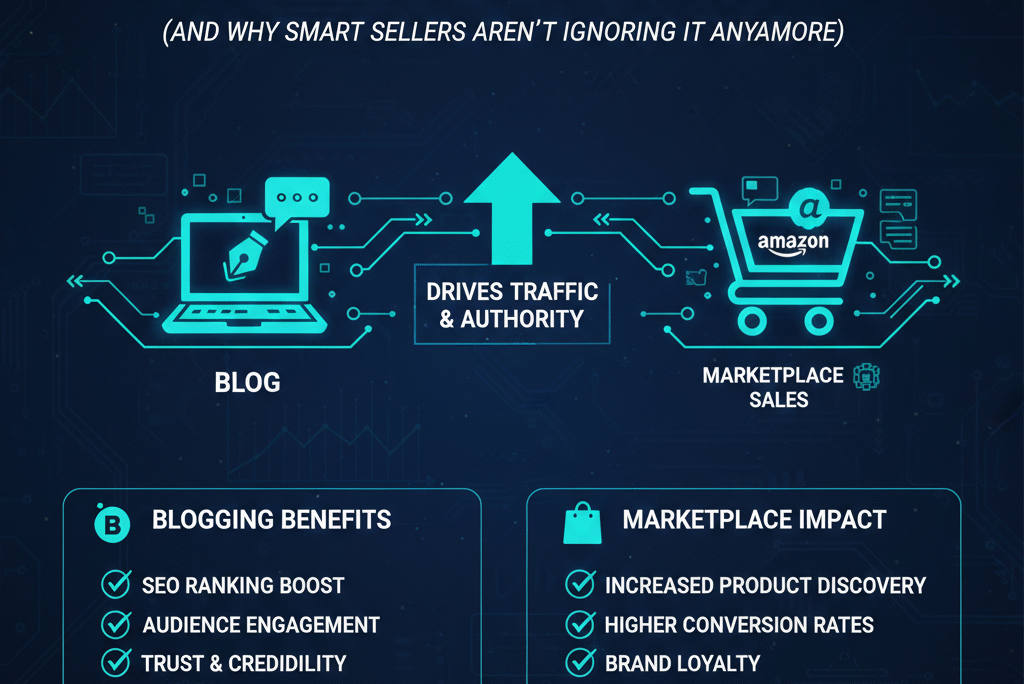
This is the mechanism through which blogging feeds marketplace sales. It intercepts buyers earlier in the decision journey, builds trust during the informational phase, and delivers buyers to the marketplace listing in a psychological state fundamentally different from the cold comparison shopping that most sellers are entirely dependent on.
The SEO Asset That Marketplaces Can’t Provide
Every business that operates primarily or exclusively on a marketplace is running on rented infrastructure. The traffic doesn’t belong to them. The customer relationships don’t belong to them. The visibility they’ve earned through listing optimization and review accumulation can be disrupted by an algorithm change, a policy shift, a listing suspension, or a fee restructure — none of which they control or are consulted about.
This is not a theoretical risk. It’s a documented pattern that has affected thousands of Amazon sellers over the years. Organic rankings that took months to build can collapse overnight following an algorithm update. Advertising costs can increase enough to make previously profitable products unviable within a single quarter. Category policy changes can restrict products that were previously unrestricted with minimal notice. Account suspensions can remove access to years of accumulated business infrastructure while appeals processes take weeks to resolve.
Sellers who have built organic search traffic through a blog have a meaningful buffer against these disruptions. Blog content that ranks well in Google generates traffic to the seller’s own website — traffic that doesn’t disappear when Amazon changes its algorithm, that doesn’t become more expensive when Amazon’s advertising auction becomes more competitive, and that doesn’t cease when an account is suspended.
That traffic can be directed to Amazon listings through well-placed links. It can be directed to eBay listings, Etsy listings, or a direct-to-consumer Shopify store depending on what best serves the buyer’s needs. It can be used to capture email addresses that create a direct communication channel with customers that no platform can revoke. It can be retargeted through paid advertising at significantly lower cost than cold traffic acquisition because these visitors have already demonstrated relevant interest.
Building this organic traffic asset requires genuine SEO work — creating content that addresses real buyer questions with sufficient depth and quality to rank in competitive searches, and doing so consistently enough that the site builds the domain authority that makes ranking possible.
For a thorough breakdown of how ecommerce SEO works technically — from site architecture to keyword targeting to link building — Ahrefs’ ecommerce SEO guide covers the foundational mechanics well; what this article focuses on is the strategic case for why marketplace sellers specifically should be building this asset rather than remaining entirely dependent on platform traffic.
This takes time. A new blog doesn’t generate significant organic traffic in its first month. But content created today continues generating traffic for years without ongoing cost, which means the return on investment compounds in a way that paid advertising fundamentally cannot.
The sellers who started building this asset two or three years ago are now operating with a level of traffic independence that newer sellers don’t have. The sellers who start now will have it in two or three years. The sellers who don’t start are accepting permanent dependence on platform conditions they don’t control.
How Content Raises Conversion Rates on Amazon Listings
The conversion rate benefit of blogging is less intuitive than the traffic benefit but arguably more immediately impactful, because it changes the economics of every existing traffic source rather than just adding a new one.
Conversion rate on a marketplace listing is determined by a complex combination of factors — price, reviews, image quality, copy clarity, competitive context. But one factor that doesn’t get discussed enough is buyer confidence at the point of arrival. A buyer who arrives at a listing cold — knowing nothing about the brand, having no prior exposure to its story or expertise — approaches the listing in a skeptical evaluation mode. They’re comparing, doubting, looking for reasons to hesitate. Their conversion probability is lower and their price sensitivity is higher than a buyer who arrives with any prior positive exposure to the brand.
A buyer who encountered the brand through a blog post before arriving at the listing is in a categorically different psychological state. They’ve already received value from the brand — the blog post helped them understand something or solve something — and that prior positive experience creates goodwill that carries directly into the listing evaluation. They’re less likely to comparison shop because they have a pre-formed preference. They’re less price-sensitive because the brand has demonstrated expertise that justifies a premium. They’re faster to convert because their doubt threshold was lowered by the prior positive experience.
This conversion lift from content exposure has been observed across enough ecommerce businesses to be treated as a reliable mechanism rather than an anecdotal pattern. The specific magnitude varies by category, by content quality, and by how well the content-to-listing transition is managed. But the direction is consistent: buyers who encountered the brand through educational content before reaching the listing convert at higher rates than cold buyers, and this effect is measurable even when the blog traffic and the marketplace traffic appear to come from different sessions.
For sellers running PPC campaigns, this creates a specific opportunity. Instead of sending paid traffic directly to an Amazon listing — which is standard practice and not wrong — a portion of that traffic can be routed through a blog post that provides genuine value before making a product recommendation. The click-to-purchase sequence becomes: ad click, valuable educational content that builds trust, product recommendation with specific context for why this product is right for this buyer, Amazon listing with pre-warmed buyer. This sequence consistently outperforms direct-to-listing sequences for buyers who are in the consideration phase rather than the immediate purchase phase.
Building Brand Authority Through Content — What It Actually Looks Like
Brand authority is one of those concepts that sounds important but can feel abstract until it’s connected to specific business outcomes. The concrete effects of blog-built brand authority on a marketplace seller’s business are worth enumerating specifically.
Price premium support is one of the most direct effects. In a competitive marketplace category, the default competitive dynamic is price compression — multiple sellers offering similar products converge toward similar prices because price is the most visible differentiator. A brand that has established genuine authority in its category through consistent educational content can maintain pricing above the category average because buyers who’ve encountered the brand’s expertise are willing to pay for the confidence that expertise provides. The content doesn’t just attract buyers — it justifies the price to buyers who’ve already been attracted.
Competitive insulation is a related effect. In most marketplace categories, a seller’s competitive position is vulnerable to any competitor who can match their product quality and undercut their price. Brand authority makes this displacement harder. A competitor can replicate a product. They cannot replicate years of accumulated expertise demonstrated through consistent, high-quality content. The buyer who has followed a brand’s blog for six months and found it consistently useful has a relationship with that brand that a lower-priced competitor can’t disrupt by appearing in the same search results.
Off-platform brand recognition compounds the marketplace effects. A seller whose brand appears not just in Amazon search results but in Google results for relevant informational queries occupies a larger share of the buyer’s awareness. When that buyer returns to Amazon for a second purchase in the category, the brand they remember encountering on Google has a recognition advantage that translates directly into conversion advantage without requiring additional advertising spend.
Candidate status for media coverage, partnership opportunities, and wholesale relationships is affected by perceived authority. Brands that publish genuine expertise are taken more seriously by journalists, by potential retail partners, and by strategic collaborators than brands that exist only as marketplace listings. As businesses scale, these relationships become increasingly valuable, and the authority established through consistent content creation is often what makes them accessible.
The Content Compounding Effect Over Time
One of the most practically significant advantages of blogging as a business investment is the compounding nature of its returns, which stands in direct contrast to the linear returns of most paid marketing.
A PPC campaign generates traffic for as long as it’s funded. Stop funding it and the traffic stops. The return on a PPC investment is limited to the period of the campaign — the investment doesn’t generate ongoing value after the campaign ends.
A blog post that ranks well in Google generates traffic continuously for years after it’s written. The research and writing investment is a one-time cost. The traffic it generates is an ongoing return that doesn’t require ongoing investment to maintain.
HubSpot’s marketing research consistently shows that businesses with active blogs generate significantly more organic traffic and inbound leads than those without — data that reflects exactly the compounding return dynamic described here, where content investment produces returns that grow rather than decay over time.
Over time, as a blog accumulates posts and as those posts accumulate links and engagement that improve domain authority, each new post benefits from the authority built by all preceding posts. The marginal return from each additional piece of content increases rather than staying constant.
This compounding creates a specific type of competitive advantage that’s difficult for competitors to close quickly even if they recognize it. A seller who has been publishing quality content for two years has accumulated something — domain authority, content volume, established rankings, audience relationships — that a competitor who starts today cannot replicate overnight. The advantage is time-gated in a way that financial investment alone cannot overcome.
The compound return on content investment also manifests in ways beyond direct organic traffic. Each well-ranked post is a potential entry point for buyers at different stages of the purchase journey. Each post provides content that can be distributed across social media, email newsletters, and advertising campaigns, multiplying the return from a single piece of content across multiple channels. Each post builds the topical authority that makes subsequent posts rank more easily. The investment compounds in all of these dimensions simultaneously.
What Effective Blogging Actually Requires
Being clear about what genuine blog strategy requires is important because the version of blogging that doesn’t work — shallow keyword-stuffed articles published inconsistently without a coherent content plan — is unfortunately the version most sellers who try it produce. Understanding what separates effective from ineffective blogging prevents the common failure mode of investing effort in content that doesn’t generate meaningful results.
Genuine depth is the most important requirement. Content that covers a topic superficially — the kind that can be written in thirty minutes without specific expertise — doesn’t rank, doesn’t earn trust, and doesn’t demonstrate authority. The posts that produce lasting organic rankings and genuine buyer trust are the ones that engage with the topic thoroughly enough to be genuinely useful to someone who needed the information. This requires actual knowledge of the subject matter, time to develop and write the content, and the judgment to know when depth has been achieved versus when the post is still surface-level.
Strategic topic selection is the prerequisite for depth to be worth the investment. Writing in depth about topics that no buyer is searching for produces high-quality content that nobody reads. The topics worth covering are determined by what buyers in the relevant category are actually searching for before they reach the marketplace — informational queries, comparison queries, problem-solution queries that signal the pre-purchase research phase. Identifying these requires keyword research combined with genuine understanding of the buyer’s psychology and information needs.
Consistent publishing frequency matters for building the domain authority and audience relationships that compound over time. A blog that publishes one or two strong pieces per week builds authority progressively. A blog that publishes inconsistently — three posts in January, nothing until April, two in May — struggles to build the authority accumulation that makes each new post rank more easily. Consistency matters more than volume, but some regularity is required for the compounding effect to develop.
Internal linking strategy connects individual pieces of content into a coherent architecture that guides readers from informational content toward product pages and buying decisions. A blog post about choosing an ergonomic desk chair that doesn’t link to the seller’s product listing is leaving conversion value uncaptured. The architecture of the blog should create natural pathways from the topics buyers research to the products that address their needs.
Blogging and the Multi-Platform Selling Advantage
For sellers operating across multiple marketplaces — Amazon, eBay, Etsy, or a combination — blogging creates a specific strategic advantage that single-channel sellers don’t need to think about but multi-channel sellers absolutely should.
Each marketplace has its own buyer psychology. Amazon buyers are typically looking for established products with strong social proof. Etsy buyers are typically looking for handmade or unique items with a personal story. eBay buyers are often more price-sensitive and deal-oriented. A seller who operates across all three is essentially serving three different buyer mindsets from the same product catalog.
A blog acts as a platform-agnostic hub that can serve all three buyer types and direct them toward the marketplace that best fits their needs and preferences. Content like “Where to buy handmade home décor online” can honestly compare the different marketplace options and guide buyers toward the platform where the seller’s products are listed and where the buyer’s preferences are best served. Content like “How to evaluate quality when buying online” can build the expertise positioning that serves Amazon buyers. Content like “The story behind our products” can build the personal connection that Etsy buyers are seeking.
This multi-platform content strategy positions the brand above any individual marketplace — the brand has a presence and an authority that exists independently of where any individual transaction happens. As buyer discovery patterns shift — as more searches happen through AI tools, as social commerce develops, as new platforms emerge — a brand with genuine content authority can adapt its distribution channels while maintaining its audience relationships. The blog is the consistent anchor that makes platform flexibility possible.
Blogging in the Age of AI Search
The relationship between content quality and search visibility is changing in ways that make blogging investment more valuable rather than less, despite the understandable concern that AI-generated content has raised about the future of search.
Generative AI tools — ChatGPT, Google’s AI Overviews, Perplexity, and similar systems — are increasingly the first destination for buyers with informational questions. Someone trying to understand which type of water filter is right for their home, or what the difference between cotton and linen bedding is, or how to evaluate quality in a particular product category, is as likely to ask an AI assistant as to type the question into a traditional search engine.
These AI systems generate their responses by synthesizing information from sources they’ve indexed and assessed as authoritative. Brands that have published genuine, well-structured, expert-level content on topics relevant to their products are more likely to have their content referenced in AI-generated responses, and more likely to have their brand mentioned as a recommendation, than brands that have no content presence.
This is not a hypothetical future benefit — it’s happening now. Brands that started building content authority before AI search became dominant are being surfaced in AI responses in ways that generate brand awareness and trust in a channel that didn’t exist at meaningful scale two years ago. Brands that start now are building the content asset that positions them for the AI discovery landscape that will be even more significant two years from now.
The specific content characteristics that AI systems favor are aligned with what quality-focused content creation has always required: genuine depth, accurate information, clear structure, specific expertise that goes beyond what can be assembled from surface-level sources. The brands that have been producing this kind of content for non-AI reasons are now benefiting from AI distribution as a bonus. The brands that produce thin, keyword-oriented content for ranking manipulation purposes are finding that AI systems are less receptive to it.
Frequently Asked Questions About Blogging for Marketplace Sellers
How long before a blog generates meaningful organic traffic?
For most new blogs in competitive niches, meaningful organic traffic typically begins appearing between six and twelve months after consistent publishing starts. The timeline depends on several factors: the competitiveness of the topics being targeted, the quality and depth of the content, the frequency of publishing, and whether any link building or promotion is supporting the organic ranking effort. Early traffic tends to come from less competitive informational queries; as domain authority builds, more competitive queries become rankable. The timeline is genuinely longer than most sellers want to hear, which is why starting early and maintaining consistency matters so much.
How do you measure whether the blog is helping marketplace sales?
The most direct measurement is tracking conversions from blog-referred traffic to marketplace purchases, which can be done through UTM parameters on links from blog posts to marketplace listings. Additional useful metrics include changes in branded search volume over time (suggesting growing brand recognition), changes in direct traffic to marketplace listings (suggesting buyers who arrived via organic channels and are returning), changes in conversion rate for buyers who appear to have prior brand exposure versus cold buyers, and changes in average order value or repeat purchase rate over time. The full impact of blogging on marketplace sales is difficult to attribute precisely, but the combination of these metrics provides a reasonable picture of the contribution.
What topics should a marketplace seller blog about?
The most valuable topics are those that address the informational questions buyers in the product category have before they reach a marketplace. This includes how-to content related to the problem the product solves, comparison content that helps buyers evaluate options in the category, buying guide content that explains what to look for when purchasing products like these, and educational content about the category that demonstrates the brand’s expertise. These topics intercept buyers during their research phase and position the brand as a knowledgeable guide rather than just another option in a comparison grid.
Is it worth blogging if the business is still small?
Yes — and arguably more worth it than for established businesses, because the compounding nature of content investment means that starting earlier produces more accumulated authority over time. A small business that starts publishing consistent quality content now will have a meaningful content asset in two years that a competitor who waits until they’re larger won’t have. The investment required to start is modest — a WordPress site, a content plan, and consistent execution — and the barrier of small size is not a genuine obstacle to producing content that ranks and builds authority.
What’s the biggest mistake sellers make with business blogging?
Treating it like a short-term project with an expected return timeline similar to paid advertising. Sellers who publish ten blog posts, see minimal immediate results, and conclude that blogging doesn’t work have misunderstood both how organic search works and how content authority builds. The other common mistake is producing content for search engines rather than for buyers — technically SEO-optimized articles that address keyword queries without genuinely helping the reader. This content may achieve temporary rankings but doesn’t build the trust and authority that drives the conversion and retention benefits that make blogging genuinely valuable.
Final Thought: Building the Asset That Outlasts the Platform
The question that every marketplace seller eventually needs to answer is whether they’re building a business or building a listing.
A listing is dependent on the platform it exists on. Its performance rises and falls with the platform’s algorithm, its visibility is rented from the marketplace, and its customer relationships belong to the platform rather than to the brand. When the platform changes — and platforms always change — the listing adapts or suffers.
A brand is something different. It has an identity that exists beyond any single platform, an authority that was built through demonstrated expertise rather than just through optimization mechanics, and customer relationships that were formed through genuine value rather than transactional convenience. When platforms change, the brand adapts because it has optionality — multiple channels, an owned audience, an authority that allows it to rebuild in new environments.
Blogging is one of the primary tools through which marketplace sellers build toward the brand end of this spectrum rather than the listing end. It creates the organic traffic independence that reduces platform dependency. It builds the authority that supports premium pricing and competitive insulation. It intercepts buyers earlier in the purchase journey and delivers them with higher trust and lower resistance. And it compounds in value over time in ways that make the investment more rational the earlier it begins.
The sellers who are building this asset now are making their future selves more resilient, more independent, and more valuable than the sellers who aren’t.
That’s the investment case for blogging. Not traffic numbers or ranking positions or content output metrics — but the structural difference between a business that depends entirely on platforms it doesn’t control and a business that has built something those platforms can’t take away.
If you’re building an ecommerce brand and want to develop the content and SEO strategy that supports your marketplace sales while building genuine brand independence, you can explore how we approach this at ecommate.co.uk.