For a while, marketplaces feel like magic.
You list a product on Amazon, Etsy, or eBay. Traffic is already there. People are searching with their wallets out. Sales start happening faster than you expected. It feels like you’ve cracked the system.
And for many sellers, that’s exactly where the story stops.
Because marketplaces are great for starting. They are terrible for owning.
A serious ecommerce brand — the kind that lasts, scales, and doesn’t panic every time an algorithm sneezes — eventually needs something stronger than a seller account. It needs a home. A place it controls. A place that doesn’t change the rules overnight.
That place is your website.
This isn’t a “websites are cool” argument. This is about leverage, survival, and building something that’s actually yours.
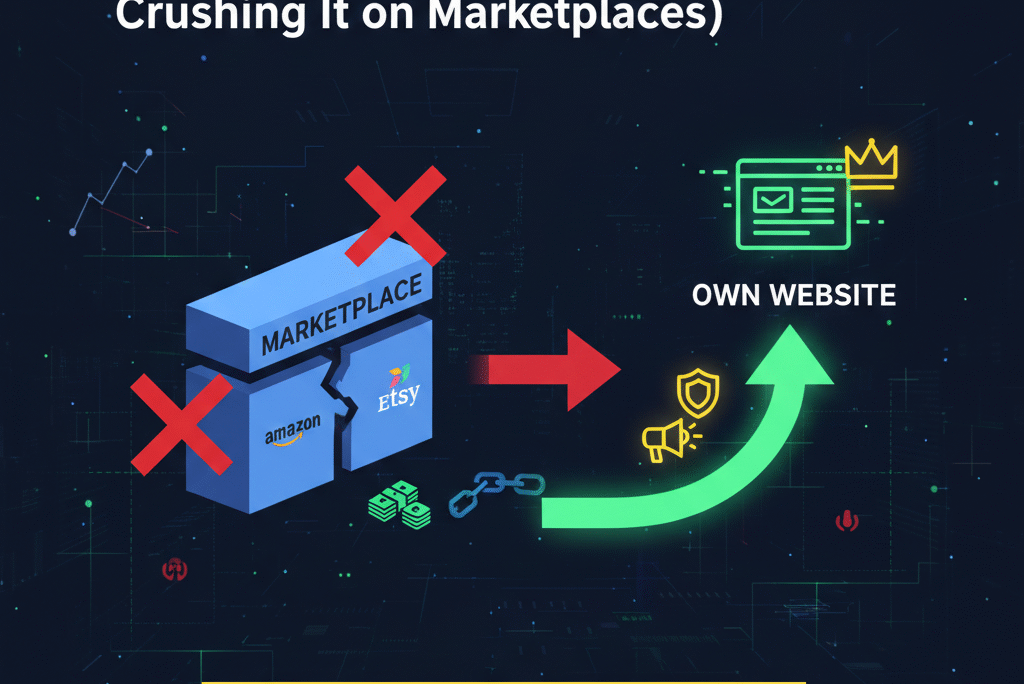
Marketplaces Are Landlords. Your Website Is Property.
When you sell on Amazon, eBay, or Etsy, you’re renting shelf space.
They decide:
- Who sees your product
- How your listing looks
- What data you get access to
- How much you pay in fees
- Whether your account stays alive tomorrow
You can be a five-star seller and still wake up to a suspended listing because of a policy update you never violated. Sellers learn this the hard way every single day.
A website flips the power dynamic.
You control the design. The messaging. The customer journey. The data. The relationship. No one can delist you. No one can hijack your Buy Box. No competitor can sit right next to your product with a cheaper knockoff.
Marketplaces are distribution channels.
A website is ownership.
Serious brands don’t confuse the two.
A Website Turns Customers Into an Audience
Marketplaces don’t want you building relationships. They want transactions.
You don’t get customer emails. You don’t get to retarget freely. You don’t get to tell your story beyond a bullet point and a few images. The customer belongs to the platform, not you.
A website changes that completely.
Now you can:
- Build an email list
- Collect first-party data
- Retarget visitors with ads
- Educate before selling
- Launch new products to people who already trust you
This is how brands stop depending on constant new traffic and start making money from repeat buyers.
A customer who buys once on Amazon is a sale.
A customer who joins your email list through your website is an asset.
That difference compounds fast.
Ecommerce Brand Actually Work on a Website (It Barely Exists on Marketplaces)
On marketplaces, branding is decorative. On your website, it’s functional.
On Amazon, your logo sits quietly in a corner. Your colors don’t matter much. Your story gets skimmed, if it gets read at all. Everything is optimized for comparison and price pressure.
On a website, branding shapes behavior.
Your design controls trust. Your copy controls emotion. Your layout controls flow. You decide whether someone feels like they’re buying a cheap product or joining a real brand.
This matters more than sellers like to admit.
People don’t just buy products. They buy confidence. They buy clarity. They buy the feeling that someone competent is behind the screen.
A well-built website communicates legitimacy in a way a marketplace listing never can.
Websites De-Risk Your Business
Every serious seller has had this nightmare:
- A listing taken down without warning
- An account suspended pending “review”
- A competitor filing a false complaint
- A sudden drop in organic ranking
When 100% of your revenue lives on one platform, these moments aren’t inconvenient. They’re existential.
A website acts as a pressure release valve.
Even if marketplaces remain your main revenue source, your website:
- Gives customers a backup buying option
- Keeps your brand discoverable if listings go dark
- Allows you to communicate directly during disruptions
- Protects your cash flow from total shutdown
This isn’t paranoia. This is experience talking.
The sellers who survive long-term always have something outside the marketplace ecosystem.
SEO Is a Long-Term Growth Engine Marketplaces Can’t Replace
Marketplaces give you traffic — as long as you keep paying in fees, ads, and compliance.
A website gives you discoverability that compounds.
Search engine optimization (SEO) lets your brand show up when people are researching problems, comparing options, or learning — not just when they’re ready to click “Buy Now.”
That means:
- You attract warmer buyers
- You educate before selling
- You rank for brand-related searches
- You build authority in your niche
Over time, this lowers ad dependency and increases margins.
Marketplaces are pay-to-play.
Websites are build-to-win.
They reward patience, consistency, and quality — the same traits that define serious brands.
Websites Support Marketplaces (They Don’t Compete With Them)
This part surprises people.
Having a website doesn’t hurt your marketplace sales. It often boosts them.
Customers Google brands. They check legitimacy. They look for social proof outside the platform. A strong website reassures them that you’re not a fly-by-night seller.
Websites also:
- Strengthen brand recall
- Increase trust before Amazon purchases
- Support off-platform traffic campaigns
- Improve conversion rates across channels
Your website doesn’t replace Amazon, eBay, or Etsy. It strengthens everything around them.
Think of marketplaces as highways.
Your website is the headquarters those highways lead to.
Data Is the Quiet Superpower of Websites
Marketplaces show you what they want you to see.
A website shows you reality.
You can track:
- Where users come from
- What pages convert best
- Where people drop off
- Which products attract attention
- How content influences purchases
This data improves decision-making everywhere else — from product launches to ad spend to pricing strategy.
Brands that rely only on marketplace dashboards are operating with partial vision. Brands with websites see the full picture.
And in ecommerce, clarity is money.
A Website Makes Your Business Sellable
This is the part many sellers don’t think about until it’s too late.
If you ever want to:
- Sell your brand
- Raise investment
- Partner with another company
- Exit profitably
A website dramatically increases perceived value.
Buyers and investors don’t just look at revenue. They look at:
- Brand independence
- Traffic sources
- Email lists
- Customer data
- SEO footprint
A marketplace-only business is fragile. A brand with its own website is infrastructure.
Infrastructure sells.
“But I’m Doing Fine Without One” Is a Temporary Truth
Many sellers say this — and they’re not lying.
You can absolutely make money without a website. Plenty of people do. Some even do very well.
The question isn’t whether you can.
The question is how long that advantage lasts.
Marketplaces get more competitive every year. Fees rise. Ads get more expensive. Rules tighten. Copycats multiply. Margins shrink.
Websites aren’t about today’s sales. They’re about tomorrow’s control.
The moment you start thinking beyond your next payout, a website stops feeling optional.
The Real Question Isn’t “Do I Need a Website?”
It’s this:
Do you want to run a store…
or build a brand?
Stores depend on platforms.
Brands create leverage.
Every serious ecommerce brand eventually makes the same move: they stop renting attention and start owning it.
A website isn’t just a page on the internet.
It’s the foundation that turns products into a business — and a business into an asset.
And once you see it that way, not having one feels less like simplicity and more like standing on borrowed ground.
If you’re serious about building an ecommerce brand that isn’t dependent on a single platform, the next step is creating a website that actually works — not just one that looks nice. At Eccommate, we help sellers turn marketplace success into real brand ownership through website development, branding, SEO, and growth-focused ecommerce strategies. If you’re ready to move from “just selling” to building something sustainable, you can explore how we do it on our Eccommate services page.
For a clear, expert viewpoint on why your own ecommerce site matters, consider how ecommerce platforms like Shopify position it compared to marketplaces. They highlight that owning your own online store gives you total control over your brand presentation and customer data, something you simply don’t get when your products live solely on third-party marketplaces. This means you can craft the exact experience you want for your customers — from branding to customer retention strategies — rather than being boxed into someone else’s rules and layouts.