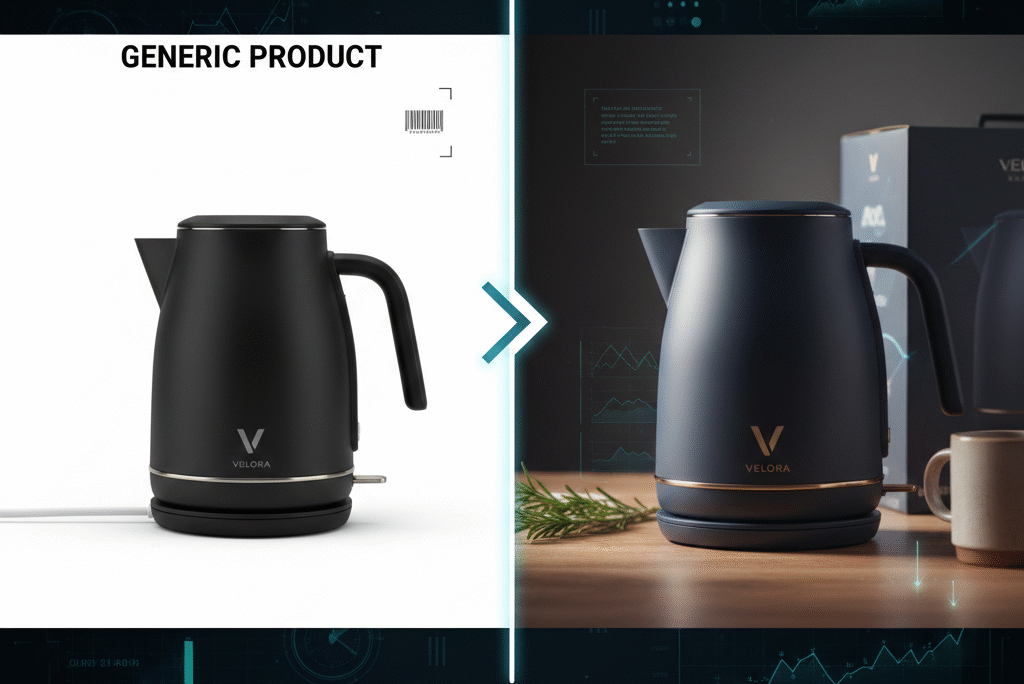
This is a walkthrough of what brand transformation actually looks like in practice — not the inspirational version, but the mechanical one. What changed, why it changed, and what happened to the business as a result. Written for sellers who are tired of abstract branding advice and want to understand the process concretely.
The Problem Nobody Talks About When Sales Are “Fine”: Visual Transformation
There’s a specific kind of stuck that’s harder to diagnose than obvious failure.
Sales are coming in. The product works. Reviews are acceptable — nothing spectacular, but nothing alarming. The business is alive. By most surface measures, things are going okay.
But growth feels fragile. Every month depends on ad spend staying consistent. Pricing power is essentially nonexistent — drop the price and sales pick up, raise it and they evaporate. There are no repeat customers to speak of. The listing could disappear tomorrow and nobody would notice.
This is what selling a product without a brand actually feels like from the inside. Not dramatic failure — quiet ceiling. The kind of ceiling that sellers try to push through by tweaking bids, adjusting prices, chasing keywords, and wondering why nothing fundamentally changes.
What’s actually broken in this situation isn’t the product, the pricing, or the algorithm. It’s perception. The business hasn’t given customers a reason to choose it specifically — only a reason to buy the category. And in a crowded marketplace, that distinction determines everything: conversion rate, pricing power, review quality, long-term defensibility, and ultimately whether what you’re building is an asset or just a revenue stream that evaporates the moment a better-priced competitor shows up.
This case study walks through what fixing that actually looks like — from diagnosis through execution, with the specific reasoning behind each decision.
The Starting Point: A Product That Was Perfectly Forgettable
The product in this case study wasn’t bad. That’s what made the problem so easy to ignore.
It lived in a competitive Amazon category — the kind where you can scroll through two hundred listings and struggle to tell most of them apart. Same basic shapes, same feature claims, same price clustering. Different brand names applied like name tags at a conference, most of them carrying zero meaning or recognition.
Visually, the product had three symptoms that are common enough to have a pattern.
The logo looked like it came with the supplier template. Thin generic font, a clip-art-adjacent icon, no visual personality, no particular intention behind it. It didn’t offend anyone. It also didn’t stick with anyone. A logo that generates no reaction is doing nothing for the business.
The packaging communicated existence rather than belonging. White box, stock icons, bullet points crowded onto every available surface, no visual hierarchy, no sense of considered design. It looked like packaging that was created to meet a minimum requirement rather than to make a customer feel good about what they’d purchased.
The listing images were informational rather than persuasive. They showed what the product was — dimensions, components, features — without communicating what owning it felt like or what problem it solved. Technically functional, emotionally inert.
The business results matched the visual reality. Conversion rate sat around category average. PPC required constant aggressive funding to generate any significant sales velocity. Repeat purchases were rare. Searching the brand name outside of Amazon produced nothing coherent. The business was surviving — not compounding.
The Diagnosis: Why Customers Compare Signals Before They Compare Features
Here’s the thing most sellers resist accepting: customers don’t evaluate products rationally first.
Before anyone reads a bullet point, before they compare specifications, before they look at price, the brain runs a rapid unconscious assessment based entirely on visual signals. Does this look legitimate? Does this feel like a brand or a random seller? Is this safe to buy, or will I regret it? Will I feel embarrassed if someone sees this product in my home?
These questions happen in under three seconds. They’re answered entirely by visual presentation. And they determine whether the buyer is in a receptive state to evaluate the actual product — or whether they’ve already moved on. This isn’t marketing theory — research on how humans form first impressions confirms that visual judgments happen automatically and precede any rational evaluation of content.
In a category with dozens of visually similar listings, design functions as a trust shortcut. Buyers can’t touch the product, can’t verify quality directly, and often haven’t heard of the seller before. In the absence of other trust signals, visual coherence and professionalism carry enormous weight. A listing that looks considered and intentional communicates competence. A listing that looks generic communicates risk.
The goal of the transformation wasn’t to make the product look prettier. Aesthetics were never the point. The goal was to control perception — specifically, to make the brand feel like the safe, obvious choice in a category where most listings feel interchangeable.
That’s a strategic objective, not a creative one. The design decisions that followed all served that objective.
Step One: Defining the Brand Before Touching Any Design
The most common mistake in brand transformation is starting with visuals. Picking colors, experimenting with logos, browsing inspiration — all before answering the questions that should determine every visual decision downstream.
Before anything was designed or redesigned, three things were locked down.
Who is this product specifically for? Not “adults who need this category of product.” A specific buyer with a specific context — age range, use situation, emotional state when they’re making the purchase, what they’ve probably tried before and been disappointed by. The specificity feels uncomfortable at first because it seems like you’re excluding people. What it actually does is make the brand legible to the people it’s for, who then recognize themselves in it and convert at higher rates.
What does this product solve emotionally, not just functionally? Every product has a functional job — it does something. But the purchase decision is usually emotional — it promises something. Convenience, confidence, relief, simplicity, belonging, competence. Understanding the emotional job the product does determines what the brand needs to feel like, which determines everything from color palette to copy tone.
What is the single word that should define how the brand feels? Not a list of adjectives. One word. Calm. Precise. Bold. Trustworthy. Friendly. Effortless. That anchor word becomes the filter for every subsequent design decision. When two options are on the table, the question is always: which one is more [anchor word]? It makes decisions faster and more consistent.
Design without this foundation is decoration. It might look good and mean nothing. Design with this foundation is strategy — every visual element is doing specific work toward a specific goal.
Step Two: Logo Redesign — From Identifier to Signal
The original logo had one job: identify the brand name. It did that job minimally and nothing else.
A logo for an ecommerce brand operating in a crowded visual environment has a more demanding job. It needs to work at the size of an Amazon thumbnail. It needs to communicate personality in a glance. It needs to feel like it belongs to a real company rather than a product that was sourced and labeled.
The redesign wasn’t dramatic for drama’s sake. Every change was deliberate.
The typeface moved from a generic sans-serif — the kind that says “I had a font on my computer” — to one selected specifically because it matched the brand’s anchor word. Typography carries personality in ways that most people feel but can’t articulate. The right typeface makes a brand feel consistent with itself. The wrong one creates subtle dissonance.
The icon was simplified until it worked at small sizes without losing its shape. Complex logos that look good on a business card often become unrecognizable at thumbnail dimensions. Amazon listings live at thumbnail dimensions. The icon needed to read clearly there first.
Spacing and proportions were adjusted so the logo felt confident rather than cramped. Tight, crowded logos feel uncertain. Logos with appropriate breathing room feel established.
Most importantly, the logo stopped trying to explain what the product does — a common mistake that produces icons of the literal product category — and started representing what the brand stands for. A logo isn’t a diagram. It’s a flag. It marks territory. Over time, repeated exposure makes that flag recognizable, and recognition builds trust automatically.
Step Three: Color Palette — Choosing Trust Over Trend
Color decisions in branding are where the most arbitrary choices get made and the most damage gets done.
The wrong question is: what colors look nice? Color preference is personal and irrelevant. The right question is: what colors does this specific customer already associate with legitimacy and quality in this category?
Before selecting colors, the category’s existing visual language was studied — not to copy the leaders but to understand what signals legitimacy in that specific market context. Different categories have different visual norms. Ignoring those norms reads as amateur. Understanding them allows for informed decisions about where to align and where to differentiate.
The final palette was structured around three roles. One dominant color for recognition — the color that would become associated with the brand through repeated exposure. One supporting neutral for balance — giving the dominant color something to rest against without competing. One accent color for attention — used sparingly for calls to action and highlight elements.
No gradients for visual interest. No rainbow of brand colors. Consistency across every touchpoint, because consistency is how color builds recognition, and recognition is how color eventually builds trust.
When a buyer has seen your brand colors across search results, listing images, packaging, and a website, encountering them again reduces friction. Familiarity lowers perceived risk. The brand feels new but not risky — which is exactly the psychological position that converts browsers into buyers.
Step Four: Packaging — The First Physical Handshake
Packaging is almost universally treated as a cost to be minimized. That framing is expensive in the long run.
Packaging is the first physical interaction a customer has with the brand. It arrives in their home. It sits on their counter while they open it. It influences the emotional state they’re in when they first use the product — and that emotional state influences whether they feel the product lived up to expectations, which influences whether they leave a review and what that review says.
The redesign started with subtraction. The original packaging was cluttered — icons, claims, bullet points, certifications, all competing for attention simultaneously. Visual hierarchy was nonexistent. The first step was removing everything that didn’t need to be on the front panel.
The front of the box was reduced to three jobs: state clearly what the product is, reinforce the brand visually through consistent color and logo, and make the buyer feel they made a good decision. That last job sounds vague but it’s specific in execution — clean design, quality materials, considered proportions all communicate that a company with standards made this, which validates the purchase decision at the moment of unboxing.
Everything else — instructions, specifications, certifications, secondary messaging — moved to side panels and inserts where buyers who want that information can find it, without cluttering the primary visual impression.
Inside the box, a branded insert replaced the generic supplier card. Not a review request disguised as a thank-you note — actual human language, on-brand in tone and visual style, that extended the brand experience into the physical interaction. This single element consistently generates comments in reviews about packaging quality and brand feel, from customers who’d have no particular reason to mention it if the experience had been generic.
The cumulative effect is that the purchase becomes an experience rather than a transaction. That distinction is what separates products people forget from brands people mention.
Step Five: Listing Images — Narrative Replaces Information
This is where the most measurable conversion impact appeared, and it’s worth understanding why in detail.
The original listing images were informational. They showed the product accurately and completely — dimensions, components, features, what’s included in the box. Buyers looking for that specific information could find it. But information without narrative doesn’t convert. It satisfies a checklist without creating desire or confidence.
The new images were built around a narrative sequence designed to match how buyers actually move through a purchase decision.
The first image — the main image visible in search results — was redesigned around the outcome the product produces rather than the product itself. Before buyers click through, they need a reason to click. That reason is almost never a feature. It’s a result, a feeling, a situation they recognize.
Secondary images provided use-case context. Instead of isolated product shots against white backgrounds, images showed the product being used in recognizable situations by recognizable people. This does two things: it helps buyers visualize themselves using the product, which is a prerequisite for purchase, and it communicates scale and proportion more naturally than dimension callouts.
Each subsequent image in the sequence addressed a specific stage in the buyer’s decision process: initial emotional hook, use-case relevance, key differentiator from alternatives, social proof or reassurance, and practical details for buyers who need them before committing.
Text overlays on images were reduced in volume and sharpened in language. Fewer words, more specific claims. Generic phrases like “high quality” and “durable construction” were replaced with specific statements about what that quality and durability means in the buyer’s real life.
The sequence meant that buyers didn’t need to read everything carefully to feel confident enough to purchase. The visual narrative did the persuasion work, and the text was there for buyers who wanted the supporting detail.
Step Six: Extending the Brand Beyond Amazon
This step is where sellers who are building brands diverge from sellers who are building listings.
A basic website was created. Not sophisticated — clean, fast, visually consistent with the Amazon presence, containing enough information to answer the questions a curious buyer or a potential wholesale partner might have. The purpose wasn’t to drive direct-to-consumer sales. It was to ensure that when someone searched the brand name — a customer considering a repeat purchase, someone who’d received the product as a gift, a retailer evaluating stocking it — they found something coherent rather than a dead end.
Social profiles were aligned visually: same colors, same logo treatment, same tonal register in the copy, even without aggressive posting schedules. The objective was coherence, not content volume. A buyer who discovers the brand on Instagram should feel they’ve found the same brand they encountered on Amazon.
Coherence across touchpoints does something specific to buyer psychology: it signals that the brand is real and stable. Random sellers don’t have websites. Established brands do. Random sellers don’t have consistent visual identities across platforms. Brands do. These signals don’t require a massive marketing operation to create — they require intention and consistency.
The result was that the brand now had an existence beyond its Amazon listing. That existence builds pricing power, because buyers who trust a brand are willing to pay more than buyers who are simply purchasing a commodity from the cheapest available source.
What the Results Actually Looked Like
The temptation in a case study is to present the results as dramatic and immediate. They weren’t, and presenting them that way would be dishonest.
Advertising didn’t become free. Competition didn’t disappear. The algorithm didn’t send organic traffic as a reward for better design. What changed was efficiency across every metric that matters for long-term business health.
Conversion rate increased without any change to ad spend. The same traffic that had been generating average conversion began converting at a higher rate because the listing was doing more of the persuasion work before the buyer had to make a conscious decision.
PPC became more forgiving. Higher conversion rate means Amazon’s advertising system rewards the listing with lower cost-per-click, because the algorithm knows this listing is likely to convert traffic it sends — which is valuable to Amazon. The economics of paid traffic improved without changing bidding strategy.
Customer questions decreased. Clearer listing images and more specific copy meant buyers arrived with accurate expectations and fewer unresolved questions. Fewer questions means lower customer service burden and fewer pre-purchase doubts that prevent purchase.
Reviews began mentioning brand quality and packaging specifically. This is a meaningful signal — buyers who mention packaging and brand presentation in reviews are reporting an experience that exceeded the baseline expectation for the category. That kind of review accelerates trust for subsequent buyers in a way that feature-focused reviews don’t.
Launching product variants became significantly easier. An established brand identity meant new products didn’t have to build credibility from zero — they borrowed it from the existing brand recognition and visual coherence.
The most important change was qualitative: the business stopped feeling disposable. The brand had defensibility that the generic listing had lacked. Copycats could replicate the product but not the accumulated brand recognition. That’s the compounding advantage that branding creates over time.
The Real Lesson: Branding Is About Consistency, Not Scale
A persistent misconception about branding is that it’s something large companies do — that it requires significant budgets, creative agencies, and market research operations that small ecommerce sellers can’t access.
The actual requirement for branding is much simpler: every visual touchpoint should tell the same story, consistently, over time. Logo, packaging, listing images, website, social presence — when all of these feel like they belong to the same brand, the effect on buyer perception is significant and cumulative.
Generic products compete on price because price is the only available differentiator when everything else is identical. Brands compete on belief — the buyer’s belief that this specific brand is worth choosing over alternatives, even when alternatives are cheaper. One of those competitive positions is exhausting and margin-destroying. The other compounds.
The uncomfortable test of whether you’ve built a brand or just a product: if your listing disappeared from Amazon tomorrow, would any customer notice or care? If the honest answer is no — if the business is entirely interchangeable with any other seller in the category — the work of brand-building hasn’t happened yet.
That work is worth doing. Not because it’s creatively satisfying, though it can be, but because it’s the mechanism that transforms a revenue stream into a business asset, and a product launch into something with long-term defensibility and value.
Frequently Asked Questions
Does visual branding really affect Amazon conversion rate that directly?
Yes, measurably. Amazon’s algorithm rewards conversion rate with increased organic traffic and lower advertising costs. Anything that improves conversion rate — including visual trust signals — feeds directly into ranking and advertising efficiency. The relationship isn’t indirect or theoretical.
How much does brand transformation cost?
It varies significantly depending on scope, who does the work, and what elements are being addressed. The more relevant question is what the current cost of weak branding is — in conversion rate below potential, in PPC spend required to compensate for low organic conversion, in inability to raise prices, in ease of being displaced by cheaper competitors.
Can a small seller realistically build a brand on Amazon?
Yes. Brand-building on Amazon doesn’t require large budgets — it requires consistency and intention. A coherent logo, a considered color palette, professional listing images, and packaging that creates a positive unboxing experience are all achievable at modest cost and have measurable impact on conversion and customer perception.
How long before branding changes affect business results?
Some effects are relatively fast — listing image changes can affect conversion rate within weeks of meaningful traffic. Brand recognition and the compounding effects on repeat purchase rate, organic ranking stability, and pricing power build over months. The investment pays returns that increase over time rather than requiring constant reinvestment.
What’s the most important element to address first?
Listing images, consistently. They’re the highest-leverage visual element because they affect both click-through rate from search results and conversion rate on the listing page. If the images aren’t doing persuasion work — if they’re informational rather than narrative — that’s the most impactful place to start.
Final Thought: Products Make Sales. Brands Make Businesses.
Launching a product is accessible to almost anyone. Building a brand — something that customers recognize, trust, and choose deliberately — requires a different level of intention and consistency.
Visual transformation isn’t cosmetic. It’s the process of aligning what the brand looks like with what the brand actually is — and making that alignment visible to buyers who have a few seconds and dozens of alternatives to evaluate.
When the visuals finally match the value, something shifts in how buyers respond. They can’t always articulate what changed. They just feel more confident clicking buy. That confidence is the product of dozens of small design decisions made intentionally in service of a clear positioning goal.
And in a marketplace where most competitors are making those decisions arbitrarily or not at all, intentionality compounds into a durable advantage.
If you’re building an Amazon private label business and want to understand what this transformation looks like for your specific product and category, you can explore how we approach branding and visual strategy at ecommate.co.uk.
This case study reflects direct experience working with Amazon private label sellers. Results described represent patterns observed across multiple brand transformation projects as of 2026. Individual results vary based on category, product, and execution quality.