There’s a moment every Amazon seller hits that feels oddly like standing at a fork in the road with fog on both sides when you scale an amazon product. Sales are coming in. Reviews are trickling. PPC is either behaving… or absolutely feral. And the question starts whispering in your ear at 2 a.m.:
Do I double down on this product — or quietly put it out of its misery?
Scaling too early can drain your cash and sanity. Holding on too long can turn a “maybe” product into a slow financial leak. The hard part is that Amazon doesn’t give you a big flashing sign that says SCALE NOW or ABANDON HOPE. You have to read the signals. And most sellers read them wrong.
Let’s talk about how to make that call like an adult with spreadsheets instead of vibes.
The Lie when you scale an Amazon Product: “More Sales Means It’s Time to Scale”
Sales alone are a terrible reason to scale.
That sentence just offended half of Amazon YouTube, but it’s true. Early sales can come from discounting, aggressive PPC, friends and family buying, or sheer novelty. Amazon loves momentum, but momentum without margins is just a treadmill.
Before you even whisper the word “scale,” you need to answer one uncomfortable question:
Is this product profitable without me babysitting it?
If the answer is no, scaling just means losing money faster.
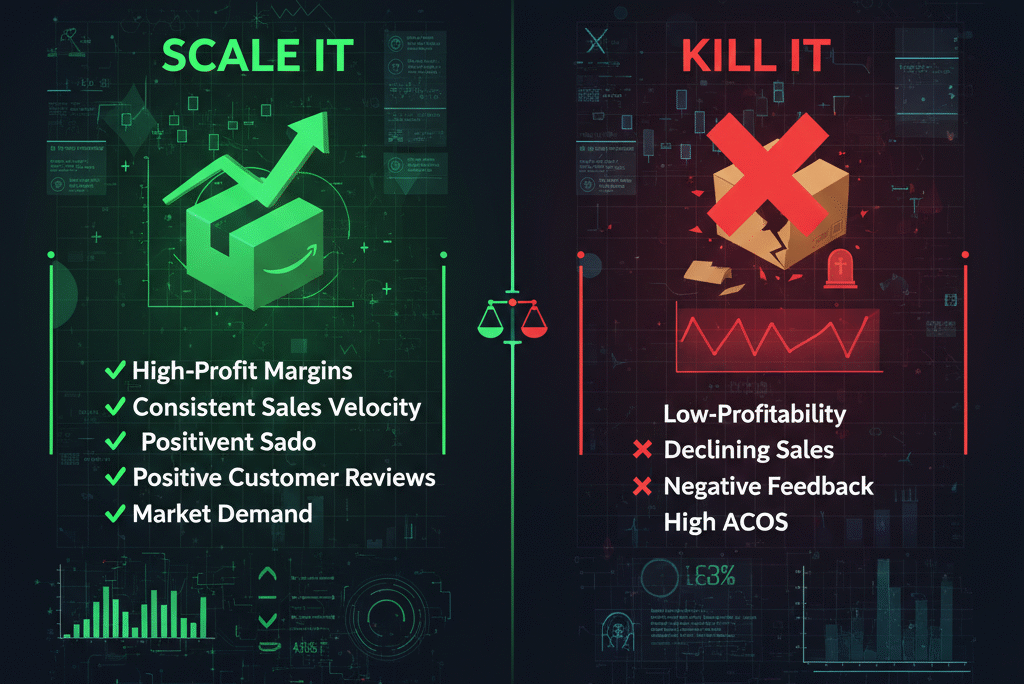
A product worth scaling shows three boring but beautiful traits: consistent demand, stable conversion rates, and predictable costs. Boring is good. Boring pays rent.
The First Green Light: Organic Sales Exist (And Aren’t Accidental)
If all your sales disappear the moment you pause ads, you don’t have a scalable product. You have a sponsored listing with delusions of grandeur.
Organic sales mean Amazon’s algorithm is starting to trust you. That trust comes from customers clicking, buying, not returning the product, and not setting it on fire in the reviews.
A healthy sign is when organic sales make up a meaningful chunk of your total orders and continue even when PPC is reduced—not eliminated, just reduced. This tells you your listing, pricing, and positioning are doing real work.
If organic sales never show up, scaling is premature. Fix the foundation first.
Conversion Rate Tells You More Than Revenue Ever Will
Revenue is loud. Conversion rate is honest.
A high conversion rate means customers understand your product, trust your brand, and feel the price makes sense. A low conversion rate means something is off—bad images, weak copy, poor reviews, mismatched keywords, or unrealistic pricing.
Here’s the key:
If your conversion rate improves as traffic increases, that’s a strong scale signal.
If it drops as traffic increases, scaling will magnify the problem.
Throwing more traffic at a leaky bucket doesn’t fill the bucket. It just makes a mess.
Reviews: Quantity Matters, But Quality Matters More
A product with 200 reviews and a 3.9 rating is far riskier than a product with 30 reviews and a 4.6 rating.
Why? Because bad reviews are sticky. They follow you into every future marketing decision. They raise your PPC costs, lower conversion rates, and scare off buyers who would have converted.
Before scaling, look at review patterns. Are complaints about things you can fix—packaging, instructions, a minor feature? Or are they about fundamental product flaws?
If the problem is fixable, improve the product before scaling. If the problem is structural, that’s your cue to consider killing it.
Margins Don’t Care About Your Feelings
Scaling increases everything: ad spend, inventory risk, storage fees, customer service issues, and stress. If your margins are thin now, they will get thinner later.
A product worth scaling can survive price pressure, ad fluctuations, and Amazon’s random fee changes without collapsing. That usually means you’re not barely scraping by at launch.
If you need perfect conditions to stay profitable, the product isn’t ready. Or worse, it’s never going to be.
This is where sellers get emotionally attached. They say things like, “Once we scale, margins will improve.” Sometimes that’s true. Often, it’s wishful thinking wearing a spreadsheet as a disguise.
Inventory Stress Is a Signal, Not a Badge of Honor
Running out of stock feels like success. It’s also one of the fastest ways to murder your ranking.
A product ready to scale has predictable sales velocity and lead times you can actually manage. If every reorder feels like a gamble and every shipment feels late, scaling will amplify chaos.
When your supply chain is fragile, killing the product might be kinder than forcing it to grow.
Scaling is not about speed. It’s about control.
When It’s Time to Kill a Product (And Why That’s Not Failure)
Let’s talk about the part nobody brags about on LinkedIn.
Some products should die.
Kill a product when:
- PPC never stabilizes, no matter how much you optimize
- Reviews highlight core issues you can’t fix without a redesign
- Margins shrink every time competition increases
- The product requires constant intervention to survive
Killing a product isn’t quitting. It’s capital allocation. The best sellers aren’t the ones who never fail—they’re the ones who fail fast and reuse the money wisely.
Every dead product teaches you something: about sourcing, branding, pricing, or demand. The real failure is dragging a bad product along because you’ve already invested time and money.
That’s sunk cost fallacy wearing a seller account.
The Middle Path: Improve Before You Decide
Not every product needs to be scaled or killed immediately. Some need fixing.
Before making the call, try improving one major variable at a time. Better images. Stronger branding. Revised pricing. Cleaner PPC structure. Improved packaging. Clearer copy.
If improvements lead to better conversion and organic growth, scaling becomes logical. If nothing moves the needle, the market has spoken. Loudly.
Amazon is brutally honest. It doesn’t care how hard you worked.
Scaling the Right Way (When the Signals Line Up)
When the signals align—organic traction, strong conversion, healthy margins, manageable inventory—scaling should be boring and methodical.
Increase ad spend gradually. Expand keyword coverage intentionally. Improve brand assets. Test small expansions before massive orders. Scaling is not a leap. It’s a series of controlled steps.
The goal isn’t growth for its own sake. It’s building a product that survives algorithm updates, competitors, and your own future decisions.
Final Thought: Products Are Experiments, Not Children
The fastest way to lose money on Amazon is treating products like emotional investments. They’re not. They’re experiments with data, timelines, and expiration dates.
Scale the ones that prove themselves. Kill the ones that don’t. And remember—your success as a seller isn’t defined by how many products you launch, but by how well you decide which ones deserve to live.
That’s the unglamorous skill that separates real brands from expensive hobbies.
If you’re stuck deciding whether to scale a product or cut it loose, you don’t have to figure it out alone. Our Amazon Private Label services are built around data-driven decisions—product research, branding, listings, and scaling strategies designed to grow real brands, not short-term wins. You can explore how we work and what we offer on our main service page here: Amazon Private Label Services.
For deeper insights from Amazon itself on optimizing product listings and scaling successfully within the marketplace, check out the official Amazon Selling Partner Blog — a hub of up-to-date tips and strategy advice straight from Amazon.