Quick Answer: Amazon PPC doesn’t create demand — it amplifies what’s already there. If your product, listing, or pricing is weak, ads accelerate the losses rather than reversing them. PPC works when it’s used to buy controlled visibility during launch, extract keyword intelligence, and scale listings that have already demonstrated they convert. High ACoS is almost never a bidding problem — it’s a conversion problem. Fix the listing first, then fix the ads. The sellers who understand this distinction build brands. The ones who don’t burn through budget wondering why nothing works.
The Uncomfortable Truth About Amazon PPC
Most sellers come to Amazon PPC carrying a specific expectation that nobody taught them to question. They’ve heard the stories — launch a product, activate campaigns, watch the orders come in. So they open Seller Central, create a few auto campaigns, set a £20 daily budget, and then stare at an ACoS of 75% two weeks later, trying to figure out what they did wrong.
The answer is: nothing. The campaigns did exactly what campaigns do. They put the product in front of people who were looking for it. The problem isn’t the campaigns — it’s the product, the listing, the pricing, or all three simultaneously. And PPC didn’t create those problems. It just made them visible faster than organic traffic ever would have.
This is actually PPC’s most undervalued function. Not as a profit engine. As a diagnostic tool. The Amazon marketplace is, at its core, a giant real-time consumer behaviour study, and PPC gives you access to the results in real time. What buyers click. What converts. What price point holds. What images stop the scroll. You can theorise about all of this from research. PPC shows you the reality.
The sellers who consistently lose money on Amazon PPC share one characteristic: they’re trying to buy results that the underlying business hasn’t earned yet. They’re using ad spend to substitute for product differentiation, listing quality, brand trust, and review social proof. Ads cannot substitute for any of those things. What they can do — when those things are in place — is take a working product and push it significantly faster and further than organic growth alone would allow.
Understanding that distinction, at a deep level, changes how you approach every single campaign decision.
What PPC Is Actually Doing in Your Business
Before getting into campaign structure or bid strategy, it’s worth being precise about the functional role PPC plays at each stage of a private label business. Clarity here changes everything downstream.
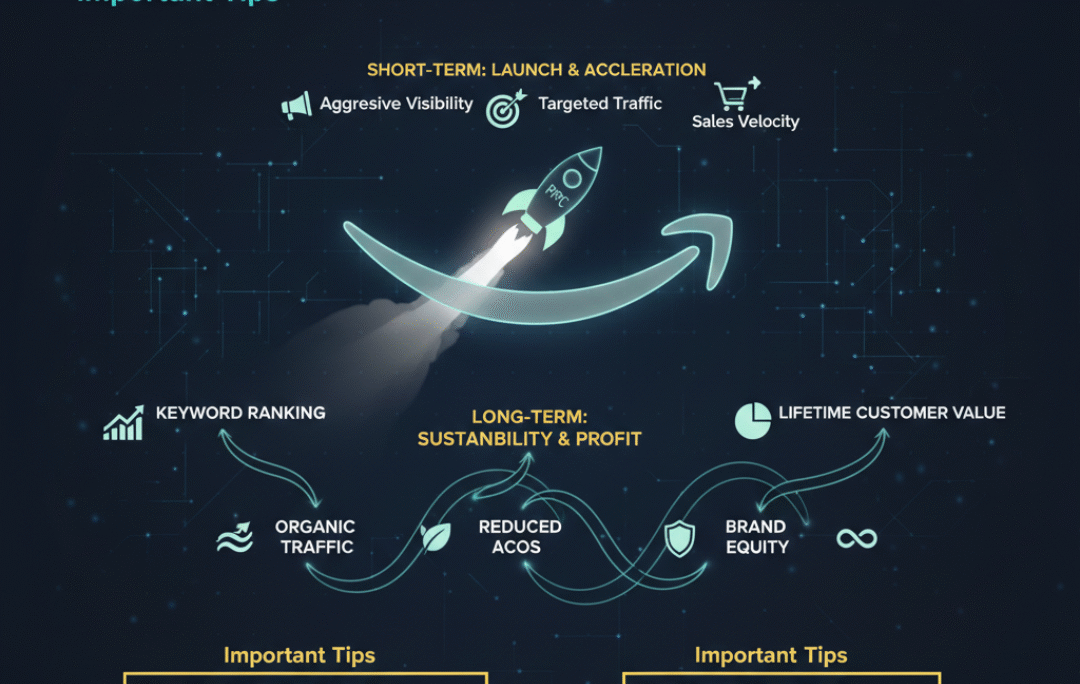
PPC buys visibility while organic rank builds. Amazon’s A10 algorithm — and its predecessor A9 — is fundamentally a performance-ranking system. Products with strong sales velocity, high conversion rates, and keyword relevance get shown to more buyers. New listings have none of those signals. They’ve made no sales, accumulated no conversion history, and haven’t demonstrated relevance to anything. Without intervention, a new listing gets buried on page four or five, where organic traffic is effectively zero. PPC is the intervention — it artificially generates the early sales signals that give Amazon enough data to evaluate the product and begin assigning organic rank.
PPC generates irreplaceable market intelligence. Every pound you spend on advertising comes back with information attached: which search terms actually led to purchases, what ACoS looks like across different keyword types, how the conversion rate changes across different dayparts, which product variations buyers are clicking on most, and how competitive your pricing is relative to what the market accepts. This data cannot be acquired any other way. You could run the most thorough pre-launch keyword research in the world and still not know how your specific product converts on your specific terms until real buyers with real money see it in a live marketplace environment.
PPC defends market position against active competition. A product that gains significant organic rank attracts competitors. They bid on your brand terms. They run Sponsored Product campaigns targeting your ASIN specifically. They appear in the “sponsored” slots on your product page, offering a similar product to customers who were already looking at yours. Without defensive campaigns, a meaningful percentage of your hard-earned organic traffic converts on competitors’ listings. Ads are how you close that door.
PPC enables controlled scaling of proven products. Once a listing has demonstrated that it converts — real buyers, real purchases, real conversion data — PPC is the lever that accelerates growth in a measurable, controllable way. More spend on proven converting terms produces predictable revenue at known unit economics. That’s a fundamentally different situation from launch PPC, where spending is exploratory and outcomes are uncertain.
These four functions are different enough that they require different campaign structures, different success metrics, and different mindsets. Treating all PPC as a single undifferentiated activity — “I’m running ads” — is why many sellers never improve their results despite months of adjustments.
Why Your PPC Isn’t Working Right Now
Before touching a single bid, these four variables need to be assessed honestly. If any one of them is broken, no amount of campaign optimisation will produce healthy economics. This is the most important diagnostic checklist in Amazon advertising.
Product-market fit. Is there genuine, documented demand for what you’re selling, at the price you’re charging, with the differentiation your product actually offers? Not demand in theory — demand evidenced by search volume, BSR movement, and competitor sales history. PPC cannot manufacture desire. It can only put your product in front of people who might already have it. If the product is in a market where the demand is thinner than the research suggested, or where the category is already saturated with established brands, PPC will make that reality expensive to discover.
Listing conversion rate. A well-performing Amazon listing converts somewhere between 10% and 20% depending on category, review count, and price competitiveness. Below 10%, there’s a listing problem. Below 7%, there’s a serious listing problem. The conversion rate measures what percentage of visitors choose to buy — and if that number is low, it means something in the listing is creating friction or doubt at the moment the customer is deciding. A main image that doesn’t communicate the product clearly, bullet points that don’t address the buyer’s core concern, a price that feels inconsistent with the visual presentation, or an A+ content section that’s either missing or generic — each of these suppresses conversion, and none of them are fixed by adjusting bids.
Pricing relative to competition. Amazon customers are comparison shoppers by default. The platform is built for it — alternative products are one scroll away at all times. If your product is priced above the category average without a clear, immediately visible reason to justify the premium, you will pay for clicks that convert on competitors’ listings. This isn’t always obvious at the research stage because the “right” price is specific to how your product is positioned and how strong the brand trust signals are in the listing. A premium price with exceptional photography, strong brand identity, and 200 verified reviews converts differently from a premium price with stock images and eight reviews.
Review count and quality. Fewer than 15 reviews doesn’t create a PPC problem — it creates a conversion problem that looks like a PPC problem. Traffic arriving on a listing with a handful of reviews and a competitor’s listing with several hundred will, in most categories, convert on the competitor. The star rating matters too. A 4.7 average across 200 reviews converts better than a 4.9 average across 12 reviews, because volume creates confidence that the star rating is representative rather than the result of friends and family orders. No bidding adjustment compensates for the trust deficit created by thin review coverage.
If any of these four areas is problematic, that gets addressed before significant budget goes into advertising. Not because PPC can’t run simultaneously with improvements — it can — but because every pound spent on PPC while any of these leaks remain is partially wasted. Fix the leak, then fill the bucket.
Phase 1 — Launch PPC: Paying for Information, Not Just Sales
During the launch phase, the realistic expectation is that campaigns will lose money. This isn’t a failure state — it’s the cost of acquiring market intelligence, and it’s dramatically cheaper than the alternative of scaling blind and discovering conversion problems when you’ve committed your full inventory budget.
The campaign structure at launch serves a specific purpose: covering the keyword universe from multiple angles to surface where real demand lives.
Auto campaigns are the broadest net. Amazon selects placements based on its own understanding of your listing’s content, product type, and category. Auto campaigns often surface unexpected converting terms that keyword research missed — adjacent searches, different phrasing of the same intent, complementary product terms. They’re inefficient by design, but the data they generate is worth the cost. Set a modest daily budget, let them run for two to three weeks without heavy interference, and mine the search term reports for signals.
Broad match manual campaigns on your core category terms expand the edges of your keyword coverage. Broad match allows Amazon to match your ad to variations, related terms, and synonyms of your target keyword. It catches buyers who describe the problem in slightly different language. Like auto campaigns, broad match produces significant irrelevant traffic alongside useful data — which is why aggressive negative keyword management from week two onwards is essential.
Phrase match campaigns on your most important terms provide a middle ground between broad exploration and tight exact-match control. They require your target keyword to appear in the search query in order, which filters out the loosest matches while still capturing long-tail variations.
Exact match campaigns on your clearest, highest-intent terms ensure visibility on the searches that most directly describe what you’re selling. These will often have higher CPCs because competition for exact match placement is more direct, but they produce the cleanest data about whether your listing converts on its most relevant traffic.
During launch, the question being asked is not “how do I achieve target ACoS?” — it’s “if qualified buyers see this product, do they purchase it?” Conversion rate on your exact-match core terms is the most important number to watch. If it’s strong, the listing is working and scaling is justified. If it’s weak, something in the listing is breaking the sale.
Amazon’s own Sponsored Products documentation is worth reading before setting up your first campaign structure. It explains precisely how the ad auction works, what signals influence ad placement, and what the platform is designed to reward — which aligns directly with the approach above.
Keep launch budgets controlled and data-focused. Over-spending before conversion data is established means paying more to learn the same things more slowly. Tight, structured campaigns on a modest daily budget — enough to generate meaningful impression and click volume — teach you everything the expensive version would, in the same timeframe.
Negative keywords deserve early and consistent attention. From week two, pull the search term report, identify queries that are driving clicks without conversions, and add them as negatives. Left unmanaged, these terms accumulate over time and become a significant source of budget waste that becomes harder to trace the longer it runs. Category-level search terms with no purchase intent, irrelevant product types, competitor brand names (in most strategies), and broad generic terms with low purchase signal are typical early negatives.
Phase 2 — Scaling PPC: From Discovery to Dominance
Once you have confirmed converting keywords — terms where buyers are both clicking and purchasing at a frequency and price point that the margin model supports — PPC changes roles entirely. The exploratory phase is complete. The objective now is to push proven terms up organic rankings and build the sales velocity that reduces dependence on paid traffic over time.
The TACoS distinction is critical here and most guides skip it entirely. ACoS (Advertising Cost of Sale) measures ad spend as a percentage of ad-attributed revenue only. TACoS (Total Advertising Cost of Sale) measures ad spend as a percentage of total revenue — paid and organic combined. During scaling, these two metrics tell different stories.
A falling TACoS over a three to six month period, even while absolute ad spend increases, indicates that organic revenue is growing faster than ad spend. That’s the sign of a healthy scaling business. Organic rank is improving, more traffic is arriving without paid intervention, and the flywheel is turning. An ACoS that looks stable or slightly elevated in this context is not a concern — the business is becoming more efficient even if the individual campaign metric doesn’t show it.
An ACoS that’s falling because you’re cutting bids aggressively, meanwhile, may be accompanied by a rising TACoS — because the rank you built is eroding as ad support is removed prematurely. This is one of the most common scaling mistakes: celebrating ACoS improvement while inadvertently destroying the organic position that made the business economics work.
Harvesting and promoting converting search terms is the core activity of this phase. Pull search term reports weekly, identify terms with consistent conversion history, and move them into tight exact-match campaigns with controlled bids. These become your performing portfolio — the campaigns you protect, monitor closely, and fund generously because every pound spent here has a known return.
Non-converting spend gets cut methodically, but not recklessly. A term that has driven 30 clicks and zero purchases is probably not converting and can be paused. A term that has driven 8 clicks and zero purchases hasn’t received enough traffic to draw conclusions — it needs more data before a decision is made.
Dayparting — adjusting bids based on the time of day and day of week — is an advanced tactic that can meaningfully improve efficiency once you have conversion data segmented by time. If your conversion data shows that purchases happen disproportionately between 7pm and 10pm on weekdays, and your current campaigns are spending equally at 3am when nobody is buying, you’re wasting a material percentage of your budget. The Dayparting Analyzer at ecommate.co.uk/tool-box/dayparting-analyzer/ is built exactly for this analysis — it identifies the time patterns in your conversion data so you can concentrate spend where it produces results rather than distributing it equally across hours that don’t perform.
Sponsored Brand campaigns become relevant at this phase for sellers with brand registry. Sponsored Brands appear at the top of search results above the product grid and command premium visibility. They don’t replace Sponsored Products campaigns — they complement them, providing a brand-level presence on category searches while individual product campaigns capture the more specific intent. For categories with strong brand recognition dynamics, this double presence on high-volume terms significantly increases overall market share of the search results page.
Phase 3 — Brand Defense: The Quiet War Most Sellers Ignore Until It’s Too Late
Once a product achieves meaningful traction — first-page organic rank, consistent sales velocity, a growing review base — the competitive dynamic changes. You’ve built something worth taking, and competitors have noticed.
The most direct attack is bid competition on brand terms and product-specific ASIN targeting. Sellers who identify high-converting products in their category will run campaigns targeting your ASIN specifically, appearing in the sponsored placements on your product page and detail page with “Sponsored products related to this item” placements. These are your customers, already on your listing, being shown an alternative. Without campaigns defending those positions, some of them will click through and convert elsewhere.
Brand keyword campaigns ensure that when customers search for your brand name specifically — after seeing your product in ads, after a friend recommended it, after a social media mention — your product appears in the top sponsored position rather than a competitor’s. This sounds obvious but is frequently neglected until a brand search term starts showing high impression volume going to a competitor’s product.
ASIN-targeting campaigns on your own product defend the detail page placements. By bidding on your own ASINs in a Sponsored Products campaign with product targeting, you fill the sponsored placements that would otherwise be occupied by competitors. The CPCs are typically low because you’re bidding against yourself effectively, and the cost is justified by the traffic you retain that would otherwise leave the page.
Sponsored Display retargeting allows you to re-engage buyers who viewed your listing but didn’t convert. These campaigns appear off-Amazon as well as on-platform, reminding potential customers of the product they were considering. Conversion rates for retargeting traffic tend to be higher than cold traffic because the buyer has already demonstrated category interest and product-specific attention.
The sellers who experience “unexplained” conversion drops after a period of strong organic performance are almost always losing this quiet war. Competitors have identified the traffic and are systematically redirecting a portion of it. The fix is not mysterious — it’s campaign coverage of positions you’ve left undefended.
Why Generic Products Pay More for PPC — and Always Will
This dynamic deserves its own explanation because it’s not immediately obvious from looking at campaign dashboards.
Amazon’s ad auction is not simply a highest-bid-wins system. It’s a relevance-weighted auction where placement is determined by a combination of bid and expected performance. Expected performance is based on historical data about your listing’s click-through rate and conversion rate for a given search term. A listing with strong CTR and conversion history pays less per conversion — over time — than a listing with weak CTR and conversion history bidding the same amount, because Amazon’s algorithm favours sending traffic to listings where it’s more likely to result in a purchase.
A generic product with a forgettable main image, no brand identity, weak social proof, and average listing copy will have both lower CTR (fewer people click on it in search results) and lower conversion rate (fewer people who arrive on the listing buy). Both of these signals tell Amazon’s auction system that traffic sent to this listing is less likely to produce a sale, which means the listing needs to bid higher to compete for the same placements. Over time, the cost-per-conversion structurally increases.
A branded product with strong photography, a coherent visual identity, a compelling main image that clearly communicates a reason to buy, and consistent listing quality earns better CTR and conversion — which lowers its effective cost-per-conversion in the same auction. The brand investment is financially expressed in advertising efficiency, not just in intangible “brand equity.”
This is why sellers who under-invest in branding and over-invest in bids are playing a structurally losing game. They’re trying to purchase placement that better listings would earn at lower cost. The gap compounds over time rather than closing.
Using PPC Data to Fix Listing Problems
When ACoS is high and conversion is low, the instinct most sellers follow is to cut bids. This is usually the wrong response. Lower bids reduce visibility, which reduces clicks, which reduces the data volume needed to diagnose the actual problem accurately. It’s the equivalent of turning the lights down to get a better look at something.
The correct approach is to understand precisely where in the funnel the breakdown is occurring.
Impressions are adequate but CTR is low. The listing is appearing in search results and buyers are choosing not to click. The problem is almost always the main image, the price, or the visible title text. The main image is the most powerful click driver in Amazon search — it’s what stops or continues a scroll within milliseconds. A main image that doesn’t communicate the product clearly, that doesn’t differentiate visually from the surrounding results, or that doesn’t create an immediate sense of quality for the price point will produce low CTR regardless of bid. This is a creative problem, not a campaign problem.
CTR is adequate but conversion rate is low. Buyers are clicking through to the listing and leaving without purchasing. The problem is in the listing body — the secondary images, the bullet points, the A+ content, the reviews, the price. Something on the page is either creating doubt or failing to create sufficient confidence to complete the purchase. This requires identifying what the specific friction point is, which is harder than identifying a CTR problem but equally fixable.
Conversion rate varies significantly across keyword types. A high conversion rate on exact-match brand terms but low conversion on category terms suggests that buyers who already know the brand are committing, but cold buyers who discover the product through category searches aren’t convinced. This points to a listing that hasn’t done enough work to communicate its differentiation to a first-time visitor — the brand familiarity is carrying conversions that the listing quality alone wouldn’t.
Understanding how search behaviour maps to actual sales is one of the most valuable diagnostic activities available, and it requires combining multiple data sources properly. The SQP-STR Combo Analyzer at ecommate.co.uk/tool-box/sqp-str-combo-analyzer/ is built for exactly this — it combines Search Query Performance data with Search Term Report data so you can see organic visibility and paid performance side by side for the same keywords. Instead of bouncing between two reports and trying to reconcile them manually, you can see the full picture in one place: which terms are driving organic traffic, which are driving paid clicks, and which are converting across both. That combination identifies where the real leverage is in a way that neither report achieves on its own.
If you’re trying to calibrate whether your current ACoS is a campaign strategy problem or a category reality, WordStream’s benchmarks for Amazon advertising performance across categories provide a useful independent reference point — grounded in aggregated campaign data rather than platform claims.
Match Types: How to Use Them Without Wasting Budget
Match types are one of the most misunderstood levers in Amazon PPC, and using them incorrectly is responsible for a significant portion of wasted ad spend across most seller accounts.
Broad match casts the widest net. Amazon can match your ad to queries that include your keyword’s words in any order, along with related terms and synonyms. Broad match is for exploration — finding search terms you didn’t know were relevant. It’s not for efficiency. Running exclusively broad match campaigns is like leaving all the windows and doors open in winter. You’ll find things, but you’ll lose a lot of heat doing it.
Phrase match requires your keyword to appear in the search query in sequence, though additional words can appear before or after. This filters the loosest matches while still capturing long-tail variations. Phrase match is useful for keyword families where the core term matters but you want to capture the full range of associated queries.
Exact match only triggers on the specific keyword and its close variants. No extra words, no reordering. Exact match is for your best-performing, highest-confidence terms — the keywords with documented conversion history that you want to control tightly and bid on deliberately. These are your most valuable campaign assets and they deserve the most attention.
The typical maturing campaign structure moves from broad and auto at launch — exploration and discovery — toward a progressively higher proportion of phrase and exact at scale, as the search terms worth targeting are identified and committed to tight campaigns with controlled bids. Broad campaigns continue running in the background to surface new terms, but the bulk of the budget concentrates on what’s proven.
Negative keywords apply across all match types and deserve as much ongoing attention as positive keywords. A term that has never converted after meaningful traffic is a drain on budget that funds the campaigns that matter. Building a negative keyword library from the search term report — added weekly rather than monthly — is one of the highest-leverage low-effort optimisations available.
Long-Term PPC: When Ads Become a Strategic Asset
At scale, the PPC experience changes character completely. The panic is gone. Budgets behave predictably. The relationship between ad spend, organic rank, and total revenue is understood clearly enough to be managed deliberately.
Mature campaign strategy uses advertising for specific, targeted objectives rather than general visibility maintenance. Launching new variations of proven products into an established keyword framework. Expanding coverage into adjacent search terms as organic authority grows. Capturing seasonal demand spikes that organic rank alone won’t capture fast enough. Testing pricing elasticity at controlled scale. Supporting external traffic from influencer partnerships or social media by maintaining conversion infrastructure.
These are offensive decisions from a position of business strength — not defensive spending to maintain a fragile organic position.
The myth of “turning off PPC once you rank” is expensive. Organic rank is not a permanent achievement. It’s a competitive position. Competitors are actively working to displace it — through advertising, through product improvements, through pricing adjustments, through review generation. The decision to remove ad support from a product that has earned organic rank is a strategic choice to concede a share of that position over time. The right ongoing question isn’t “can I stop running ads yet?” — it’s “what is the minimum efficient ad spend required to maintain and extend this position?”
The answers to that question, over a successful product’s lifetime, produce steadily lower TACoS as organic revenue grows and the absolute ad spend required to maintain position decreases relative to total revenue. That trajectory — not a specific ACoS number at any single point — is what a healthy PPC strategy looks like over time.
How PPC Fits Into the Full Private Label System
PPC amplifies what works. That is its entire function. A product with genuine differentiation, a listing that converts visitors into buyers, professional imagery that builds trust at a glance, and a growing base of verified reviews will produce strong PPC results and ultimately strong organic results. A product without those characteristics will produce expensive PPC results regardless of how intelligently the campaigns are structured.
The sellers who consistently win with Amazon advertising are the ones who understand PPC as one component in a system — one that includes product validation, brand positioning, listing quality, review strategy, pricing discipline, and financial planning that accounts honestly for the investment period before profitability. When every element of that system is functioning, PPC is the accelerant that turns a working product into a growing brand.
When any element of the system is missing, PPC becomes the most visible symptom of the deeper problem — the thing that drains the budget while the real issue goes unaddressed. Recognising which situation you’re in is the first and most important decision in Amazon advertising.
If you want to understand how PPC fits into a complete private label growth strategy — and what the full system looks like when it’s operating properly — start here: ecommate.co.uk