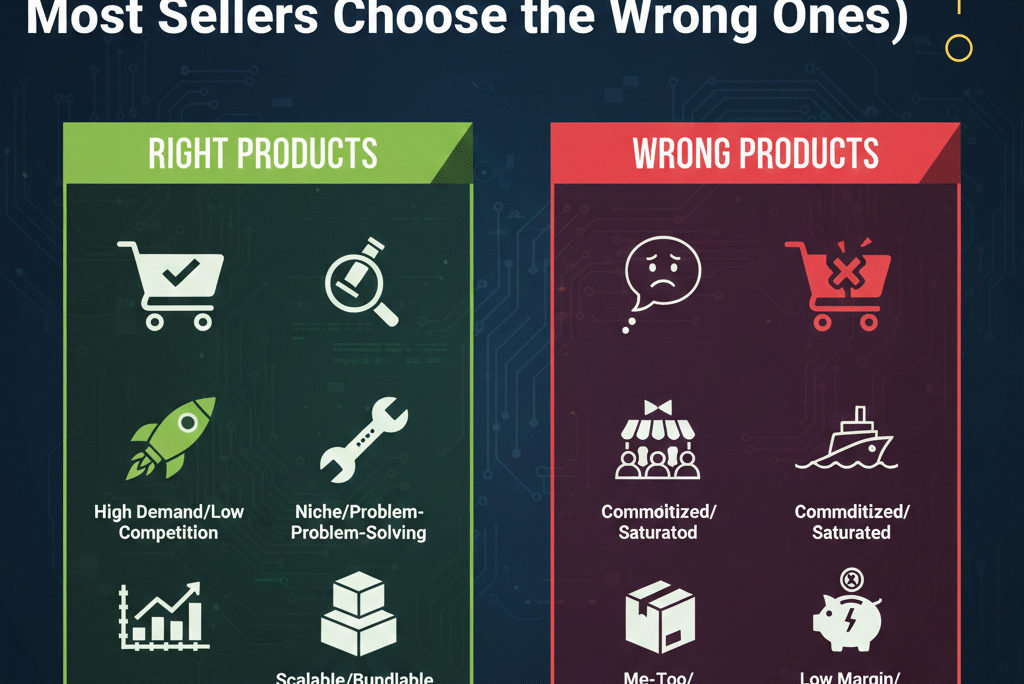
Quick Answer: What Products work best? The eBay private label products that consistently perform well share a specific profile: they solve practical, functional problems, have low brand loyalty in their category, benefit from clear and accurate listing descriptions rather than lifestyle branding, and attract buyers who are searching with high purchase intent rather than browsing for inspiration. The strongest categories include automotive accessories, home improvement and DIY tools, storage and organisation products, pet accessories, low-tech electronics accessories, office and work-from-home essentials, and replacement parts. Products that rely on trend-driven demand, emotional branding, or social proof from external platforms almost always underperform on eBay.
Why eBay Private Label Is Undervalued — and Why That’s an Opportunity
eBay doesn’t get the private label attention that Amazon does. The YouTube channels, the courses, the Reddit threads, the seller communities — the overwhelming majority of that content is Amazon-centric. eBay is treated as the afterthought, the platform for second-hand goods and liquidation stock, the place you go when Amazon rejects your application or your product gets suppressed.
This perception is wrong, and the gap between perception and reality is exactly where the opportunity sits.
eBay has over 132 million active buyers globally. It processes hundreds of millions of transactions annually. In specific categories — automotive parts and accessories in particular — it generates more commerce than Amazon does. And because the seller community’s collective attention is focused elsewhere, the competitive landscape on eBay for private label products is materially less saturated than the equivalent landscape on Amazon.
The sellers who succeed at eBay private label tend to share one characteristic: they understand that eBay’s buyer is fundamentally different from Amazon’s buyer, and they select and position products accordingly. Sellers who copy-paste Amazon private label logic onto eBay — flashy brands, lifestyle photography, emotional positioning — consistently underperform. Sellers who understand eBay’s specific buyer psychology and choose products that align with it build stores that are less competitive, more stable, and often significantly more profitable per unit than their Amazon equivalents.
Understanding the buyer is where product selection starts.
How eBay Buyers Actually Think (And Why It Changes Everything)
Amazon buyers often arrive with browsing intent — they have a general need, they search for a category, and they evaluate products against each other through a combination of images, reviews, Prime eligibility, and brand recognition. Trust is partly platform-level: Amazon’s fulfilment guarantee reduces buyer risk, which creates more tolerance for lesser-known sellers.
eBay buyers, by contrast, tend to arrive with specific, problem-driven search intent. They know what they need. They searched for it specifically. They are comparing options on the basis of accuracy, compatibility, price, and seller reputation — in that order. The emotional and aspirational dimensions that influence Amazon purchases play a much smaller role. The logic-driven dimensions — does this product do exactly what I need, does the description match what I’m looking for, does the seller have the track record that makes this purchase feel safe — are dominant.
This is why eBay buyers read descriptions carefully. It’s why compatibility specifications, material details, and dimension accuracy matter more on eBay than on Amazon. It’s why a listing with a clear, specific, technically accurate description outperforms a listing with aspirational photography and vague copy. And it’s why private label products that rely on brand perception to drive conversion — products where the brand name is doing the trust work — consistently underperform on eBay. The brand name means nothing to an eBay buyer who has never encountered it before. What means something is: does this listing give me the specific information I need to be confident this is the right product?
eBay’s Cassini algorithm reinforces this dynamic. Cassini evaluates and ranks listings based on a combination of seller performance metrics (feedback score, shipping speed, return rate), listing quality (accurate titles, complete specifications, relevant category placement), and buyer behaviour signals (click-through, purchase completion, return rate). Products that attract high-intent buyers, deliver accurate descriptions, and generate low return rates are rewarded algorithmically with better placement. Products with inflated claims, compatibility ambiguity, or poor seller performance metrics lose placement over time regardless of how competitive their pricing is.
Product selection, therefore, is not just about choosing categories with demand. It’s about choosing products that lend themselves to the clear, accurate, functional presentation that eBay’s buyers require and eBay’s algorithm rewards.
Category 1: Automotive Accessories and Tools
Automotive is eBay’s strongest private label category, and the reasons are structural rather than circumstantial.
Car ownership creates an ongoing, predictable stream of practical needs. Something breaks. Something needs maintaining. Something needs upgrading for function rather than aesthetics. The buyer searching for an OBD-II diagnostic scanner, a set of LED interior lights, a car organiser for the back seat, or a tyre inflator that actually fits in the boot is not browsing for inspiration. They have a vehicle, they have a need, they have done enough research to know what they’re looking for, and they want to find it at a fair price from a seller they can trust.
The brand loyalty dynamics in automotive accessories are unusually favourable for private label. Most buyers do not have a preferred brand for a diagnostic scanner. They have preferred specifications — compatibility with their vehicle’s OBD-II port, support for specific fault code readers, a display that’s readable in daylight. A private label product that clearly matches those specifications, from a seller with a strong feedback score, competes effectively with established brand names because the category’s purchase decision is specification-driven rather than brand-driven.
The product range within automotive accessories is also well-suited to private label’s strengths. Car organiser systems can be differentiated by capacity, mounting mechanism, and material quality. Cleaning tool kits can be bundled by application — interior detailing sets, exterior wash kits — to create unique listings that don’t compete directly with individual commodity items. LED accessories can be differentiated by colour temperature, fitment compatibility, and ease of installation. Tyre inflators can be positioned around digital pressure accuracy, portability, or multi-use capability.
What makes automotive listings succeed on eBay is technical accuracy over everything else. Vehicle compatibility information — “compatible with Ford Focus 2015–2021,” “fits 12V standard sockets in most passenger vehicles manufactured after 2010” — gives the buyer the confirmation they need that this product is for their situation. Measurements, weight limits, and material specifications answer the practical questions before they become doubt. Images that show the product installed in a real vehicle context, at scale, provide visual confirmation that written descriptions cannot fully achieve.
The automotive category also benefits from strong repeat purchase potential. A buyer who purchases a reliable cable organiser from a private label seller and has a good experience knows where to return when they need a compatible accessory or a replacement. Building that repeat purchase dynamic early creates compounding value that commodity sellers without a consistent brand presence cannot achieve.
Category 2: Home Improvement and DIY Tools
eBay’s home improvement and DIY category attracts a specific buyer type that is particularly well-suited to private label: the practical problem-solver who knows exactly what they need and is searching for it with full purchase intent.
The search patterns in this category tell the story. Buyers search for “replacement bathroom tap cartridge,” “door handle repair kit for internal doors,” “drill bit set for tile and masonry,” “grout repair kit white.” These are not exploratory searches. They’re searches from someone standing in front of a specific problem, looking for the specific solution. This specificity of intent is the highest-quality traffic available on any platform — buyers who arrive knowing what they need convert at significantly higher rates than buyers who arrive browsing.
Private label in this category succeeds when it meets that intent precisely. A drill bit set that lists the specific materials it’s rated for, the shank diameter, the bit sizes included, and compatibility with standard three-jaw chucks gives the buyer everything they need to confirm this is the right product for their situation. A plumbing repair kit that clearly describes which fitting sizes it covers, what materials it’s compatible with, and what tools are required for installation answers the questions a competent DIY buyer will ask before purchasing.
Bundling is particularly powerful in home improvement private label. The buyer who needs to replace a door lock set doesn’t just need the lock — they may also need the strike plate, the screws in the right size, and the instructions that explain how the installation works for their door type. A bundle that includes those related components at a price point that’s competitive with buying them separately creates genuine value for the buyer while differentiating the listing from single-component commodity competitors.
The competitive landscape in home improvement is also more fragmented on eBay than on Amazon. Large brands dominate certain subcategories, but the specificity of the problem-solving purchases in this category creates thousands of niches where private label can hold strong position. The seller who is the best-positioned option for “bathroom tap cartridge replacement kit for Bristan single lever taps” does not need to compete with Bristan’s own listings — they need to be the clearest, most confidence-inspiring option for that specific search query.
Category 3: Storage, Organisation, and Utility Products
If a product solves a clutter or organisation problem, it has a consistent buyer base on eBay — and the category’s characteristics make it particularly accessible for private label sellers.
The demand in storage and organisation is driven by a universal consumer frustration: physical spaces that don’t efficiently accommodate the things that need to be stored. Home offices that have accumulated cables without a management system. Garages with tools distributed across flat surfaces without dedicated storage. Kitchen drawers that contain a mixture of items without separators. Wardrobes that don’t efficiently use vertical space. Every one of these frustrations generates specific search queries from people who have decided to address them — and those search queries are the entry points for storage and organisation private label sales.
The brand loyalty characteristics in this category are extremely favourable for private label. Buyers searching for drawer organiser inserts do not have a preferred brand. They have preferred dimensions — specifically, dimensions that will fit the exact drawer they’re trying to organise — and preferred materials, usually defined by whether the product needs to be water-resistant, load-bearing, or visually neutral. A private label product that addresses those specific requirements clearly in its listing competes effectively with any established brand in the category.
Differentiation in storage products takes several practical forms. Size variations — offering the same product in multiple dimension configurations, each in a separate listing or as a variation within a single listing — capture buyers who have different spatial constraints. Material variations — drawer inserts in bamboo, polypropylene, or metal mesh — serve different aesthetic and functional preferences. Use-case specificity — a cable management kit explicitly designed for standing desk setups, or a garage hook system explicitly designed for tool handles rather than sports equipment — attracts buyers whose specific application the listing speaks to directly.
The visual presentation of storage products deserves particular attention. Buyers in this category are making a spatial judgement: will this fit in my space, will it hold what I need it to hold, does it look the way I want it to look in context? Images that show the product in realistic use situations — a drawer organiser actually filled with the type of items it’s designed for, shown against a measuring tape to convey scale — answer those questions more efficiently than any amount of descriptive text. On eBay, where listings are text-heavier than Amazon’s image-forward format, supplementing strong text specifications with clear, contextual photography is a meaningful competitive advantage.
Category 4: Pet Accessories
The pet accessories category on eBay is substantially different from its Amazon equivalent, and understanding that difference is what makes private label work here.
Amazon’s pet category is heavily dominated by brand-conscious buyers. Premium pet food brands, designer collar brands, and lifestyle-oriented pet product ranges perform strongly there because a portion of Amazon’s pet buyer base treats pet ownership as an expression of lifestyle and identity. Expensive, beautifully packaged, aesthetically-led pet products find their audience on Amazon because the buyer is receptive to brand cues.
eBay’s pet buyers skew practical. They’re often searching for specific functional products — a replacement harness in the right size for a breed-specific measurement, a food bowl stand at the height appropriate for a large dog’s joint health, a grooming tool for a specific coat type, a travel carrier that meets airline cabin specifications. These are problem-solving purchases, not identity purchases. The brand name of the harness means considerably less than the chest measurement range, the escape-proof latch mechanism, and the visibility of the rating for the weight class the buyer’s dog falls into.
This creates clear private label opportunity in specific segments. Functional pet leads and harnesses, where clear sizing information and hardware durability are the primary purchase criteria. Grooming tools, where the specific coat type compatibility and tool specifications drive the decision. Pet travel accessories, where weight limits, dimensions, and ventilation specifications are the dominant decision factors. Feeding accessories, where elevation, material (stainless steel vs. ceramic vs. plastic), and bowl capacity are the relevant specifications. Training aids and behaviour management tools, where mechanism clarity and user instructions matter more than branding.
The private label advantage in pet accessories comes from the combination of specification clarity and reliable quality. eBay pet buyers who have been disappointed by generic products that didn’t match their specifications or failed quickly are cautious buyers — they read descriptions carefully, check seller feedback, and are more likely than the average buyer to leave detailed reviews that reflect on both product quality and listing accuracy. Getting those two things right from the start builds the seller feedback profile that drives long-term category performance.
One important distinction: pet accessories that touch animals directly — harnesses, collars, leads, and anything used as a restraint — need to communicate material safety and load-bearing specifications clearly. Buyers whose dog’s safety depends on a lead not failing have a higher threshold of anxiety before purchase, which requires more specific reassurance in the listing than an equivalent inanimate product would need.
Category 5: Low-Tech Electronics Accessories
The electronics accessories category on eBay is not about competing with consumer electronics brands. It’s about serving the massive, constant replacement and upgrade demand that exists for the accessories those brands don’t focus on.
The private label opportunity here is structural: every smartphone, laptop, tablet, desk setup, and home entertainment system generates ongoing accessory demand. Cables degrade and stop working. Mounts and stands get lost in moves. Cases crack and need replacing. Adapters become obsolete as device standards evolve. The buyer for these products is not shopping for prestige — they’re shopping for compatibility and reliability at a fair price point, and they arrive on eBay having already decided the product category they need.
Charging cables are the most obvious example. A well-described cable listing that clearly specifies the connector types at each end, the charging speed supported (USB-C Power Delivery specification, for example), the cable length options, and the device compatibility range serves a buyer who needs that specific cable without requiring any brand recognition to convert. The private label seller who provides that specificity clearly and accurately, at a competitive price, with a strong feedback history, competes effectively with cables from established brands at significantly higher price points.
The bundle opportunity in electronics accessories is particularly strong because accessory needs tend to cluster. A buyer setting up a new desk setup might need a monitor stand, a cable management tray, a USB hub, and a laptop riser. A listing that bundles several of these complementary items creates a more valuable purchase for the buyer — one unit sale that solves multiple related problems simultaneously — while reducing the direct price comparison that makes individual commodity accessories difficult to differentiate.
Compatibility specificity is the dominant trust signal in electronics accessories listings. “Compatible with MacBook Pro 2019–2023, MacBook Air 2018–2023, and all devices with USB-C charging” is more persuasive to the right buyer than any brand name, because it directly answers the question that drives or blocks the purchase decision.
Category 6: Office and Work-From-Home Essentials
The sustained growth of remote and hybrid working has created a durable, long-term category of practical purchasing demand that shows no signs of reversing. Buyers equipping home offices are practical purchasers — they want products that work reliably, fit their available space, and improve daily workflow without requiring significant effort to set up or maintain.
eBay’s office buyer tends to be even more function-focused than the category’s Amazon equivalent. They’re less likely to be influenced by lifestyle aesthetics and more likely to be evaluating specific functional benefits: does this monitor riser give me the exact height adjustment I need? Will this cable management tray fit under my specific desk profile? Does this desk organiser have the specific compartment configuration that accommodates a particular combination of items?
The strongest private label opportunities in this category are products that address specific daily friction points. Monitor risers that clearly specify height, width, and weight capacity for different monitor setups. Cable management solutions that provide specific measurements and installation hardware for different desk types. Desk organiser systems with explicit compartment dimensions so buyers can verify their equipment fits. Ergonomic accessories — footrests, wrist rests, laptop stands — with clear specification of adjustment ranges and weight capacity.
The wfh category also benefits from bundling logic. Office setup components tend to be purchased in clusters — a buyer who needs a monitor riser may also need a compatible cable management solution and a desk pad. Listings that bundle these related items create clear value while making direct price comparison on individual items less central to the purchase decision.
Listing quality in this category needs to work harder than in most others because the products are functional rather than visually dramatic. A cable management tray photographed in perfect lighting is still a cable management tray — the visual excitement ceiling is low. What compensates is specificity and clarity: detailed dimensions, clear before-and-after use images, installation information that reduces buyer anxiety about whether they can set it up correctly.
Category 7: Replacement Parts and Maintenance Items — The Most Underrated Category
Replacement parts and maintenance items represent what may be the highest-quality buyer intent available in eBay private label, and the category is consistently underestimated by sellers who focus on more visually interesting products.
The buyer intent in this category is, by definition, maximum. A buyer searching for a replacement water filter cartridge for a specific appliance model has already identified the problem, already decided to fix it rather than replace the appliance, and already determined the specific part they need. They’re not considering whether to buy — they’ve already decided. They’re evaluating which listing most clearly confirms this is the right part and which seller they can trust to fulfil the order reliably. The purchase decision is almost entirely determined by listing accuracy, seller feedback, and price.
This creates a private label environment where branding is essentially irrelevant and specification accuracy is everything. The buyer searching for “replacement filter cartridge for Samsung side-by-side refrigerator model RF28R7351SR” is not going to choose a listing because the brand name on the product is appealing. They’re going to choose the listing that most clearly confirms this cartridge is compatible with their specific model, from a seller with strong positive feedback history, at a competitive price.
The research methodology for replacement parts is also more specific than other categories, and it’s worth understanding. Identifying which appliance models, machines, or systems have high ownership rates but underserved aftermarket parts supply requires cross-referencing product popularity data with parts availability. Products with high installed base — common household appliances, standard power tools, popular HVAC systems — but fragmented or unreliable existing parts supply create the strongest opportunity. Once compatibility is confirmed and a reliable supplier is identified, the listings almost write themselves: model numbers, part numbers, compatibility range, and installation guidance.
Repeat purchase rates in replacement parts are among the highest in eBay private label. A buyer who successfully replaces a water filter cartridge from a specific seller will return to the same seller when the cartridge needs replacing again — typically every three to six months depending on the product. Building a catalogue around consumable replacement parts, where the same buyer returns multiple times per year, creates compounding value from each acquired customer that single-purchase product categories cannot match.
For research into which replacement part categories have real search demand behind them, using eBay’s official Product Research tools to analyse actual sales data and trend movements provides a reliable foundation — it surfaces what buyers are actively purchasing rather than what appears theoretically attractive.
Products That Consistently Underperform in eBay Private Label
Understanding what to avoid is as strategically valuable as understanding what works.
High-fashion and apparel items struggle on eBay private label because the category’s trust dynamics are difficult to establish for unknown brands. Fashion buyers on eBay are often looking for specific known brand names at discounted prices, or vintage pieces with established value. A new private label clothing brand without brand recognition or social proof finds it difficult to generate the conversion rates needed to build positive feedback history quickly enough to become competitive.
Trend-driven and viral products carry the same risks on eBay as they do on Amazon — but eBay’s slower listing velocity and less algorithm-driven discovery mean that trend products may not generate meaningful sales volume before the trend dissipates. eBay rewards consistent, sustainable demand rather than short-cycle viral activity.
Products that rely heavily on lifestyle branding or aspirational positioning to justify their price point struggle because eBay’s buyer is less receptive to those signals. A skincare product that commands a premium through aesthetic packaging and brand storytelling will typically underperform compared to the same product sold with functional specifications and a lower price point that the platform’s value-oriented buyers find more convincing.
Highly regulated products — health supplements, electrical equipment requiring certification, products involving food contact or safety compliance — carry regulatory complexity that disproportionately affects smaller private label sellers. The resources required to navigate compliance correctly, and the risk profile of getting it wrong, often exceed the category opportunity for a new seller.
What Makes a Product Truly eBay-Optimised
Beyond category selection, the specific characteristics that make individual products perform on eBay private label follow a consistent pattern.
The product solves a problem that the buyer can articulate in a search query. This specificity of problem-to-query alignment is what drives high-intent traffic. A drawer organiser for cutlery has a specific buyer with a specific search query. A “lifestyle storage solution” does not.
The product’s key specifications can be communicated clearly in text. eBay listings rely more heavily on text-based descriptions than Amazon’s image-forward format. Products where the critical purchase decision information — dimensions, compatibility, material, capacity, weight rating — is communicable in clear, scannable text perform better than products where the decision is primarily emotional or visual.
The product has room for genuine listing improvement over commodity competitors. If the best available listing for a product in a specific niche provides incomplete compatibility information, vague dimension data, or no installation guidance, a new listing that provides all three clearly has a structural conversion advantage regardless of brand recognition.
The product’s price point allows for a competitive offer while maintaining margin after eBay’s fees, shipping, and cost of goods. eBay’s fee structure includes a final value fee on the sale price plus postage, which affects margin differently from Amazon’s FBA model. Products with sufficient margin to absorb those fees while pricing competitively are sustainable; products where the margin structure only works at prices above what the market accepts are not.
The seller’s feedback history in the relevant category supports the listing’s credibility. eBay’s trust system is more buyer-visible than Amazon’s. A seller with strong positive feedback in automotive accessories, evidenced by specific feedback mentioning compatibility accuracy and shipping speed, converts at a higher rate on new automotive listings than a seller with equivalent feedback spread across unrelated categories.
Branding on eBay: What It Means and What It Doesn’t
Private label on eBay requires a specific reframing of what branding is for and how it operates.
On Amazon, brand building involves creating enough visual and narrative identity that buyers develop a preference for the brand over equivalent alternatives. Logo recognition, packaging aesthetics, and brand story all contribute to a brand premium that experienced Amazon sellers work to develop deliberately.
On eBay, brand building works differently. It’s not logo recognition — most eBay buyers don’t care about the logo on the product. It’s not packaging aesthetics — packaging matters for product protection and professional impression, but it’s not the primary trust signal. What branding means on eBay is consistency, reliability, and the accumulated evidence that previous buyers had good experiences.
That evidence lives in the feedback profile. A seller with 2,000 positive feedbacks and specific comments about compatibility accuracy, fast despatch, and accurate descriptions has built a brand — not a visual brand, but a trust brand. That trust transfers to new listings from the same seller in ways that a strong logo never would. New buyers who see the feedback history don’t know the brand name, but they know that many previous buyers in similar situations were satisfied with what they received.
The practical implication for private label: invest in consistent packaging quality and professional presentation because they contribute to the unboxing experience that generates positive feedback. Invest in listing accuracy because it reduces returns and negative feedback. Invest in despatch speed and communication because they produce the specific feedback mentions that future buyers find reassuring. These investments build the eBay brand that matters — the trust brand — more effectively than any visual identity investment would.
How to Research Product Demand Before Committing Inventory
Product selection without demand validation is speculation. The goal is to confirm, with real data, that buyers are actively searching for and purchasing the type of product you’re considering before any inventory capital is committed.
eBay’s own research tools provide the most direct demand signal available — actual sales data for products sold on the platform, giving visibility into what buyers are purchasing and at what price points. Cross-referencing that data with search volume data from external tools provides a fuller picture: high search volume combined with consistent sales data at healthy average selling prices indicates real, fundable demand.
Understanding keyword patterns matters as much as volume figures. The specific language buyers use to search for a product category on eBay often differs from the language sellers use to describe it. Buyers searching for an automotive cable organiser might search “car cable tidy,” “boot cable organiser,” or “vehicle cable management” — all referring to the same product type. A private label listing that captures multiple search phrasing variations through a well-structured title and detailed description captures more of the demand pool.
For validating the specific search terms that represent real buyer intent in a category before building a product selection strategy around them, the Search Term Harvester at ecommate.co.uk/tool-box/search-term-harvester/ extracts actual buyer search queries so the demand basis is grounded in documented behaviour rather than category assumptions.
Frequently Asked Questions about What Products Work Best
Is eBay private label still profitable in 2026? Yes, particularly in the categories described above. The lower competitive intensity compared to Amazon in most private label categories, combined with eBay’s large and loyal buyer base in specific verticals like automotive and home improvement, makes the platform viable for sellers who understand and work with its specific dynamics rather than against them.
How much does it cost to start private label on eBay? The capital requirements are generally lower than Amazon due to the absence of FBA-equivalent fulfilment fees and the option to fulfil directly from a home or small warehouse setup. A realistic starting budget for a first private label listing on eBay, including initial inventory, basic packaging, and listing photography, is between £1,000 and £3,000 depending on product type and initial order size.
Do I need a professional seller account on eBay for private label? For any serious private label operation, yes. A business seller account provides access to Promoted Listings, fee structures appropriate for volume selling, and the seller tools needed to manage inventory, pricing, and performance metrics effectively.
How important are reviews and feedback on eBay compared to Amazon? Feedback on eBay functions differently from Amazon reviews but is arguably more purchase-decisive. eBay buyers can see feedback percentage and read specific comments before purchasing, and low feedback scores are a significant conversion barrier regardless of listing quality. Building feedback quickly and protecting it carefully is as important as product selection and listing quality.
Can I sell the same private label product on both Amazon and eBay? Yes, and many successful sellers do. The differentiation is in the listing strategy: the same product needs a different title structure, different specification emphasis, and potentially different price point for each platform because the buyer, the algorithm, and the competitive context are different. A listing transplanted directly from Amazon to eBay without adaptation will underperform on both the algorithmic and buyer experience dimensions.
What’s the biggest mistake eBay private label sellers make? Treating eBay like a second Amazon. The buyer psychology, the algorithm, the trust signals, and the listing strategy are fundamentally different. Sellers who adapt to eBay’s specific requirements — specification clarity, seller reputation, competitive pricing, and functional product positioning — build stronger businesses than those who apply Amazon’s brand-forward, lifestyle-marketing approach to a platform where it doesn’t resonate.
Final Thought: eBay Rewards Practical Thinkers
The sellers who build sustainable private label businesses on eBay tend to share a specific orientation: they prioritise functional clarity over aesthetic ambition, specification accuracy over marketing language, and seller reputation over brand recognition. Those priorities align precisely with what eBay’s buyers value and what eBay’s algorithm rewards.
The product categories that work best — automotive accessories, home improvement tools, storage products, practical pet accessories, electronics accessories, office essentials, and replacement parts — all share the same fundamental characteristic: they serve buyers who know what they need and are looking for the clearest, most trustworthy source of it. Private label serves those buyers well when it meets them with the specific, accurate, reliable information they’re searching for.
If you want to build an eBay private label business on data rather than guesswork — with the product research, sourcing, branding, listing strategy, and growth management handled by a team that understands how the platform actually works — explore our eBay Private Label services and see how the approach translates from theory into operational results.