Most private label sellers make the same mistake:
They treat Amazon, eBay, and Etsy like three different businesses.
Three logos.
Three brand voices.
Three strategies duct-taped together with panic and spreadsheets.
That’s not diversification. That’s brand identity theft… against yourself.
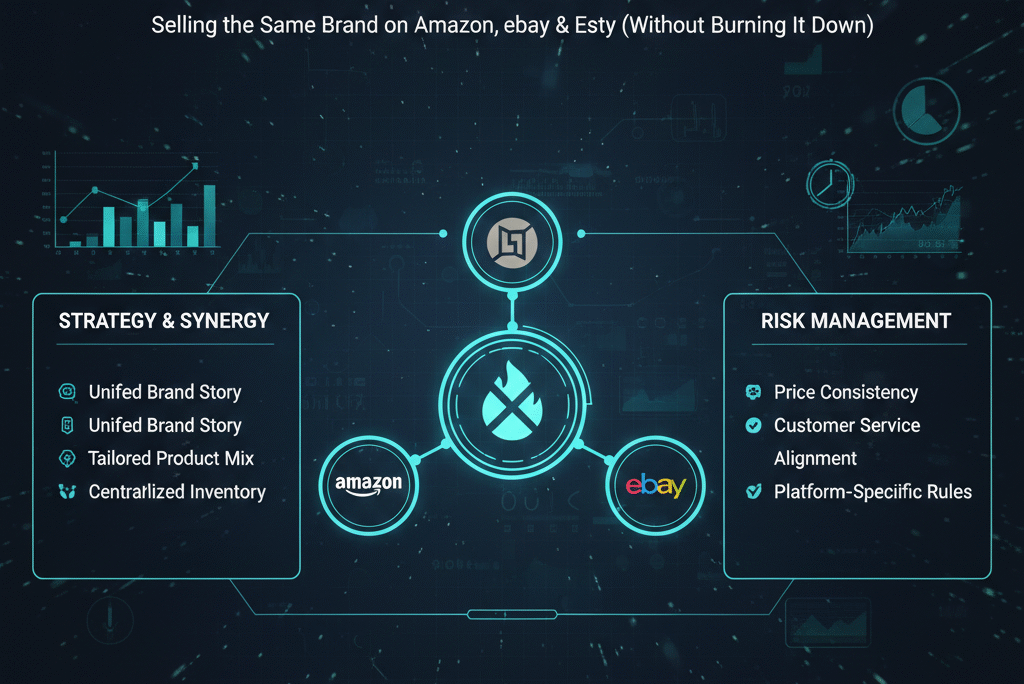
The smarter move—the one real brands quietly use—is one brand, multiple platforms, each playing a specific role. Same DNA. Same promise. Different stage lighting.
This article breaks down how multi-platform private label actually works, why it’s harder than people admit, and how to do it without getting suspended, diluted, or buried alive by algorithms.
No guru nonsense. Just reality.
First: Why Multi-Platform Private Label Is Even Worth Doing
Amazon alone is powerful, but it’s also a single point of failure.
You don’t own the traffic.
You don’t control the rules.
You wake up one day and… surprise, policy update.
Selling the same brand across Amazon, eBay, and Etsy gives you three massive advantages:
- Risk distribution
If one platform sneezes, your business doesn’t catch pneumonia. - Audience expansion
Each marketplace attracts a different buyer mindset. - Brand gravity
When customers see your brand in multiple places, it feels bigger, safer, more legitimate.
Real brands don’t live in one mall. They’re everywhere their customers already hang out.
The Big Mental Shift: One Brand, Three Behaviors
Here’s the key idea most sellers miss:
Amazon, eBay, and Etsy are not just platforms.
They’re cultures.
Your brand stays the same.
Your presentation adapts.
Think of it like a person at work, at a family dinner, and with close friends. Same human. Different tone.
Amazon: The Conversion Machine
Amazon buyers are not browsing. They’re hunting.
They search with intent.
They compare fast.
They punish hesitation.
What Amazon Is Best For
- Scalable volume
- Keyword-driven demand
- Predictable conversion behavior
Amazon is where your brand proves it can sell under pressure.
How Your Brand Should Show Up on Amazon
- Clean, authoritative visuals
- Benefit-first copy
- Zero fluff
Amazon doesn’t reward personality. It rewards clarity and confidence.
This is where your branding needs to:
- Instantly communicate value
- Look trustworthy at thumbnail size
- Answer objections before they’re formed
If Etsy is a story and eBay is a conversation, Amazon is a job interview with 10 seconds to impress.
eBay: The Underrated Flex Platform
eBay sits in a weird middle ground that most sellers underestimate.
It’s not as rigid as Amazon.
It’s not as aesthetic as Etsy.
But it’s incredibly flexible.
What eBay Is Best For
- Brand extensions
- Bundles and variations
- Testing price sensitivity
- International buyers
eBay shoppers compare sellers, not just listings. That’s huge.
How Your Brand Should Show Up on eBay
- More conversational copy
- Clear seller credibility
- Practical, value-oriented positioning
This is where your brand can:
- Offer bundles Amazon doesn’t allow
- Speak more directly to the buyer
- Win on trust, not just rank
Think of eBay as your brand’s “practical older sibling.” Less polish, more honesty.
Etsy: Where Story Becomes Currency
Etsy is not just a marketplace. It’s a belief system.
Buyers here want:
- Meaning
- Story
- A reason to care
They’re allergic to anything that smells mass-produced—even when it is.
What Etsy Is Best For
- Aesthetic-driven products
- Lifestyle positioning
- Emotional branding
Yes, you can private label on Etsy.
No, you can’t be lazy about it.
How Your Brand Should Show Up on Etsy
- Story-led descriptions
- Visual warmth and cohesion
- A sense of “why this exists”
Your brand doesn’t need to pretend it’s handmade by monks. But it does need a narrative that feels human.
On Etsy, branding isn’t decoration. It’s the product.
The Golden Rule: Never Clone Listings Across Platforms
Copy-pasting Amazon listings onto eBay or Etsy is one of the fastest ways to fail quietly.
Algorithms notice.
Customers feel it.
Trust evaporates.
Each platform rewards different things:
- Amazon rewards relevance and conversion
- eBay rewards clarity and seller credibility
- Etsy rewards originality and story
Same brand voice. Different emphasis.
This isn’t extra work for fun. It’s how you stay visible.
Pricing Strategy: One Brand, Smart Differences
Here’s a truth that makes people uncomfortable:
Your prices don’t need to match perfectly across platforms.
They need to make sense within each ecosystem.
Amazon buyers expect:
- Competitive pricing
- Fast fulfillment
- Clear value
Etsy buyers tolerate:
- Higher prices
- Slower fulfillment
- Emotional justification
eBay buyers compare:
- Total value
- Shipping
- Seller reputation
The mistake is chasing “price consistency” instead of platform logic.
Your brand isn’t cheap if the value is clear. It’s only cheap when the positioning is weak.
Inventory & Operations: Where Most People Panic
Multi-platform selling sounds sexy until inventory enters the chat.
Here’s how grown-ups handle it:
- Centralized inventory tracking
- Platform-specific buffers
- Conservative scaling
You don’t push full stock everywhere at once. You phase it.
Amazon usually gets priority because of volume predictability.
eBay and Etsy act as controlled expansion channels.
This isn’t about being everywhere fast.
It’s about being everywhere stable.
Brand Consistency Without Brand Suffocation
Consistency doesn’t mean repetition.
It means:
- Same logo family
- Same color logic
- Same core promise
But the expression changes.
Your Etsy banner can feel cozy.
Your Amazon images should feel surgical.
Your eBay store can feel practical and grounded.
This is brand intelligence, not brand dilution.
The Long Game: Why Multi-Platform Brands Win
Here’s the quiet advantage no one brags about:
When your brand exists on multiple platforms, it becomes harder to erase.
Competitors copy listings.
They can’t copy presence.
Platforms change rules.
Brands with roots survive.
And when you eventually build your own website, you’re not starting from zero. You’re consolidating gravity that already exists.
That’s the difference between “selling products” and building an asset.
Final Thought: Platforms Are Tools, Brands Are Leverage
Amazon, eBay, and Etsy are not enemies.
They’re instruments.
Used together, they turn a fragile side hustle into a resilient business.
Used separately, they keep you dependent.
Multi-platform private label isn’t about doing more.
It’s about thinking bigger without acting sloppy.
And when done right, your brand stops chasing platforms—and platforms start working for your brand.
Building a real private label brand isn’t about shortcuts or copy-paste tactics. It’s about strategy, branding, and execution that actually holds up under pressure. If you want a done-for-you approach—product research, brand identity, listings, platforms, and long-term growth—all working together, explore our Private Label & Ecommerce Services and see how we help brands scale without breaking when platforms change.
To get familiar with each marketplace we’re talking about, it helps to visit the platforms directly — whether you’re researching where to launch your product or seeing how top sellers position their offerings. You can explore Amazon Marketplace to understand how third-party sellers list and scale products on one of the largest global marketplaces, check out eBay to see how flexible listing formats and pricing play out in practice, and browse Etsy if you want to feel the vibe of a community-oriented marketplace focused on craft, design, and lifestyle brands.