You’ve done the keyword research. You’ve stuffed your titles with the right terms. You’ve read the guides, watched the YouTube tutorials, maybe even paid for a course. And still — your listings sit in search results getting ignored while shops with comparable products, sometimes worse products, consistently outrank you.
If that sounds familiar, here’s the uncomfortable truth: the problem probably isn’t your keywords. Keywords got you into the search results. Something else is determining whether you stay there.
That something else is branding — and specifically, the way branding directly shapes the behavioral signals that Etsy’s algorithm uses to decide which listings deserve visibility and which ones quietly get demoted.
This isn’t a soft, feel-good argument about aesthetics or “looking professional.” It’s a specific, mechanical explanation of how Etsy’s search system works, what it actually measures, and why sellers with weaker keyword optimisation but stronger brand execution consistently outperform sellers who’ve done the opposite.
Quick Answer: Does Branding Affect Etsy SEO?
Yes — significantly and in measurable ways.
Branding directly influences click-through rate, listing engagement, conversion rate, shop trust signals, and repeat buyer behaviour. Each of these feeds into the performance signals that Etsy’s search algorithm uses to rank listings after the initial keyword match. In other words, keywords determine whether your listing appears in a search result. Branding determines whether it rises or falls once it’s there.
How Etsy Search Actually Works — The Full Picture Most Sellers Miss
To understand why branding matters for Etsy SEO, you first need to understand that Etsy’s search process has two distinct phases that most sellers only think about one of.
Phase one is query matching — Etsy scans its index to find listings whose titles, tags, categories, and attributes contain terms relevant to the buyer’s search query. This is the phase that keyword research addresses, and it’s where most SEO advice for Etsy stops.
Phase two is ranking — among all the listings that matched the query in phase one, Etsy decides which order to display them in. This is where things get more interesting, and where keyword optimisation alone runs out of answers.
According to Etsy’s own documentation in the Seller Handbook, the ranking phase considers multiple factors beyond keyword relevance: listing quality score, shop quality score, customer experience history, and the probability that a given shopper will engage with and purchase from a given listing. Etsy is explicit that its goal is to connect buyers with listings they’re most likely to actually purchase from — which means the algorithm is fundamentally trying to predict human behaviour, not just catalogue keyword matches.
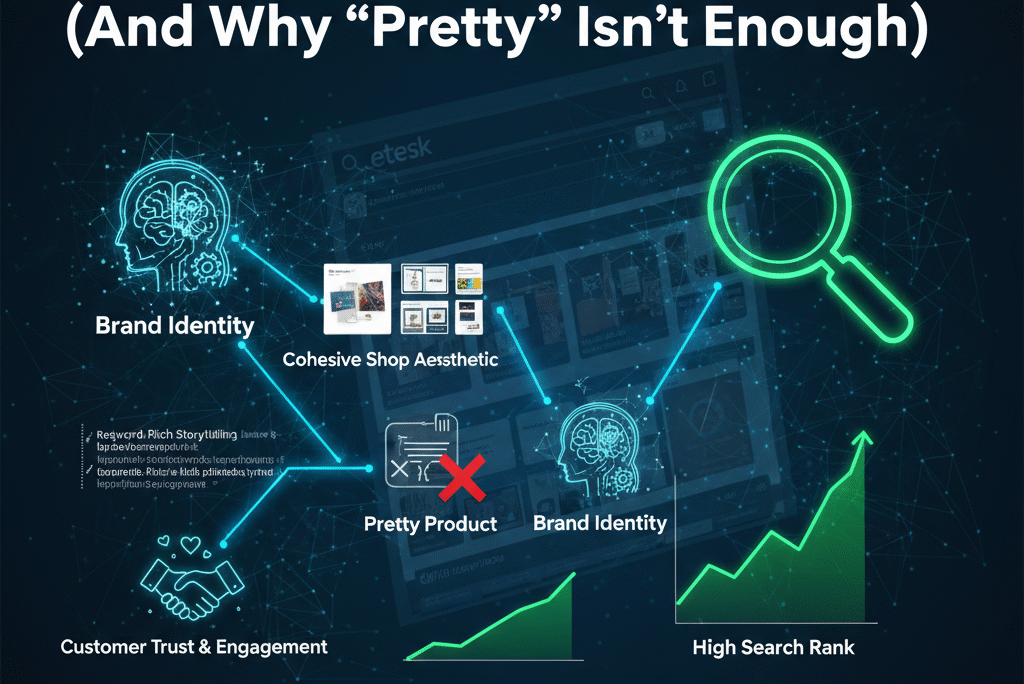
Branding is what shapes that human behaviour. Every element of your shop’s visual identity, coherence, and perceived trustworthiness affects whether a buyer clicks, engages, favourites, and buys. And every one of those actions feeds data back into the algorithm’s ranking decisions.
Understanding this two-phase model changes the entire way you should think about Etsy SEO. Getting into search results is phase one. Staying near the top of them is phase two. Keywords solve phase one. Branding solves phase two.
Why Keywords Alone Stop Working Past a Certain Point
Here’s the specific scenario that plays out repeatedly for Etsy sellers who’ve optimised their keywords but are still frustrated with visibility.
The listing gets impressions — it’s showing up in search results. But the click-through rate is low. Buyers are seeing the listing and scrolling past it. Because Etsy’s algorithm tracks what happens when a listing is shown, a low click-through rate is a negative performance signal. The listing gets fewer future impressions. The seller assumes the keywords need more work, adjusts titles and tags, gets impressions again, but the underlying problem — that buyers aren’t clicking — remains because nothing about the listing’s visual presentation or perceived trustworthiness has changed.
This is the keyword treadmill. You can optimise indefinitely and still not solve a problem that isn’t actually a keyword problem.
The listings that perform well after the keyword match are the ones that stop a buyer’s scroll. And the thing that stops a scroll — in a feed of dozens of competing thumbnail images viewed on a mobile phone screen, in under a second each — is not the keyword in the title. It’s the visual signal communicated by the main image.
Click-Through Rate: The First Branding Gatekeeper
Click-through rate (CTR) is the percentage of times your listing is shown in search results that results in a click through to the listing page. It is one of the most direct behavioural signals Etsy’s algorithm uses to assess listing quality, and it is almost entirely a function of your main product image and how that image performs in a competitive thumbnail context.
Think about the actual experience from the buyer’s side. A buyer types “handmade ceramic mug” into Etsy search and sees a grid of 24 or 48 results. They’re on mobile — most Etsy traffic is. Each thumbnail is approximately the size of a postage stamp. They scroll through at conversational speed, pausing only when something catches their eye.
What catches their eye is not the keyword in your title. What catches it is the visual quality, clarity, and distinctiveness of the main image.
Research on visual attention from Nielsen Norman Group consistently shows that in e-commerce contexts, product images are processed before text, and the quality of those images directly influences whether users engage further with the listing. On a platform like Etsy where the search result page is almost entirely image-based, this effect is amplified.
What branding does for CTR specifically:
A branded shop with a consistent visual style — consistent photography background, consistent lighting, consistent composition and crop, consistent use of props or negative space — creates thumbnail images that are immediately recognisable as belonging to the same shop. When a buyer sees multiple listings from the same shop in search results (which happens regularly, especially if your shop has strong relevance signals), the visual coherence creates a sub-conscious impression: this is an established, intentional operation.
An unbranded shop with inconsistent photography — different backgrounds, different lighting conditions, different framing approaches, different levels of image quality across products — presents thumbnails that don’t cohere. They may each individually be decent images, but they don’t accumulate into a visual identity. The shop looks like a collection of individual listings rather than a brand.
The buyer processing 24 thumbnails in 10 seconds doesn’t consciously articulate this distinction. But the shops that look like brands get the clicks that the shops that look like listings don’t.
Main image quality is non-negotiable. This means proper lighting (natural or studio, not mixed), a background that doesn’t compete with the product, composition that fills the frame appropriately, and a level of technical quality (focus, exposure, colour accuracy) that communicates care. These are branding decisions as much as photography decisions — they reflect intentionality, which is exactly what buyers are reading for in a thumbnail.
Listing Quality Score: How Etsy Builds Its Confidence in Your Listing
Etsy’s listing quality score is the platform’s internal assessment of how likely a given listing is to generate engagement and purchase behaviour. It’s not a number Etsy publishes or makes directly visible to sellers, but it’s a real factor in how listings are ranked — and it’s built from the cumulative behavioral signals generated by buyer interactions with the listing over time.
The three primary inputs are clicks, favourites, and purchases. A listing that consistently generates clicks when it appears in search, that gets favourited at a meaningful rate by shoppers who encounter it, and that converts a reasonable proportion of those engaged shoppers into buyers develops a stronger quality score. A listing that gets impressions but minimal clicks, that rarely gets favourited, and that converts poorly accumulates a weak quality score — and over time, gets shown to fewer buyers because Etsy’s algorithm has learned that showing it doesn’t produce the engagement it’s optimising for.
Branding influences all three inputs:
Clicks are primarily influenced by main image quality and visual coherence, as discussed above. A branded listing gets more clicks per impression than an equivalent unbranded listing because the visual presentation communicates credibility faster.
Favourites are influenced by the overall listing experience — the imagery, the price positioning, the shop identity visible from the listing page. Buyers favourite listings they intend to return to, or that they want to save as reference points. A listing that feels complete, credible, and visually appealing gets favourited at a higher rate. A listing that feels uncertain — where the photography is inconsistent, the shop identity is unclear, the pricing seems arbitrary without visual justification — gets passed over.
Purchases are influenced by everything that reduces doubt at the moment of decision: clear product imagery showing the item from multiple angles, a shop identity that feels trustworthy, policies that are clearly stated, reviews that confirm others have had positive experiences, and an overall presentation that makes the buyer feel confident they know what they’re ordering. Branding directly reduces the doubt that prevents conversions.
The compound effect is significant. A listing with stronger branding converts at a higher rate. Higher conversion rate means more purchases per impression. More purchases per impression means a stronger listing quality score. A stronger quality score means more impressions in high-intent search positions. More impressions means more opportunities to convert. The cycle is self-reinforcing — and it starts with the first impression that branding controls.
Shop Trust Signals: Etsy Evaluates Your Entire Shop, Not Just the Listing
This is the dimension most Etsy SEO advice underemphasises, because it’s harder to reduce to a checklist than keyword optimisation. But it’s significant: Etsy doesn’t rank listings in isolation. It evaluates the shop those listings belong to, and uses shop-level signals as part of the ranking calculation.
From Etsy’s perspective, this makes complete sense. Etsy’s business depends on buyers having positive experiences. A buyer who has a negative experience — because the shop didn’t deliver, or the product wasn’t as described, or the customer service was poor — is a buyer who trusts Etsy less. So Etsy is motivated to send traffic preferentially to shops that convert well, deliver reliably, and generate satisfied buyers who come back.
The signals Etsy uses to assess shop quality include:
Review history and star rating. A shop with hundreds of positive reviews is, statistically, more likely to satisfy the next buyer than a shop with a thin or mixed review history. Branding affects this indirectly but meaningfully — shops with clear, accurate product photography generate fewer disappointment-driven negative reviews because buyers receive what they expected. Shops with aspirational or misleading photography generate more complaints because the product doesn’t match the presentation.
Policy completeness. Etsy factors the completeness and clarity of your shop’s returns, exchanges, and shipping policies into its shop quality assessment. A shop with no policies, or vague policies, signals uncertainty that Etsy doesn’t want to amplify by sending it traffic. Clear, professional policies are a branding element that has direct SEO implications.
Shop About section. Etsy’s seller handbook explicitly recommends completing your About section as part of building a credible shop. An About section that tells the brand’s story, communicates who is behind the products, and establishes a personality creates a trust signal that a blank or generic About section doesn’t. From an E-E-A-T perspective, this is where Etsy sellers communicate genuine experience and expertise — the human behind the shop.
Shop banner and logo. These are the most visually prominent brand elements on a shop homepage. A shop with a professional logo and a banner that communicates the brand’s visual identity and positioning looks established. A shop with no logo and a default or template banner looks provisional. Buyers who click through to your shop page — which happens routinely when they want to browse before committing to a listing — make trust assessments based on these elements within seconds.
Response rate and time. Etsy tracks how quickly and consistently sellers respond to messages. Poor responsiveness is a negative shop quality signal. This is partly operational and partly about the shop’s capacity to deliver a positive customer experience — which is also a branding and professionalism signal.
The cumulative effect of strong shop-level signals is that your listings get the benefit of the doubt in ranking decisions. Etsy is more willing to test a listing from a high-quality shop in a prominent search position than it is to test a listing from an uncertain shop — because the historical data tells it that the high-quality shop is more likely to produce the positive outcome Etsy is optimising for.
Conversion Rate: The Ranking Signal Most Sellers Don’t Connect to Branding
Conversion rate — the proportion of listing page visits that result in a purchase — is one of the most significant ranking inputs in Etsy’s algorithm, and it’s one of the most directly influenced by branding.
A buyer who lands on your listing page has already cleared one hurdle (they clicked from search results). What happens on the listing page determines whether they clear the second one (they buy). The elements that determine this are almost entirely branding and presentation elements:
Multiple high-quality images showing the product comprehensively. Etsy allows up to ten listing images, and using that space to show the product from multiple angles, in context, with scale references, and in use, directly addresses the uncertainty that prevents online purchases. Buyers cannot touch the product. They cannot assess its size intuitively. They cannot see how it looks in different lighting or in a real environment. Images that provide this information reduce uncertainty. Reduced uncertainty increases conversion.
Accurate, specific product description. A description that answers the questions buyers actually have — what are the exact dimensions, what material is it made from, how should it be cared for, what will it look and feel like in person — converts better than a description focused on promotional language. This is a brand voice and content decision, not just a copywriting exercise.
Price positioning that’s visually supported. A product priced at £65 needs photography, presentation, and listing quality that justifies £65. If the visual presentation communicates £20 in quality, the price creates cognitive dissonance that browsers don’t resolve by purchasing. Branding is how you visually communicate the value proposition that justifies your price point.
Shop identity visible from the listing page. When a buyer is on your listing page, they can see your shop name, your listing images from the same shop, and a preview of your shop. If those elements communicate a coherent, trustworthy brand, the buyer’s confidence in purchasing increases. If they communicate a miscellaneous collection of unrelated products, the buyer’s confidence decreases — not necessarily consciously, but in the way it affects their decision.
The conversion rate that results from all of this feeds back into listing quality score, which feeds back into search ranking. Branding improves conversion. Conversion improves ranking. Better ranking means more traffic from high-intent buyers. Better quality traffic improves conversion further. The compounding is real and measurable over time.
Favourites, Saves, and Repeat Buyers: The Long-Term Visibility Engine
One of the more nuanced ways branding influences Etsy SEO is through the signals generated by buyers who don’t convert immediately but engage with the shop in ways that signal future intent.
When a buyer favourites a listing, they’re telling Etsy’s algorithm something specific: this listing was interesting enough to save. Etsy tracks favourites as a positive engagement signal that improves listing quality score. Buyers who favourite but don’t purchase are also potential future purchasers — Etsy may surface the listing again in their personalised search results, and sellers can market to favouriters directly through Etsy’s Offsite Ads system.
When a buyer favourites your entire shop, the signal is stronger — this is a buyer who found enough value in the overall shop experience to want to follow it. Shop favourites contribute to the shop’s authority signal across all its listings, not just the one the buyer found first.
When a buyer returns to purchase again — a repeat customer — the signal is most valuable of all. Repeat purchase behaviour tells Etsy that your shop delivers experiences that make buyers want to come back. Etsy weights shops that generate loyal behaviour more highly in ranking, because loyal buyer behaviour is the most direct evidence that Etsy’s traffic is producing value.
Branding is what creates memory. A shop without a distinctive visual identity, without a coherent personality, without a recognisable name — is forgettable. The buyer who found it, bought from it, and had a positive experience has no reliable mental anchor to return to it. They might try to search for it again and not find it. They might see it in search results and not recognise it as the shop they previously bought from.
A branded shop is memorable. The buyer who found it, bought from it, and had a positive experience has a visual and verbal memory associated with it — a shop name they recognise, a visual style they associate with quality, a brand they’d search for specifically. That translates into direct searches (which Etsy tracks), return visits, and repeat purchases that build the shop’s authority over time.
Visual Differentiation: Why Looking Like Everyone Else Is an SEO Problem
There’s a specific trap many Etsy sellers fall into when trying to improve their search performance: they study top-performing listings and approximate what they see. Similar photography style, similar composition, similar prop choices, similar listing structure. The reasoning is sound — replicate what’s working. The problem is that Etsy already has that version, often from the shops that established the visual convention in the first place.
A listing that looks like a generic version of the category’s top performers doesn’t give Etsy a reason to test it with new buyers. It’s another entry in a pool of visually interchangeable listings competing for the same position. The algorithm has no basis for preferring it over the listings that established the visual convention with more authority, more reviews, and more performance history.
A listing with a distinctive visual identity — not necessarily a more expensive production, but a more intentional one — gives Etsy something to test. It’s visually differentiated enough that buyers who’ve scrolled past the generic alternatives might pause. If they click and engage at a meaningful rate, the algorithm learns that this listing is reaching buyers who weren’t being reached by the visual convention it departs from. That’s useful data for Etsy, and it’s rewarded with continued testing in more prominent positions.
Distinctive branding creates this opportunity. It doesn’t guarantee success — distinctiveness in the wrong direction (unprofessional, unclear, visually confusing) produces lower performance, not higher. But intentional distinctiveness that’s still credible and relevant to the category creates algorithmic opportunity that imitation does not.
Photography Is Not Just Aesthetics — It’s the Delivery Mechanism for Your SEO
This point deserves its own section because it’s consistently underweighted in Etsy SEO discussions that focus primarily on titles and tags.
Your main listing image is the element of your Etsy presence that does the most SEO work per second of buyer attention. In a search result, it is the only thing buyers interact with before deciding whether to click. Everything else — the title, the price, the seller name — is secondary to the thumbnail image in the scrolling experience that determines CTR.
The photography decisions that most directly affect search performance:
Lighting. Inconsistent, mixed, or poor lighting communicates lack of care. Products photographed in consistent, appropriate lighting (whether natural light managed carefully, or artificial studio lighting) look more professional and more trustworthy than the same products photographed in whatever light was available. This is a direct trust signal.
Background choice. A clean, consistent background that doesn’t compete with the product allows the product to communicate clearly. Busy, cluttered, or inconsistent backgrounds create visual noise that makes the listing harder to process in a thumbnail context. The industry convention of white or neutral backgrounds exists for functional reasons — it makes products legible at thumbnail size — but off-white, lifestyle, or context-appropriate backgrounds can be equally effective when applied consistently.
Composition and crop. The product should fill an appropriate proportion of the frame — close enough to be clearly visible at thumbnail size, but not so close that context or scale is lost. Consistent composition across listings creates the visual coherence that branded shops exhibit and unbranded shops don’t.
Style consistency across all listings. This is the branding element that elevates individual good photographs into a shop-level visual identity. When all your listings share a visual language — the same background, the same lighting approach, the same compositional sensibility, the same approach to props or context — buyers encountering multiple listings from your shop in a search result see a brand, not a collection of individual items. That brand signal affects click behaviour in ways that individual strong photos do not.
A study on visual trust signals in e-commerce from the Baymard Institute found that product image quality and quantity are among the top factors users cite in trusting an unfamiliar online seller. For Etsy sellers, where unfamiliarity with the specific shop is the default state for new buyers, this trust establishment through imagery is foundational.
Brand Consistency Helps Etsy Understand Your Shop — Which Improves Distribution
There’s a subtler mechanism through which branding affects Etsy SEO that goes beyond the direct behavioral signals discussed above.
Etsy’s algorithm needs to understand what a shop is about in order to match it with relevant buyers. A shop with a coherent, consistent identity — a defined visual style, a focused product range, a consistent tone of voice — gives the algorithm clear signals about what kind of buyers this shop is relevant for. Etsy can match it confidently with searches from buyers who fit that profile.
A shop that sends mixed signals — stylistically inconsistent, covering an unfocused range of product types, using varying tones across listings — is harder for the algorithm to categorise confidently. If Etsy can’t confidently predict which buyers a shop is relevant for, it distributes that shop’s listings more conservatively — testing with smaller audiences, investing less in surface them to high-intent searches.
Clarity in branding is clarity for the algorithm. When your shop consistently communicates a specific aesthetic, a specific type of product, and a specific positioning — handmade, sustainable, minimalist, for example, or bold, maximalist, colourful — the algorithm gets better at matching your listings with the buyers most likely to engage with and buy from them. Better matching means higher quality traffic. Higher quality traffic means better conversion rates. Better conversion rates mean better listing quality scores. Better listing quality scores mean more visibility.
This is why copying top listings without building your own coherent brand identity only works briefly. The copies may individually perform acceptably in the short term, but they don’t accumulate into a shop identity that Etsy learns to trust and distribute with confidence. The shop stays dependent on keyword matching at the most basic level, without ever building the shop-level authority that makes the algorithm work in its favour.
The Internal Keyword Competition Problem
One specific Etsy SEO issue that connects directly to the brand and listing coherence discussion is worth addressing separately: the problem of listings within the same shop competing against each other for the same search terms.
Many Etsy sellers build out their product range without paying attention to keyword overlap between listings. Two listings targeting the same core search terms — “personalized gold necklace” for example — are in direct competition with each other in Etsy search. Etsy can only show one listing per shop in a typical search result for most queries. If both listings are competing for the same query, neither accumulates the full performance signal it would if it were the sole representative of the shop for that search.
The solution is strategic keyword architecture — ensuring that each listing in a shop targets distinct, complementary search terms rather than overlapping ones. If you have multiple products that buyers might search for with similar terms, each listing should be optimised for a different angle on that intent: one for the broad term, one for a more specific variation, one for a use-case-based query.
If your listings aren’t gaining traction despite good keywords, internal keyword overlap may be part of the problem. You can identify and fix this using our Duplicate Keyword Analyzer — a tool built specifically for Etsy sellers to find where listings are cannibalising each other’s search performance.
Practical Steps: How to Improve Your Etsy Branding for Better SEO
Everything above describes the problem. Here’s what to actually do about it.
Audit your shop’s visual consistency. Open your shop in a browser as a buyer would see it. Look at the grid of listings. Do they share a visual language? Is the photography consistent in background, lighting, and composition? If not, prioritise reshooting your highest-traffic listings first, establishing the visual standard you’ll apply going forward.
Set a defined photography brief and stick to it. Before shooting any product, define: what background colour and material, what lighting setup, what composition approach, what props (if any), what image size and crop. Write it down so that every future photo session produces images that fit the established visual identity, not just good images in isolation.
Complete every shop section. Logo, banner, About section, and policies are all shop trust signals that Etsy factors into shop quality assessment. None of them require significant budget — a thoughtful About section that tells the real story behind the shop, clear and fair policies, and a simple but professional logo and banner make a measurable difference to how the shop is perceived.
Narrow your product focus if it’s currently too broad. A shop that sells minimalist jewellery, vintage-style home decor, and pet accessories is confusing to buyers and to the algorithm. Each of those categories has a different buyer, a different aesthetic, and a different search context. Shops that perform best in Etsy search typically have a coherent product range that serves a defined customer with a defined aesthetic. If your current shop is unfocused, consider whether some product types would be better in a separate shop, or whether a focused edit of the existing range would produce better results.
Price to match your presentation. If your product quality justifies premium pricing, your photography and brand presentation need to visually communicate that premium. If your photography communicates commodity pricing, you’ll face resistance on premium prices regardless of actual product quality. The alignment between visual presentation and price point is a conversion factor that directly affects your listing quality score.
Review your listing images beyond the main image. Your listing allows up to ten images and a video. Sellers who use fewer than five images are providing less information to buyers who need it before purchasing. Images showing scale, materials, process, use context, and close-up detail answer the questions buyers have and would otherwise have to message about — or more likely, use as a reason not to buy.
Frequently Asked Questions
Does branding affect Etsy ranking directly?
Not in the way a keyword tag does — branding isn’t a ranking factor that Etsy’s algorithm scores against directly. What it does is shape the human behaviours — clicks, favourites, purchases, return visits — that Etsy’s algorithm uses as its ranking inputs. Branding’s effect on ranking is indirect but significant and compounding. Shops with strong branding consistently outperform equivalent shops without it in organic search position over time, because the behavioural signals generated by branded shops feed the algorithm signals that branded shops deserve more visibility.
My photos are good but my CTR is still low. What else could affect it?
Photography is the primary driver of CTR but not the only one. Your main image thumbnail needs to be competitive specifically in the context of what else appears in the same search result — if every competitor is using similar photography conventions, a technically good image may not be visually distinct enough to stop a scroll. Consider whether your thumbnail is immediately clear about what the product is (blurry, abstract, or context-heavy images often underperform even when they’re artistically strong), whether your price is competitive for the quality your imagery communicates, and whether your title’s visible portion (the first few words that appear under the thumbnail) is reading well.
Does Etsy’s algorithm favour shops with more listings?
More listings mean more chances to appear for different search queries, and some surface area in Etsy search is beneficial. But quantity doesn’t substitute for quality — a smaller shop with strong performance signals per listing will typically outperform a larger shop with weak performance signals overall. The algorithm’s goal is matching buyers with listings they’re likely to purchase from, not maximising impressions for the shops with the most inventory.
How long does it take for branding improvements to affect SEO performance?
Etsy’s algorithm updates listing quality scores continuously based on accumulated performance data. Branding improvements that increase CTR and conversion rate will begin affecting ranking within weeks of the change — not months — because the behavioral signal change is immediate if the visual change is effective. However, building the shop-level trust signals (reviews, favourites, return purchase behaviour) that contribute to longer-term authority takes longer. A fair expectation is that meaningful photography and branding improvements show measurable CTR improvement within 30 days, with ranking improvements following as the new CTR data accumulates.
Should I rebrand if my shop has existing reviews and a performance history?
A full rebrand — changing your shop name significantly — can disrupt brand recognition that your existing buyers have built, and Etsy doesn’t automatically redirect traffic from an old shop name. Gradual visual evolution (refreshing photography, improving banner and logo, updating listings to a more consistent visual standard) is usually preferable to a complete restart for an established shop with positive history. The exception is a shop with a weak or off-brand name that’s actively limiting growth — in which case the long-term benefit of a proper name may outweigh the short-term disruption.
Does Etsy penalise shops for changing their main images?
No. Updating listing images resets some of the accumulated performance data associated with that specific listing (since the new image is effectively a new visual experience for buyers), but if the replacement image performs better, the new data will show that relatively quickly. Sellers worried about losing ranking by updating weak images should consider that keeping weak images is already producing underperformance — a better image that generates higher CTR and conversion will build a stronger quality score than a suboptimal image maintaining a mediocre one.
Final Thought: Branding Is the SEO Strategy Most Etsy Sellers Are Missing
The Etsy sellers who consistently rank well over time are almost never the ones who’ve found some keyword trick that others haven’t discovered. Etsy’s algorithm evolves specifically to close those gaps when they’re found. The sellers ranking consistently well are the ones who’ve built shops that Etsy’s algorithm is confident will satisfy buyers — because those shops have a track record of satisfying buyers, as measured by the clicks, favourites, conversions, and return visits that real buyers generate.
Branding is how you build that track record. It’s how you communicate trustworthiness before a buyer has any experience with you. It’s how you stop a scroll in a search result, earn a click, convert that click into a purchase, and make the purchase memorable enough that the buyer returns. Every one of those outcomes feeds the algorithm that determines your visibility.
Treat branding as an afterthought and you’ll spend months optimising keywords while watching your listings stagnate in positions that good keywords alone can’t improve. Treat branding as the performance infrastructure it actually is, and keywords become the starting point for a visibility system that compounds over time rather than spinning in place.
If you’re building a shop that you want to actually convert and rank — with a visual identity, photography approach, and brand positioning built around your specific customer — explore how we work with Etsy sellers and ecommerce brands at ecommate.co.uk.