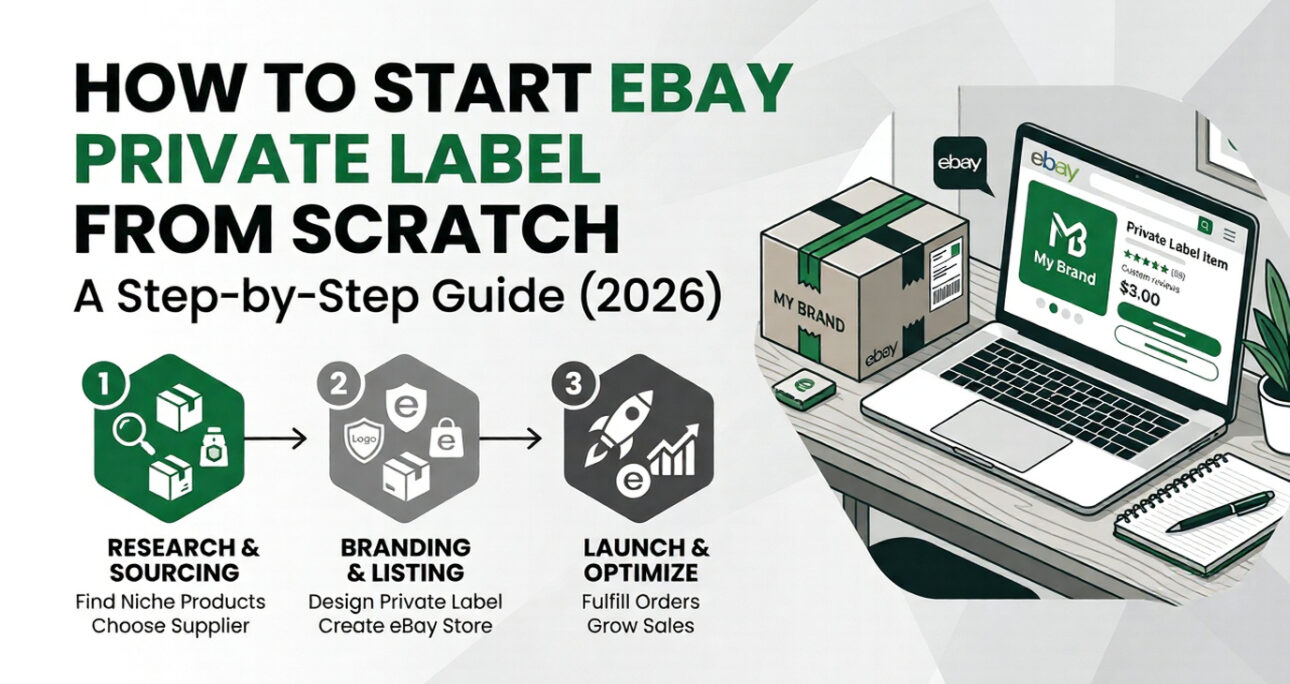
How to Start eBay Private Label From Scratch? Quick Answer: Starting eBay private label means registering a Business Seller account, sourcing a product from a manufacturer (primarily via Alibaba), building a brand identity with custom packaging and photography, creating an optimised fixed-price listing, and fulfilling orders either yourself or through a third-party logistics provider. Unlike Amazon, eBay has no fulfilment programme like FBA — but that also means lower fees, less competition in most categories, and stronger unit margins on comparable products. The process follows seven stages: account setup, product research, supplier sourcing, brand creation, listing build, launch, and ongoing management.
Why eBay Gets Overlooked — And Why That’s an Opportunity
Most private label content focuses on Amazon. The courses, the YouTube channels, the Reddit threads — almost all of them use Amazon as the default, the assumed platform, the obvious starting point. eBay gets mentioned occasionally as an afterthought, usually in a sentence about “multichannel selling” that doesn’t explain anything useful about how eBay actually works as a private label channel.
The result is a category of seller that understands private label in principle but approaches eBay with Amazon instincts — and wonders why the results don’t match.
eBay is not a smaller or inferior version of Amazon. It’s a different marketplace with different buyer behaviour, different algorithmic logic, different fee structures, and different competitive dynamics. In many categories — automotive parts and accessories, home improvement, tools, storage and organisation, garden and outdoor, pet supplies — eBay moves significant volume with markedly less competition than the equivalent Amazon category. The sellers capturing that volume aren’t necessarily better operators than Amazon sellers. They’re simply the ones who understood that eBay rewards different things and built accordingly.
This guide explains what those things are, and gives you the specific steps to build a private label brand on eBay from scratch in 2026.
What’s Different About Private Label on eBay
Before the step-by-step, it’s worth establishing where eBay diverges from Amazon in ways that affect every decision downstream.
No fulfilment programme. Amazon FBA lets you ship inventory to Amazon’s warehouses and outsource storage, packing, and despatch entirely. eBay has no equivalent. Every eBay order is fulfilled by the seller — either by holding inventory yourself and packing orders from a home or commercial premises, or by using a third-party logistics provider (3PL) that stores your inventory and ships on your behalf. This changes the capital model, the operational requirements, and the margin structure.
Feedback, not reviews. Amazon’s conversion rate depends heavily on product review count and star rating. eBay’s conversion rate depends on seller feedback. A new eBay seller with zero feedback sells at a significant conversion disadvantage against an established seller with 500 positive feedback entries — regardless of product quality. Building feedback is therefore the primary launch activity on eBay in a way that has no direct Amazon equivalent.
The Cassini algorithm rewards different signals. Amazon’s A9/A10 algorithm weights sales velocity and conversion rate heavily. eBay’s Cassini algorithm weights seller performance metrics — despatch time, accurate item specifics, competitive pricing, and buyer satisfaction — alongside listing completeness and category relevance. A listing with poor item specifics or a seller with late despatch history ranks lower than an equivalent listing from a seller with clean metrics, even if the underperforming seller has more sales history.
Lower fees, lower ceiling. eBay’s fee structure is simpler and typically less aggressive than Amazon’s. The referral fee (called a “final value fee” on eBay) ranges from 7–12.8% depending on category, with no FBA equivalent adding a further 10–20%. There’s no mandatory advertising spend to achieve visibility in the way that Amazon PPC has become effectively compulsory for new listings. The trade-off is lower organic reach — eBay’s buyer base, at approximately 130 million active buyers globally, is smaller than Amazon’s — but the margin per unit on a well-priced eBay listing is often meaningfully better than on an equivalent Amazon listing.
Price-conscious buyers, specification-driven decisions. eBay buyers tend to evaluate products on specification accuracy, price point, and seller reputation rather than brand presentation and social proof. This doesn’t mean branding is irrelevant on eBay — it means the return on branding investment is felt differently. A professional listing with clear specifications, good photography, and accurate item specifics converts better than a poorly constructed listing for the same product. But the buyer who abandons an eBay listing is more often reacting to an unclear spec or an uncertain seller than to a brand identity that didn’t resonate.
Understanding these differences is the foundation that makes every subsequent step make sense.
Step 1 — Set Up a Business Seller Account Correctly
Private label on eBay requires a Business Seller account, not a personal account. This isn’t optional — it’s both a legal requirement for commercial selling activity and a practical necessity for the tools and policies that business-scale selling requires.
Go to ebay.co.uk (or ebay.com for the US market) and register a new account, selecting Business Seller at the point of account type selection. You’ll need a business name, registered business address, and a bank account for payouts. eBay processes seller payments through eBay Managed Payments, which means payouts land directly in your bank account on a daily or weekly cycle — there’s no third-party payment processor needed.
New eBay seller accounts start with selling limits. These are restrictions on the number of listings and the total monthly sales value the account can process, applied to all new accounts to manage fraud risk. Typical starting limits are around 10 listings and £1,000 total monthly sales value for new UK accounts. These limits increase automatically as account history builds, and you can request manual limit increases through Seller Hub once you’ve established a track record of successful transactions. For private label specifically — where the initial product range is typically narrow — the early limits are rarely the binding constraint. The more significant constraint is building the feedback history that converts browsers into buyers.
One decision worth making at account setup: your seller name. On eBay, the seller name is visible on every listing and is part of the brand experience in a way that’s more prominent than on Amazon. Choosing a name that is consistent with your product brand rather than a generic username is worth the ten seconds it takes to do correctly.
eBay Shop Subscription
Once you have inventory live and are generating consistent sales, subscribing to an eBay Shop (the UK equivalent of Amazon’s Professional selling plan) becomes financially worthwhile. Shop subscriptions reduce the per-listing insertion fee, provide access to promotional tools including markdown sales and coded coupons, and give the brand a dedicated storefront page where buyers can browse the full product range. The Basic Shop subscription costs £27 per month and reduces free monthly listings from 1,000 to unlimited zero-insertion-fee listings in most categories. At meaningful volume, the subscription saves money on insertion fees while providing marketing tools that individual listings don’t offer.
Step 2 — Research and Validate a Product for eBay Specifically
Product research for eBay follows the same fundamental principle as for Amazon — find proven demand, identify where existing products are failing buyers, and plan a version that addresses those failures — but the data sources and selection criteria are different.
Where Demand Lives on eBay
eBay’s own search data is the most direct source. The Terapeak Product Research tool, available free to all eBay sellers through Seller Hub, provides sales data for any product category on eBay: how many units sold in the past 30, 90, or 365 days, at what price points, from how many sellers, and with what average sell-through rate. Terapeak is the equivalent of Jungle Scout or Helium 10 for eBay — it tells you what’s actually selling, not what seems popular. A product category showing consistent monthly sales volume across multiple sellers, at a price point that leaves room for your margin model, with no single dominant seller capturing all of the volume, is the pattern you’re looking for.
Search volume within eBay is visible through Seller Hub Promotions and through the search suggest behaviour — what eBay autocompletes when buyers start typing in the search bar. These aren’t perfect demand proxies, but they confirm that buyers are actively searching for terms related to a product category.
External validation through Google Trends provides a useful sanity check on seasonal patterns. A product category that peaks sharply in November and collapses in January needs inventory planning that accounts for that cycle. A category with a flat or slowly growing 12-month trend has the demand consistency that a first private label product benefits from.
eBay Category Selection Criteria
The categories where private label has historically worked best on eBay share a consistent set of characteristics. They’re utility-oriented rather than fashion or trend-dependent — buyers are making functional purchasing decisions based on specification and price rather than aesthetic preferences that shift with seasons. They have mid-range price points (£15–£60 typically) that are high enough to support healthy margins after fees but low enough that the buyer doesn’t require significant consideration time. And they have established, consistent search demand rather than viral spikes that disappear before inventory arrives.
Categories consistently performing well for eBay private label in 2026 include: automotive accessories (car organisers, cleaning tools, seat covers, boot liners), home storage and organisation (drawer dividers, cable management solutions, bathroom organisers), garden and outdoor (plant supports, tool storage, pest control), pet accessories (feeding accessories, grooming tools, pet travel products), home improvement tools and accessories (safety equipment, measurement tools, fixings and fasteners), and fitness and health (resistance bands, recovery tools, foam rollers). These categories share the utility, consistent demand, and competitive landscape characteristics that eBay private label rewards.
Reading the Competition on eBay
Competitive analysis on eBay is different from Amazon. Instead of reading review content for product failure patterns, you’re reading seller feedback comments for service and product quality signals, and examining listing quality for gaps that a more carefully constructed listing could exploit.
Search for the product category on eBay and sort by Best Match — this is how buyers see results by default and how Cassini’s ranking logic presents itself. Examine the top-ranking listings: how complete are the item specifics? How professional is the photography? How clearly is the product described? How is the seller’s feedback score? In many categories, the top-ranking sellers on eBay have adequate but not excellent listings — incomplete item specifics, amateur photography, vague descriptions. That’s the competitive gap a well-constructed private label listing can occupy.
Step 3 — Source and Qualify a Manufacturer
The supplier sourcing process for eBay private label is identical in structure to Amazon private label — Alibaba is the primary platform, with the same distinction between manufacturers and trading companies, the same sample-first approach, and the same pre-shipment inspection discipline. The differences are in the quantity decisions and the specification focus.
Minimum Order Quantities for eBay
eBay’s fulfilment model — where you’re shipping individual orders yourself rather than sending bulk inventory to a warehouse — changes the inventory calculus relative to Amazon. You need enough stock to maintain a consistent supply as sales build, but you’re not trying to pre-load a fulfilment centre with three months of inventory. For most eBay private label products, a first order of 100–200 units is appropriate. This provides enough inventory to build feedback and sales history without overcommitting capital to a product that hasn’t yet proven its sell-through rate on the platform.
Specifications for eBay’s Buyer Base
eBay buyers make decisions based on specification accuracy in a way that Amazon buyers are less dependent on, because eBay’s item specifics system — the structured data fields that describe a product’s dimensions, materials, capacity, colour, and other attributes — feeds directly into buyer search filters. A buyer searching for a storage box with specific dimensions will filter by those dimensions. If your listing’s item specifics don’t include accurate dimensional data, your product doesn’t appear in filtered search results. This means the product specification needs to be precisely documented before you can build an effective listing — dimensions, weight, material composition, capacity, colour options, and any applicable certifications need to be captured at the sample evaluation stage.
Third-party inspection before bulk order release remains as important for eBay as for Amazon. The consequences of a quality failure are different — eBay’s feedback system means a batch of defective units generating negative feedback can damage the account in ways that are difficult to recover from — but the solution is the same: QIMA, Bureau Veritas, or SGS pre-shipment inspection, confirmed before balance payment is released.
Packaging for Self-Fulfilment
Because eBay orders are fulfilled by the seller rather than a fulfilment centre, packaging serves an additional function: it needs to survive the postal and courier network without additional outer packaging in most cases. Products destined for Amazon FBA are typically packed in manufacturer cartons and then repacked in FBA-compliant boxes. Products shipped direct from your stock to eBay buyers need packaging robust enough to arrive undamaged from a Royal Mail or courier depot. Accounting for this at the packaging design stage — building in sufficient structural rigidity for the primary packaging rather than relying on additional outer boxes — reduces damage-related returns significantly.
Step 4 — Build the Brand for eBay’s Context
Brand on eBay communicates something slightly different to brand on Amazon, and the investment should reflect that difference.
On Amazon, brand identity — the name, logo, packaging, photography, and brand story — functions as the primary mechanism for building buyer confidence in the absence of a physical interaction with the product. Amazon buyers can’t pick the product up. The brand presentation is everything.
On eBay, brand identity functions more as a professionalism signal than an emotional engagement mechanism. The buyer who sees a listing with professional photography, a coherent brand name, and clean packaging is forming a judgment about seller reliability and product quality rather than brand affiliation. That’s still valuable — it converts — but the mechanism is different.
What to Build
A private label brand for eBay needs: a business name that is credible and consistent with the product category, a simple logo suitable for inclusion on packaging and in the eBay Store header, product photography that is technically excellent (more on this below), and custom packaging or at minimum a professionally designed product label that is applied before despatch.
The packaging specification for eBay private label can be simpler than for Amazon, where unboxing experience is a marketing signal and review driver. On eBay, packaging needs to present well enough to confirm that the buyer made a good purchase, and to survive transit without damage. Polybags, retail boxes, and simple card packaging with a professionally printed label all work effectively depending on the product type.
Photography Standards for eBay
eBay’s listing main image requirements are clear: white or plain background, product clearly visible, no additional text or graphics overlaid on the main image. These are the same as Amazon’s main image requirements. For eBay specifically, the image needs to render well at the thumbnail size displayed in search results — small, cropped, competing for attention against twenty other thumbnails on the same page.
The secondary images in an eBay listing serve a purpose that is distinct from Amazon: they need to communicate specification visually. Buyers who don’t read descriptions carefully will look at secondary images to understand dimensions, material, and compatibility. An image that shows the product next to a common reference object for scale, an image that shows the material or construction detail, and an image that shows the product in use all address buyer questions that would otherwise generate pre-purchase messages or post-purchase returns.
Professional photography for an eBay product listing — covering the main image plus four to six secondary images — is typically available for £200–£450 and delivers a return that is disproportionate to its cost. The listings that rank well on eBay and convert at high rates have photography that is noticeably better than the category average.
Step 5 — Build the Listing to eBay’s Ranking Logic
An eBay listing is not just a product description. It’s a structured data submission to the Cassini algorithm, and every field in the listing affects how and where the product appears in search results.
Fixed-Price Format
Private label on eBay uses fixed-price listings, not auction format. This is not a preference — it’s a structural requirement of a private label model. Auction format implies a single item, unpredictable pricing, and no ability to build consistent brand presentation. Fixed-price listings allow you to maintain continuous inventory, present a consistent price and brand identity, and accumulate sales history on a single listing rather than starting afresh with each auction. Every successful eBay private label seller uses fixed-price format.
Title Optimisation
The eBay listing title is the most important single field for search visibility. Cassini indexes the title text as the primary keyword signal for search matching — not the description, not the subtitle, not the custom label fields. The title has an 80-character limit and should use that space to include the specific search terms buyers use when looking for a product in the category.
Effective eBay titles are structured differently from Amazon titles. Amazon titles often include brand name prominently because brand recognition is a conversion factor. eBay titles prioritise the search terms buyers actually use — often specification-led rather than brand-led — and include the brand name as a secondary element. A storage organiser listing title might read: “Bamboo Drawer Organiser 30x20cm Kitchen Cutlery Tray Divider — Natura Home” rather than leading with the brand name.
Research the exact phrasing buyers use through eBay’s search suggest, Terapeak, and by examining the titles of top-performing listings in the category. The words in those titles are what Cassini is matching to buyer searches.
Item Specifics
Item specifics are the structured attribute fields beneath the listing title — the dropdown-selected fields for material, dimensions, colour, brand, type, and dozens of category-specific attributes. These are the fields that buyers use to filter search results, and they feed into Cassini’s relevance scoring.
Many sellers treat item specifics as an optional extra that takes time to complete. That’s a competitive mistake. A listing with complete item specifics — every available field filled with accurate, specific data — ranks higher in filtered searches and converts at a higher rate because it answers specification questions before the buyer needs to ask them. An incomplete item specifics section is one of the most common weaknesses in eBay listings, and correcting it is one of the fastest wins available to a new private label seller.
Product Description
The product description in an eBay listing is not as algorithmically important as the title and item specifics, but it is a conversion factor. Buyers who click through from search results and read descriptions are typically close to a purchasing decision — they’re looking for confirmation that this product does what they need. A description that clearly states what the product is, what it includes, what its dimensions and specifications are, and what the buyer should know before purchasing converts those readers into buyers. A description that is vague, poorly structured, or obviously copied from another listing does not.
eBay descriptions support HTML. A description with clear headers separating product specifications from product benefits from package contents converts better than a wall of text. This doesn’t require design expertise — simple HTML formatting that organises information logically is sufficient.
Pricing Strategy
Because private label on eBay means you own the brand and are therefore the only seller of your specific product, you have pricing freedom — but eBay’s buyer base is price-conscious in a way that Amazon’s is not, and pricing significantly above comparable products without a clear reason visible in the listing will suppress conversion.
Research the price distribution of comparable products in the category through Terapeak’s sold listings data. Identify the price point where most successful transactions occur. Launching within 10–15% of that price point, or at it, while delivering superior listing quality, gives the algorithm the conversion data it needs without fighting the buyer psychology of price sensitivity. As feedback accumulates and the listing’s conversion history builds, there is room to test price increases.
eBay’s Best Offer feature — which allows buyers to submit offers below the listed price — is worth enabling on most private label listings. It doesn’t obligate you to accept any particular offer, and you can set automatic decline rules for offers below a threshold. What Best Offer does is increase the volume of buyer engagement with the listing, which is a Cassini positive signal, and it converts buyers who are genuinely interested but price-resistant at the full price.
Step 6 — Fulfil Orders and Build Feedback
This is the stage that is most different from Amazon, and where new eBay sellers most often underestimate the operational requirements.
Fulfilment Options
Self-fulfilment from home or premises. For initial volumes — up to 5–10 orders per day — packing and posting orders yourself from home is operationally manageable and preserves the maximum margin. You need: sufficient storage space for inventory, appropriate packaging materials (boxes, void fill, tape, branded packaging or labels), a label printer for despatch labels (a thermal label printer costs £80–£150 and saves significant time over handwritten or inkjet labels), and accounts with Royal Mail (via the Click & Drop platform for business shipping) and at least one courier (DPD, Hermes/Evri, DHL, or UPS for larger items). Despatch needs to happen within the handling time you commit to in the listing — eBay’s Cassini algorithm and your Top Rated Seller status both depend on this being met consistently.
Third-party logistics (3PL). As volume grows beyond what home fulfilment can absorb, or if you want an infrastructure-light model from the start, a 3PL takes over the warehousing and despatch operation. You send inventory to the 3PL’s warehouse in bulk. When an eBay order is placed, the 3PL’s system picks up the order (typically via API integration with eBay), picks, packs, and despatches the order the same or next business day. 3PL pricing varies but typically involves a per-unit storage fee and a per-order pick-and-pack fee. For a standard consumer product in the £20–£40 price range, total 3PL costs of £2.50–£4.50 per order are typical in the UK market. This is higher than Amazon FBA’s fulfilment fee equivalent for the same category, but with no storage fee escalation for slow-moving inventory and no Amazon marketing fee on top.
eBay has no native 3PL partner, so the 3PL relationship is independent — you choose the provider, negotiate rates, and manage the integration. Huboo, Mintsoft, Zendbox, and Fulfilment by Huboo are UK-based 3PL providers that integrate with eBay and are suitable for private label operations at varying volume levels.
Building Feedback
Feedback is the foundation that everything else on eBay is built on. A seller with 200 positive feedback entries, a 99%+ positive rating, and a consistent despatch history converts at a rate that a new seller with zero feedback cannot match — regardless of product quality or listing quality. Building that feedback history is the primary objective of the first three to six months of selling.
Feedback accumulates through completed transactions where the buyer leaves a positive rating. You cannot incentivise buyers to leave feedback (eBay’s policy prohibits this in ways that parallel Amazon’s no-incentivised-reviews rule), but you can increase the probability of positive feedback through operational excellence: accurate listings that match what buyers receive, despatch within the committed handling time, correct order contents, and responsive, professional handling of any buyer queries or problems.
eBay’s Follow-Up Message feature allows you to send a single post-purchase message to buyers. A concise, professional message confirming that the order has been despatched and inviting the buyer to reach out if they have any questions — without explicitly asking for feedback — increases buyer satisfaction signals without violating eBay policy.
The initial feedback building can be accelerated by listing a small number of fast-moving, low-value items at competitive prices alongside the main private label product. Some eBay sellers use this approach in the first few weeks specifically to accumulate transactions and feedback entries before the primary product achieves significant volume.
Top Rated Seller Status
eBay’s Top Rated Seller (TRS) status is awarded to sellers meeting specific performance thresholds: minimum 100 transactions and £1,000 in sales in the past 12 months, at least 95% of transactions despatched within one business day, a transaction defect rate below 0.5%, and cases closed without seller resolution below 0.3%. The Top Rated Seller badge appears on listings and provides a meaningful conversion lift — buyers recognise and respond to it as a trust signal. For a new private label seller, TRS is the 6–12 month operational target, not a day-one expectation.
Step 7 — Advertise with eBay Promoted Listings
eBay’s advertising system is fundamentally different from Amazon PPC, and the difference matters for how you plan launch investment.
Promoted Listings Standard is eBay’s primary advertising product. Unlike Amazon Sponsored Products, which charges per click regardless of whether the click converts to a sale, Promoted Listings Standard charges a percentage of the final sale price only when a promoted listing results in a sale within 30 days of the ad click. There is no cost for clicks that don’t convert. The advertiser sets the “ad rate” — the percentage of the final sale price they’re willing to pay for promoted placement — and eBay’s system adjusts the listing’s visibility in search results based on that rate relative to what other sellers in the category are bidding.
The practical implication: Promoted Listings Standard is less risky than Amazon PPC for a new seller with an unproven listing. You’re not paying for clicks that don’t convert. The trade-off is less control over placement — the system is less transparent than Amazon’s bid management, and eBay adjusts placements algorithmically based on the ad rate and the listing’s organic performance.
Promoted Listings Advanced is eBay’s cost-per-click option, more similar to Amazon PPC in structure. You bid on specific keywords, pay per click, and have more control over placement. This option is more appropriate for established listings with a known conversion rate — where you can model the economics of paying per click against a known proportion of click-to-purchase conversions. For a new listing without that data, Standard is the more appropriate starting point.
The recommended launch approach: set a Promoted Listings Standard ad rate of 5–10% (eBay typically suggests a “suggested ad rate” for each category based on competitive landscape data — starting at or slightly above the suggested rate is reasonable), run it for 30 days, and evaluate which search terms drove promoted sales through eBay’s Promotions Manager reporting. This data directly informs both listing optimisation and the decision about whether to add Advanced campaigns for high-converting keywords.
The Full Cost Stack: What eBay Private Label Actually Costs
Running the real numbers before committing to a product is the discipline that separates sustainable private label businesses from expensive experiments. Here’s what the cost model looks like for a typical UK eBay private label launch in 2026.
Setup costs (one-time or first-order):
- Product samples from manufacturer: £50–£200
- First inventory order (150–200 units, mid-range product): £900–£3,000
- Sea freight from China (typical lead time 5–7 weeks): £200–£600
- Custom packaging design: £100–£400
- Product photography: £200–£450
- Third-party pre-shipment inspection: £200–£400
- eBay Shop subscription (annual, Basic): £324 / year (or £27/month)
Total realistic first-launch investment: £2,000–£5,500
This is meaningfully lower than an Amazon private label launch at equivalent scale, primarily because there are no FBA prep costs, no Amazon gating fees for restricted categories, and no Brand Registry requirements on day one.
Ongoing per-unit cost stack on a £29.99 listing:
- Manufacturing cost (illustrative, mid-range product): £6.00
- Inbound freight per unit (amortised): £1.50
- Packaging materials / labels: £0.40
- eBay final value fee (approx. 12.8% for most categories): £3.84
- eBay Shop insertion fee: £0.00 (included in subscription)
- Promoted Listings Standard (7% ad rate, not every sale): £1.40 (blended)
- Fulfilment — self (materials + postage via Royal Mail): £3.20–£4.50
- Fulfilment — 3PL alternative: £2.80–£4.50
- Returns allowance (approx. 2–3%): £0.60
Illustrative net profit per unit: £9.00–£12.00 (approximately 30–40% net margin)
This is a better margin outcome than the equivalent Amazon listing, primarily because eBay’s fee structure is less aggressive and doesn’t include FBA fees on top of the referral fee. The model is more sensitive to fulfilment cost than Amazon because you’re managing it directly — which is why fulfilment efficiency becomes increasingly important as volume grows.
eBay-Specific Policies Private Label Sellers Must Know
Selling limits on new accounts. As covered in Step 1, new accounts start with transaction and GMV limits. Plan the first two to three months with these limits in mind — they won’t prevent you from building feedback and validating the product, but they will prevent explosive inventory deployment until the account history supports it.
Listing accuracy requirements. eBay’s policies require that listings accurately describe the item in the seller’s possession. Selling branded products you don’t actually stock, using misleading item specifics to appear in unrelated searches, or using a brand name in the title for SEO when the product isn’t that brand are all policy violations that can result in listing removal and account restrictions. Private label listings should use your brand name — not competitor brand names — in the title and item specifics.
Intellectual property. eBay’s VeRO (Verified Rights Owner) programme allows IP rights holders to report infringing listings for removal. This creates a risk for private label sellers whose products are visually similar to existing patents, whose packaging uses protected trade dress, or whose brand name conflicts with a registered trademark. Checking for existing UK or US trademarks in the relevant product class before committing to a brand name is a one-off task that takes thirty minutes and prevents problems that take significantly longer to resolve.
eBay’s Money Back Guarantee. Every eBay transaction is covered by eBay’s Money Back Guarantee — buyers can claim a refund for items not received or not as described, and eBay arbitrates disputes. Sellers who lose a Money Back Guarantee case have the refund deducted from their Managed Payments balance. Accurate listing descriptions and prompt, helpful handling of buyer queries are the best defences against losing cases that a more communicative seller would have resolved without escalation.
What Makes Private Label Work on eBay in 2026
The sellers building successful eBay private label brands in 2026 share a consistent set of operational characteristics that can be distilled into a short list of things that matter most.
Listing completeness. Complete item specifics, accurate titles, professional photography, and clear descriptions are the table stakes for competitive visibility on eBay. Listings that are missing item specifics fields, using amateur photography, or describing products vaguely are leaving ranking and conversion on the table. This is one of the most correctable competitive gaps in the market.
Operational consistency. eBay’s Cassini algorithm and Top Rated Seller requirements both penalise inconsistent despatch times. A seller who ships within one business day 95% of the time and provides tracking on every shipment builds the performance metrics that support ranking and conversion. A seller with variable despatch times — even if driven by legitimate external factors — loses the metric-driven advantages that consistent operators accumulate.
Category selection discipline. The eBay categories that are easiest to enter in 2026 are not the ones with the most transaction volume. They’re the ones where existing sellers have listing quality gaps, where there’s no dominant seller with thousands of feedback entries defending their position, and where the product specification is close enough to existing sold items that demand is proven but different enough to occupy a distinct position in filtered search results.
Realistic feedback-building expectations. The sellers who quit eBay private label prematurely are typically the ones who expected Amazon-speed traction on a platform where feedback accumulation is the rate-limiting factor. An eBay private label listing gaining 20–30 feedback entries in the first 60 days while conversion improves incrementally is performing normally. Abandoning it at day 45 because it hasn’t matched an Amazon launch benchmark is a category error — comparing outcomes across platforms with fundamentally different launch mechanics.
eBay vs Amazon Private Label: Which Should You Start With?
The honest answer depends on your starting position.
If you have £5,000+ to invest, are comfortable with a more complex operating system, and want to access the largest single private label opportunity, Amazon is the higher-ceiling channel. The work is harder, the fees are higher, the competition in most categories is more intense, and the learning curve is steeper — but the volume opportunity is larger.
If you have £2,000–£4,000 to invest, want a simpler operational structure, prefer lower fees, or are targeting categories where eBay has a stronger buyer base than Amazon (automotive, home improvement, tools, garden), eBay is the more accessible entry point with comparable or better unit margins.
Many successful private label businesses start on eBay, validate the product and brand there, then expand to Amazon with a product that has already demonstrated market fit and a brand that has been built and tested. That sequencing is underutilised and underreported compared to the Amazon-first approach that most content pushes — partly because most content is written by people selling Amazon courses.
Both platforms can support a genuine product brand. The skills built on one transfer to the other. The difference is the entry standard, the operational model, and the competitive intensity in the first 12 months.
Common eBay Private Label Mistakes to Avoid
Treating eBay like Amazon with lower fees. The fee structure is different, the algorithm is different, the buyer behaviour is different, and the operational requirements are different. Approaching eBay with Amazon assumptions — expecting FBA-equivalent fulfilment options, expecting reviews to drive conversion, expecting PPC to work the same way — produces confusion rather than results. eBay rewards the seller who understands what it actually rewards.
Neglecting item specifics. This is the most consistently undercapitalised area of eBay listing quality. Sellers who spend hours on photography and descriptions but leave item specifics fields empty or generic are filtering themselves out of buyer search results without knowing it. Fill every field. Use accurate, specific values. Return to the listing and update item specifics when new fields are added to the category — eBay periodically adds required or recommended fields that older listings don’t have completed.
Setting slow handling times to feel safe. A 3-day or 5-day handling time feels like a buffer for busy days. What it actually does is rank the listing lower in Cassini’s results and reduce conversion, because eBay buyers respond negatively to slow expected delivery and the algorithm rewards sellers who commit to faster despatch. If you can reliably ship within one business day, committing to that in the listing — and then doing it — builds the operational record that Top Rated Seller and Cassini both reward.
Underpricing to generate early sales. Pricing significantly below market to generate initial feedback transactions is a common strategy that has two problems: it trains buyers to expect a price point the margin model can’t sustain long-term, and it doesn’t actually build the feedback that converts organic buyers — because the buyers attracted by extreme pricing are often one-off bargain hunters rather than the normal-range buyers whose transactions represent the product’s real market.
Ignoring fulfilment quality. On Amazon, FBA handles packing and despatch to Amazon’s standard. On eBay, the packing and despatch is yours. Orders that arrive with crushed packaging, insufficient protection, or incorrect items generate buyer dissatisfaction that directly damages the feedback record. The physical quality of the fulfilment operation — the packaging materials, the packing process, the despatch accuracy — is a visible output of the business in a way it isn’t on FBA.
Frequently Asked Questions
Do I need a registered company to sell private label on eBay? Not to start, but eBay’s Business Seller status requires you to represent that you’re selling commercially — and in the UK, HMRC’s trading income rules mean that consistent commercial selling income is taxable regardless of company structure. Most private label sellers operating at meaningful volume are either sole traders registered with HMRC or operate through a limited company. The business structure decision is worth taking proper tax advice on before it becomes an urgent problem rather than a planning question.
Can I sell the same product on both eBay and Amazon? Yes. The same product, branded identically, can be listed on both platforms. This is called multichannel selling and is standard practice. Inventory management across both channels needs to be tracked carefully to prevent overselling — selling a unit on eBay that is also committed to Amazon FBA inventory, for example. If you’re self-fulfilling eBay orders and using FBA for Amazon, the inventory is physically separated, which simplifies this. If you’re using a 3PL for eBay fulfilment, your 3PL’s platform typically offers direct eBay integration.
How long until an eBay private label product is profitable? The break-even timeline on eBay is typically 4–8 months from first sales — driven primarily by the time required to build feedback, accumulate sales history, and achieve the Cassini ranking that generates organic traffic without full reliance on Promoted Listings. This is a shorter break-even timeline than Amazon for most categories, where the review accumulation requirement and higher advertising costs extend the payback period. Individual products vary significantly based on category competition, price point, and operational execution.
What’s the eBay equivalent of Amazon Brand Registry? eBay doesn’t have a direct equivalent to Amazon Brand Registry. eBay does have a GTIN exemption process — allowing sellers of private label products without barcodes to list without a standard product identifier — and sellers can apply for brand name recognition within eBay’s catalogue. There is no eBay programme that provides the enhanced listing content, brand storefront features, or anti-counterfeiting tools that Amazon Brand Registry provides. The eBay Shop subscription provides the nearest equivalent to a brand storefront.
Do eBay private label listings need barcodes? Most eBay categories require or strongly recommend a barcode (EAN, UPC, or ISBN) on listings. For private label products without a manufacturer’s barcode, you have two options: apply for a GTIN exemption for the specific category and brand, or purchase EAN codes from GS1 (the official issuer) and assign them to your products. GS1 EAN codes cost from £107 for a starter package covering ten products and are the recommended approach for sellers building a long-term brand, as they provide legitimate barcodes that are recognised across multiple platforms and by wholesale buyers.
Is private label on eBay still viable in 2026? Yes — and in many categories, more viable than it was three years ago. Amazon’s fee increases and adverting cost inflation have pushed some sellers to explore eBay more seriously, but the overall eBay private label ecosystem remains less saturated than Amazon. The sellers entering eBay private label now face less listing-level competition than they would on Amazon for equivalent categories, with a fee structure that supports better unit margins. The trade-off is lower organic volume ceiling — eBay’s buyer base is smaller — but for a new brand validating a product and building operational capability, that trade-off is often favourable.
The Honest Summary On How to Start eBay Private Label From Scratch
eBay private label works because it’s the platform most private label content ignores. That neglect creates genuine competitive white space in categories that Amazon has made expensive and crowded. The fees are lower, the entry investment is smaller, the listing quality gap in most categories is wider than on Amazon, and the operational model — while more hands-on than FBA — is straightforward once the systems are in place.
The gap this guide fills is the gap between knowing that eBay can work and understanding exactly how to make it work: the Cassini signals that drive ranking, the item specifics that filter buyers into your listing, the feedback mechanics that replace Amazon’s review system as the primary conversion driver, and the fulfilment structure that makes the whole operation run without an Amazon warehouse doing the heavy lifting.
If you’re ready to move from understanding the model to executing it — with research, supplier qualification, listing build, and launch strategy handled by people who have done this in exactly these categories — explore our eBay Private Label services and see what a properly structured launch looks like from the inside.