Search is changing again. Not in the slow, polite way it used to. This time it’s more like someone quietly rearranged the entire supermarket while you were asleep.
For years, SEO meant optimizing for Google’s search results. Rank higher, get clicks, win traffic. Simple in theory, brutally competitive in practice.
Now? People aren’t just searching. They’re asking.
They’re typing full questions into AI search. They’re using voice assistants. They’re getting summarized answers instead of scrolling through ten blue links. And sometimes, they’re making buying decisions without ever clicking a website.
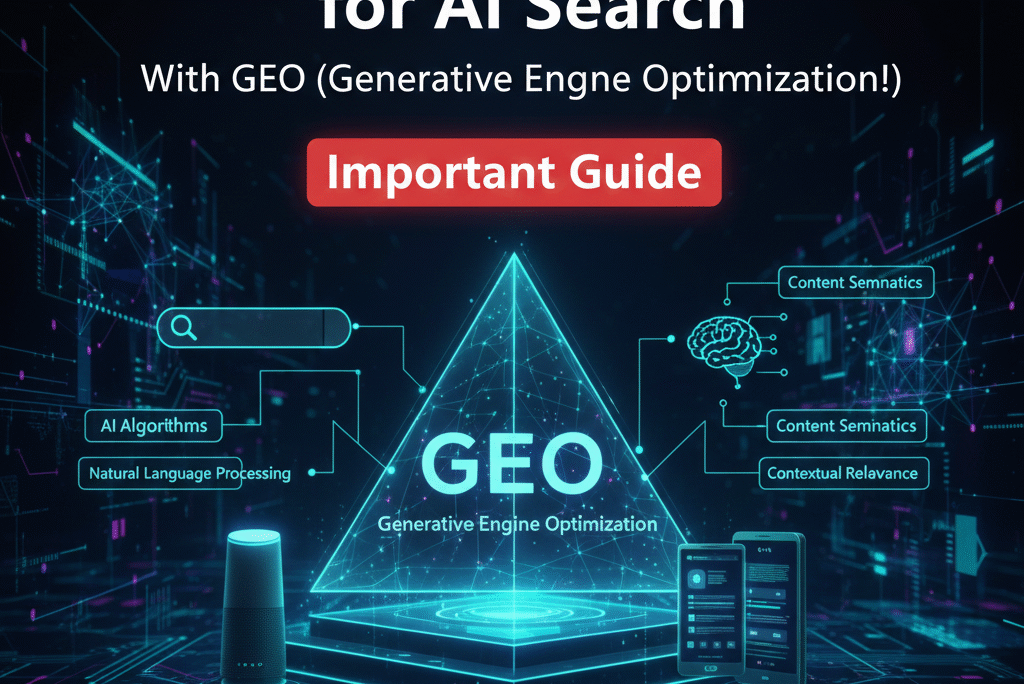
That’s where GEO — Generative Engine Optimization — comes in.
If SEO was about ranking on search engines, GEO is about being understood, referenced, and surfaced inside AI-generated answers.
Let’s break it down without the hype.
What Is GEO (Really)?
Generative Engine Optimization is the process of positioning your brand so AI systems can:
- Recognize it
- Understand it
- Trust it
- Reference it
Traditional SEO optimized for algorithms that ranked pages.
GEO optimizes for models that generate answers.
That difference matters.
Search engines index pages and rank them. AI systems digest content, summarize it, and then respond conversationally. Instead of “Here are ten links,” users get something like:
“The best way to launch an Amazon private label brand is to start with product validation, branding, and supplier vetting…”
If your brand contributed to that knowledge pool — and is structured properly — you increase the chances of being cited, recommended, or influencing that output.
This is not about gaming AI. It’s about clarity and authority.
Why GEO Matters for Ecommerce Brands
If you’re running:
- Amazon Private Label services
- eBay or Etsy Private Label
- Graphic Design & Brand Identity
- Website Design
- SEO, GEO, or Social Media Marketing
Your future clients are already using AI to research you.
They’re asking things like:
- “How much does Amazon private label cost?”
- “Is eBay private label worth it?”
- “Best branding agency for ecommerce startups”
- “How do I prepare my brand for AI search?”
If your brand doesn’t exist clearly in the digital ecosystem, AI won’t confidently surface it.
And if AI doesn’t surface it, you don’t exist in that conversation.
That’s the shift.
SEO vs GEO: The Key Differences
Let’s simplify this.
Old Search:
User types keywords → Google shows ranked pages → User clicks.
AI Search:
User asks a question → AI generates an answer → Maybe shows sources → User trusts summary.
The battlefield changes from “ranking first” to “being authoritative enough to be included.”
GEO isn’t replacing SEO. It’s layered on top of it.
Strong SEO builds discoverability.
Strong GEO builds influence inside AI answers.
If SEO is about traffic, GEO is about presence.
How AI Systems Decide What to Surface
Here’s the fascinating part.
AI models don’t “choose favorites.” They analyze patterns across vast datasets. They prioritize:
- Consistency of information
- Authority signals
- Clear explanations
- Structured content
- Reputable mentions
- Frequently referenced sources
So if your brand:
- Publishes in-depth, well-structured educational content
- Gets mentioned on credible sites
- Maintains consistent messaging
- Demonstrates expertise repeatedly
You increase your probability of being referenced.
It’s probabilistic, not guaranteed. But probability is a powerful lever in marketing.
The Foundations of GEO
Let’s make this practical.
1. Write for Humans First
Ironically, the best way to optimize for AI is to stop writing like you’re optimizing for AI.
Clear, structured, helpful content wins.
That means:
- Explaining concepts plainly
- Using real-world examples
- Answering full questions
- Avoiding keyword stuffing
- Structuring with clear headings
If your blog reads like a robot wrote it for another robot, generative systems don’t reward that. They reward clarity and authority.
2. Build Topical Authority
AI systems look for depth.
If you offer Amazon Private Label services, one blog isn’t enough. You need clusters:
- Product research guides
- Branding breakdowns
- PPC explanations
- Case studies
- Cost analysis posts
- Platform comparison posts
When your content consistently revolves around a theme, you become contextually strong in that domain.
Think of it as building gravity in a topic.
3. Structure Content Clearly
Generative systems parse structure.
That means:
- Descriptive headings
- FAQ sections
- Clear summaries
- Defined terms
- Bullet clarity where useful
When you define “What is Amazon Private Label?” clearly, AI can extract and reuse that definition more easily.
Messy structure equals weak extraction.
4. Be Citable
This one is underrated.
If your insights are sharp, original, and clearly phrased, they become quote-worthy.
For example:
Instead of writing:
“Branding is important.”
Write:
“Without brand differentiation, private label becomes a race to the bottom on price.”
That’s a sentence that sticks. That’s citable.
Generative systems gravitate toward clarity and distinct insights.
5. Strengthen Off-Site Signals
AI systems are influenced by broader web credibility.
That means:
- Guest posts
- Mentions on reputable sites
- Consistent business listings
- Author bios with expertise
- LinkedIn authority
- Podcast appearances
Your brand should exist beyond your own website.
If no one else references you, why would an AI system?
GEO and Ecommerce: A Strategic Advantage
Let’s zoom in.
Imagine someone asks:
“Who should I hire to build my Amazon private label brand?”
An AI answer might summarize:
- What to look for
- What services matter
- Common mistakes
- Recommended agencies (if available)
If your site consistently publishes high-value content about:
- Product validation
- Brand positioning
- Conversion optimization
- Long-term scaling
You’re training the ecosystem to associate your brand with authority in that space.
This isn’t overnight magic. It’s cumulative positioning.
GEO Is Also About Brand Clarity
Many ecommerce agencies struggle with vague messaging.
“We help you grow.”
That’s not AI-friendly.
Instead:
“We build scalable private label brands on Amazon, eBay, and Etsy through product research, branding, and performance-driven marketing.”
Clear beats clever.
Specific beats generic.
AI systems prefer precision because precision reduces ambiguity.
The Rise of AI-Assisted Buying Decisions
Consumers increasingly ask AI:
- “Which platform is best for private label?”
- “Should I start on Amazon or Etsy?”
- “What’s the difference between branding and logo design?”
If your brand consistently answers these questions publicly, you shape those AI summaries.
In other words, educational content becomes long-term leverage.
Not just traffic leverage. Authority leverage.
GEO + SEO + Branding = The Real Edge
Let’s connect the dots.
Your website design influences trust.
Your branding influences perception.
Your SEO influences discoverability.
Your GEO influences AI visibility.
This isn’t separate departments. It’s a system.
For example:
A clean website design improves user engagement.
Engagement improves trust signals.
Trust signals strengthen authority.
Authority strengthens inclusion probability in AI outputs.
Everything compounds.
Mistakes to Avoid
Some brands will panic and try to “optimize for AI” by:
- Stuffing FAQs everywhere
- Writing robotic Q&A content
- Chasing every AI trend
- Generating low-quality AI-written blogs at scale
That approach collapses fast.
AI systems are trained on high-quality language patterns. Thin content doesn’t become authoritative just because you mass-produce it.
Depth wins.
Clarity wins.
Consistency wins.
The Bigger Picture
GEO is not about manipulating machines.
It’s about becoming unmistakably clear in your domain.
The brands that will win in the AI search era are not the loudest. They’re the most structured, credible, and helpful.
If your ecommerce service company:
- Publishes in-depth guides
- Shows real process transparency
- Demonstrates expertise repeatedly
- Maintains consistent branding
- Earns mentions across the web
You are future-proofing visibility.
AI search is not the end of websites.
It’s the evolution of discovery.
And the brands that adapt early won’t just get traffic.
They’ll shape the answers.
The question is no longer “How do we rank?”
It’s “How do we become the obvious authority in our niche?”
When you build that foundation across Amazon Private Label, eBay, Etsy, branding, web development, and SEO — including GEO itself — you don’t just compete for clicks.
You compete for influence.
And influence compounds.
AI search is evolving fast, but the fundamentals remain the same: clear positioning, strong branding, technical precision, and strategic visibility. If you’re serious about building an ecommerce brand that doesn’t just rank — but gets recognized across Amazon, eBay, Etsy, search engines, and AI-driven platforms — it’s time to think bigger. At Eccommate, we help businesses build scalable private label brands through product research, branding, website development, SEO, GEO, and performance marketing. Explore our full range of services and see how we can position your brand for long-term growth.
To really grasp how Generative Engine Optimization fits into the future of search, it helps to see how other industry experts are defining the practice. BrandRadar’s complete guide on Generative Engine Optimization (GEO) breaks down the core concepts behind optimizing content for AI models like ChatGPT, Gemini, and Perplexity and explains how GEO extends traditional SEO to boost visibility inside AI-generated answers. Understanding these foundational principles can deepen your strategy and give you an edge as AI search continues to reshape discovery and decision-making online.