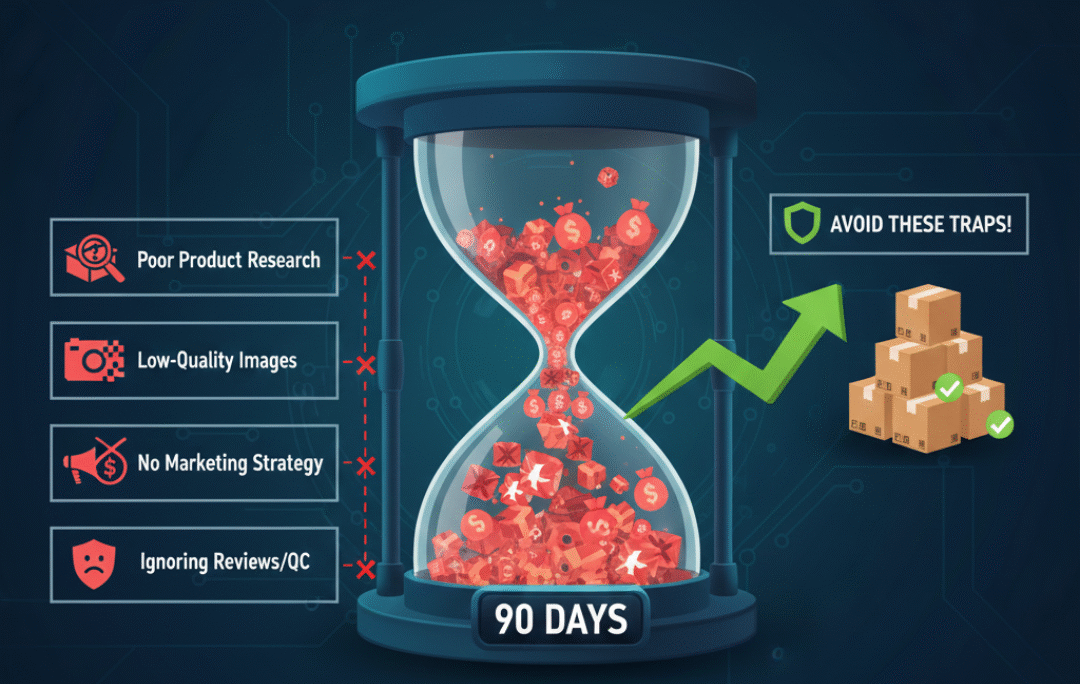
The First 90 Days of Private Label Are Not About Winning
They’re about not losing
Most new sellers think the first three months are about hitting sales. They’re not. They’re about survival. The goal isn’t domination—it’s building something that doesn’t collapse under its own weight.
The fastest way to fail is to treat private label like a lottery ticket instead of a business.
Now let’s walk through the biggest mistakes, one by one.
Mistake #1: Choosing a Product Because “It’s Trending”
This is the classic one.
Someone sees a product blowing up on TikTok, YouTube, or a product research tool with a big green arrow next to it. Dopamine hits. Logic exits the chat.
Here’s the uncomfortable truth:
Trending products are already late-stage products.
By the time you see it trending:
- Big sellers have already optimized it
- Factories have raised prices
- Competition is brutal
- Margins are thinner than they look
New sellers chase trends because it feels like certainty. In reality, it’s the opposite.
Private label works best with:
- Stable demand
- Boring-looking products
- Clear problems
- Room for branding improvements
If a product looks exciting, viral, or flashy—be suspicious. Boring pays bills.
Mistake #2: Confusing Revenue With Profit
A $30,000 launch screenshot looks sexy on Instagram.
A $3,000 profit statement does not.
Most new sellers don’t actually calculate profit correctly in their first 90 days. They look at:
- Sales
- Best Seller Rank
- Units sold
And completely ignore:
- PPC burn
- Refunds
- Storage fees
- Long-term ad dependency
- Cash flow timing
Private label isn’t about how much money comes in.
It’s about how much stays after Amazon (or any platform) takes its cut.
Many sellers realize too late that their “winning product” is just a very expensive hobby.
Mistake #3: Racing to Order Inventory Before Validation
New sellers rush inventory like they’re afraid the factory will disappear tomorrow.
They order:
- Huge MOQs
- Custom packaging
- Multiple variations
- Large shipments
All before knowing if the product actually converts.
This is backwards.
Your first inventory order is a test, not a commitment.
The goal is to learn:
- Will customers buy this?
- Do they understand the value?
- Are returns high?
- Does pricing work?
Inventory should scale after data—not before it.
Early over-ordering doesn’t make you serious. It just makes mistakes more expensive.
Mistake #4: Treating Branding as Decoration
Most new sellers think branding means:
- A logo
- A color
- A nice-looking box
That’s decoration, not branding.
Real branding answers questions instantly:
- Is this trustworthy?
- Is this better than alternatives?
- Who is this for?
- Why should I care?
Poor branding leads to:
- Lower conversion rates
- Price sensitivity
- Higher ad costs
- Weak reviews
In private label, your product is rarely unique.
Your presentation is.
Customers don’t compare specs. They compare feelings.
Mistake #5: Writing Listings for Algorithms Instead of Humans
This one is subtle—and deadly.
New sellers obsess over keywords:
- Stuffing titles
- Repeating phrases
- Writing robotic bullet points
They forget one small detail.
Algorithms don’t buy products. Humans do.
Yes, SEO matters. Yes, keywords matter. But if your listing:
- Doesn’t tell a clear story
- Doesn’t solve a specific problem
- Doesn’t reduce buyer anxiety
Then traffic is wasted.
The best listings feel like a conversation, not a spreadsheet.
Mistake #6: Depending on Ads to Fix a Bad Product
Ads are not magic. They are magnifiers.
If your product:
- Has poor reviews
- Has weak branding
- Isn’t clearly differentiated
Ads will just help more people notice that.
New sellers often think:
“If I just increase PPC, sales will come.”
What actually happens:
- Costs increase
- Conversion stays low
- Profit disappears
Ads should accelerate what’s already working—not compensate for what isn’t.
Mistake #7: Ignoring Reviews Until It’s Too Late
Reviews are feedback, not decoration.
New sellers either:
- Ignore reviews completely
- Panic at the first negative one
- Try to bury problems instead of fixing them
Early reviews are gold.
They tell you:
- What customers expected but didn’t get
- What confused them
- What almost stopped them from buying
The worst move is doing nothing.
Every negative review is a free product improvement consultation—paid for by someone else.
Mistake #8: Trying to Do Everything Alone
Private label touches:
- Product research
- Sourcing
- Branding
- Listings
- Ads
- SEO
- Customer psychology
- Supply chain logistics
No one is good at all of it.
New sellers burn out because they:
- Learn everything at once
- Make avoidable mistakes
- Spend months fixing errors professionals see in minutes
Doing it solo feels cheaper.
Fixing mistakes later is not.
Mistake #9: Expecting the First Product to Be “The One”
Your first product is not your empire.
It’s your education.
Too many sellers quit because:
- Sales aren’t instant
- Margins aren’t perfect
- It doesn’t scale immediately
Private label success is built across multiple launches, not one miracle product.
The first product teaches you:
- What customers respond to
- What suppliers to avoid
- How platforms really work
That knowledge compounds. Quitting resets it to zero.
The Truth About the First 90 Days
The first 90 days of private label aren’t about freedom, Lambos, or passive income.
They’re about:
- Learning fast
- Spending carefully
- Making reversible decisions
- Building something that can grow
Most failures aren’t caused by bad ideas.
They’re caused by rushed decisions and false expectations.
Private label works—but only when treated like a real business, not a shortcut.
Final Thought
If you’re in your first 90 days right now, the goal isn’t perfection.
It’s clarity.
Every smart move you make early gives you leverage later. Every mistake you avoid keeps you in the game long enough to win.
Private label doesn’t reward speed.
It rewards understanding.
And understanding compounds.
If you want to avoid these mistakes entirely and build your private label business the right way from day one, our team helps sellers launch and scale across Amazon, eBay, and Etsy with a proven, end-to-end process. From product research and branding to listings, ads, and growth strategy, everything is handled with clarity and data—not guesswork.
Explore our private label services here → [ Service Page Link]