Private label sounds simple on the surface. Find a product. Put your brand on it. Sell it online. Profit.
Reality is messier. Platforms behave differently. Algorithms have personalities. Budgets stretch or snap depending on where you start. And risk doesn’t just mean “losing money”—it means time, stress, account shutdowns, and being stuck with a garage full of inventory you now emotionally resent.
Amazon vs eBay vs Etsy all support private label—but they reward very different types of sellers. Picking the wrong one for your budget or risk tolerance is how people burn out and swear ecommerce is “dead.”
It isn’t dead. It’s just picky.
Let’s break this down like adults.
First, what “private label” actually means on each platform
Private label always means selling under your own brand, not reselling Nike or Apple. But the flavor changes by platform.
On Amazon, private label is hyper-competitive, algorithm-driven, and scale-focused. You’re building a product business inside a machine that cares deeply about price, reviews, fulfillment speed, and consistency.
On eBay, private label is more flexible. Branding matters, but the marketplace still allows variation, testing, and smaller runs. You’re not crushed by a single algorithm update the way Amazon sellers are.
On Etsy, private label lives in a weird middle space. Etsy likes branding and uniqueness, but dislikes anything that smells mass-produced. You’re selling a brand story as much as a product.
Same term. Three very different games.
Amazon Private Label: High budget, high competition, high upside
Amazon is the most structured—and the most unforgiving.
Budget reality
Amazon private label isn’t cheap anymore. The era of launching with $500 and vibes is gone.
A realistic starting budget usually includes:
- Product manufacturing (often MOQ-based)
- Freight and customs
- Amazon FBA fees
- PPC advertising
- Professional branding and listing optimization
- A buffer for mistakes (because mistakes will happen)
For most serious launches, $3,000–$8,000 is common. Scaling requires more.
Amazon rewards commitment. It punishes hesitation.
Risk profile
Amazon’s risk isn’t subtle. It’s loud.
- Account suspensions can happen fast
- Listing hijackers exist
- Review velocity matters enormously
- PPC can drain cash if mismanaged
- You’re tied to inventory decisions made months ago
The upside is scale. Amazon moves volume like no one else. If a product hits, it hits hard. Six figures annually is normal for successful brands. Seven figures isn’t fantasy.
But Amazon doesn’t forgive sloppy execution. If you hate rules, this is not your platform.
Who Amazon is best for
Amazon private label fits sellers who:
- Can invest upfront without panic
- Are comfortable with data and metrics
- Want scale more than flexibility
- Think long-term and systemically
- Accept that control is shared with Amazon
If you’re patient, analytical, and okay playing inside a giant machine, Amazon rewards discipline.
eBay Private Label: Lower budget, more flexibility, quieter wins
eBay is often overlooked—and that’s exactly why it still works.
Budget reality
eBay private label is far more forgiving financially.
You can:
- Start with smaller inventory batches
- Test multiple products without committing heavily
- Avoid massive ad spend early on
- Adjust listings faster without penalties
Many sellers start eBay private label with $500–$2,000, especially if they control sourcing tightly.
Margins can still be solid. Volume is lower than Amazon, but risk is lower too.
Risk profile
eBay’s risks are… calmer.
- No brutal PPC arms race
- Less dependency on review velocity
- More tolerance for experimentation
- Fewer sudden account-wide disasters
That doesn’t mean zero risk. Policy violations still matter. Customer service still matters. But eBay doesn’t feel like walking a tightrope in a windstorm.
The biggest risk on eBay is stagnation—selling “okay” but never scaling aggressively.
Who eBay is best for
eBay private label fits sellers who:
- Want to test without heavy upfront investment
- Prefer flexibility over scale
- Like adjusting strategy quickly
- Want profit before expansion
- Hate burning cash on ads
eBay is excellent for disciplined operators who want predictable cash flow without constant anxiety.
Etsy Private Label: Brand-heavy, creativity-driven, rule-sensitive
Etsy is not Amazon Lite. Treating it that way gets stores shut down.
Budget reality
Etsy private label can start lean.
Many successful Etsy brands begin with:
- Small-batch production
- Print-on-demand or custom suppliers
- Simple but consistent branding
- Minimal ad spend
Starting budgets can be $300–$1,500, depending on product type.
The catch: time investment is higher. Branding, storytelling, visuals, and customer communication matter more than raw volume.
Risk profile
Etsy’s biggest risk isn’t competition—it’s compliance.
Etsy:
- Dislikes mass-produced-looking products
- Enforces “handmade” or “designed by seller” narratives
- Can suspend shops without much warning
- Penalizes stores that feel too generic
On the upside, Etsy customers are loyal. They pay premiums. They care about aesthetics and story. A strong brand can dominate a niche quietly and profitably.
Who Etsy is best for
Etsy private label fits sellers who:
- Are brand and design-focused
- Enjoy storytelling and aesthetics
- Want community-driven sales
- Prefer smaller but loyal audiences
- Can follow platform rules carefully
If you treat Etsy like a craft fair with algorithms, it rewards authenticity. If you treat it like Amazon, it slaps you.
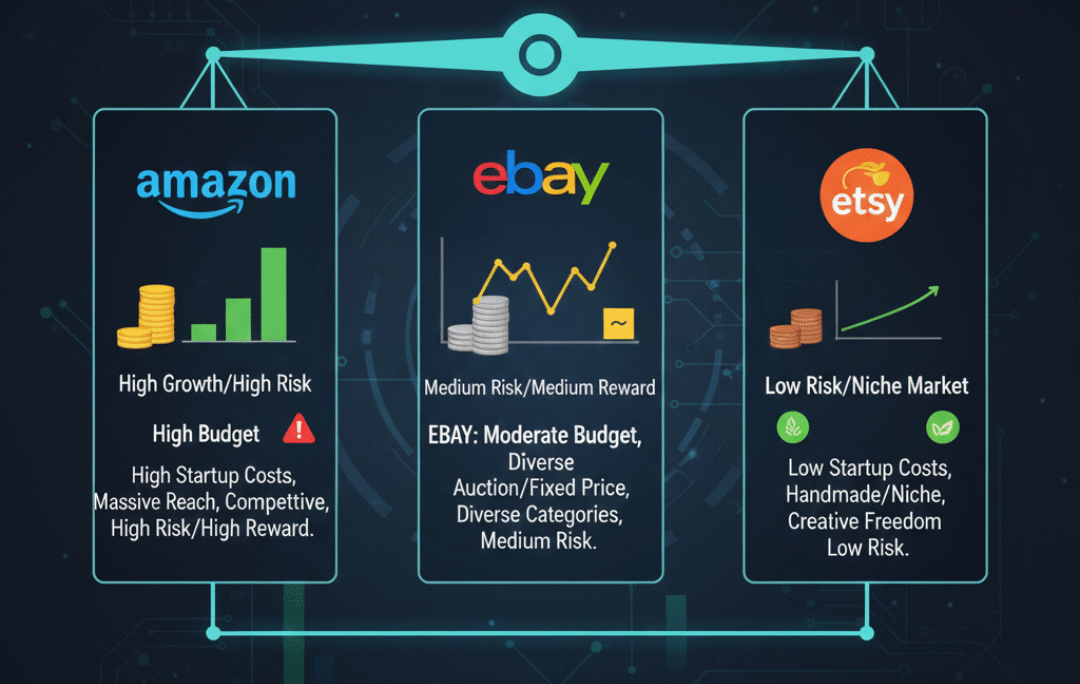
Budget vs Risk: Side-by-side reality check
If we strip emotions out of it:
- Amazon = Highest budget, highest competition, highest upside, highest stress
- eBay = Moderate budget, moderate competition, moderate upside, lower stress
- Etsy = Low-to-moderate budget, niche competition, brand-driven upside, compliance risk
No platform is “best.” There’s only best for where you are right now.
The biggest mistake: choosing based on hype instead of temperament
Most failures happen here.
People with small budgets choose Amazon because YouTube told them it’s “where the money is.” Then they panic at PPC costs and quit.
People who hate branding choose Etsy and wonder why no one buys.
People who want fast scale choose eBay and feel “stuck.”
Platform choice isn’t just financial. It’s psychological.
Ask yourself honestly:
- How much capital can I risk without stress?
- How patient am I?
- Do I enjoy systems or creativity more?
- Can I survive slow months?
- Do I want scale or control?
Your answers matter more than trend charts.
Can you sell on more than one platform?
Yes. But not at the start.
The smartest brands master one platform first, then expand. Amazon brands add Etsy for brand exposure. Etsy brands add Amazon for scale. eBay brands diversify to stabilize revenue.
Multi-platform works when systems already exist. Starting everywhere at once is how people do everything poorly.
So… which one fits you? Amongst Amazon vs eBay vs Etsy
If you have capital, patience, and long-term ambition → Amazon
If you want controlled risk and steady profit → eBay
If you love branding and niche audiences → Etsy
None of these are shortcuts. All of them work when executed correctly.
The real advantage comes from alignment—between your budget, your temperament, and the platform’s reality.
Get that alignment right, and private label stops feeling like gambling and starts feeling like a business.
And businesses, unlike hype, tend to stick around.
Choosing the right platform is only the first step. Execution is what decides whether private label becomes a real business or just another abandoned idea. If you want expert help with product research, branding, listings, and launch strategy across Amazon, eBay, or Etsy, explore our Services page to see how we build brands with clarity, data, and long-term growth in mind.