If you sell on Amazon long enough, this question eventually creeps in like an unpaid invoice:
“Do I really need a website… or is my Amazon Storefront enough?”
On the surface, it feels reasonable. Amazon already has traffic. It already has trust. It already has customers pulling out their wallets like it’s muscle memory. Why build a whole separate site when Amazon is doing the heavy lifting?
Here’s the honest answer most people won’t give you upfront:
An Amazon Storefront and a website are not competitors.
They are tools for different jobs.
Using one instead of the other is like trying to cook, eat, and store leftovers using only a frying pan. Technically possible. Strategically… not great.
Let’s untangle what each one is actually for, where sellers go wrong, and how smart brands use both without wasting money or energy.
What an Amazon Storefront Really Is (No Romance, Just Reality)
An Amazon Storefront is a curated brand space inside Amazon’s ecosystem. Think of it as a mini showroom inside a massive shopping mall where Amazon owns the building, the security, the rules, and the exits.
It exists to do three main things:
- Organize your products
- Reinforce brand credibility
- Increase conversions from Amazon traffic
That’s it. No magic. No secret growth lever.
When someone is already on Amazon and clicks your brand name, the Storefront helps them:
- See your full catalog
- Understand your brand positioning
- Feel more confident buying from you instead of a random competitor
It’s very good at this job.
What it is not designed to do:
- Build long-term brand loyalty
- Capture customer data
- Rank on Google
- Tell a deep brand story
- Protect you from Amazon policy changes
Amazon Storefronts are conversion tools, not ownership tools.
And Amazon is very clear about this, even if sellers ignore it:
You are renting attention, not owning an audience.
What a Website Actually Is (And Why Sellers Underestimate It)
This is your home base. Your land. Your rules.
It doesn’t replace Amazon. It complements it in ways Amazon never will.
A proper ecommerce or brand website exists to:
- Establish brand authority outside marketplaces
- Capture organic traffic from Google and AI-driven search
- Build trust before someone is ready to buy
- Collect emails, behavior data, and customer insights
- Support SEO, content marketing, and retargeting
- Increase lifetime value, not just one-off sales
In other words, a site plays the long game.
Amazon is where people go when they already want to buy.
Your site is where people go when they want to understand, compare, and trust.
And that distinction matters more every year.
Traffic: Borrowed vs Earned
Here’s the core philosophical difference.
Amazon traffic is borrowed.
Web traffic is earned (and owned).
On Amazon:
- You don’t control where traffic comes from
- You don’t control how products are displayed next to yours
- You don’t control algorithm changes
- You don’t control account risk
On your website:
- SEO traffic compounds over time
- Content continues working months or years later
- You can retarget visitors
- You can build direct relationships
Amazon is a highway with toll booths and speed limits.
A website is a city you build brick by brick.
Most sellers obsess over traffic volume and ignore traffic quality.
A website quietly wins on quality.
Branding: Surface-Level vs Deep Trust
Amazon Storefront branding is cosmetic but useful.
Website branding is structural and strategic.
On Amazon, branding helps with:
- Visual differentiation
- Perceived professionalism
- Conversion confidence
But Amazon strips brands down to essentials.
You don’t control layouts freely.
You don’t control customer journeys fully.
You don’t control post-purchase experiences.
A website lets you:
- Tell your origin story
- Show behind-the-scenes credibility
- Display reviews, press, certifications, and social proof properly
- Shape how people emotionally understand your brand
Strong brands are not built inside checkout carts.
They’re built before checkout ever happens.
SEO & Discoverability: The Quiet Superpower
Here’s where things get spicy.
Amazon SEO helps you rank inside Amazon.
Web SEO helps you rank everywhere else — including places Amazon can’t touch.
A well-built website can rank for:
- Informational searches (“best X for Y”)
- Comparison searches
- Problem-aware queries
- AI-generated answers (GEO / Generative Engine Optimization)
This means people can discover your brand:
- Before they’re ready to buy
- Without seeing competitors next to you
- Without Amazon ads hijacking the click
And here’s the kicker:
Those people often end up buying on Amazon anyway — but now they’re looking specifically for you.
Your website becomes a silent sales assistant that pre-sells your product before Amazon ever enters the picture.
Data & Control: The Thing Amazon Will Never Give You
Amazon gives you sales data.
Sites give you behavior data.
That difference is massive.
With a website, you can understand:
- What content converts
- What objections customers have
- Which products get interest but not purchases
- How people move from curiosity to confidence
You can:
- Build email lists
- Run retargeting ads
- Test messaging
- Improve offers based on real insights
Amazon keeps that power for itself. Always has. Always will.
Risk Management: The Uncomfortable Truth
Amazon accounts get suspended.
Listings get taken down.
Categories change.
Fees increase.
Rules tighten.
None of this is hypothetical.
A web presence doesn’t eliminate Amazon risk, but it softens the blow.
Brands with websites:
- Recover faster
- Communicate with customers directly
- Pivot traffic sources
- Maintain credibility during disruptions
Brands without webpages disappear overnight.
This isn’t fear-mongering. It’s just experience talking.
So… Which One Should You Focus On?
Here’s the practical breakdown.
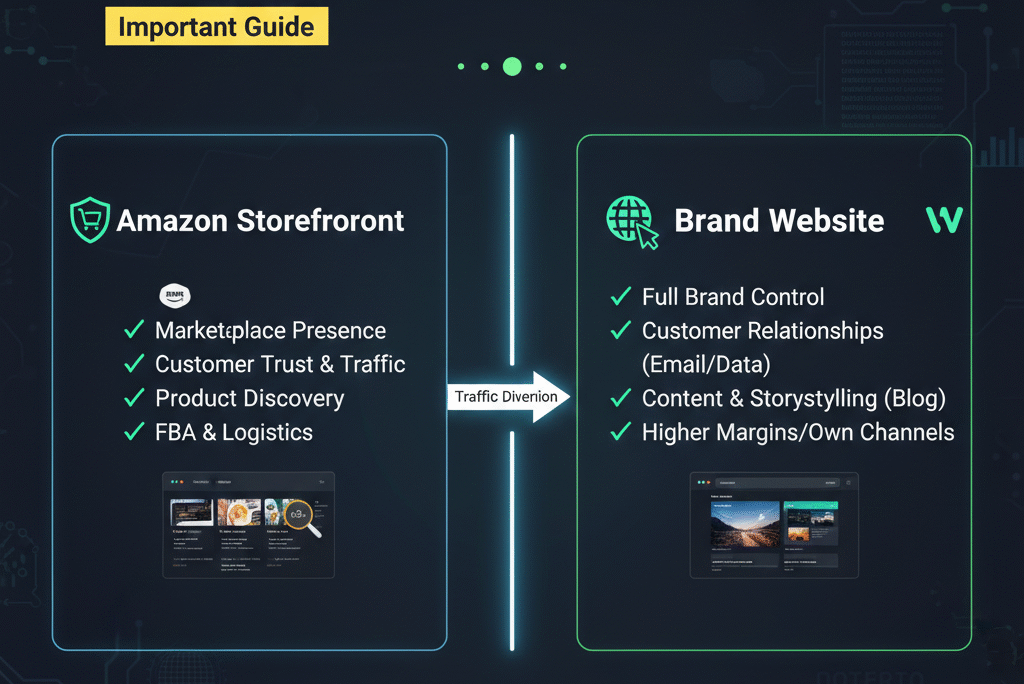
Amazon Storefront is for:
- Converting existing Amazon shoppers
- Improving brand perception on-platform
- Increasing average order value
- Supporting PPC traffic
A Website is for:
- Building brand equity
- Long-term SEO growth
- Trust and authority
- Audience ownership
- Scaling beyond one platform
If you’re early-stage and capital is tight, Amazon comes first.
If you’re serious about longevity, a website becomes non-negotiable.
Mature brands don’t choose. They integrate.
The Smart Strategy: Let Them Do What They’re Good At
The smartest ecommerce brands use:
- Amazon to close
- Websites to educate, warm, and differentiate
The website feeds trust.
Amazon captures demand.
This setup:
- Improves conversion rates
- Lowers ad dependency over time
- Builds something that survives algorithm chaos
Amazon is where transactions happen.
Websites are where brands are born.
And brands — real brands — are what last.
Final Thought
If Amazon vanished tomorrow, would your business still exist?
That question isn’t meant to scare you. It’s meant to clarify strategy.
An Amazon Storefront is a powerful tool.
A website is a foundation.
The difference between sellers who plateau and brands that scale usually comes down to understanding that distinction — and acting on it before they’re forced to.
Build where you sell.
But also build where you own.
If you’re serious about building an ecommerce brand that doesn’t depend on a single platform, this is where strategy matters. At our Eccommate SEO Services, we help sellers design Storefronts that convert and sites that build long-term brand value — so your business grows even when algorithms change. If you’re ready to stop guessing and start building with intention, explore our services and see how we help brands scale sustainably.
For a deeper look at why owning your own website matters — even if you’re already selling on Amazon — SellerApp’s article “5 Reasons Amazon Sellers Should Still Have Their Own Website” does a great job of breaking down the core advantages, including how a website lets you build brand identity, capture valuable customer data, and boost visibility beyond what Amazon’s ecosystem allows.