“Private Label” might be the most abused phrase in Amazon ecommerce.
Everyone throws it around like it’s a magic spell. You say the words, upload a logo, send some money to Alibaba, and—boom—you’re a brand owner. Passive income rains from the sky. Bezos sends a thank-you card.
Reality, sadly, is less cinematic.
Amazon Private label isn’t a product model. It’s a business model. And most sellers misunderstand it so badly that they accidentally build expensive, fragile knockoffs instead of real brands.
Let’s untangle this mess properly.
What Private Label Actually Means (Stripped of Hype)
At its core, Amazon private label means this:
You sell a product manufactured by someone else, under your own brand, where you control:
• Branding
• Positioning
• Listing
• Pricing
• Customer experience
• Long-term strategy
You are not just reselling inventory. You are assuming responsibility for the entire lifecycle of the product.
That last sentence is where most sellers quietly mess up.
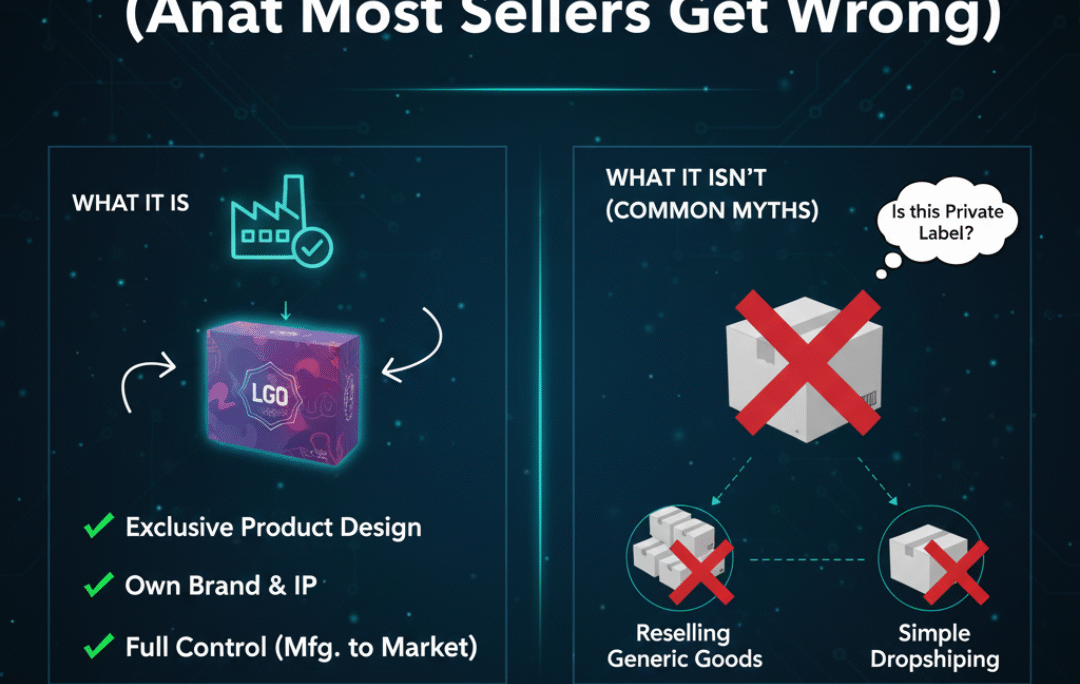
Private label is not:
- “Find product → slap logo → list → pray”
- Dropshipping with extra steps
- Wholesale with a custom box
- A one-product side hustle that runs itself
Private label is closer to launching a micro consumer brand inside Amazon’s ecosystem.
Amazon just happens to be the mall.
The Biggest Misunderstanding: Product ≠ Brand
Most sellers think private label means “custom product.”
Wrong.
Private label means brand differentiation, not product invention.
You can sell the exact same physical item as 50 other sellers and still win—if:
- Your brand story is clearer
- Your visuals signal trust
- Your positioning matches a specific buyer
- Your listing removes friction and doubt
What most sellers do instead is obsess over:
- Tiny feature tweaks no customer asked for
- Marginal supplier differences
- “Unique” variations that add cost but not value
Customers don’t buy products.
They buy confidence.
Private label done right manufactures confidence at scale.
What Most Sellers Get Wrong (The Greatest Hits)
Let’s lovingly roast the common mistakes.
1. “My Logo Makes Me a Brand”
A logo doesn’t make you a brand any more than a username makes you a personality.
Branding is:
- Tone
- Promise
- Consistency
- Visual coherence
- Expectations met repeatedly
Most Amazon sellers:
- Hire a $5 logo
- Use five fonts
- Change colors every product
- Have no story beyond “high quality product”
That’s not branding. That’s decorative hope.
2. Chasing “Low Competition” Instead of Buyer Intent
New sellers hunt keywords like they’re Pokémon.
“Low competition”
“High demand”
“Under 300 reviews”
Meanwhile, they ignore:
- Why people buy the product
- What frustrates them
- What they complain about in reviews
- What they actually care about
Private label works when you understand psychology, not just software metrics.
A product with “competition” but clear unmet expectations is far easier to win than a dead niche with zero demand.
3. Thinking Private Label Is Passive
This myth refuses to die.
Private label is front-loaded hard work:
- Research
- Design
- Sourcing
- Launch
- PPC
- Reviews
- Optimization
- Inventory planning
It becomes semi-passive later—if done well.
People who want passive income should buy index funds, not inventory.
4. Treating Amazon Like the Business (Instead of the Channel)
Amazon is not your brand.
Amazon is where your brand rents shelf space.
Sellers who build only for Amazon:
- Panic during algorithm changes
- Lose leverage
- Get wiped by suspensions
- Can’t sell their business later
Smart private label sellers:
- Build branding that survives outside Amazon
- Think in terms of assets
- Treat Amazon as traffic + fulfillment, not ownership
This distinction matters more every year.
What Private Label Looks Like When Done Right
Let’s paint the correct picture.
A proper private label business has:
• A defined target customer
• A clear reason why this product exists
• Consistent visual identity across listings and packaging
• Copy that speaks to pain points, not features
• A long-term catalog strategy (not one-hit products)
• Pricing that supports ads, returns, and growth
• A feedback loop using reviews and data
Notice what’s missing?
“Secret hacks.”
“Easy money.”
“Tricks Amazon doesn’t want you to know.”
Because real businesses don’t run on secrets. They run on execution.
Private Label vs White Label (Yes, There’s a Difference)
This one causes endless confusion.
White label:
You sell a generic product exactly as-is, with minimal changes, often competing purely on price.
Private label:
You customize positioning, branding, messaging, packaging, and often experience—even if the core product is similar.
Most Amazon sellers think they’re private labeling.
In reality, they’re white labeling with a logo.
That’s why margins get crushed.
Why So Many Private Label Stores Fail in Year One
Not because private label is dead.
But because:
- Expectations are wrong
- Capital is underestimated
- Branding is treated as decoration
- PPC is treated as optional
- Inventory planning is guessed
- Sellers copy competitors instead of customers
Private label punishes laziness and rewards clarity.
Amazon is brutally fair that way.
The Real Timeline Nobody Talks About
Let’s be honest about time.
A realistic private label journey looks like:
• Month 1–2: Research, branding, sourcing
• Month 3: Manufacturing + listing prep
• Month 4: Launch, ads, optimization
• Month 5–6: Data-driven improvements
• Month 6–9: Stabilization
• Month 9+: Scaling or expansion
Anyone promising “profit in 30 days” is either:
- Selling a course
- Ignoring ad spend
- Redefining profit creatively
Why Branding Is the Multiplier (Not the Decoration)
Two sellers.
Same product.
Same supplier.
Same price.
One looks like a random Amazon listing.
The other looks like a company.
Guess who converts better.
Guess who survives price wars.
Guess who gets repeat buyers.
Branding:
- Increases conversion rate
- Lowers ad costs
- Builds defensibility
- Makes copycats less effective
It’s not aesthetic fluff.
It’s economic leverage.
The Hard Truth Most Sellers Avoid
Private label isn’t hard because Amazon is saturated.
It’s hard because most people don’t want to build a business—they want a shortcut that behaves like a business.
Amazon private label still works.
Very well.
For people who treat it like:
- A system
- A process
- A brand
- An asset
Not a lottery ticket.
So What Should You Do Differently?
Think less like:
“I need a winning product.”
Think more like:
“I’m building a small brand that solves a specific problem.”
Products come and go.
Brands compound.
That’s the difference between sellers who quit and sellers who scale.
Private label works best when it’s treated like a real business—not a shortcut. Research, branding, sourcing, listings, and scaling all have to work together, or the whole thing collapses. If you’re serious about building an Amazon private label brand the right way, we break down and handle the entire process on our Amazon Private Label Services page—from product research to launch and growth—so you’re not guessing your way through expensive mistakes.