Amazon PPC (Pay-Per-Click) gets talked about like it’s either a cheat code or a scam. One guru says “just turn on auto ads and profit.” Another says “PPC will bleed you dry.” Both are wrong — and both are telling half-truths that get sellers stuck.
PPC isn’t the business.
PPC isn’t the strategy.
PPC is a tool.
In a real Amazon Private Label business, PPC has one job: accelerate what already works and expose what doesn’t. When used correctly, it speeds up growth, sharpens your data, and protects your listing. When used badly, it becomes an expensive way to delay reality.
This guide breaks down how PPC actually fits into a long-term private label strategy — from launch to scale — without the fantasy math.
The Big Misunderstanding About Amazon PPC
Most sellers treat PPC like a slot machine.
They launch a product, turn on ads, stare at ACoS (Advertising Cost of Sale), panic, tweak bids randomly, then declare Amazon “too competitive.”
The problem isn’t PPC.
The problem is expectation mismatch.
PPC does not:
- Fix a bad product
- Save a weak listing
- Compensate for poor branding
- Replace real demand
What PPC does:
- Buy visibility while your organic rank matures
- Generate keyword and conversion data
- Defend your brand from competitors
- Scale proven listings faster
Think of PPC as fuel. If the engine is broken, more fuel just makes smoke.
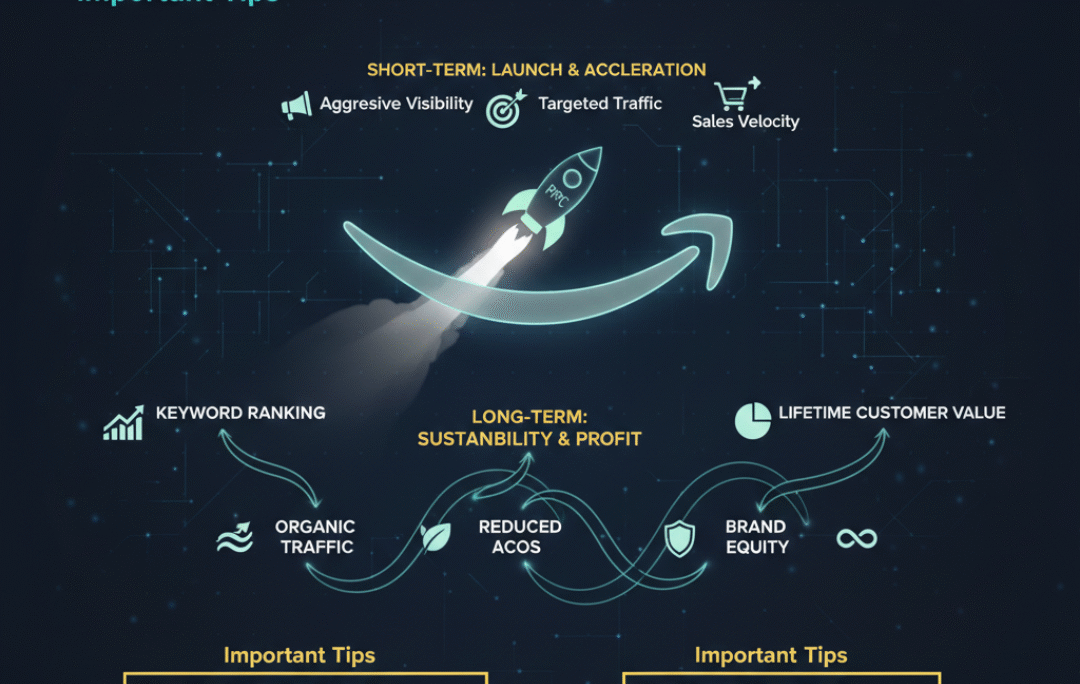
PPC’s Real Role in Private Label Strategy: Speed + Data
Amazon’s algorithm rewards performance. Sales velocity, conversion rate, and relevance matter more than anything. PPC gives you controlled exposure so Amazon can see how shoppers react to your product.
At its best, PPC does two things simultaneously:
- Speeds up ranking by generating early sales
- Teaches you what the market actually wants, not what you assumed
That second part is underrated. PPC isn’t just advertising — it’s market research that pays you back in insights.
Phase 1: PPC During Product Launch (Controlled Losses, Valuable Data)
Let’s say this part out loud:
You will probably lose money on PPC at launch.
That’s not failure. That’s tuition.
During launch, PPC’s purpose is not profit. It’s:
- Discovering high-converting keywords
- Testing price sensitivity
- Measuring listing quality
- Generating initial sales velocity
What Smart Launch PPC Looks Like
At launch, your listing has:
- No reviews (or very few)
- No organic rank
- No historical data
Expecting low ACoS here is unrealistic. The goal is learning quickly without bleeding uncontrollably.
Smart launch PPC focuses on:
- Auto campaigns to mine keyword data
- Broad and phrase match to explore search behavior
- Limited budgets with strict monitoring
- Manual campaigns only for obvious core keywords
You’re asking Amazon a question:
“If I show this product to real shoppers, do they buy it?”
If the answer is consistently “no,” PPC didn’t fail — it saved you from scaling the wrong product.
Phase 2: PPC as a Ranking Accelerator (Where Most Sellers Misuse It)
Once you identify keywords that convert, PPC shifts from exploration to acceleration.
Here’s where many sellers go wrong:
They keep throwing money at everything instead of doubling down on what works.
At this stage, PPC should:
- Push winning keywords higher in organic rank
- Reduce dependency on ads over time
- Support your listing while reviews grow
The Hand-Off Between Paid and Organic
The long-term goal isn’t “always running ads.”
The goal is organic dominance with paid support.
When PPC is aligned correctly:
- Paid ads drive sales
- Sales improve organic rank
- Organic rank reduces reliance on ads
- PPC budgets shift to defense and scaling
If your PPC spend never goes down as your rank improves, something upstream is broken — usually conversion rate, pricing, or listing quality.
Phase 3: PPC as Brand Defense (The Quiet War No One Talks About)
Once your product gains traction, PPC changes roles again.
Now it’s not just about growth — it’s about protection.
Competitors will:
- Bid on your brand name
- Copy your images and angles
- Undercut price temporarily
- Hijack keywords you worked to rank for
At this stage, PPC becomes defensive.
Brand Defense PPC Includes:
- Brand-name keyword campaigns
- Sponsored Brand ads
- ASIN targeting on competitor listings
- Protecting top organic keywords
This keeps competitors from siphoning off customers who were already looking for you. Sellers who ignore brand defense often notice “mysterious” drops in conversion and blame the algorithm.
It’s not the algorithm. It’s open warfare.
PPC and Branding: Why Generic Products Pay More
Here’s a truth sellers hate:
Weak brands pay more for clicks.
Amazon charges everyone roughly the same per click, but branded products convert better. Better conversion = lower effective ad cost.
Branding impacts PPC through:
- Higher click-through rates (CTR)
- Better conversion rates
- Stronger repeat purchases
- Improved customer trust
A generic-looking product with no story, no visual hierarchy, and no differentiation will always need more PPC to survive. Branding doesn’t eliminate ad spend — it makes ad spend efficient.
This is why long-term private label strategies invest in:
- Professional images
- Clear value propositions
- Consistent packaging
- Brand voice and positioning
PPC rewards clarity. Confusion is expensive.
PPC Is Not a Substitute for Listing Optimization
If your PPC ACoS is high, the first instinct is to tweak bids.
That’s usually the last thing you should do.
High ACoS often means:
- Images don’t match search intent
- Bullet points don’t answer objections
- Price doesn’t match perceived value
- Reviews highlight unresolved issues
PPC exposes listing weaknesses faster than organic traffic ever will. Instead of fighting the data, use it.
When ads get clicks but not conversions, that’s feedback — not punishment.
Long-Term PPC Strategy: From Expense to Asset
In mature private label brands, PPC becomes predictable and strategic.
At scale, PPC is used to:
- Launch new variations
- Enter new keyword clusters
- Dominate seasonal demand
- Test pricing changes
- Support external traffic
Notice what’s missing: panic.
Long-term PPC strategies are boring by design. Budgets are planned. Margins are known. Decisions are data-backed, not emotional.
This is the difference between sellers who “try Amazon” and brands that treat Amazon like a serious business channel.
The Myth of “Turning Off PPC”
Some sellers dream of the day they can turn PPC off completely.
That day rarely comes — and shouldn’t.
Even the strongest brands keep PPC running because:
- It protects rank
- It controls brand messaging
- It blocks competitors
- It accelerates growth when opportunities appear
The real goal isn’t zero PPC.
The goal is PPC that earns its place.
How PPC Fits Into the Bigger Private Label Picture
Amazon PPC works best when it’s part of a system:
- Strong product-market fit
- Clear brand positioning
- Optimized listings
- Realistic financial planning
- Long-term thinking
When PPC is treated as a short-term hack, it burns budgets. When treated as a strategic lever, it compounds results.
Private label success isn’t about finding a loophole. It’s about stacking small advantages until the business becomes hard to disrupt.
PPC is one of those advantages — powerful, dangerous, and incredibly useful when respected.
Final Thought
Amazon PPC isn’t your enemy.
It’s also not your savior.
It’s a mirror. It shows you exactly how the market feels about your product — faster and more honestly than almost anything else on the platform.
Long-term private label brands don’t ask, “How do I reduce PPC?”
They ask, “How do I make PPC smarter every quarter?”
That mindset is what separates sellers who survive from brands that scale.
If you’re serious about building an Amazon private label brand — not just launching a product and hoping for the best — PPC needs to sit inside a larger system. That system includes product research, branding, listing optimization, and long-term growth planning. If you want that handled end-to-end, you can explore our Amazon Private Label services, where we focus on building scalable brands, not short-term wins.
For detailed best practices and official guidance straight from Amazon’s own documentation, check out the Amazon Advertising Marketing Guidelines which outline how sponsored ads, brand ads, and PPC efforts should be structured and managed.