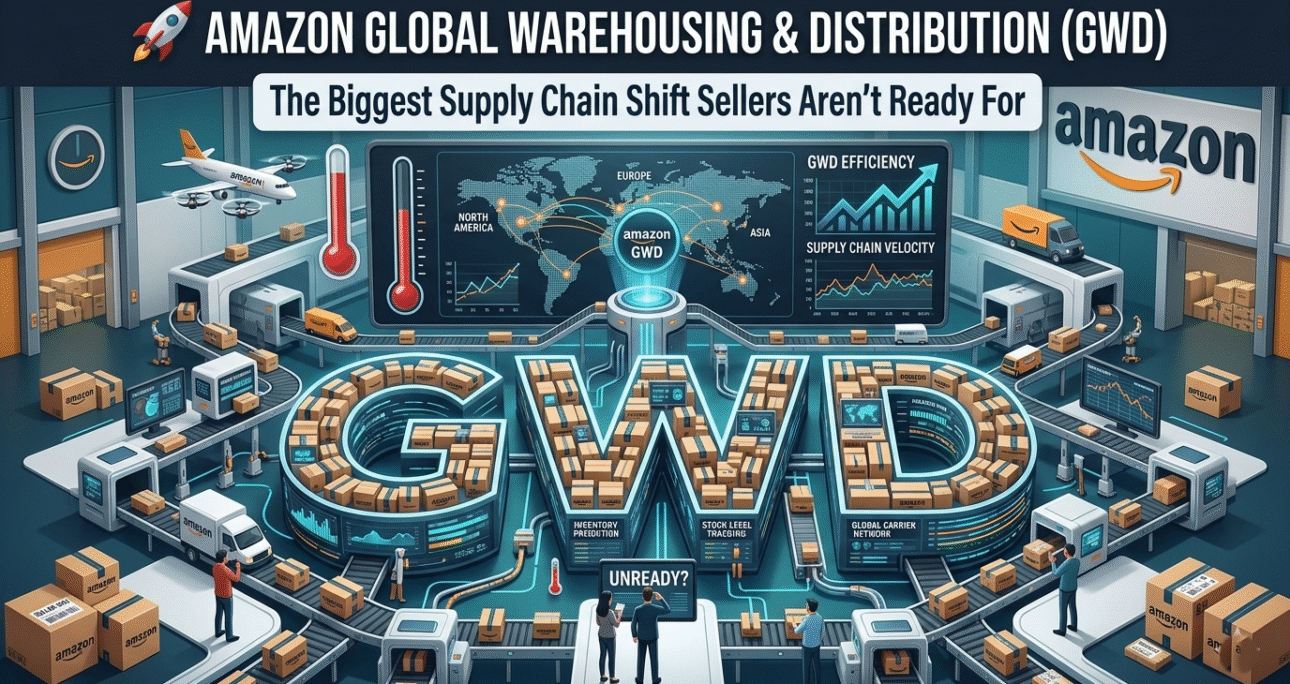
This is for Amazon sellers who’ve seen the GWD announcement and aren’t sure whether it’s genuinely significant or just another logistics feature buried in a Seller Central update. It’s significant. Here’s why, and what it actually means for how you run your business.
Why This Is More Than a Logistics Update
Amazon releases operational updates regularly, and most of them are incremental improvements to existing systems — fee adjustments, fulfillment center changes, policy clarifications. Sellers have learned, reasonably, to evaluate these announcements with calibrated skepticism before changing how they operate.
Amazon’s Global Warehousing and Distribution program, launched out of Shenzhen, China, is different in a way that deserves more attention than most sellers are giving it.
The surface-level description sounds like a logistics convenience: sellers can now store inventory in a centralized hub in China and let Amazon handle distribution to multiple global markets from that single location. That framing undersells what’s actually happening.
What’s actually happening is that Amazon is inserting itself into a part of the supply chain it previously didn’t control — the period between when a product leaves the manufacturer and when it enters an Amazon fulfillment center. By doing this, Amazon is solving one of the most persistent structural problems in global private label selling while simultaneously deepening seller dependency on its ecosystem in ways that have long-term strategic implications for both parties.
Understanding GWD clearly — what it solves, what it costs, who it helps, and what risks it introduces — is what allows sellers to make an informed decision about whether and how to adopt it, rather than either ignoring it until they’re behind or rushing into it without understanding the full picture.
The Problem GWD Is Designed to Solve
To understand why GWD matters, it helps to understand the specific operational problem that global Amazon sellers have been managing for years.
A private label seller who sells in multiple Amazon marketplaces — the United States, the United Kingdom, Germany, Japan — currently has to manage separate inventory pools for each market. They forecast demand for each market independently, ship inventory separately to fulfillment centers in each region, pay storage fees in each region, and live with the consequences when their forecasts are wrong — which, given the difficulty of predicting demand across multiple markets simultaneously, is regularly.
The consequences of getting this wrong are expensive in both directions. Overstock in one region means elevated storage fees, potential long-term storage surcharges, and capital tied up in inventory that isn’t selling. Stockouts in another region mean lost sales, ranking decline from reduced sales velocity, and buy box instability — all of which take time and money to recover from after the stockout is resolved.
This inventory fragmentation problem grows proportionally with the number of markets a seller operates in. A seller in two markets manages it with difficulty. A seller in four or five markets finds that inventory management alone requires significant operational resources and still produces suboptimal outcomes because the fundamental problem — separate inventory pools that can’t dynamically respond to demand shifts — doesn’t have a good solution within the existing system.
GWD is Amazon’s solution to this problem. Sellers send inventory to a centralized hub in Shenzhen. Amazon manages warehousing, customs clearance, cross-border transportation, and distribution routing from that hub to fulfillment centers across its global marketplace network. When demand in one market outpaces another, inventory is directed there rather than sitting idle in a region where it isn’t needed.
The shift from fragmented regional inventory pools to a single centralized pool that flows dynamically to where demand exists is a genuine operational improvement for sellers managing multi-market operations. The question is what that improvement costs, in both fees and strategic terms.
How the Old Model Worked and Where It Failed
Walking through a specific scenario makes the difference concrete.
Under the existing FBA model, a seller planning to sell one thousand units of a product across three markets — the United States, the United Kingdom, and Germany — has to make several decisions before a single unit ships. How many units go to each market? The answer requires a demand forecast for each market, which requires historical sales data that a growing brand may not have in sufficient volume to forecast reliably, especially for newer products or recently expanded markets.
A reasonable allocation might be four hundred units to the United States, three hundred to the United Kingdom, and three hundred to Germany. The seller ships accordingly, pays freight to three destinations, pays storage fees in three fulfillment networks, and then waits.
What frequently happens: demand in one market exceeds the forecast. The United States sells through its four hundred units in six weeks instead of ten. The United Kingdom and Germany still have inventory sitting in their respective fulfillment centers. The seller faces a stockout in the United States — their largest market — while paying storage fees on inventory they can’t immediately redirect.
Restocking the United States requires another production order, another shipping cycle, another customs clearance. Depending on the supply chain, this takes four to eight weeks or longer. During that time, organic ranking in the United States declines from reduced sales velocity. PPC efficiency drops. The buy box may be affected. Recovering from a significant stockout in a primary market can take months.
Meanwhile, the inventory sitting in the United Kingdom and Germany continues accumulating storage fees while demand waits for the next restock cycle.
This scenario is not exceptional — it’s common among growing multi-market Amazon sellers. The fundamental cause is always the same: inventory committed to regional pools can’t respond dynamically to demand that the forecast didn’t accurately predict.
What GWD Actually Changes
Under the GWD model, the same seller sends their thousand units to a centralized hub in Shenzhen rather than splitting shipments to three destinations. Amazon holds the inventory in the hub and distributes units to fulfillment centers in each market based on real-time demand signals rather than the seller’s upfront forecast.
When United States demand accelerates, more units are routed there. When United Kingdom demand is slower than expected, fewer units are committed to that market’s fulfillment centers. The inventory pool responds to actual demand rather than to a forecast that was necessarily made with incomplete information.
Amazon’s official global selling documentation outlines the program’s current structure, eligibility requirements, and fee framework — what this analysis builds on top of that is the strategic and operational context that the program description alone doesn’t provide.
The practical implications for sellers who operate across multiple markets are meaningful across several dimensions.
Storage cost reduction comes from consolidating inventory that would previously be held in multiple regional fulfillment networks into a single hub location. Amazon has indicated storage cost reductions of up to forty-five percent for sellers using GWD compared to maintaining equivalent inventory across multiple regional FBA programs. The actual savings depend on the seller’s current multi-market inventory profile, but the directional reduction is structurally logical — consolidated storage in a hub is inherently more efficient than distributed storage across multiple fulfillment networks.
Replenishment speed improves because inventory already positioned in the distribution network can be routed to a specific market more quickly than a new production order can be manufactured, shipped, and cleared through customs. Amazon has indicated replenishment speed improvements of up to seven days for GWD-managed inventory compared to standard cross-border restocking timelines. For sellers whose primary operational risk is stockout in key markets, seven days of additional replenishment speed represents a meaningful reduction in that risk.
Market expansion becomes less capital-intensive. Testing a new market under the existing model requires committing a regional inventory allocation before the seller knows whether demand in that market will justify it. Under GWD, inventory already in the hub can be directed to a new market without a separate inventory commitment for that market. A seller curious about German demand can test it by routing hub inventory there, observe the results, and scale or withdraw without having made a dedicated inventory commitment to that market in advance.
Global logistics complexity is reduced for sellers who have been managing multiple freight relationships, customs brokers, and regional fulfillment strategies independently. Amazon handling cross-border shipping, customs clearance, and distribution routing consolidates a significant operational burden that many sellers have been managing with external logistics providers or considerable internal effort.
The Strategic Implications: What Amazon Is Actually Building
Understanding GWD requires stepping back from the seller-level operational benefits to understand what Amazon is building at a structural level, because the two perspectives aren’t identical and the difference matters for sellers making long-term strategic decisions.
Amazon is systematically inserting itself into more of the ecommerce supply chain. The trajectory is consistent across multiple recent developments: Amazon Logistics handling last-mile delivery, Amazon Global Logistics handling ocean freight, and now GWD handling the warehousing and distribution layer between manufacturer and fulfillment center. Each step adds a capability that sellers previously sourced from third parties and gives Amazon another infrastructure layer through which seller dependency flows.
This is not inherently bad for sellers in the short and medium term. Amazon’s logistics infrastructure is genuinely world-class, and accessing it at the cost structures Amazon can offer through scale is a real benefit that independent third-party logistics providers often cannot match. Sellers who use GWD are getting access to logistics capability that would cost significantly more to replicate through independent providers.
The long-term implication is worth noting, however: sellers who migrate their entire logistics operation into Amazon’s ecosystem increase their dependency on Amazon’s pricing decisions, policy changes, and operational priorities. The cost structure that makes GWD attractive today is the cost structure Amazon chooses to maintain. If Amazon adjusts GWD fees as the program scales — as it has done with FBA fees over time as seller dependency has grown — sellers deeply integrated into the GWD system have limited alternatives and limited leverage to negotiate.
This doesn’t mean avoiding GWD. It means using it thoughtfully — capturing its genuine operational benefits while maintaining enough logistics independence to have alternatives if the economics shift.
Who Benefits Most From GWD — And Who Doesn’t
GWD is not uniformly beneficial across seller types. The operational benefits are concentrated in specific seller profiles, and the sellers for whom the program is least suited are worth identifying clearly.
The sellers for whom GWD is most likely to generate meaningful benefit share several characteristics. They’re selling in multiple Amazon marketplaces or planning to expand into additional markets in the near term. They’re managing significant inventory volume — enough that the storage cost differential between consolidated and distributed inventory is meaningful in absolute dollars. They source from Chinese manufacturers and currently manage their own international freight and customs operations. They’ve experienced stockouts in key markets that they attribute partly to the slow cross-border restocking cycle. They’re private label brands with stable, recurring demand that makes centralized inventory management practical.
For sellers matching this profile, GWD offers genuine operational improvement across multiple dimensions simultaneously — cost, speed, flexibility, and complexity reduction. The program is worth evaluating seriously and testing with a portion of inventory before committing fully.
The sellers for whom GWD is less suitable are equally identifiable. Sellers operating in a single market have no inventory fragmentation problem to solve — the central benefit of GWD doesn’t apply to their situation. Sellers with low inventory volumes won’t generate enough storage cost differential to justify the operational transition to a new logistics approach. Sellers of handmade, custom, or highly variable products for which centralized standardized storage is impractical. Sellers who manufacture domestically or in markets other than China, for whom routing inventory through a Shenzhen hub adds logistical complexity rather than reducing it.
The program is also unlikely to benefit sellers whose primary operational challenge is something other than inventory distribution — sellers struggling with product quality, listing conversion, or advertising efficiency won’t find those problems addressed by a logistics optimization.
The Hidden Costs and Risks Worth Understanding
Every Amazon program has costs that aren’t fully visible in the initial announcement, and GWD is no exception. Sellers evaluating the program should model several risk factors alongside the advertised benefits.
Fee structure evolution is a risk that Amazon’s history makes predictable. FBA fees have increased consistently over the years as seller dependency on the program has grown and Amazon’s leverage in pricing decisions has increased correspondingly. GWD fees are competitive today, partly because Amazon needs seller adoption to make the program operationally viable at scale. As adoption grows and the program becomes more embedded in sellers’ supply chains, the fee structure may evolve in ways that reduce the current savings differential. Sellers who build their unit economics around current GWD fee levels should stress-test those economics against potential fee increases before committing deeply.
Reduced logistics visibility is a practical concern. When Amazon controls the distribution routing from the centralized hub, sellers have less direct visibility into where their inventory is at any given point in the supply chain and less direct control over distribution decisions. Sellers accustomed to managing their own freight relationships and customs processes will find GWD’s black-box distribution less transparent than their current approach, which can make diagnosing problems more difficult when they arise.
Supply chain concentration in Shenzhen introduces geographic risk. A significant disruption to the Shenzhen hub — whether from regulatory changes, port disruption, or other regional factors — would affect all inventory in the GWD system simultaneously rather than just one market’s supply. Sellers with all their inventory routed through a single hub have concentrated their supply chain risk in ways that sellers maintaining regional inventory pools haven’t. This risk deserves consideration in the context of recent years’ supply chain disruptions, which have made geographic concentration risk more visible than it was previously.
GWD does not fix operational weaknesses — it exposes them. Sellers with unreliable suppliers, inconsistent quality control, or weak demand forecasting will find that the program amplifies the consequences of those problems rather than mitigating them. Inventory problems that were contained within one regional market become global inventory problems when inventory is managed through a centralized distribution system. The program is best suited for sellers whose operations are already reasonably disciplined.
Practical Inventory Management in a GWD Context
One of the operational adjustments GWD requires is a change in how sellers track and manage stock levels. When inventory is distributed across multiple regional pools, each pool’s days-of-stock calculation is relatively straightforward. When inventory is centralized and dynamically distributed, the tracking question becomes more complex — how much total inventory do you have, how is it being allocated across markets, and how long will it last at current demand rates across the full market portfolio?
Maintaining accurate days-of-stock visibility across a centralized GWD inventory position requires tracking demand by market, understanding Amazon’s distribution routing decisions, and building reorder triggers that account for the full replenishment cycle from new production order through hub delivery. Getting this wrong in a centralized system creates stockouts across multiple markets simultaneously rather than in a single region, which makes the consequences of poor inventory management more severe rather than less.
Sellers transitioning to GWD should invest in the inventory tracking and forecasting infrastructure necessary to manage a centralized pool before migrating significant inventory volume to the program. The operational simplification GWD provides on the logistics side is partially offset by the increased sophistication required on the inventory management side.
The Broader Context: Amazon’s Supply Chain Strategy
GWD makes more sense when understood as one piece of a larger strategic initiative rather than as a standalone program.
Amazon has been systematically building end-to-end logistics infrastructure for more than a decade. The progression from marketplace to fulfillment provider to last-mile delivery operator to ocean freight provider to hub-and-distribution operator follows a consistent logic: capture more of the value chain that ecommerce requires, reduce the seller’s need for non-Amazon logistics providers, and deepen the ecosystem lock-in that makes Amazon increasingly difficult to reduce dependency on.
From a seller’s perspective, this trajectory has produced genuinely useful logistics capabilities at competitive price points. Amazon’s fulfillment infrastructure is better than what most sellers could build independently, and the unit economics of using it are favorable at current fee levels. The services Amazon has added to its logistics portfolio over time have generally provided real value to sellers who’ve adopted them.
The strategic question for sellers is where they want to be on the spectrum between fully integrated into Amazon’s logistics ecosystem and maintaining meaningful logistics independence. Full integration maximizes access to Amazon’s operational capabilities and minimizes logistics management overhead. Meaningful independence maintains alternatives and reduces the leverage Amazon can exercise through fee adjustments or policy changes.
Most sellers would be well served by a position somewhere between these extremes — using GWD for the markets and products where it provides clear economic benefit while maintaining the operational knowledge and third-party relationships that preserve alternatives if the program’s economics change.
A Practical Approach to Evaluating GWD for Your Business
Rather than either adopting GWD immediately or dismissing it as another Amazon program that benefits Amazon more than sellers, a structured evaluation process produces better decisions.
Start with your current logistics cost model. What are you currently paying for storage across all markets, cross-border freight, customs brokerage, and the operational overhead of managing multiple regional inventory pools? This baseline is what GWD needs to be compared against — not the theoretical savings Amazon quotes, but the savings relative to your specific current cost structure.
Model the GWD economics against that baseline. Apply GWD’s storage rates and distribution fees to your current inventory profile across your current markets. Calculate the expected cost differential. Include the cost of any operational changes required to transition to GWD — changes to your supplier relationships, freight arrangements, and inventory tracking systems.
Test with a portion of inventory before committing fully. Select one or two products that represent your typical inventory profile and route them through GWD for a quarter. Compare the actual cost, replenishment performance, and inventory visibility against your expectations and against equivalent products managed through your current approach. Real operational data from your specific product and market combination is more reliable than projected savings from a program description.
Evaluate the strategic trade-offs alongside the economics. The cost savings are real but so is the increased dependency. Consider how the GWD decision fits into your broader strategy — your market expansion plans, your risk tolerance for supply chain concentration, and your view on the long-term trajectory of Amazon’s logistics fee structure.
Maintain alternatives. Even for sellers for whom GWD is clearly economically beneficial, preserving relationships with third-party logistics providers and maintaining the knowledge to operate outside Amazon’s logistics ecosystem reduces the leverage Amazon can exercise and provides options if program economics change.
Frequently Asked Questions About Amazon GWD
Is GWD available to all Amazon sellers?
GWD is currently available to sellers sourcing from China who sell across multiple Amazon marketplaces. Eligibility requirements and available markets are evolving as the program scales. Sellers should check current eligibility criteria in Seller Central and through Amazon’s official GWD documentation, as program availability has been expanding since the initial Shenzhen launch.
How does GWD affect FBA fees?
GWD introduces its own fee structure for hub storage and distribution services, which operates alongside rather than replacing standard FBA fulfillment fees. The storage cost savings Amazon cites come from the difference between GWD hub storage rates and the combined cost of maintaining equivalent inventory in multiple regional FBA storage systems. The total landed cost per unit sold depends on the specific fee structure, which sellers should model against their current cost profile rather than assuming the advertised savings percentages apply directly to their situation.
Does GWD work for sellers who source outside China?
The current GWD hub is in Shenzhen, which is most efficient for sellers sourcing from Chinese manufacturers. Sellers sourcing from other regions — Southeast Asia, South Asia, Eastern Europe — would need to route inventory to Shenzhen before it enters the GWD system, which adds freight cost and transit time that reduces the program’s net benefit for non-China sourcing. Amazon may expand hub locations as the program develops.
What happens to inventory visibility when using GWD?
Inventory visibility through Seller Central continues to show inventory levels and market allocation, but the dynamic distribution routing decisions are managed by Amazon rather than the seller. Sellers accustomed to direct control over which inventory goes to which market will find this less transparent than their current approach, which is a trade-off worth factoring into the evaluation.
Should new sellers consider GWD?
Generally no, not as a starting point. GWD provides its clearest benefits to sellers who are already managing multi-market operations with sufficient volume to make the storage cost differential meaningful. New sellers launching their first product in a single market have more immediate priorities — product research, listing optimization, launch strategy — and the logistics complexity that GWD addresses isn’t yet relevant to their situation. GWD is a scaling tool rather than a launch tool.
Final Thought: Logistics as Competitive Advantage
The sellers who tend to win at scale on Amazon are not always the ones with the best products or the most sophisticated advertising. They’re often the ones whose operational infrastructure allows them to stay in stock, deliver consistently, expand into new markets without prohibitive capital requirements, and maintain margins under the pressure of rising costs.
GWD, evaluated and implemented thoughtfully, can contribute to that operational advantage in meaningful ways. It’s not a shortcut — poor supply chain management, weak demand forecasting, and unreliable sourcing will produce poor outcomes under GWD just as they do under any logistics system. But for sellers whose operations are already reasonably disciplined and who are genuinely constrained by inventory fragmentation across multiple markets, the program addresses a real structural problem with a real solution.
The sellers who will benefit most from GWD are the ones who evaluate it honestly against their specific cost structure, test it carefully before committing, and use it as one component of a broader logistics strategy rather than as a complete solution to all supply chain challenges.
Amazon is building global logistics infrastructure that will define how cross-border ecommerce operates for years. Understanding that infrastructure — its capabilities, its costs, and its strategic implications — is part of what it means to operate seriously in this environment.
If you’re scaling an Amazon private label business and want to understand how logistics decisions fit into your broader growth strategy, you can explore how we approach this at ecommate.co.uk.
This article reflects analysis of Amazon’s Global Warehousing and Distribution program based on available information as of May 2026. Program details, fee structures, and eligibility requirements are subject to change as Amazon develops the program. Sellers should verify current program specifics through official Amazon Seller Central documentation before making operational decisions.