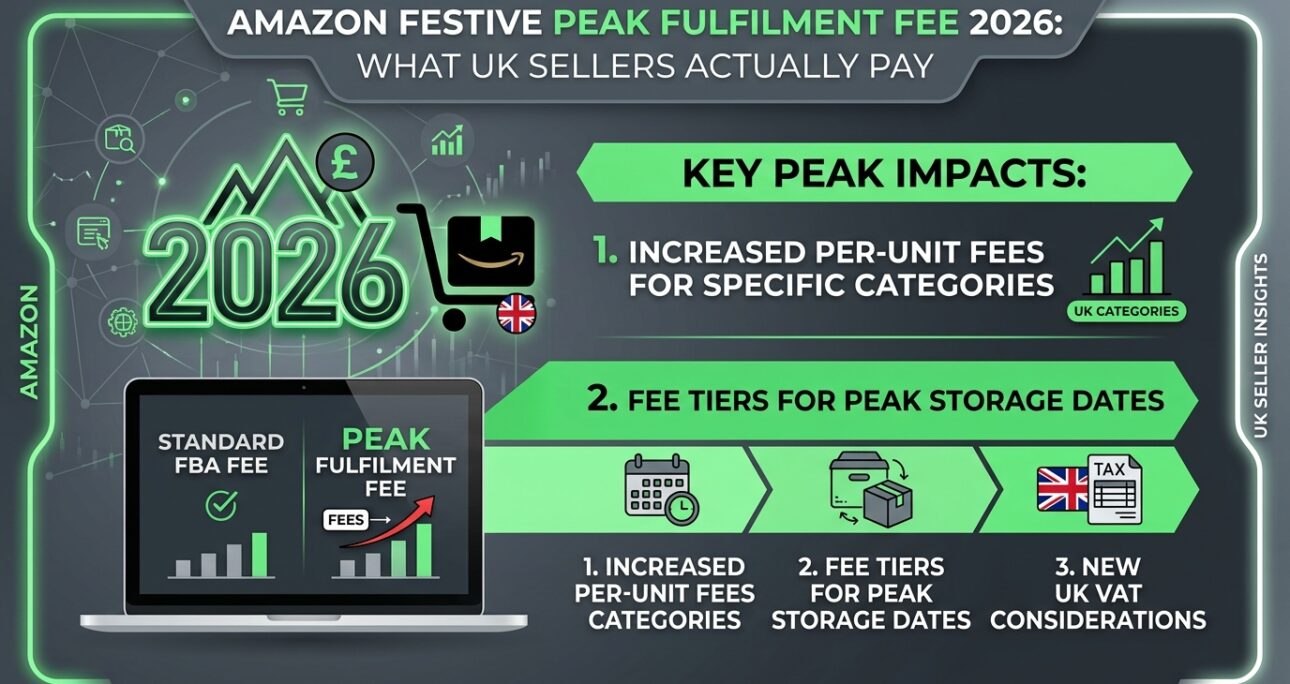
Quick Answer: The Amazon festive peak fulfilment fee runs from 15 October 2026 to 14 January 2027. In the UK it averages £0.12 per parcel item and £0.07 per large or extra-large envelope item, not the $0.32 figure circulating online, which is the US number. Oversize, Low-Price FBA and apparel are excluded, so a large share of UK catalogues pay no peak fee at all.
Every July, Amazon announces its holiday fulfilment fees and the trade press runs the same headline. This year it was $0.32 per unit, with a 3.5% fuel surcharge on top.
Both figures are correct. Neither applies to you if you sell in the UK.
The peak fee is set per store, and the UK numbers are smaller, structured differently, and carry exclusions broad enough that a good number of British sellers will finish the season without paying a penny of it. Meanwhile the change that genuinely moved UK margins this year happened back in April, applies all twelve months, and has barely been written about.
This article covers what the UK fee actually is, who is excluded, why the charge lands later than most people assume, and the two 2026 changes that matter more to your Q4 P&L than the peak fee does.
The number you have probably read is the American one
Amazon announced its 2026 peak fulfilment fees in July, and the coverage that followed was almost entirely US-focused. Supply Chain Dive reported the US programme, with fees running 15 October to 14 January across FBA, Remote Fulfilment with FBA, Multi-Channel Fulfilment and Buy with Prime.
The US uplift averages roughly $0.32 per unit above non-peak rates, unchanged from last year, with a 3.5% fuel and logistics surcharge applying on top. Canada runs the same window at around CAD $0.39 per unit. Germany sits at about €0.27.
None of those is the UK figure, and the surcharge percentage is wrong for the UK too.
This matters more than a pedantic correction. If you built a Q4 margin model off American coverage, you have overstated your peak fee by roughly two and a half times and more than doubled your surcharge assumption. That produces the wrong pricing decision in both directions: you either raise prices you did not need to raise, or you skip a promotion that would have cleared margin comfortably.
What UK sellers actually pay for the Amazon Festive Peak Fulfilment Fee
Amazon’s seller announcement for the UK and Germany sets out the festive peak fulfilment fee for the same window, 15 October 2026 to 14 January 2027, with non-peak rates resuming on 15 January.
| Peak uplift | Fuel and logistics surcharge | |
|---|---|---|
| UK, small and standard parcels | Around £0.12 per item | 1.5% |
| UK, large and extra-large envelopes | Around £0.07 per item | 1.5% |
| Germany, small and standard parcels | Around €0.27 per unit | 1.5% |
| US, average across units | Around $0.32 per unit | 3.5% |
The UK fee covers small and standard parcels plus large and extra-large envelopes, fulfilled through local UK FBA and through Remote Fulfilment from the EU into the UK.
On a £24 product, £0.12 is half a percent of the sale price. Real money at volume. Not the thing that decides whether your Q4 works. Treating it as the headline risk is how sellers spend a week on a rounding error and miss the charge underneath it.
The exclusions are the story
This is the part almost nobody covers, and it is where most UK sellers will find their actual answer.
The festive peak fulfilment fee does not apply to oversize items. It does not apply to Low-Price FBA items. It does not apply to orders delivered to buyers in other EU countries. And according to Amazon’s European FBA rate card effective 1 July 2026, the festive peak fulfilment fee for FBA excludes apparel.
Read that list against your own catalogue before you touch anything.
If you sell clothing, the peak fee does not reach you. If your products are oversize, it does not reach you. If your items sit under the Low-Price FBA threshold, which Amazon extended to products at or below £20 in most categories from January 2026, it does not reach you either. A UK seller running a sub-£20 apparel brand is outside this announcement entirely, and will spend Q4 reading anxious LinkedIn posts about a fee they do not pay.
The exclusions are also why the average figure is close to useless for planning. An average across a catalogue where a large slice pays zero tells you nothing about the SKUs that do pay. Amazon has published peak rates in the Revenue Calculator and the FBA Fee Preview report, and the honest answer for any individual seller lives there rather than in any article, including this one.
The charge lands on ship date, not arrival date
This is the timing detail that catches people, and it works against the intuition most sellers have.
Amazon’s announcement of the equivalent US programme states that fulfilment fees are determined and applied when items leave fulfilment centres, meaning anything dispatched on or after 15 October incurs peak rates. The inventory you sent in during September does not lock in September pricing. It sits in the network, and the fee is decided when it ships out.
The practical consequence: pricing and promotion decisions you make in early October are already peak-rate decisions, because the units they sell will almost all ship after the 15th. If you are planning a Prime Big Deal Days discount or an early Black Friday price, model it at the peak rate rather than the one on your current settlement statements.
Worth confirming the exact mechanism in your own rate card for the UK store, since Amazon publishes these separately by region and the wording differs. The direction of the point holds either way: do not assume an early inbound shipment buys you off-peak fees on the way out.
Amazon has also flagged that its fulfilment centres concentrate on receiving inventory through September and October, then shift to processing customer orders in November and December, so sellers may see lower capacity limits during that period. Plan the inbound side around that rather than around the fee.
What actually moved UK margins in 2026
Two changes this year matter more to a British seller’s Q4 than the peak fee does, and they point in opposite directions.
The fuel and logistics surcharge. From 17 April 2026, Amazon applies a 1.5% fuel and logistics-related surcharge to FBA fulfilment fees across the UK, France, Germany, Italy, Spain, Poland, Sweden, the Netherlands, Ireland and Belgium. It applies year round, peak or not. It is smaller than the American 3.5%, and unlike the peak fee it has no end date attached. If your fulfilment costs feel higher than last year and the peak fee alone does not explain it, this is usually why.
The January fee reductions, which went the other way. Amazon cut several European referral fees from 5 January 2026: Home Products from 15% to 8% on items up to £20, Pet Clothing and Food from 15% to 5% on items up to £10, and Grocery and Gourmet plus Vitamins, Minerals and Supplements from 8% to 5% on items up to £10. Amazon also extended reduced Low-Price FBA rates to products at or below £20 in most categories, lowering FBA fees on newly eligible products by an average of around £0.40 per unit, as set out in Amazon’s own summary of the 2026 European fee changes.
That last one is worth sitting with. A UK seller with a £19 supplement product may have seen their referral fee drop, their FBA fee drop by roughly £0.40, and their peak fee exclusion apply, all in the same year. Their fulfilment cost went down in 2026, not up. Nobody publishes that headline because it does not travel.
The lesson for the accounts we manage is the same every year: the fee announcement tells you what Amazon changed, not what happened to you. Only your own numbers do that.
How to work out your own number
Do this in order. It takes about an hour for a normal catalogue and it replaces guessing entirely.
- Export your FBA Fee Preview report. This gives you current per-unit fulfilment fees by SKU. It is the starting position everything else is measured against.
- Sort by units sold in Q4 last year, descending. Your top ten to fifteen SKUs will account for most of the exposure. The tail does not need this level of attention.
- Mark which of those SKUs are excluded. Oversize, Low-Price FBA, apparel, and anything shipping to buyers in other EU countries. If most of your volume is excluded, you can stop here and go and do something more useful.
- For the remainder, open the Revenue Calculator and switch to peak rates. Amazon has made peak rates previewable, so use the real per-SKU number rather than the average. Sizes and weights vary, and so does the uplift.
- Add the 1.5% surcharge on the fulfilment fee. Not on the sale price. It applies to the fulfilment fee itself.
- Recalculate contribution margin at your planned Q4 promotional price, not your current list price. A SKU that clears margin at full price can go underwater at a 20% discount once peak fees and higher advertising costs land together.
- Flag anything that falls below your margin floor and decide now whether it gets a price change, a reduced ad budget, or gets left out of promotions entirely. Decide in September, not in the third week of November.
If you sell across multiple marketplaces, run steps four to six separately per store. UK, Germany and the US are three different fee structures with three different exclusion lists, and a single blended assumption will be wrong in all three.
What not to do
Do not apply the average to your whole catalogue. The actual uplift varies by product size, weight and fulfilment method, and a meaningful share of UK SKUs are excluded. Applying £0.12 across the board overstates costs on excluded items and understates them on the heaviest ones.
Do not raise every price by a fixed percentage. A blanket increase moves you down the price-competitiveness signals that feed the Featured Offer on your best sellers, which costs far more than £0.12 a unit. Price the SKUs that need it.
Do not delay inbound shipments to dodge the fee. The fee follows the ship-out date, so holding stock back does not avoid it. It just risks you being out of stock in the highest-traffic weeks of the year, which is a much more expensive mistake.
If your Q4 volume is modest, this is not where your attention belongs. On a few hundred units, the peak fee is a two-figure number. Your conversion rate on the traffic you are already paying for moves more money. We covered that in the guide to writing an Amazon listing that converts rather than just ranks, and in Q4, when click costs climb, listing conversion is doing double duty.
One more thing worth saying plainly. If peak fees are the difference between a profitable Q4 and an unprofitable one, fees are not really the problem. A margin that thin usually points at sourcing cost, product selection or an advertising structure that was never rebuilt after launch. That is a harder conversation than a fee announcement, and a more useful one.
Frequently asked questions
When do Amazon’s 2026 peak fulfilment fees start and end?
They apply from 15 October 2026 to 14 January 2027, with non-peak rates resuming on 15 January 2027. The same window applies in the UK, Germany and the US, though the fee amounts and exclusions differ by store. This is the third consecutive year Amazon has run a holiday-specific fulfilment fee.
How much is the UK festive peak fulfilment fee?
Amazon’s announcement gives an average of around £0.12 per item for small and standard parcels and around £0.07 per item for large and extra-large envelopes, fulfilled through local UK FBA or Remote Fulfilment from the EU. The figure varies by size and weight, so use the Revenue Calculator for your specific SKUs rather than the average.
Which UK products are excluded from the peak fee?
Oversize items, Low-Price FBA items, and orders delivered to buyers in other EU countries are excluded. Amazon’s European FBA rate card effective 1 July 2026 also excludes apparel from the festive peak fulfilment fee. Check your own SKUs in the FBA Fee Preview report, since category and size classification decide this rather than your own description of the product.
Is the UK fuel surcharge the same as the US one?
No. The US surcharge is 3.5%. Amazon applies a 1.5% fuel and logistics-related surcharge to FBA fulfilment fees in the UK and several other European stores, in effect since 17 April 2026. It applies year round rather than only during peak, and Amazon has not published an end date.
Can I avoid the peak fee by sending inventory in early?
No. Fulfilment fees are determined when units leave the fulfilment centre, not when they arrive, so anything shipping to a customer on or after 15 October is charged at peak rates regardless of when you sent it in. Sending inventory early protects your availability during peak demand, which is the actual reason to do it.
Should I raise my prices to cover the peak fee?
Only on the SKUs where the maths requires it, and only after you have checked which of your products are excluded. On a mid-priced item the UK peak fee is a fraction of a percent of the sale price, and a blanket price rise across a catalogue usually costs more in lost competitiveness than the fee ever would.
Where this leaves you
The UK peak fee is small, narrowly applied, and widely misreported because the American number travels further. The things that genuinely changed your fulfilment economics this year were the April surcharge and the January rate changes, and those cut in both directions depending on what you sell.
What that adds up to is not a reason to relax. It is a reason to work from your own FBA Fee Preview export rather than from a headline, because your answer and your competitor’s answer are not the same, and neither matches the one in the trade press.
If you want that done properly before mid-October, send us the account for a free audit and we will run the per-SKU peak model and tell you which listings need a price change. We handle this as part of ongoing Amazon account and FBA management, and for brands worried about margin concentration in one channel, eBay private label is the usual second lane. If you are earlier in the journey, the primer on how private label actually works is the better starting point, and the Amazon case studies show what the account work looks like in practice.