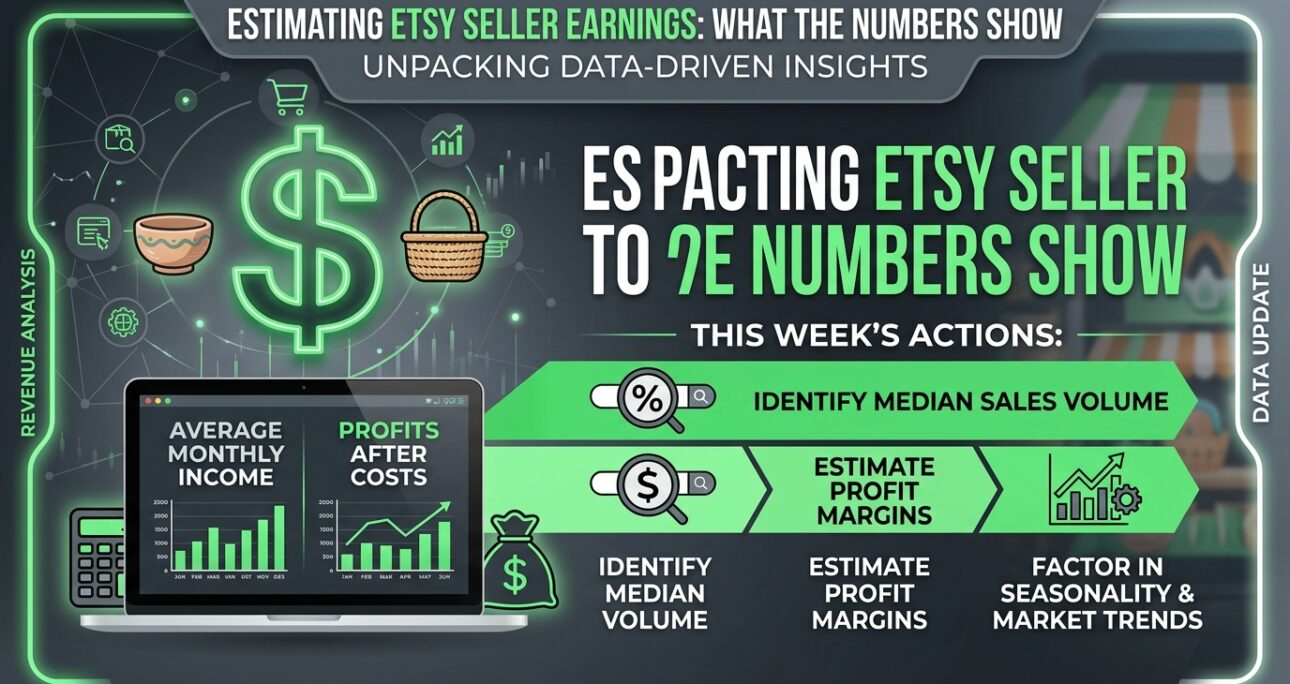
How Much Do Etsy Sellers Make? Quick Answer: Etsy does not publish what its sellers earn. Dividing its 2025 marketplace sales of $10.46 billion by its 5.6 million active sellers gives roughly $1,870 in sales per seller for the year. That is revenue, not profit, before fees, materials and postage. Because a small number of large shops pull the average up, the typical seller makes less than that.
Search this question and you will find confident answers. Most sellers make under $100 a month. The top 1% make six figures. The average shop earns a few hundred a year.
We tried to trace those figures back to a source. Almost none of them lead anywhere.
The reason is simple. Etsy has never published a breakdown of what individual sellers earn. What it does publish, because it is a listed company, is the total value of everything sold on the marketplace and the number of sellers doing the selling. Put those two numbers next to each other and you get an answer that is more honest than most of what ranks for this question, and less comfortable.
This article does that maths, explains why the real typical figure sits below it, shows where the money goes before it reaches you, and covers the rule that decides what you are allowed to sell in the first place.
The division Etsy does not do for you
Two numbers from Etsy’s 2025 annual report do most of the work here.
In its annual report for 2025, Etsy reports marketplace gross merchandise sales of $10,460.7 million for the year, and 5.6 million Etsy marketplace active sellers as of 31 December 2025.
Divide one by the other.
$10.46 billion across 5.6 million sellers is roughly $1,868 per active seller, for the entire year. Call it $1,870. Around $155 a month.
Before going further, be clear about what that number is. Gross merchandise sales is the value of items sold, excluding shipping fees and net of refunds. It is what buyers paid for goods. It is not what sellers kept. Nothing has been taken out yet: no Etsy fees, no materials, no packaging, no postage, no advertising, no time.
So the honest headline is not “Etsy sellers make $1,870 a year.” It is “the average Etsy seller sells about $1,870 of goods a year, and then pays for everything out of that.”
Why the typical seller makes less than that
An average is only useful when the numbers underneath it are spread fairly evenly. On a marketplace, they never are.
A small group of established shops doing tens or hundreds of thousands in sales pulls the mean upward. For every one of them, there are many shops selling a handful of items a year. The median seller, the one in the exact middle, sits well below $1,870. Etsy does not publish the median, so nobody outside the company can tell you what it is.
Two definitions in Etsy’s own reporting push the typical figure down further.
An “active seller” does not have to have sold anything. Etsy defines an active seller as one who has had a charge or a sale in the last 12 months. A shop that paid to list items and sold nothing still counts. Those shops dilute the average, and they are exactly the shops that would drag a median lower.
One person can be several sellers. Etsy identifies sellers by email address, so a single person running two shops counts twice.
There is one more detail worth knowing. In its third quarter 2025 results, Etsy said the percentage of active sellers with a sale increased year over year. It did not say what that percentage is. When a company tells you a number went up but not what the number is, it is usually not a figure it expects to impress you.
None of this means Etsy sellers do not make money. Plenty do. It means the platform is shaped like almost every marketplace: a lot of small shops, a smaller group of real businesses, and an average that describes neither.
Where the money goes before it reaches you
Now take the fees out. Etsy’s Fees and Payments Policy is the authority here, and the core charges for a US seller are:
| Fee | US rate | What it applies to |
|---|---|---|
| Listing fee | $0.20 | Each listing, renewed every four months or when it sells |
| Transaction fee | 6.5% | Item price plus the shipping and gift wrap you charge |
| Payment processing | 3% + $0.25 | The order total |
| Offsite Ads | 15%, or 12% for larger shops | Only orders attributed to Etsy’s offsite advertising |
The detail that catches people is the shipping. The 6.5% transaction fee applies to what you charge for postage as well as the item, so building shipping into your price does not dodge it.
A worked example. A $30 item with $5 shipping is a $35 order. The transaction fee is about $2.28, payment processing about $1.30, and the listing fee $0.20. That is roughly $3.78 gone, close to 11% of the order, before advertising.
Offsite Ads change the picture on the orders they touch. Etsy advertises your listings on other platforms and charges a percentage when a sale comes through one of those ads. For smaller shops the fee is 15% and you can opt out. Once a shop passes $10,000 in sales over twelve months, the rate drops to 12% but participation becomes mandatory. On an attributed order, that single fee is bigger than all the others combined.
UK sellers pay a different payment processing rate, 4% plus £0.20, and face a regulatory operating fee plus VAT on Etsy’s fees if they are not VAT registered. Check the current UK rates on Etsy’s policy page rather than relying on any article, including this one, because they are adjusted more often than the US figures.
For a sense of scale on the platform’s side: Etsy reported a revenue take rate of 24.2% for 2025, up from 22.3% in 2024. That is not a fee rate. It includes services sellers choose to buy, like on-site ads and shipping labels. But it tells you that for every dollar of goods sold across Etsy’s marketplaces, roughly 24 cents ended up as Etsy revenue.
The marketplace you would be joining
Context matters, because selling on a growing marketplace and a shrinking one are different propositions.
Etsy’s consolidated gross merchandise sales fell 5.3% in 2025, to $11.92 billion, while revenue rose 2.7%. Active buyers on the Etsy marketplace stood at 86.5 million at the end of the year, down 3.4%.
The more recent signal is better. In its fourth quarter 2025 results, Etsy reported marketplace GMS up 0.1% year over year, its first increase in two years, and said retention of prior-year active sellers had improved. Etsy also noted that sales through its app grew 6.6% and now make up about 46% of marketplace GMS.
Read plainly: a marketplace that shrank for several years, stabilised late in 2025, and is increasingly shopped on phones. That last point is practical. If nearly half your sales come through the app, your first photo and your title need to work on a small screen.
The seller count also dropped sharply after April 2024, which Etsy linked to a new seller set-up fee. Fewer casual shops is arguably good news for anyone serious, because the long tail of abandoned listings competing for the same searches got shorter.
What you are allowed to sell decides what you can earn
This is the part most earnings articles skip, and it matters more than the fees.
Etsy’s rules state that everything listed must be made, designed, handpicked or sourced by the seller. Etsy’s help page on what you can sell is blunt about the boundary: reselling mass-produced items is not allowed, and reselling is not allowed in the handmade category at all.
That rules out the model that works on Amazon for a lot of people: find a product from a supplier, put a logo on it, and list it. On Etsy, that is reselling, and shops doing it get listings removed or worse.
What is allowed is more useful than it sounds. Under “designed by a seller”, you can create your own design and use a third party to produce or print it onto a physical item. That covers print-on-demand, where you supply original artwork and a partner prints and ships it, and production partners who manufacture something you designed. The requirement is that the design is genuinely yours and the production partner is disclosed.
So when people talk about private label on Etsy, the version that survives is design-led. Your own artwork, your own product design, your own brand, produced by a partner and disclosed properly. This is how we approach Etsy private label for clients, and it is why so much of the work starts with original product and brand design rather than sourcing.
It also explains why the average is low. A large share of Etsy shops are hobby sellers making items by hand, which caps output at the hours in a week. The shops earning well above $1,870 have usually found a way to separate their income from their personal production time.
What the shops above the average tend to have in common
This section is our read from working with sellers, not a statistic.
Designs that scale without more hours. Print-on-demand, digital downloads, and designs made by a production partner all break the link between sales and personal making time.
A niche narrow enough to own. Broad searches like “necklace” are dominated by shops with thousands of reviews. Specific searches with clear buyer intent are where a newer shop can actually appear.
Personalisation that justifies a higher price. Custom names, dates and details give buyers a reason to pay more and a reason not to buy the generic version elsewhere.
Prices set after the fees, not before. Many small shops price by gut, then discover that 11% in fees plus postage plus materials leaves almost nothing. The shops that last price backwards from the margin they need.
Repeat and gifting demand. Items bought for occasions come back every year. A shop that captures one wedding or birthday niche can build a base of returning buyers.
Working out your own number
The average tells you about the platform. This tells you about your shop.
- Pick a realistic price for one product, based on what comparable listings actually sell at, not the highest price you can find.
- Take off the Etsy fees. Roughly 11% of the order total for a US seller on a typical order, including the shipping you charge. Use your own country’s rates if you are outside the US.
- Take off the real cost of making and sending it. Materials, packaging, postage, and the production partner’s charge if you use one.
- Allow for advertising. Either your on-site ad spend per sale, or the Offsite Ads fee on the share of orders it will touch.
- Look at what is left per sale, then decide honestly how many sales a month you can make and fulfil.
- If you are making items by hand, divide the monthly profit by the hours it took. This is the step people skip, and it is the one that tells you whether you have a business or a low-paid job.
If the number from step six is less than you would accept for any other work, the shop needs a different product, a different price, or a production model that does not depend on your hours.
What not to do
Do not treat the average as a forecast. $1,870 is a platform-wide mean inflated by large shops. A new shop should plan for less than that in its first year, not more.
Do not trust earnings screenshots. Revenue dashboards show sales, not profit. A shop showing $5,000 in a month may have kept a small fraction of it.
Do not resell sourced products as your own. It breaks Etsy’s rules. No margin is worth losing the shop.
Do not forget that shipping is in the fee base. Etsy takes its cut of your postage charge too.
Do not rely on Etsy as your only channel if you have a real product. Etsy is a strong place to find buyers for original work. It is also a platform whose rules and fees you do not control. If your products can legitimately sell elsewhere, a second channel reduces that risk, and eBay private label is often the natural next step. We covered how that works from scratch in the guide to starting eBay private label.
Frequently asked questions
How much does the average Etsy seller make a year?
Etsy does not publish seller earnings. Dividing its 2025 marketplace sales of $10.46 billion by its 5.6 million active sellers gives about $1,870 in sales per seller for the year, before fees, materials and postage. Because large shops raise the average, the typical seller sells less than that.
How much does Etsy take from each sale?
For a US seller, the core fees are a $0.20 listing fee, a 6.5% transaction fee on the item and shipping, and payment processing of 3% plus $0.25. On a typical order that comes to roughly 11%. Orders from Etsy’s Offsite Ads carry an extra 12% or 15% fee.
Can you make a full-time income on Etsy?
Some sellers do, but they are a minority. Full-time Etsy incomes usually come from shops that have separated sales from personal making time, through print-on-demand, digital products or production partners, and that own a specific niche. Handmade-only shops are limited by the hours in a week.
Can you sell private label products on Etsy?
Only in a specific form. Etsy requires items to be made, designed, handpicked or sourced by the seller, and reselling mass-produced items is not allowed. Selling your own original designs produced by a disclosed production partner, including print-on-demand, is allowed. Buying finished products and adding a logo is not.
Is Etsy still worth selling on in 2026?
It depends on what you sell. Etsy’s marketplace shrank for several years before returning to slight growth in late 2025, and it still reached 86.5 million active buyers at the end of that year. For original, design-led products, it remains one of the best places to find buyers who specifically want them.
Why do Etsy earnings claims online vary so much?
Because most of them have no source. Etsy does not publish seller earnings data, so figures like “most sellers make under $100 a month” are usually surveys of small groups, guesses, or numbers copied between articles. Etsy’s own filings are the only authoritative starting point.
Where this leaves you
Etsy’s numbers tell a clear story once you do the division. The average shop sells about $1,870 a year, most sell less, and roughly a tenth of every order goes to fees before you pay for anything else. That is not a reason to avoid Etsy. It is a reason to arrive with a real product, a price built around the fees, and a production model that does not cap your income at your own hours.
The shops that do well are rarely the ones with the most listings. They are the ones selling something original that a specific buyer is already looking for.
If you want your product, pricing and Etsy setup checked properly before you commit time to it, request a free audit and we will tell you honestly whether the numbers work. If you are still deciding what kind of product business you want to build, our primer on how private label works is a useful place to start.