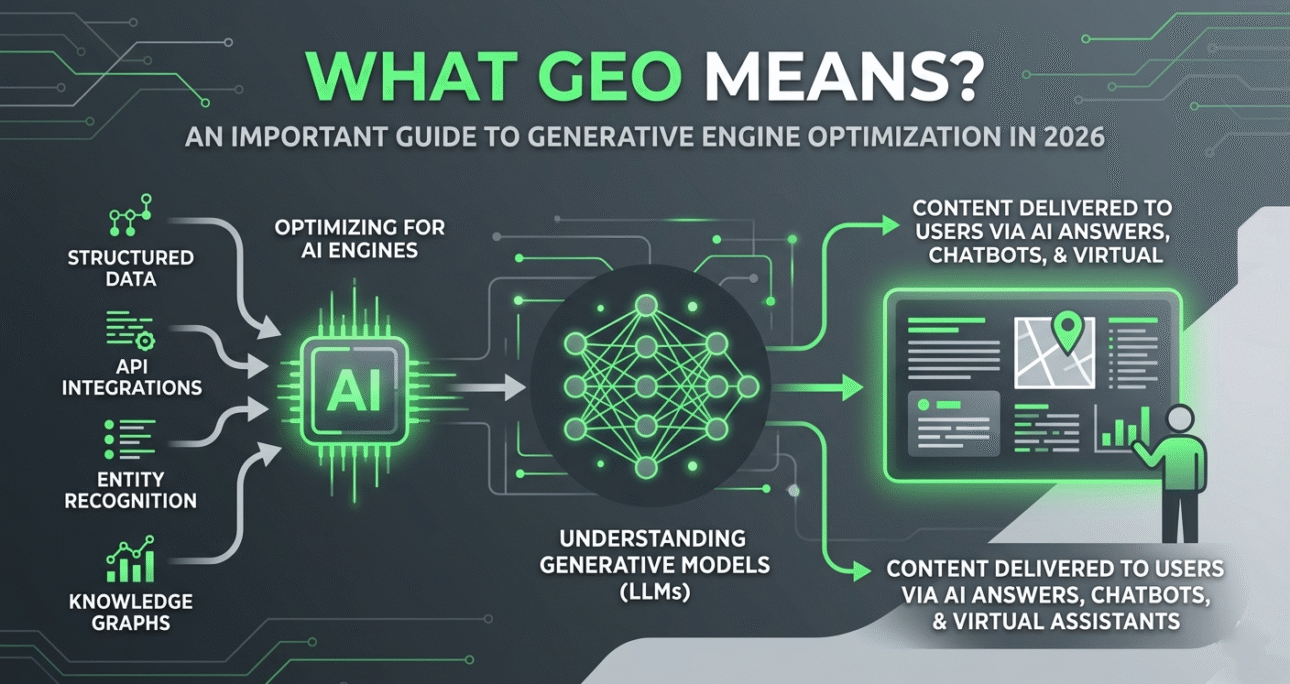
This is for business owners, ecommerce sellers, and marketers, who don’t know what geo means, who’ve noticed that people are increasingly getting answers from AI tools rather than clicking through to websites — and are wondering what that means for their visibility strategy. It means something significant, and the brands that understand it early have a genuine advantage over those that don’t.
Why Search Is Behaving Differently in 2026
Something has shifted in how people find information, and the shift is happening fast enough that businesses which built their visibility strategy around traditional search are starting to feel it in their traffic data before they’ve fully understood what’s causing it.
The basic behavior change is this: a growing proportion of people who previously would have typed a query into Google, scanned ten blue links, and clicked through to one or more websites are now typing or speaking that same query into an AI tool — ChatGPT, Google’s AI Overviews, Gemini, Perplexity, or any of the other generative search platforms that have moved from novelty to habit over the past two years — and receiving a synthesized answer without visiting any website at all.
This isn’t a complete replacement of traditional search. People still use Google. They still click through to websites. The traditional search behavior hasn’t disappeared. What’s changed is that it’s no longer the only significant behavior pattern — a new behavior has developed alongside it, and it operates on fundamentally different principles.
In traditional search, visibility means appearing in the ranked list of results that a search engine presents. Businesses compete for positions in that list. Users see the list and choose which results to investigate. The website gets the traffic.
In AI-generated search, visibility means being referenced or synthesized into the answer that the AI system generates.
Google’s official documentation on its AI-powered search experience explains how its generative systems synthesize information from across the web to compose answers — confirming that the shift from ranked link lists to AI-generated responses is a deliberate platform direction rather than a gradual algorithm update sellers can afford to wait and see on.
There often isn’t a list of ranked results to appear in. The AI produces an answer, and that answer may or may not draw on your content. If it does, your brand is part of the answer — with some probability of the user seeking more from you. If it doesn’t, your brand is invisible regardless of how well optimized your website is for traditional search.
This new form of visibility — being present in AI-generated answers rather than in ranked link lists — requires a different optimization approach from traditional SEO. That approach is what Generative Engine Optimization, or GEO, addresses. And understanding it is increasingly important for any business that depends on being discovered online.
What GEO Means
Generative Engine Optimization is the practice of creating and structuring content so that AI-powered search systems can discover it, understand it, trust it, and reference it when generating answers to user queries.
The name is deliberately parallel to Search Engine Optimization — both disciplines are about being found in the relevant search environment — but the mechanisms are different enough that treating GEO as simply an extension of SEO produces suboptimal results. They share some foundations but serve different systems with different requirements.
SEO, at its core, is about signals. Search engines like Google use hundreds of signals — keyword relevance, page authority, backlink profiles, technical quality, user behavior — to rank content in a list of results. The goal of SEO is to accumulate the signals that move content up that list. The content’s job is to attract clicks from users who see it in the list.
GEO is about synthesis. Generative AI systems don’t rank content in a list — they synthesize information from multiple sources into a coherent answer. The goal of GEO is to make content so clearly, accurately, and authoritatively expressive of a topic that the AI system identifies it as a reliable source to draw from when composing its answer. The content’s job is to be trustworthy and useful enough that the AI chooses to incorporate it rather than ignoring it in favor of other sources.
This distinction has practical implications for how content should be created. Content optimized primarily for SEO may be structured around keywords, page authority signals, and ranking mechanics in ways that don’t serve AI synthesis well. Content optimized for GEO is structured around clear, complete, accurate expression of topical expertise in ways that AI systems can parse and trust. The best content for brands investing in both traditional search and AI search visibility is content that serves both purposes simultaneously — which is achievable, but requires understanding what each system needs.
How AI Search Systems Evaluate and Choose Sources
To optimize for AI-generated answers, it helps to understand how these systems make decisions about which sources to draw from. Different AI search platforms use different architectures and training approaches, but certain evaluation patterns appear consistently enough to describe with confidence.
Clarity and directness of information is the first factor that matters across all AI search systems. Generative AI is fundamentally a pattern-matching and synthesis system — it identifies information that clearly answers a question and incorporates it into a coherent response. Content that makes a reader work to extract the relevant information, that buries answers in verbose preamble, or that presents information ambiguously doesn’t serve the AI synthesis process well. Content that states its key points clearly, defines important terms explicitly, and answers questions directly is significantly more likely to be incorporated into AI-generated answers.
Topical authority and breadth is the second factor. AI systems are more likely to draw from sources that demonstrate deep, consistent expertise across a topic area rather than sources that have one article about a subject surrounded by unrelated content. This reflects the reasonable inference that a source with comprehensive coverage of a topic has genuine expertise rather than having produced one piece of content about something outside its core focus. For businesses, this means that clusters of related content on relevant topics — rather than isolated individual articles — build the topical authority profile that AI systems use as a quality signal.
Factual accuracy and currency matter because AI systems increasingly have mechanisms for assessing whether content is current and accurate relative to other available sources. Outdated information, demonstrably incorrect claims, or content that contradicts established facts reduces a source’s reliability signal. Content that cites primary sources, references current data, and acknowledges limitations honestly tends to be assessed more favorably than content that makes sweeping claims without evidence.
Entity recognition and brand consistency is a less obvious but increasingly important factor. AI systems build models of entities — companies, individuals, concepts — and develop assessments of each entity’s relevance and credibility within specific domains. A brand that is consistently referenced across multiple sources, that has clear and consistent information about what it does and what it specializes in, and that appears in contexts associated with the topics it claims expertise in builds a stronger entity signal than a brand that is referenced inconsistently or only in its own content.
Structural quality affects how easily AI systems can parse and use content. Well-organized content with clear headings, explicit section structure, and logical progression from general to specific is easier for AI systems to extract specific information from than equivalent information presented in dense, undifferentiated prose. FAQ sections, defined terms, and concise summaries at the beginning of sections provide the AI with easily extractable answer units that can be incorporated directly into responses.
GEO vs SEO: The Relationship That Matters Most
One of the most important things to understand about GEO is that it doesn’t replace SEO — it extends it. The relationship between them is complementary rather than competitive, and brands that invest in one at the expense of the other are systematically underperforming relative to brands that integrate both.
Traditional SEO remains valuable and will continue to be for the foreseeable future. People still use Google. They still click through to websites. The traditional search behavior that SEO has been optimizing for over the past two decades hasn’t disappeared — it’s been supplemented by AI search behavior, not replaced by it. A brand that abandons traditional SEO investment in favor of GEO would be giving up a significant existing traffic channel in favor of one that’s still developing.
What GEO adds is visibility in the AI search context that traditional SEO doesn’t address. A brand with strong traditional SEO but no GEO investment will be visible in Google’s ranked results while being absent from AI-generated answers to the same queries. As the proportion of searches that produce AI-generated answers rather than traditional results grows — which the trajectory of major AI search products suggests it will — the visibility gap created by not investing in GEO will widen.
The good news is that the investment that builds good GEO performance is substantially the same investment that builds good traditional SEO performance. Both benefit from high-quality, authoritative, well-structured content. Both benefit from credible external references to the brand. Both benefit from comprehensive topical coverage rather than isolated pieces of content. Both benefit from technical quality and fresh, accurate information.
The specific differences in emphasis are worth noting. Traditional SEO gives relatively more weight to specific keyword optimization, backlink acquisition, and technical ranking signals. GEO gives relatively more weight to content clarity, topical authority breadth, entity recognition, and the kind of structured, direct answer format that AI systems can easily extract and synthesize. An SEO strategy that’s updated to incorporate GEO principles produces content that performs better in both contexts than content optimized purely for one or the other.
What Makes Content GEO-Ready: The Specific Practices
Understanding the evaluation criteria that AI systems use translates into specific content creation and structuring practices that improve GEO performance. These aren’t speculative recommendations — they reflect what AI systems are known to need for effective synthesis.
Building topic clusters rather than isolated articles is the foundational GEO content strategy. A topic cluster is a group of related content pieces that together cover a subject area comprehensively — a central pillar piece that addresses the topic broadly, surrounded by supporting pieces that address specific aspects of the topic in depth. For an ecommerce brand, a topic cluster around “Amazon private label” might include a pillar piece explaining what private label is and how it works, surrounded by supporting pieces on product research, supplier sourcing, listing optimization, brand building, and scaling — each linking to the others and to the pillar piece.
This cluster structure benefits GEO because it builds the topical authority signal that AI systems use to assess expertise. An AI evaluating whether to draw from a source that has one article about Amazon private label versus a source that has twelve interconnected articles covering the topic comprehensively will consistently prefer the latter, inferring from the breadth of coverage that the source has genuine depth of expertise rather than passing familiarity.
Providing direct, explicit answers at the beginning of sections is the GEO equivalent of on-page SEO’s emphasis on placing important keywords in prominent positions. AI systems that are looking for content to synthesize into an answer to “what is GEO?” will favor content that answers that question explicitly and immediately — ideally in the first sentence or two of the relevant section — over content that approaches the answer indirectly or that requires reading several paragraphs before the core point emerges. The inverted pyramid structure familiar from journalism — lead with the most important information, then elaborate — is ideal for GEO optimization.
Including FAQ sections with specific, useful answers is one of the highest-leverage structural choices for GEO performance. FAQ sections provide AI systems with pre-packaged question-and-answer pairs that can be extracted directly and incorporated into conversational AI responses. A well-constructed FAQ section that addresses the questions buyers in a specific niche actually ask — rather than questions selected to rank for keywords — is frequently the section of a content piece that AI systems draw from most directly.
Citing primary sources and data improves the credibility signal that AI systems use to assess content reliability. Content that makes factual claims supported by references to recognized research organizations, established industry publications, or primary platform documentation is more trustworthy from the AI system’s perspective than equivalent claims made without citation. This doesn’t require academic citation formatting — it requires acknowledging where key facts come from and linking to credible sources for claims that benefit from external validation.
Maintaining consistent entity information across all online presences builds the entity recognition signal that AI systems use to identify and assess brands. A brand’s name, description of what it does, and the topics it specializes in should be consistent across its website, social media profiles, business directories, press mentions, and any other context where it appears online. Inconsistency in how a brand describes itself across different contexts reduces the strength of the entity signal the AI system builds for that brand.
Writing for comprehension rather than keyword density is the underlying principle that connects all of the specific GEO practices. AI systems are language understanding systems — they process content the way a highly capable reader processes it, extracting meaning from structure, context, and logical coherence rather than from keyword frequency. Content written for a knowledgeable human reader who wants clear, useful information is fundamentally better suited to AI synthesis than content written primarily to satisfy algorithmic keyword metrics.
GEO for Ecommerce Brands: The Specific Opportunity
Ecommerce brands have a specific and growing opportunity in GEO that’s worth understanding in concrete terms rather than in the abstract.
Buying decisions for an increasing proportion of product purchases now involve an AI search step — a moment where the buyer asks an AI system a question related to their purchase before completing it. These questions take various forms: general category questions that orient the buyer in a new product area, comparison questions that help the buyer distinguish between options, brand credibility questions that help the buyer assess whether a specific brand is trustworthy, and use-case questions that help the buyer determine whether a product suits their specific situation.
A brand whose content is incorporated into AI answers to these questions gains visibility at one of the highest-leverage points in the buyer’s decision journey — before the buyer has formed strong preferences and while they’re actively forming their understanding of the category. This visibility creates brand familiarity and credibility that affects subsequent purchase behavior even when the buyer eventually makes their purchase through a marketplace or retailer rather than directly with the brand.
The categories of content that ecommerce brands should invest in for GEO performance mirror the questions their buyers are asking AI systems before purchasing. Buying guides that explain what to look for when purchasing products in the category, comparison content that honestly addresses how different product types or brands compare, educational content that builds the buyer’s understanding of the category, and FAQ content that addresses the specific concerns buyers have before purchasing all represent GEO opportunities that marketplace listing optimization — which addresses buyers who have already arrived at a marketplace — doesn’t capture.
For private label sellers specifically, GEO represents an opportunity to build brand visibility that exists independently of any marketplace’s algorithm. A private label brand whose content consistently appears in AI-generated answers to relevant category questions has a presence that Amazon’s search algorithm can’t revoke — it’s visibility that belongs to the brand rather than to the platform, which reduces the platform dependency that makes marketplace-only businesses structurally fragile.
Why Original Insight Is the Core GEO Differentiator
Among all the practices that improve GEO performance, one stands apart as both the most impactful and the least replicable: the consistent publication of original insight that isn’t available anywhere else.
AI systems synthesize information from across the web. When they draw from a source, they’re typically drawing from information that can also be found in other sources — established facts, widely documented practices, general principles that multiple authoritative sources address. In this environment, content that says the same things that dozens of other pieces of content say, even if it says them well, doesn’t offer a meaningful incremental contribution to the AI’s answer.
Content that presents genuinely original analysis, observations from direct experience, specific data that isn’t available elsewhere, or frameworks and interpretations that represent the author’s genuine intellectual contribution offers something that AI systems can’t find anywhere else. This exclusivity makes the content disproportionately valuable for AI synthesis — the AI draws from it specifically because only this source offers this particular insight or data.
For ecommerce brands, the most natural sources of original insight are direct operational experience — what has actually worked in running Amazon businesses, what the competitive dynamics in specific categories actually look like, how specific policy changes have affected real businesses — and first-party data from customer interactions, product performance, and market analysis. This kind of insight is genuinely original because it comes from lived experience rather than from the aggregation and synthesis of existing sources.
Brands that publish this kind of original insight consistently — that use their actual operational knowledge as a content foundation rather than synthesizing what others have already written — build a GEO profile that’s more distinctive and more valuable than brands that produce technically competent content without original contribution.
Common GEO Mistakes That Undermine Results
The GEO mistakes that brands most commonly make reflect the same patterns that have always undermined content marketing effectiveness — adapted to the AI search context.
Publishing AI-generated content without original contribution is the most counterproductive GEO approach, despite being the most tempting efficiency play. Using AI writing tools to produce content at scale without adding original insight, specific experience, or unique perspective produces content that is technically complete but offers nothing that AI search systems couldn’t already find in their training data. AI systems can’t draw distinctive value from content that has no distinctive value. The result is content that consumes production resources without building the authority and distinctiveness that GEO requires.
Treating GEO as keyword optimization with a new name misses the fundamental shift in how AI search works. Traditional SEO keyword optimization focuses on the presence and prominence of specific terms. GEO optimization focuses on the clarity and authority with which topics are addressed. A piece of content that mentions “generative engine optimization” frequently but doesn’t clearly explain what it is, how it works, or how it differs from traditional SEO doesn’t serve an AI system trying to answer “what is GEO?” — regardless of keyword density.
Neglecting topical breadth in favor of individual piece optimization misunderstands how AI systems assess authority. Optimizing individual pieces of content without building the surrounding topic cluster that signals comprehensive expertise produces content that may rank reasonably in traditional search without building the topical authority profile that GEO requires. Brands that invest in topic clusters consistently build stronger GEO performance than brands that produce equivalent individual pieces without the surrounding context.
Ignoring the consistency of entity information across platforms is a structural mistake that undermines GEO performance regardless of content quality. If a brand’s name, description, and specialization areas are inconsistent across its website, social media, press coverage, and business listings, the AI system’s entity model for that brand is weaker than it would be with consistent information — which reduces the brand’s visibility in AI-generated answers even when its content is strong.
The Timeline and Realistic Expectations for GEO
One of the most important things to communicate about GEO investment is the realistic timeline for results, because misaligned expectations cause brands to abandon the investment before it produces meaningful outcomes.
GEO results develop more slowly than paid advertising results and at a similar pace to traditional SEO results. The early months of content investment build the foundation of topical coverage and content quality that GEO requires without producing immediately visible AI citation. During this period, the investment is building the signals — topical authority, content quality, entity recognition — that eventually produce GEO visibility.
Between six and twelve months of consistent, quality content investment, the first meaningful GEO outcomes typically become apparent. Brand content begins appearing in AI-generated answers to relevant queries, brand mention frequency in AI tools increases, and the brand’s entity profile in AI systems strengthens. These outcomes don’t appear simultaneously in an easily trackable metric — GEO visibility measurement is less precise than traditional SEO ranking tracking — but they become apparent through brand awareness signals, direct search volume increases, and the qualitative experience of seeing brand content referenced in AI answers.
After twelve to eighteen months of sustained investment, the compounding of topical authority, content volume, and entity recognition typically produces GEO visibility that is consistent and significant enough to affect customer acquisition metrics noticeably. The specific timeline varies by category competitiveness, content quality, and publication frequency, but the directional pattern is consistent: GEO visibility requires patient investment that builds over time rather than immediate returns that justify the investment in the first months.
Measuring GEO Performance: What to Track
Measuring GEO performance is less precise than measuring traditional SEO performance because AI search systems don’t provide the kind of impression and click data that Google Search Console provides for organic search. This doesn’t mean measurement is impossible — it means measuring different signals that together provide a picture of GEO performance.
Branded search volume trend is one of the most useful indirect GEO metrics. When a brand’s content is being incorporated into AI-generated answers, brand awareness grows among users who encounter those answers. This brand awareness eventually manifests as increased direct and branded searches — people searching the brand name specifically after encountering it in an AI response. A consistently increasing branded search volume trend is evidence that brand visibility is growing across channels that include AI search.
Direct traffic to informational content measures whether buyers are discovering educational content and navigating to the website from AI tool sessions. This traffic pattern — landing on a blog post or guide rather than a product page — suggests discovery through an AI interface rather than through a product-specific search, which is a GEO visibility signal.
Qualitative AI citation monitoring involves regularly querying AI tools with the questions relevant to the brand’s expertise areas and noting whether the brand’s content or insights are referenced in the responses. This is labor-intensive as a systematic measurement approach but provides the most direct evidence of GEO performance.
Content authority signals — backlink acquisition rate, domain authority progression, topical authority indicators from tools like Ahrefs or SEMrush — serve as proxy metrics for GEO performance because the same authority signals that drive traditional SEO authority are closely correlated with GEO visibility.
Frequently Asked Questions About GEO
Will GEO replace SEO?
No, and this framing is worth resisting. GEO and traditional SEO address different search behaviors that currently coexist and are likely to continue coexisting. Traditional search produces click-through behavior that drives website traffic. AI search produces answer synthesis behavior that creates brand awareness and influences decisions without necessarily producing website visits. Both channels matter for total brand visibility, and investing in one at the expense of the other produces suboptimal results.
Is GEO relevant for ecommerce businesses that primarily sell through Amazon?
Yes, specifically because GEO builds the off-platform brand visibility that reduces Amazon dependency. Buyers who discover a brand through AI-generated answers to category questions before reaching Amazon arrive at the marketplace with pre-formed brand familiarity that improves conversion rate. GEO also builds the kind of brand equity that supports premium pricing, reduces dependence on Amazon’s algorithm for visibility, and creates the defensibility that makes a business worth more than just its current Amazon revenue.
How much content is needed to build meaningful GEO authority?
There’s no universal minimum, but the pattern that consistently produces GEO visibility is comprehensive topical coverage — multiple pieces of quality content covering a topic area from different angles — rather than a large number of loosely related articles. Five to ten high-quality, interconnected pieces on a specific topic area typically build more GEO authority than twenty loosely related pieces of lower quality. Depth and coherence matter more than volume alone.
Does social media presence affect GEO performance?
Indirectly, through the entity recognition signal it contributes. Consistent brand presence on relevant social media platforms — where the brand’s name, description, and specialization areas are consistent with the website — strengthens the AI system’s model of the brand as an established entity in its domain. Direct social media content isn’t typically incorporated into AI-generated answers in the same way website content is, but social presence contributes to the overall entity signal that affects GEO performance.
What’s the relationship between E-E-A-T and GEO?
Google’s E-E-A-T framework — Experience, Expertise, Authoritativeness, Trustworthiness — was developed for traditional search quality assessment but aligns closely with what AI systems are assessing when evaluating sources for GEO purposes. Content that demonstrates genuine experience and expertise, that has accumulated authority through external recognition, and that communicates trustworthiness through accurate, well-sourced information performs well in both traditional E-E-A-T assessment and AI search source evaluation. Brands that have invested in E-E-A-T for traditional SEO purposes are well-positioned to extend that investment into GEO.
Final Thought: Being Part of the Answer
The shift from search engine optimization to generative engine optimization reflects something deeper than a technology change — it reflects a change in what visibility means in an AI-mediated information environment.
For most of the internet’s commercial history, visibility meant being in the list of results that a search engine showed to a user. The competition was for position in that list. The win condition was a click. The measure of success was traffic.
In the emerging AI search environment, visibility means being part of the answer. Not a link that a user might click, but a source that an AI system draws from when composing the response to a user’s question. The competition is for inclusion in that synthesis. The win condition is being referenced — being trusted enough by the AI system to be incorporated into its answer. The measure of success is authority, not just traffic.
This is a meaningful shift for brands that take it seriously. It elevates the importance of genuine expertise, original insight, and consistent authority over the keyword mechanics that have dominated SEO practice. It rewards brands that invest in actually being the most useful, trustworthy source on their relevant topics rather than brands that invest in appearing to be that source through optimization tactics.
The brands that will perform best in the GEO era are the same brands that perform best in every information environment that rewards genuine value: those with real expertise, honest communication, and the patience to build authority through consistent contribution rather than through shortcut-seeking.
GEO is not a new game with new rules. It’s an evolved environment that rewards the same fundamental qualities more directly and more completely than previous search environments did.
If you’re building an ecommerce brand and want to develop the content strategy and authority that positions you for both traditional search and AI-generated discovery, you can explore how we approach this at ecommate.co.uk.