There’s a conversation that happens in almost every ecommerce brand owner’s head at some point — usually around month six or seven of serious ad spend. Revenue is coming in. ROAS looks respectable. The dashboard is green. And somewhere underneath all of that, a quiet, uncomfortable question starts forming: what am I actually building here?
This piece is for the brand owner who’s sitting with that question. The one who’s noticed that turning the ads off for a week feels more like pulling a plug than taking a holiday. Who’s watching competitors with seemingly smaller budgets show up in Google search results for terms that would cost a fortune to own through paid advertising. Who’s starting to suspect that there’s a structural problem with a marketing strategy built almost entirely on rented attention.
There is. And the good news is it’s fixable — but only if you understand precisely what the problem is and why organic search authority solves it in a way that nothing else does.
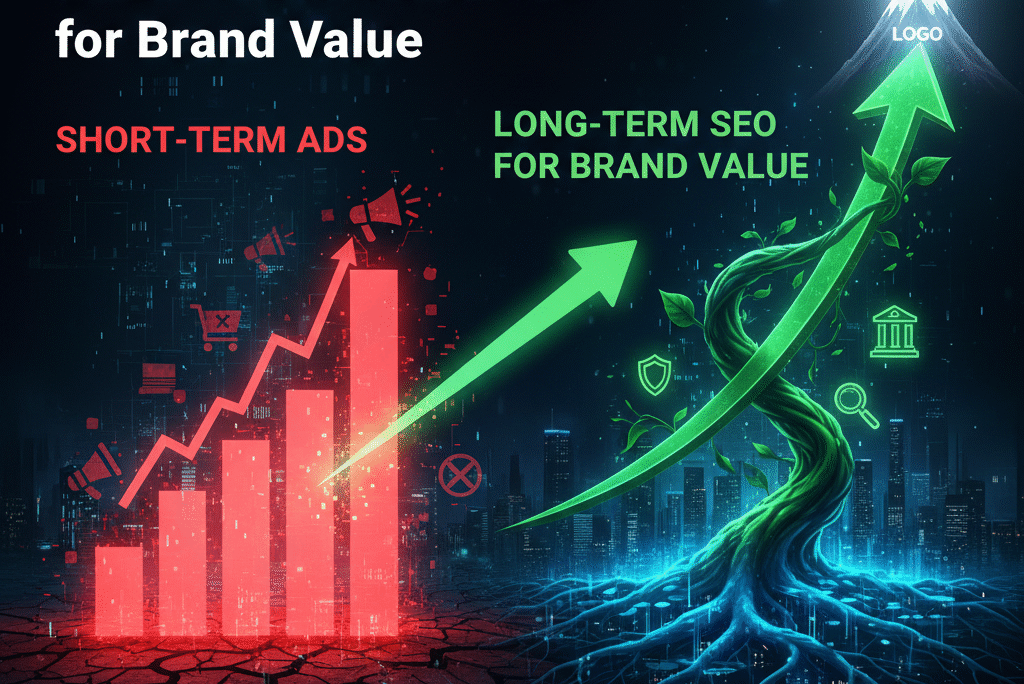
This isn’t an anti-advertising argument. Paid ads belong in the toolkit of any serious ecommerce brand. What it is is an honest examination of what paid advertising builds, what it doesn’t build, and why the brands that end up being worth the most — that command the highest acquisition multiples, attract the best partnerships, and survive platform upheavals intact — consistently invested in Long-term SEO alongside their paid spend instead of in place of it.
The Illusion That Paid Advertising Creates
Let’s start by giving paid advertising its full credit, because the case against exclusive paid dependency is weaker if you haven’t genuinely understood what makes paid advertising so compelling in the first place.
Paid advertising works. That’s the honest starting point. You can launch a Google Shopping campaign on a Monday, have relevant buyers clicking through by Tuesday, and see transactions in your Shopify or Amazon dashboard by Wednesday. That feedback loop — budget in, traffic out, revenue confirmed — is genuinely intoxicating to a business owner, and it’s intoxicating for a rational reason. It works. The mechanism is real.
The specific psychological pull is the legibility of it. You can see every step. You know exactly what you paid for each click. You can measure cost per acquisition with real precision. You can test two versions of an ad, let £500 of spend reveal which one converts better, and make a data-backed decision. In a world where most business decisions involve significant uncertainty, paid advertising hands you a dashboard that makes the cause-and-effect relationship unusually visible. That’s worth something.
But here’s what that dashboard doesn’t show you — and this is the part that matters.
The Treadmill Metric Nobody Talks About
The total amount you’ve spent on paid advertising to date. Not this month. Total. Ever.
Add it up. For most ecommerce brands operating at any serious scale, this number is large. And then ask what that total spend has produced beyond the revenue it generated at the time. Not the revenue — that’s real and already happened — but what asset does that spend represent today?
The answer, in most cases, is nothing. The £80,000 spent on Meta ads over the past eighteen months generated £340,000 in revenue, which is a good return, but it didn’t produce a website that ranks for anything, a content library that attracts organic visitors, or a brand presence that causes buyers to seek you out without prompting. The revenue was real. The asset value is essentially zero. Next month’s revenue requires next month’s budget, at whatever cost the platform decides to charge.
This is the treadmill. It moves under you constantly, and the moment you stop running, you stop moving forward.
Platform Dependency Is the Risk That Feels Theoretical Until It Isn’t
If you’ve been in ecommerce long enough, you know someone — or you are someone — who experienced what happens when a primary paid channel changes the rules.
Apple’s iOS 14.5 update in April 2021 transformed Meta advertising almost overnight. The attribution changes that followed degraded targeting precision significantly, and CPMs on Facebook and Instagram rose by roughly 89% in the year following the update, according to WordStream’s benchmarks. Brands that had built their entire customer acquisition model on Meta advertising saw their economics collapse without changing anything about their own operations. They were running the same campaigns, with the same creative, selling the same products — but the platform had changed the terms, and they had no alternative traffic source to absorb the impact.
Amazon has done similar things to sellers over the years. PPC costs on Amazon have risen consistently — advertising cost of sale (ACoS) benchmarks across major categories increased by 30-50% between 2019 and 2023, as more sellers competed for the same advertising inventory. A product that was profitably advertised at £1.80 cost per click in 2019 might now require £3.20 to achieve the same placement. If the margin model doesn’t absorb that increase — and many don’t — the product stops being profitable to advertise, which means it stops being visible, which means revenue drops.
The brands that weathered those disruptions without catastrophic revenue loss shared one characteristic: they had organic traffic assets that continued generating visitors regardless of what any platform decided to do with its advertising system. The brands that didn’t have those assets had no cushion. Some of them didn’t survive it.
How SEO Actually Creates Compounding Value (The Mechanism, Not the Metaphor)
“SEO compounds over time” gets repeated so often that it’s lost most of its meaning. Let’s be specific about how it compounds, because the mechanism is important and it explains decisions that would otherwise seem counterintuitive.
The Authority Flywheel
Search engines assess website authority through hundreds of signals, but the most important for compounding purposes are these three: content quality and depth, the number and quality of external websites linking to your content (backlinks), and user engagement signals generated by real visitors interacting with your site.
These three signals feed each other in a way that creates genuine compounding. Here’s the sequence:
You publish a genuinely useful piece of content — say, a detailed guide to choosing the right type of storage organiser for a kitchen. The content ranks modestly at first, appearing on page two or three for relevant searches. A small number of visitors find it. Some of them are bloggers, journalists, or other website owners who find it useful enough to link to. Those links increase the domain authority signal. With higher domain authority, the same piece of content earns a better ranking. Better ranking means more visitors. More visitors means more behavioural signals (time on page, low bounce rate) telling search engines the content is valuable. More visitors also increases the probability that more external sites link to it.
Each link makes future content rank faster. Each piece of content provides more surface area for links to land on. The domain that has been publishing quality content for two years isn’t twice as authoritative as one that’s been doing it for one year — Ahrefs’ research on domain authority growth suggests it’s often 3-5x more authoritative, because authority growth is exponential rather than linear once the flywheel is turning.
What This Looks Like in Traffic Numbers
A concrete illustration: imagine a brand that publishes two substantial pieces of content per month — buying guides, how-to articles, comparison pieces — consistently for eighteen months. That’s 36 pieces of content.
In months one through three, those pieces are generating maybe 200-400 organic sessions per month total. Modest, barely measurable against paid traffic volume.
By month six, as authority builds and early content earns links and behavioral signals, total organic traffic from that content library might be 1,500-2,500 sessions per month.
By month twelve, it’s likely in the range of 5,000-12,000 sessions per month, depending on category competitiveness and content quality.
By month eighteen, if the compounding effect is operating properly, that same 36 pieces of content are generating 15,000-40,000 sessions per month — without any additional significant investment beyond the ongoing content production.
BrightEdge’s research consistently finds that organic search drives approximately 53% of all trackable website traffic, while paid search accounts for roughly 15%. The brands achieving that ratio didn’t get there by accident — they invested in authority building over a sustained period, and the compounding produced results that paid advertising can’t match for the same level of ongoing investment.
The Cost Structure Flip
Here’s the part that changes the financial logic entirely. In month one of paid advertising, you’re paying £X per visitor. In month twelve of paid advertising, you’re paying roughly £X per visitor — often more, because category competition has intensified.
In month one of SEO investment, you’re paying a lot per organic visitor, because you’re producing content for an audience that doesn’t yet exist. In month twelve, you’re paying a fraction of month one’s per-visitor cost, because the content produced earlier is generating traffic that didn’t require new investment. In month twenty-four, the per-visitor cost is a fraction of that.
Demand Metric estimates that content marketing costs 62% less than traditional outbound marketing while generating approximately 3x as many leads. That 62% cost advantage isn’t present on day one — it emerges over time as the compounding effect matures. But for ecommerce brands with any long-term horizon, it represents a fundamental shift in marketing economics.
Why Organic Discovery Creates Trust That Advertising Genuinely Cannot Buy
This section is going to make a claim that feels counterintuitive if you’ve spent years optimising ad creative to build brand credibility: advertising, no matter how well executed, cannot produce the same kind of trust as organic discovery. The mechanism is specific enough to be worth understanding precisely.
The Intent Signal That Changes Everything
When a buyer types “best bamboo drawer organisers for kitchen” into Google and clicks through to a piece of content on your website that genuinely answers that question — not a product page, actual useful content — something specific happens in their psychology.
They didn’t ask for your brand. They asked a question, and your brand was the answer. The search engine’s algorithm — which they’ve implicitly learned to trust through thousands of previous searches that returned useful results — identified your content as the most relevant and valuable response to their query. That judgment arrives carrying a form of credibility that no advertisement can manufacture, because no advertisement can plausibly claim to be independent of the advertiser’s financial interest.
Studies on search behaviour from Nielsen Norman Group and others consistently show that between 70-80% of users focus on organic results and actively skip or ignore paid listings — not because they don’t understand the distinction, but because they do, and they’ve learned through experience that organic results are more reliably relevant to their actual query. The commercial intent behind an ad is visible and creates appropriate skepticism. The editorial judgment of an algorithm is different — even if imperfect, it’s not financially motivated.
The Research-Phase Advantage
There’s a buyer journey stage that paid advertising is structurally poor at reaching, and it’s often the stage where brand preference is most durably formed: the research phase.
A buyer deciding which brand of kitchen storage to try isn’t ready to purchase when they first start researching. They’re reading comparisons, checking reviews, forming opinions about which brands seem knowledgeable and trustworthy. This research phase might last days or weeks. The brand that shows up with genuinely useful content during this research phase — the brand whose guide to “how to organise kitchen drawers properly” appears when the buyer is Googling that exact question — establishes a relationship before the buyer is ready to buy.
Paid advertising targets the buyer when they’re ready to purchase, which is powerful — but it misses the research phase entirely. A brand that appears only in paid results at the moment of purchase intent hasn’t been building trust during the weeks of research that preceded that moment. A brand whose content appeared throughout that research journey arrives at the purchase moment already familiar, already trusted in a preliminary way.
Ahrefs found that 75% of buyers research products online before purchasing in-store or from a marketplace. The content a brand publishes to capture that research traffic is doing trust-building work that no ad campaign can replicate.
The Cross-Session Trust Building Effect
Buyers who encounter the same brand organically across multiple sessions — different searches, different queries, each time finding the brand’s content genuinely useful — develop a specific kind of brand perception that feels different from the brand perception formed by seeing an advertisement.
Repeated organic discovery creates a sense of authority: this brand keeps appearing as a credible source when I have questions about this topic. That perception translates into measurably better commercial outcomes. Customers acquired through organic search have been consistently shown to have higher lifetime value than customers acquired through paid advertising — one widely cited study by Conductor found that consumers are 131% more likely to buy from a brand after consuming early-stage, educational content — because the trust relationship was built gradually through useful content rather than established through a single transactional advertising encounter.
Revenue vs. Equity: The Distinction That Changes Strategic Thinking
This is the framing that, once understood, makes it very difficult to look at an all-paid strategy the same way again.
Revenue is what the business generates this month. Equity is what the business is worth — not its current revenue, but the value of what it has built. These two numbers can diverge dramatically depending on how the business generates its revenue.
How Acquirers Think About Traffic Sources
If you’ve ever been involved in any conversation about acquiring or being acquired, you’ll have encountered the concept of EBITDA multiples — the number by which a business’s earnings are multiplied to arrive at a valuation. The multiple isn’t fixed. It’s higher for businesses with durable, defensible revenue sources and lower for businesses with fragile, conditional ones.
A business where 90% of revenue comes from paid advertising is valued at a multiple that reflects the risk of those revenue sources. An acquirer looking at that business is not buying the revenue — they’re buying the continuation probability of that revenue. If ad costs rise 30%, what happens to margin? If a platform policy changes, what happens to traffic? If the creative fatigues and the campaigns underperform, what happens to the next quarter? Every one of those risks is discounted into the multiple. In ecommerce M&A, businesses heavily dependent on paid advertising typically command multiples of 2-3x EBITDA, reflecting the fragility of the revenue source.
A business with substantial organic search authority — where a meaningful proportion of traffic arrives through content that has been building authority for years — is valued differently. The organic traffic asset doesn’t disappear if ad costs rise. It doesn’t deteriorate if a platform changes its algorithm for paid results. It represents years of investment that a competitor cannot replicate quickly. Businesses with strong organic authority and diversified traffic sources regularly command multiples of 4-6x or higher, specifically because acquirers recognise the durability of the asset they’re buying.
That multiple difference, applied to the same revenue number, can represent hundreds of thousands or millions of pounds of business value — built not from this month’s sales but from the accumulated authority investment of the past several years.
The Competitor Moat SEO Builds
There’s another equity dimension that’s less often discussed: what competitors would have to spend to replicate your organic position.
If your brand ranks first organically for “best bamboo kitchen storage UK” — a position built over eighteen months of content investment and authority building — a new competitor cannot simply outspend you to take that position. They can outspend you on paid advertising for that keyword immediately, showing up above your result in the paid section. But they cannot buy organic rank. They have to earn it, which takes the same time it took you. The competitor who starts investing in SEO today is eighteen months behind your position. The competitor who starts in six months is two years behind.
That temporal moat is a genuine competitive advantage that paid advertising doesn’t create. You can be outspent into invisibility in paid advertising by a well-funded competitor tomorrow. Your organic authority is much more resistant to that kind of competitive pressure.
Why Your SEO Investment Makes Your Ads Work Better (The Amplification Effect)
Here’s the insight that changes the conversation from “SEO vs ads” to “why SEO makes everything else perform better” — and it’s one of the most underappreciated dynamics in ecommerce marketing.
The Post-Click Validation Search
Watch your own behaviour when you encounter a new brand through advertising. You see an ad on Instagram for a product that looks interesting. Before you click through to buy, what do you do? For a significant proportion of buyers, the next step is a Google search: “[brand name] reviews,” “[brand name] legitimate,” or just the brand name itself. They want independent confirmation that this brand is real, credible, and worth trusting before completing a purchase.
Research from Search Engine Land found that approximately 65% of high-intent purchase searches follow prior advertising exposure — buyers encounter the brand through an ad and then validate it through an organic search before purchasing. What they find in that validation search determines whether the ad spend converts.
A brand with strong organic presence — content ranking for relevant queries, a well-optimised website that appears authoritative, positive coverage in organic results — passes that validation test. The buyer who was interested from the ad gets confirmation from the organic search and converts. A brand that appears only in paid results, with thin or non-existent organic presence, fails the validation test for a proportion of buyers who then don’t convert despite the ad generating a click.
This is measurable. If you’re tracking conversion rate from paid advertising and you substantially increase your organic presence over a six-month period, you should see paid advertising conversion rates improve — because the organic presence is passing validation tests that were previously failing. The paid ad didn’t change. The click was the same. The organic validation changed, and it improved conversion on ad traffic you were already paying for.
Branded Search Volume as a Free Performance Metric
One of the most useful signals of organic authority building — and its effect on overall brand health — is branded search volume: how many people are specifically Googling your brand name each month.
Branded search volume grows as a consequence of multiple factors: paid advertising that creates brand awareness, social media presence, word-of-mouth, and crucially, organic content discovery. When a buyer finds a piece of your content through an organic search, reads it, finds it useful, and then searches specifically for your brand when they’re ready to buy, they’ve transitioned from an unknown audience member to a brand-aware prospect. That transition shows up in your branded search volume data.
Google Search Console’s performance report shows you both your branded and non-branded search impressions and clicks. Watching branded search volume grow over time — driven partly by content that introduced the brand to buyers who weren’t previously aware of it — is a direct measurement of organic content’s contribution to brand building in a way that’s often attributed entirely to advertising.
The Marketplace Seller’s Specific Case for Building Off-Platform Authority
If you’re primarily a marketplace seller — Amazon, eBay, Etsy, or similar — the argument for SEO investment is simultaneously more urgent and more often neglected than for direct-to-consumer brands. This deserves its own section.
The Double Dependency Problem
Marketplace sellers face a specific structural vulnerability that DTC brands don’t: they’re dependent on a single platform for both traffic and transaction infrastructure simultaneously. When you sell exclusively on Amazon:
- Your product visibility depends on Amazon’s A10 algorithm, which Amazon controls entirely
- Your paid visibility depends on Amazon’s advertising auction, where Amazon sets the rules and takes an increasing share of seller margin
- Your customer relationships belong to Amazon, not to you — you can’t email your customers, can’t retarget them, can’t build a relationship independent of Amazon’s platform
- Your business continuity depends on Amazon’s policy decisions, account health scoring, and competitive behaviour in your categories (Amazon’s own brands have entered and undercut private label sellers in numerous high-volume categories)
Any one of these dependencies is manageable. All of them concentrated in a single platform relationship create a business that is fundamentally at Amazon’s mercy in ways that become very visible when Amazon changes something — fee structures, algorithm weights, category restrictions, or brand registry requirements.
What Off-Platform Organic Authority Actually Gives You
An independent website ranking in Google for category-relevant queries gives you something specific and valuable: a traffic source that exists outside the platform relationship entirely.
When a buyer Googles “best silicone kitchen utensil set” and clicks through to a piece of content on your ecommate.co.uk website — a buying guide you published, a comparison article, a review of different options that happens to feature your product — that visitor arrived through a channel Amazon cannot affect. Your Amazon listing’s ranking didn’t bring them. Your Amazon PPC spend didn’t generate the click. The authority your website has built over time produced a Google ranking that produced a visitor.
You can then direct that visitor to your Amazon listing (the path of least resistance for an established marketplace seller), to your own website’s checkout (higher margin but higher friction), or into an email sequence that builds the customer relationship you can’t build through Amazon. Any of those paths is better than the alternative: paying Amazon for visibility of a buyer you could have attracted organically.
For private label sellers specifically, the organic content strategy and the Amazon listing strategy should be built around the same product category and the same buyer questions. The content that ranks on Google for research-phase queries — “how to choose the right kitchen utensil set,” “silicone vs stainless steel utensils” — captures buyers before they reach Amazon, introduces the brand before they’ve started comparing products, and builds brand familiarity that affects which listing they click when they do arrive on Amazon.
That pre-Amazon brand familiarity is worth more in conversion terms than almost any on-Amazon optimisation. A buyer who already knows the brand from a Google search converts at a meaningfully higher rate when they encounter it in Amazon search results than a buyer seeing it for the first time. The organic content investment is doing Amazon conversion work that nobody counts in the ROI analysis because it’s not visible in Amazon’s attribution reports.
The Account Disruption Insurance Policy
Ask any serious Amazon seller about account suspensions and you’ll hear stories that read like natural disasters: unexpected, almost arbitrary, devastating to monthly revenue, and impossible to predict or prevent entirely. Account suspensions happen for policy violations both genuine and disputed, for ASIN complaints that take weeks to resolve, for verification requirements that appear without warning.
A brand with substantial organic traffic has something valuable when an account disruption occurs: continuity. Google doesn’t suspend websites because Amazon is investigating a policy question. Organic traffic continues during the weeks or months it might take to resolve a marketplace issue. The brand can communicate with its audience, maintain visibility, and preserve customer relationships while the platform problem is being addressed.
This isn’t a theoretical benefit. It’s the difference between an account suspension being a revenue dip and an account suspension being an existential crisis. The brands that have organic authority as a backstop treat marketplace disruptions as operational problems to be solved. The brands with nothing outside the marketplace treat them as catastrophes.
An Honest Timeline: What to Expect Month by Month
Most content on this topic gives timelines that are either wildly optimistic (ranking for competitive terms in 90 days) or so vague as to be useless (“results take time”). Let’s be specific.
Months 1-3: Foundation and Frustration
The first three months of serious SEO investment are characterised by activity with almost no visible return. This is normal and necessary — it’s not a signal that the investment isn’t working.
During this period: the technical foundation of the website should be audited and corrected (crawlability, site speed, mobile optimisation, basic on-page structure). Google’s Core Web Vitals report in Search Console will show you where technical performance needs attention. Initial content pieces are being published — ideally two to three substantial pieces per month, each targeting specific informational queries relevant to the product category. These pieces are being indexed but haven’t yet accumulated the authority signals to rank competitively.
Realistic metrics at month three: modest impressions in Google Search Console (you’re appearing in results, rarely being clicked), perhaps 100-400 organic sessions per month from early content, zero meaningful revenue directly attributable to organic traffic.
What’s actually being built: a foundation of indexed content, initial crawling and indexation signals, and the beginning of the authority accumulation that all subsequent progress depends on.
Months 4-6: Early Evidence
The first signs that the investment is working start appearing. Content from months one and two begins ranking more consistently for less competitive informational queries — “how to” searches, comparative questions, category educational content. Clicks start coming in measurably rather than just impressions. Total organic traffic from all content might be in the 800-2,500 sessions per month range.
Some of this early content, if it’s genuinely good, will begin attracting its first backlinks — other websites citing it as a resource, bloggers linking to it as a useful reference. Each backlink accelerates subsequent ranking progress.
Branded search volume may tick upward slightly as organic discovery begins introducing the brand to new audiences. This is worth tracking in Search Console’s performance data filtered by branded queries.
Months 7-12: Compounding Becomes Visible
This is the period where the investment starts feeling justified on its own terms rather than requiring faith. Total organic traffic is likely in the 3,000-10,000 sessions per month range for a well-executed strategy, depending heavily on category competitiveness and content quality. Some pieces published in the early months have climbed to page one positions for their target queries. New content is ranking faster than it did in the early months, because the domain authority built by earlier content is supporting new rankings.
Revenue directly attributable to organic traffic becomes measurable. Not dominant — paid advertising is still likely driving more revenue in absolute terms — but real and growing, with a cost-per-acquisition that’s visibly improving as the denominator (organic sessions) grows without proportional increase in the numerator (content production cost).
Months 13-24: The Return That Justifies the Patience
For brands that maintained consistent investment through the early months, the second year is where the economics of SEO become undeniable. The compounding that was happening invisibly in the first year is now producing compounding results that are visible in every metric.
Total organic traffic might be 15,000-50,000+ sessions per month. The content library now has enough accumulated authority that new pieces reach competitive positions within weeks rather than months. The cost per organic session has dropped to a fraction of what it cost in year one. Paid advertising conversion rates have improved because organic authority is passing buyer trust validation tests. Branded search volume has grown substantially, indicating that organic content has introduced the brand to thousands of buyers who are now seeking it out specifically.
This is the point at which the business owner who maintained the investment starts to understand why the business owner who abandoned it at month four made a very expensive decision.
Building the Intelligent Combination: A Practical Framework
The framing of SEO versus paid advertising as a choice is wrong. They’re not competing — they’re complementary, with different roles, different timelines, and different types of return. The intelligent strategy uses each for what it’s actually best at.
Paid Advertising’s Proper Role
Use paid advertising for: launching new products where organic traffic doesn’t yet exist, testing messaging and offers quickly before committing to content production based on them, targeting very specific audience segments that keyword intent can’t reach, amplifying seasonal demand when organic traffic can’t flex quickly enough, and bridging the gap in the early months of SEO investment when organic traffic is still building.
None of these uses disappear as organic authority grows. Paid advertising remains valuable for a mature brand — but its role shifts from being the primary customer acquisition mechanism to being a targeted, purpose-specific tool that works alongside organic traffic rather than replacing it.
How to Allocate Between Paid and Organic Investment
There’s no universal allocation that’s right for every brand, but the directional principle is straightforward: the proportion of marketing investment allocated to organic should increase over time as organic authority builds, because the marginal return on organic investment improves as authority accumulates while the marginal return on paid investment stays flat or declines as costs rise.
A practical framework for an established ecommerce brand with stable paid advertising performance: allocate 15-25% of total marketing investment to content and SEO in year one. If organic traffic grows as projected through the timeline above, increase that allocation to 25-35% in year two. By year three, many brands find that the organic channel’s efficiency has improved to the point where 35-50% of marketing investment toward SEO produces a greater proportion of total traffic — because organic’s cost per visitor has declined substantially while paid’s has not.
The revenue generated by paid advertising during this transition funds the SEO investment. The SEO investment reduces the total paid spend required to maintain revenue targets as organic traffic grows to cover more of the demand. The combination produces a gradually improving overall marketing efficiency ratio — more total traffic and revenue for roughly equivalent total marketing investment — that compounds in the same way organic authority compounds.
The Content Strategy That Makes This Work for Ecommerce Specifically
Generic advice about “producing quality content” is useless. The content strategy for an ecommerce brand building organic authority needs to address specific buyer queries at specific stages of the purchase journey, in a way that both serves the buyer and creates the organic signals that drive compounding.
The framework that works:
Category education content (top of funnel): Guides that answer questions buyers have before they know what product to buy. “How to organise a small kitchen,” “What are the different types of drawer organisers,” “How to maximise kitchen storage in a rental property.” These pieces don’t mention your products prominently — they genuinely serve the buyer’s informational need. They build authority, attract links, and introduce the brand to buyers before they’re in purchasing mode.
Comparison and evaluation content (middle of funnel): Content that helps buyers compare options when they’re ready to evaluate specific products. “Bamboo vs plastic kitchen organisers — which lasts longer,” “Best drawer dividers reviewed: 6 options tested.” These pieces can naturally include your products in the comparison, with genuine evaluation rather than promotional content masquerading as editorial.
Product-specific and transactional content (bottom of funnel): Optimised product pages and category pages that capture buyers with high purchase intent. This is where technical on-page SEO — title tags, structured data, image optimisation, internal linking — does most of its work.
The combination of all three layers creates content assets that capture buyers at every stage of the journey and move them progressively toward purchase — all through organic traffic that doesn’t require paid amplification to reach its audience.
Frequently Asked Questions on Long-Term SEO
How do you measure SEO ROI when the attribution is genuinely difficult?
Attribution in SEO is legitimately harder than in paid advertising, and anyone who claims otherwise is either selling something or hasn’t done serious measurement. The most honest approach uses a combination of metrics rather than trying to construct a single number. Track: total organic sessions over time and their trend rate (is it growing, flat, or declining?), conversion rate from organic sessions versus paid sessions (organic almost always converts better — measure the difference), branded search volume growth as an indicator of organic content’s contribution to brand awareness, the cost per organic session over time (this should be declining as authority compounds), and the total number of keywords the site ranks for in positions 1-10 (a proxy for accumulated authority breadth). Revenue directly attributable to organic sessions is trackable through Google Analytics 4 with properly configured conversion events. It won’t capture all the value — the improved paid conversion rate that organic presence produces will be attributed to paid campaigns — but it provides a floor estimate of direct return.
What’s the minimum investment level for SEO to work?
The minimum that produces meaningful compounding results within twelve to eighteen months is: two substantial pieces of content per month (1,500+ words each, genuinely useful, not thin filler), basic technical SEO maintained (site speed, crawlability, mobile performance), and someone — internal or external — who understands on-page optimisation for ecommerce. Below this threshold, authority accumulates too slowly and results take longer than most brands will sustain investment to reach. Above this threshold, more investment accelerates the timeline but the compounding eventually plateaus relative to content quality improvements. Quality consistently outperforms quantity in search results — Google’s helpful content guidance is explicit about rewarding content that prioritises genuine user value over search engine optimisation mechanics.
Does SEO work for product-focused brands without a blog?
Product and category page optimisation — structured data, title tags, internal linking, image optimisation, site speed — produces organic traffic without a content strategy. But the compounding that transforms organic from a minor channel into a primary one comes from content. Content is what attracts the links that build domain authority. Content is what captures buyers in the research phase before they reach marketplace search. Content is what gives the brand organic presence for the thousands of informational queries that product pages can never rank for. A brand that only optimises its product pages is building a ground floor without a structure above it. Useful, well-executed.
How does this interact with Amazon SEO?
Amazon’s internal search algorithm (A10) and Google’s search algorithm are entirely separate systems with different ranking factors and different optimisation requirements. Amazon SEO — optimising listing titles, bullet points, backend search terms, and images for Amazon’s algorithm — is a different discipline from the website SEO discussed throughout this piece. Both matter for marketplace sellers. Amazon SEO determines how visible the listing is within the marketplace. Website SEO determines how visible the brand is in the broader internet. The two strategies share some research overlap — the keywords that buyers use on Amazon are often similar to the queries they use on Google — but the execution is different. The brands doing both simultaneously have the strongest position: capturing buyers on Amazon who are in purchasing mode, and capturing buyers on Google who are in research mode, converting both through whichever path best suits their purchase journey.
When should an ecommerce brand prioritise paid advertising over SEO?
In several specific situations, paid advertising should genuinely take priority. New product launches where organic traffic doesn’t yet exist for the product’s keywords — paid advertising is the only immediate option. Highly seasonal demand peaks where organic traffic can’t flex up quickly enough to capture seasonal intent. Testing messaging, audience segments, or offers where the feedback speed of paid advertising provides information that organic testing can’t produce within a useful timeframe. Situations where the brand’s category is so competitive that organic positioning for commercial-intent queries is unrealistic without first building authority on informational queries — paid advertising bridges the revenue gap while authority builds. In none of these situations does paid advertising replace the strategic value of building organic authority over time. It buys time.
The Business You’re Building vs. The Revenue You’re Generating
Every decision about marketing investment is also a decision about the kind of business being built — not just the revenue it’s generating this quarter, but the structural character of the asset being constructed.
A business built primarily on paid advertising is a productive machine. It works while it’s funded. It generates real revenue, real margin, real business value within the period it’s operating. None of that is illusory — it’s real commercial activity, and dismissing it would be wrong.
But a business built with organic authority as a structural foundation alongside paid advertising is a different kind of asset. Its value doesn’t expire when the campaign budget runs out. Its competitive position isn’t fully purchasable by a well-funded competitor who decides to enter the category next week. Its revenue sources aren’t concentrated in platforms that can change their terms unilaterally and without recourse. The brand recognition it builds compounds, because a buyer who found the brand through organic content last year is more likely to search for it specifically, link to it from their own content, recommend it to someone else, and return for a subsequent purchase — none of which required another advertising dollar.
The ecommerce brands consistently worth the most — that command the valuations and attract the partnerships that less-established brands envy — built that value through sustained investment in organic authority alongside their paid spend, over periods that felt uncomfortably slow at the time. The discomfort of the slow period is the price of admission to the compounding that follows it.
If you’re building an ecommerce brand and want to develop an SEO strategy that works alongside your existing paid advertising rather than competing with it, you can see how we approach this at ecommate.co.uk.