Let’s tell the truth most ecommerce ads agencies won’t say out loud.
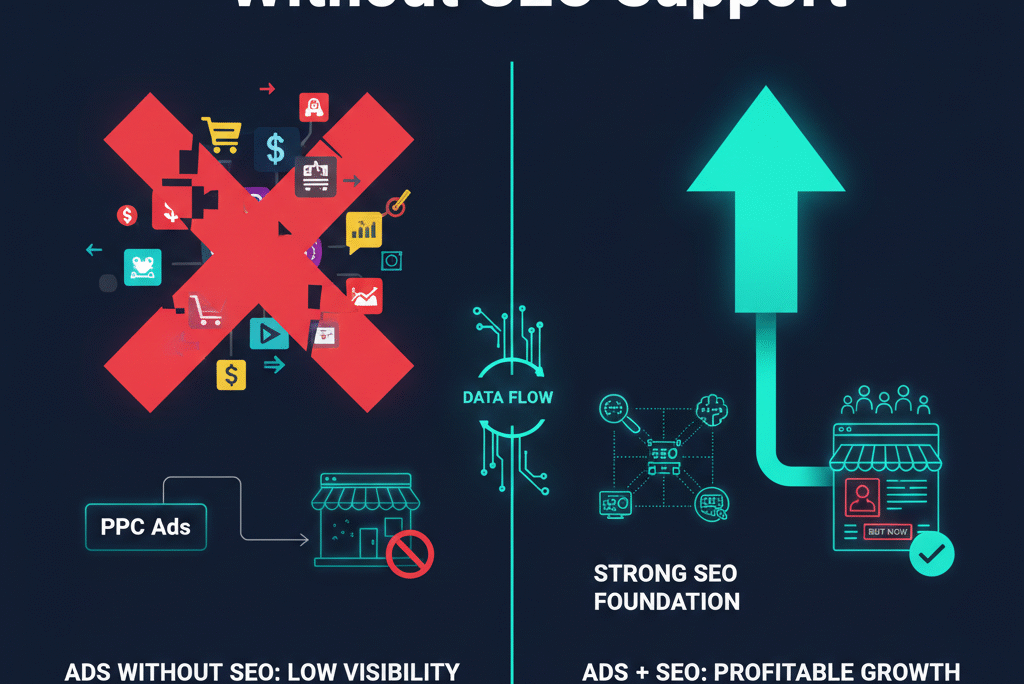
Paid ads are not magic. They are gasoline.
And if there’s no engine underneath — no SEO, no structure, no authority, no organic foundation — you’re basically pouring fuel onto sand and wondering why nothing moves.
A lot of ecommerce brands launch ads way too early. They run Facebook, Google, TikTok campaigns, see some initial traffic spikes, maybe even a few sales… and then reality sets in. Customer acquisition costs climb. Conversion rates drop. Profit margins get squeezed. Suddenly the ad platform feels “too competitive.”
But the real issue? The brand never built organic depth.
This is where SEO changes everything.
Let’s break this down properly.
Ecommerce Ads Bring Attention. SEO Builds Trust.
When someone clicks your ad, they are curious.
When someone finds you organically, they are searching with intent.
That difference is massive.
Organic traffic — especially from search engines — comes from people actively looking for solutions. They’re comparing. Evaluating. Researching. They want to trust before they buy.
If your store doesn’t show up organically for relevant searches, it creates a subtle psychological gap. People may click your ad, but they’ll still Google your brand afterward. If nothing credible appears? Trust weakens.
Search engine visibility isn’t just about traffic. It’s about legitimacy.
When your ecommerce site ranks, it signals authority. It tells buyers, “We exist beyond paid placements.”
And in a world where scam stores pop up daily, that matters.
Ads Expose Weak Foundations
Paid traffic is ruthless.
If your product page has weak copy, thin content, poor structure, slow loading speed, or unclear branding, ads will amplify the problem instead of fixing it.
This is where SEO and website optimization intersect.
Proper SEO Support forces you to:
- Build structured product descriptions
- Optimize site speed
- Improve user experience
- Use keyword-aligned messaging
- Strengthen category pages
- Develop supporting content
SEO isn’t just about ranking. It’s about refining your entire ecommerce ecosystem.
When you skip this step and jump straight to ads, you’re essentially testing unpolished infrastructure at scale. That’s expensive experimentation.
Organic work improves your conversion rate before you ever spend heavily on ads.
And higher conversion rates mean lower acquisition costs.
That’s math. Not marketing hype.
Rising Ad Costs Are a Structural Problem
Platforms like Meta and Google aren’t getting cheaper.
Competition increases. CPMs rise. Auction dynamics tighten.
If your entire sales engine depends on paid traffic, your business is sitting on rented land. The moment costs spike or algorithms shift, your margins collapse.
SEO, on the other hand, compounds.
An optimized blog post can bring traffic for years. A properly structured product category page can rank and convert without ongoing ad spend. Organic visibility reduces dependency.
Think of ads as a faucet.
Think of SEO as digging a well.
One stops when you turn it off. The other keeps producing.
Smart ecommerce brands use both. But they build the well first.
SEO Supports the Buyer Journey (Ads Alone Don’t)
Most ads target bottom-of-funnel buyers. People ready to purchase.
But buyers rarely start there.
They research first.
They type things like:
- “Best private label skincare brands”
- “How to choose ergonomic office chairs”
- “Amazon vs eBay selling comparison”
If your brand doesn’t appear in these informational searches, you’re missing early-stage customers.
This is where SEO and content strategy come in.
Educational blog posts, comparison pages, FAQs, guides — these create awareness long before someone clicks a sales ad.
By the time that person sees your paid ad, your brand already feels familiar.
That lowers resistance. And resistance is what kills conversions.
Brand Authority Lowers Ad Costs
Here’s something most people don’t realize:
Strong SEO can actually make your ads perform better.
Why?
Because brand searches increase.
When more people search your brand name directly, ad platforms interpret that as a positive signal. It improves Quality Score on Google Ads and can lower cost-per-click.
If someone has already read your blog, seen your ranking page, or discovered you organically, they’re more likely to:
- Click your ad
- Convert faster
- Require less persuasion
SEO warms up traffic before ads ever enter the picture.
Without it, ads have to do all the heavy lifting.
That’s inefficient.
Conversion Rate Optimization Starts With Search Intent
Search engine optimization forces clarity.
When you optimize for a keyword, you’re aligning with a specific intent. Informational. Commercial. Transactional.
That alignment sharpens your messaging.
Ad campaigns that aren’t supported by SEO often suffer from misalignment. They drive traffic that doesn’t match the landing page intent.
Example:
If someone searches for “how to start Amazon private label” and lands on a sales-heavy page with no education, they bounce.
SEO encourages layered content:
- Educational blogs
- Service explanation pages
- Case studies
- FAQs
- Internal linking between them
This ecosystem captures users at different awareness levels.
Ads without that ecosystem? They force every visitor into the same funnel stage.
That’s like proposing on the first date.
SEO Creates Assets. Ads Create Spikes.
Paid campaigns are temporary boosts.
SEO content is an asset.
A well-written blog targeting a high-intent keyword can generate steady monthly traffic without additional spend.
Now imagine stacking 20, 50, 100 of those assets.
That’s predictable visibility.
Predictability stabilizes revenue.
And stable revenue makes ad scaling safer.
When brands rely solely on ads, revenue fluctuates wildly with platform changes, policy updates, or seasonal competition.
SEO acts like ballast in a ship. It prevents dramatic tipping when waves hit.
The Data Advantage
SEO gives you long-term behavioral data.
You learn:
- What people search
- Which pages they stay on
- What questions they ask
- Where they drop off
This insight improves ad targeting.
Without organic data, ad strategy becomes guesswork.
You’re relying only on paid platform metrics instead of full-funnel visibility.
Organic search queries reveal pain points and objections before someone ever clicks “buy.”
That intelligence is priceless.
Finding those real search queries doesn’t have to be guesswork. You can use tools like our Search Term Harvester to uncover exactly what your audience is searching for, helping you align both your SEO strategy and ad campaigns with real demand:
👉 https://ecommate.co.uk/tool-box/search-term-harvester/
Multi-Channel Credibility Matters
When a brand shows up across:
- Organic search
- Blog results
- Social media
- Paid ads
- Marketplace listings
It feels established.
Single-channel brands feel fragile.
Imagine clicking an ad, then Googling the brand and finding nothing but the ad itself. No ranking pages. No blog. No authority signals.
That subtle absence creates doubt.
Modern buyers cross-check.
SEO ensures there’s something solid for them to find.
The Marketplace Illusion
Many ecommerce sellers focus only on marketplaces like Amazon or eBay and assume ads inside those platforms are enough.
Marketplace ads can boost visibility within the platform.
But external SEO builds brand equity outside it.
If your brand exists only inside a marketplace ecosystem, you don’t own the traffic.
Search engine presence gives you independence.
Independence protects margins.
SEO + Ads Is Not Either/Or
This isn’t an argument against advertising.
Ads are powerful.
They accelerate growth. They test offers quickly. They generate immediate data.
But without SEO, they operate in isolation.
The strongest ecommerce brands do this:
- Build SEO foundations
- Create content that answers real buyer questions
- Optimize website structure and conversion flow
- Then amplify with ads
Ads scale what already works.
They should not be used to discover whether something works.
That discovery happens through organic traction first.
The Compounding Effect
Let’s imagine two ecommerce brands:
Brand A runs ads immediately. No blog. No organic ranking. No structured SEO.
Brand B invests three months into SEO foundations, content, optimization, and then runs ads.
Six months later:
Brand A is still paying high acquisition costs and fighting platform competition.
Brand B has:
- Organic traffic
- Brand searches
- Lower bounce rates
- Warmer audiences
- Higher conversion rates
Brand B’s ads perform better because the groundwork exists.
Compound growth always beats isolated spikes.
Final Thought
Ecommerce is not just about traffic.
It’s about trust, positioning, intent alignment, and authority.
Paid ads are a megaphone.
SEO is the reputation behind the voice.
Without reputation, the megaphone just makes noise louder.
When you combine both intentionally, something powerful happens. Ads stop feeling like a gamble and start functioning like fuel for a stable engine.
And that’s when scaling becomes sustainable instead of stressful.
Build the engine first.
Then press the accelerator.
If your ecommerce ads feel expensive, inconsistent, or unpredictable, the issue usually isn’t the ad platform — it’s the foundation behind it. At Eccommate, we build ecommerce systems that combine SEO, brand positioning, and marketplace strategy before scaling paid traffic. If you’re ready to turn your store into a sustainable growth engine instead of relying on ad spikes, explore our services and see how we can support your next stage of growth.
Many industry experts highlight that SEO doesn’t just complement paid ads — it fundamentally strengthens your entire marketing ecosystem. For example, a recent overview on why SEO matters for ecommerce explains how organic search builds credibility, improves user experience, and brings high-intent traffic over time, making your paid campaigns far more effective than ads alone ever could.