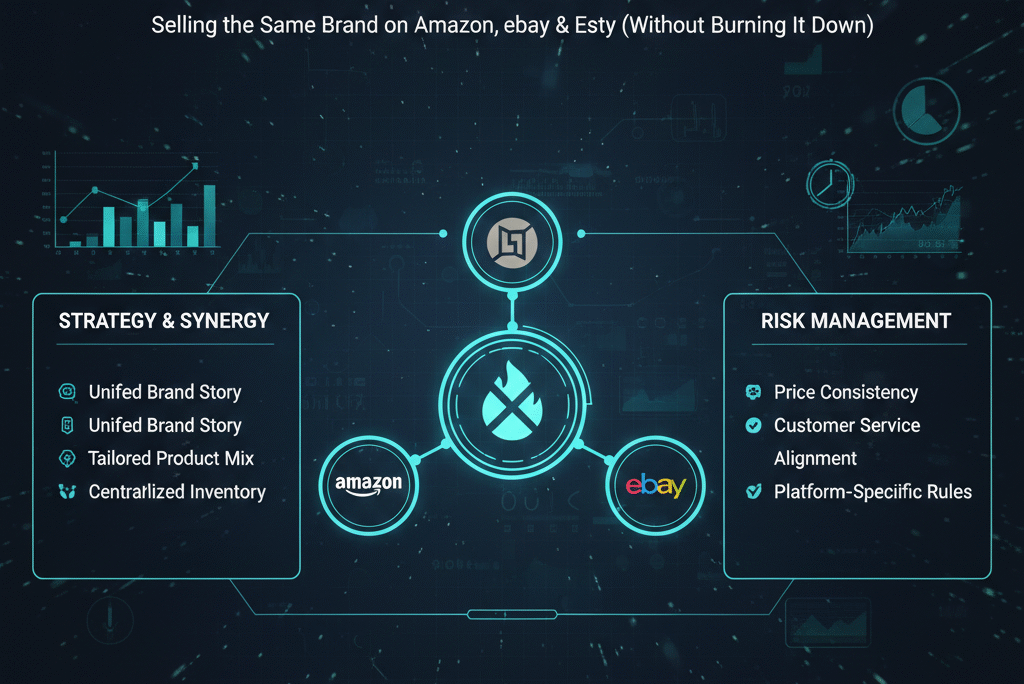
This is for sellers operating on a single marketplace who are either thinking about expanding or already on multiple platforms and finding the results disappointing. The product and the brand can be identical across all three. What has to change is how each platform’s distinct buyer environment shapes how that brand is presented.
Why Single-Platform Dependency Is a Growing Risk in 2026
Most Amazon private label sellers know, at some level, that their business sits on ground they don’t own. The traffic comes from Amazon’s algorithm. The customer relationships exist within Amazon’s system. The visibility of their listings depends on Amazon’s ranking mechanics, and the economics of selling depend on Amazon’s fee structure. All of these can change — and they do, regularly, often with limited notice and limited recourse for sellers who’ve built everything around a single channel.
This isn’t a theoretical concern. Algorithm updates have collapsed organic rankings that took years to build. Category policy changes have effectively closed specific product lines. Fee increases in FBA have turned comfortable margins into difficult ones. Account suspensions, whether justified or not, can remove access to an entire business’s revenue for weeks while appeals move through a slow process. Sellers operating solely on Amazon have no fallback during any of these events — the business simply stops performing until the platform issue is resolved.
Multi-platform selling addresses this risk structurally, not through any single product decision or operational adjustment. A seller who has active, stable listings on Amazon, eBay, and Etsy simultaneously is exposed to each platform’s specific risks without being entirely at the mercy of any one of them. An Amazon algorithm change that hurts visibility on one listing doesn’t take the business offline — the other channels continue operating. A policy change in one category doesn’t eliminate all revenue. The diversification isn’t dramatic in any single moment, but across a year or two of platform changes, policy evolutions, and competitive shifts, it consistently produces more stable business outcomes than single-platform dependency does.
This is a principle that ecommerce platforms themselves have begun advocating explicitly — Shopify’s guide to multichannel selling makes the case for channel diversification in detail, reinforcing that the risk of single-platform dependency is recognized across the industry, not just by sellers who’ve experienced it firsthand.
The second reason is audience reach that doesn’t overlap cleanly. Amazon, eBay, and Etsy don’t primarily compete for the same buyers — they serve populations with meaningfully different shopping habits, price sensitivities, and decision-making processes. A product that reaches its Amazon buyer through keyword-driven search can reach a different, genuinely distinct buyer through Etsy’s aesthetic discovery environment or eBay’s deal-comparison ecosystem. Multi-platform selling, done properly, doesn’t just distribute the same buyers across multiple interfaces — it reaches buyers who wouldn’t have found the product at all through a single channel.
The third reason is brand authority. A brand that’s discoverable across multiple channels has a different kind of presence than one that exists only on Amazon. When a buyer who encountered the brand through one channel searches the brand name independently, finding it across multiple platforms signals establishment and credibility in a way that a single listing on a single marketplace doesn’t.
The Three Platforms and What Each One Actually Is
The prerequisite for any coherent multi-platform strategy is understanding what each platform genuinely represents — not just as a place to list products, but as an environment with a specific buyer population, specific decision-making patterns, and specific signals that tell those buyers they’ve found something worth purchasing.
Amazon: A Transaction Environment Where Speed and Clarity Win
The defining characteristic of Amazon’s buyer population is purchase intent. People arrive at Amazon because they know what category of thing they’re looking for and are evaluating options to identify the best one. The interface supports this behavior with search ranking, competitive pricing displays, review aggregation, and the immediate buy button — everything is oriented toward closing a decision that was already mostly made before the buyer arrived.
This creates a specific competitive environment. A buyer scanning Amazon search results is seeing multiple listings simultaneously and making rapid comparative judgments. Click-through rates from search results are determined in a matter of seconds, based on the thumbnail image, the title’s immediate clarity, the price, and the review count — in roughly that order for most categories. Once a buyer clicks through to a listing, the job of the copy and images is to quickly resolve whatever remaining uncertainty exists before the “Add to Cart” decision.
What works in this environment is absolute clarity and immediate relevance. Titles that communicate the product’s identity and primary differentiator in the compressed space a buyer spends reading them. Main images that win the visual comparison against competing thumbnails. Bullet points that answer “why this one, at this price” directly rather than elaborating on features whose significance requires explanation. Copy that’s written for a buyer who is ready to purchase and needs confirmation they’re making the right choice — not a buyer who needs to be persuaded that the category is worth caring about.
What doesn’t work is anything that slows the decision down, asks the buyer to work harder than they will, or assumes they’ll spend more time on a listing than they actually do. Amazon buyers don’t read long copy. They don’t deeply investigate unfamiliar brands unless the listing has given them a reason to. They make fast decisions based on the immediate impression the listing creates, and the listings that convert best are the ones that make the right impression fast.
eBay: A Comparison Environment Where Seller Trust and Value Clarity Matter
eBay’s position in the marketplace landscape is frequently underestimated, partly because its cultural dominance has faded relative to its peak and partly because its buyer population is genuinely harder to characterize cleanly than Amazon’s or Etsy’s. But it occupies a genuinely useful strategic position, particularly for brands with products that benefit from pricing flexibility or international reach.
The distinctive feature of eBay’s buying environment is that buyers are often comparing sellers, not just listings. On Amazon, the listing is the primary object of evaluation — the seller behind it is largely anonymous unless they’re a recognized brand or unless negative seller metrics make themselves visible through warnings. On eBay, seller ratings are prominently displayed and explicitly factor into buyers’ decisions. A seller with strong feedback history is meaningfully more competitive against alternatives than one without — and this visibility of seller reputation changes how trust-building works.
This makes eBay an environment where the presentation of the seller as a trustworthy, knowledgeable party matters more directly than it does on Amazon. Listing copy that’s clear, detailed, and written in a way that feels like it comes from someone with genuine knowledge of the product tends to perform better than listing copy imported from Amazon’s more compressed, benefit-statement style. The tone that works is practical and conversational — here’s what this product is, here’s how it works, here’s why you should buy it from this seller rather than the alternatives you’re also looking at.
eBay also supports selling formats that Amazon doesn’t — auction-style listings, best-offer mechanics, and flexible bundle configurations — which makes it a useful environment for pricing experimentation and for moving inventory configurations that don’t fit Amazon’s more standardized listing structure. For sellers with products that have international demand, eBay’s buyer populations across Europe and Australia can represent meaningful additional reach.
Etsy: An Emotional Discovery Environment Where Story and Aesthetic Drive Purchase
Etsy operates on fundamentally different principles from the other two platforms, and understanding this is the most important thing a seller can do before putting any product there.
Etsy buyers are not primarily searching for a specific product. They’re browsing with aesthetic and emotional intent — looking for things that feel made with care, that have a story, that represent something beyond a commodity transaction. They arrived at Etsy specifically because they’re seeking that quality, and they’re less likely to find it (in their perception) on Amazon or eBay. This means the competitive environment on Etsy is less about being the best product for a functional specification and more about being the product that best captures a feeling or aesthetic that the buyer is looking for.
This affects every element of how products need to be presented on Etsy. Titles tend to be more descriptive and natural in their language — closer to how a person would describe the product to a friend than to how a keyword-focused Amazon title is structured.
Etsy’s own seller guidance on writing effective listings emphasizes this natural, descriptive approach specifically — the platform’s own recommendations consistently prioritize clarity and authenticity over the keyword density that Amazon listing optimization requires, which is direct confirmation that adapting your listing approach for Etsy isn’t just strategic preference but platform-endorsed best practice.
Descriptions have room for and benefit from genuine storytelling — the inspiration behind the product, the intention in its design, the story of the brand — because Etsy buyers are more likely to read this content and more likely to make it part of their purchase decision than Amazon buyers are.
Photography on Etsy benefits from being more contextual and atmospheric than Amazon photography typically is. Styled product shots, lifestyle imagery that creates a mood, photography that makes the product feel like part of a world the buyer wants to inhabit — these perform better than the clean, clinical product-on-white-background photography that Amazon’s format prioritizes. Etsy buyers are making more emotionally inflected purchase decisions, and imagery that addresses the emotional dimension directly — that makes the product feel desirable rather than just clear — serves that decision better.
Pricing on Etsy has more ceiling flexibility for products that genuinely fit the platform’s sensibility. The premium that Etsy buyers are often willing to pay isn’t arbitrary — it reflects the explicit value they’re placing on the intentionality and story quality that brought them to Etsy in the first place. A product that’s priced 20–30% higher on Etsy than on Amazon can still convert well on Etsy if the listing communicates the qualities that make that price feel appropriate. The same differential would likely hurt conversion on Amazon, where the alternative is directly visible in the same results page.
The Copy-Paste Problem and Why It Consistently Destroys Performance
With the distinct character of each platform established, the mechanism by which copying listings across platforms fails becomes straightforward to understand.
An Amazon listing is built to win within Amazon’s specific competitive and algorithmic environment: keyword-dense titles optimized for Amazon’s A9 search algorithm, bullet-point copy structured around features and benefits in the compressed format that Amazon buyers process quickly, pricing calibrated against the immediately visible alternatives in the same search results. Every element of an effective Amazon listing is optimized for Amazon’s specific context.
When that listing gets copied to eBay, it fails on two levels simultaneously. The writing style and tone, calibrated for Amazon’s transactional buyer population, doesn’t match the conversational, comparative register that eBay’s buyer population responds to. The structural optimization for Amazon’s search algorithm doesn’t correspond to eBay’s Cassini algorithm, which weighs different factors and rewards different listing characteristics. The result is a listing that underperforms on both the human and algorithmic dimensions at the same time.
When an Amazon listing gets copied to Etsy, the mismatch is even more pronounced. Keyword-stuffed titles feel jarring in an environment where buyers are expecting natural, descriptive language. Feature-benefit bullet points feel generic in an environment where buyers are specifically looking for story and intention. Product-on-white-background photography that’s perfectly optimized for Amazon’s visual comparison environment feels cold and disconnected in an environment where atmospheric, contextual photography performs significantly better.
The solution isn’t dramatically more work per platform. It’s writing each platform’s listing from the buyer’s perspective — asking who is this buyer, why are they on this specific platform rather than another one, and what specifically are they looking for that this platform is supposed to deliver — and letting those answers shape the listing rather than adapting whatever already exists for a different context.
Pricing Across Three Platforms: Strategic, Not Uniform
One of the most practically challenging aspects of multi-platform selling is pricing, and the instinct to maintain uniform pricing across all three channels — for simplicity, for consistency, or to avoid the complications of platform-specific price management — almost always works against the business.
The reason is that each platform carries different cost structures and different buyer price sensitivity, and pricing that ignores those differences will either leave money on the table on some platforms or be uncompetitive on others.
Amazon’s pricing environment is the most explicitly competitive of the three. Buyers can see comparable alternatives in the same search results. The buy box mechanics create strong incentives toward competitive pricing. FBA fees, advertising costs, and referral fees mean that the floor of viable pricing is higher than it might appear from product cost alone. Getting pricing right on Amazon is about finding the level that’s competitive within the visible alternatives while still generating adequate margin after all costs.
Etsy’s pricing environment allows more premium positioning for products that genuinely fit the platform’s aesthetic and story-driven character. Buyers aren’t making the same side-by-side comparison against adjacent alternatives that Amazon forces. They’re evaluating the product on its own terms, through the lens of whether it delivers the story, aesthetic quality, and intentionality they came to Etsy looking for. A well-positioned Etsy listing can sustain pricing significantly above the Amazon equivalent — sometimes 25–40% higher — because the buyer’s willingness to pay is shaped by different factors.
eBay’s pricing environment is deal-conscious but not purely price-driven. Buyers are comparing sellers as much as products, which means a modest price premium over the cheapest alternative is sustainable if the seller’s reputation, listing quality, and terms justify it. The risk on eBay is less premium ceiling and more floor — pricing that looks uncompetitively high against direct alternatives that offer comparable products from sellers with similar ratings won’t win the comparison regardless of how good the listing copy is.
The practical approach is to establish pricing for each platform based on its own logic — cost structure, competitive context, buyer price sensitivity — rather than anchoring everything to one platform’s price and adjusting from there. The brand’s overall positioning (premium, mid-range, value-focused) should be consistent. The specific price expression of that positioning will differ across channels.
How to Keep the Brand Consistent Without Making Every Listing Identical
The concept that causes the most unnecessary confusion in multi-platform strategy is brand consistency. Sellers often worry that adapting their listing style for different platforms means presenting an inconsistent brand — that a warmer, more story-oriented Etsy presence contradicts a clean, conversion-focused Amazon presence, or that adjusting tone for eBay’s practical register conflicts with the brand voice established elsewhere.
This is a misunderstanding of what consistency actually means in branding. Consistency doesn’t mean identical expression across all contexts. It means that the same underlying identity — the same visual language, the same core values, the same brand promise — shows up across all contexts, expressed in ways appropriate to each.
The visual elements that carry brand identity — the logo, the established color palette, the typography, the photography style — should be consistent across all three platforms and across any other touchpoint where the brand appears. A buyer who encounters the brand on all three platforms should immediately recognize it as the same brand, even if the copy feels different and the photography is styled differently for each platform’s conventions.
What adapts across platforms is not the identity but the expression of that identity. On Amazon, the brand’s professionalism, reliability, and value clarity show up through clean product presentation, direct copy, and competitive positioning. On Etsy, the same underlying brand shows up through more atmospheric photography, story-oriented copy, and a presentation style that communicates the intention and care behind the product. On eBay, it shows up through clear, practical communication and a seller identity that conveys trustworthiness and value.
The same person in different contexts: the character doesn’t change, the register and vocabulary adjust to what’s appropriate. That’s not inconsistency — it’s intelligence about how communication works in different environments.
Inventory Management: The Operational Reality Nobody Talks About Enough
Multi-platform selling’s operational challenge is almost always underestimated, and the underestimation consistently leads to the same problems: overselling, stockouts, and the seller reputation damage that follows from both.
The core problem is unit fungibility. When the same physical inventory is listed for sale on three platforms simultaneously, each unit can only be sold once. A sale on Amazon doesn’t automatically remove availability from eBay and Etsy unless a system exists to make that update immediately. Without that system, the same unit can theoretically be sold twice — once on Amazon and once on eBay — with no actual inventory to fulfill the second order.
This isn’t just an inconvenience. Overselling damages seller metrics on the platform where the unfulfillable order landed, generates a negative customer experience, and at scale can lead to listing penalties or account health issues that affect the entire channel.
The practical requirements are straightforward, though not trivial to set up: a centralized inventory tracking system that maintains a single real-time count of available stock and updates across all channels when any platform records a sale. There are dedicated multi-channel listing management platforms that handle this automatically; for sellers with smaller catalogs, manual processes with appropriate buffers can work, though they require more active management.
The operational approach that works best for most sellers is graduated expansion rather than simultaneous launch on all three platforms. Establishing stable, predictable performance on Amazon first — understanding the actual sales velocity, the seasonal patterns, the inventory requirements — provides the accurate demand picture that makes eBay and Etsy expansion more manageable. Expanding to a second platform with real Amazon performance data in hand produces better inventory allocation decisions than trying to forecast demand across three channels simultaneously without established history on any of them.
Channel-specific inventory buffers — deliberately holding some stock back from what’s listed as available on each individual platform — reduce the risk of overselling during demand spikes on one channel. The cost of the buffer (slightly lower listed availability on each platform) is almost always worth the benefit (reduced overselling risk and the account health consequences it produces).
The Long-Term Compounding Advantage of Multi-Platform Brand Building
Beyond the immediate benefits of risk distribution and audience reach, multi-platform brand building produces a compounding advantage over time that’s worth understanding explicitly — because it shapes how to think about the investment required in the earlier, less obviously rewarding stages of expansion.
Every month that a brand maintains an active, well-maintained presence across three platforms is a month during which brand recognition is accumulating across three buyer populations rather than one. Buyers who encounter the brand on Etsy may later purchase from Amazon. Buyers who bought on eBay may recommend the brand to someone who ends up on Etsy. The cross-channel recognition that accumulates isn’t tracked neatly in any single platform’s analytics, but it’s real and it compounds — a brand that people encounter in multiple contexts gradually becomes one they think of as established and trustworthy in a way that a brand they only ever see in one place doesn’t.
The other compounding benefit comes from what happens when the natural next step — building a direct-to-consumer website — eventually makes sense. Brands that have built multi-platform presence before launching a direct site start that launch with substantial advantages over brands that go direct immediately or only ever existed on one marketplace. The visual identity is established. The product photography exists. The brand voice has been developed across multiple contexts. Customer reviews and brand mentions across three platforms provide social proof that a new direct site can reference immediately rather than having to build from scratch.
None of this is invisible or theoretical in its business value. Exit valuations for ecommerce brands reflect it directly: brands with diversified channel presence, established cross-platform customer bases, and genuine brand equity that extends beyond any single platform’s algorithm command better multiples than brands whose revenue is entirely tied to one channel’s current cooperation.
Frequently Asked Questions About Multi-Platform Selling
Does every product need to be on every platform?
No — and trying to list everything everywhere is often the wrong approach, particularly early in multi-platform expansion. Different products have different platform fit. Products with strong keyword-searchable functional demand and competitive pricing fit Amazon best. Products with aesthetic qualities and brand stories that a buyer would find compelling fit Etsy. Products with deal-sensitive pricing and flexibility for bundle configurations fit eBay. Matching products to the platforms where their specific characteristics are most valuable tends to outperform uniform listing across all three.
How long does it take to build meaningful performance on eBay or Etsy?
Longer than Amazon in most cases — both eBay and Etsy reward seller history, accumulated reviews, and search visibility that develops over months rather than weeks. Setting expectations of six to twelve months before a new platform generates substantial revenue — and treating early platform presence as brand building and data accumulation rather than immediate revenue production — makes the trajectory easier to maintain through the early, lower-volume period.
Does selling on multiple platforms require separate inventory pools?
No — the same physical inventory can supply all three platforms. What’s required is the tracking system to manage that inventory accurately across all channels, and the operational discipline to prevent overselling when demand on one channel temporarily exceeds what was anticipated. Channel-specific buffers, described earlier in this guide, handle this without requiring dedicated separate inventory for each platform.
How should I handle customer service across three platforms?
Each platform has its own customer service interface and its own response time standards that affect seller metrics. The approach that works best treats the underlying customer service process as unified — consistent policies, consistent resolution approach, consistent communication tone — while applying that unified process through three different platform interfaces. A single customer service framework, executed through three channels, is more manageable and more consistent than three separate operations with different approaches.
What’s the first sign that multi-platform expansion isn’t working?
Usually not what sellers expect, which is often low sales on the new platforms. The earlier warning sign is usually operational — overselling events, customer service backlogs, inventory allocation errors — which then create the platform health issues that suppress organic visibility and seller ratings, which then cause the sales underperformance. The root is almost always operational infrastructure that wasn’t built before expansion rather than the market not being there.
Final Thought: Three Platforms, One Brand, More Resilience
Amazon, eBay, and Etsy aren’t competitors for a brand’s limited attention and resources — they’re complementary tools, each serving a different buyer population and serving different strategic functions within a complete brand presence.
Used with the understanding described in this guide — each platform approached on its own terms, with listings written for its specific buyer environment, with pricing calibrated to its own cost structure and competitive dynamics, held together by consistent visual identity and brand values — multi-platform selling compounds rather than merely multiplies. Each channel reinforces the others, each new buyer population reached through one platform adds to the cumulative brand authority that benefits all of them, and the reduced platform dependency that comes from operating across three channels provides a stability that no single-platform business can fully replicate.
The work required to do this properly is real. The adaptation of listings for each environment, the operational infrastructure for inventory management, the customer service coverage across three platforms — none of this is trivial, and understating it leads to the half-hearted implementation that produces disappointing results and reinforces the mistaken conclusion that multi-platform selling doesn’t work.
What actually doesn’t work is multi-platform selling done without strategy. Multi-platform selling done with the approach described here — gradual, deliberate, adapted to each environment — is one of the most reliable ways to build a more resilient, more valuable, and more authoritative brand than single-platform dependence allows.
If you’re building across multiple marketplaces and want strategic support in developing listings, brand identity, and operational systems that work across all three, you can explore how we work with sellers at ecommate.co.uk.