Is Etsy Private Label Allowed? (Where Handmade Ends and Branding Takes Over) (2026)
Thinking about private label on Etsy—but worried about getting banned?
Here’s the reality:
- Private label is allowed on Etsy
- But reselling generic products is not
- The difference comes down to creative ownership and branding
👉 If you get this wrong, your shop doesn’t grow—it disappears.
📌 Quick Answer: Is Etsy Private Label Allowed?
Yes—Etsy allows private label if:
- You design the product or its creative elements
- You disclose production partners
- You sell under your own brand
- You do not resell generic, unmodified products
👉 The difference isn’t where it’s made. The difference is who owns the idea.
Private label works on Etsy when branding and creative ownership are clear.
Why Etsy Shops Get Shut Down for “Private Label”
Most sellers don’t get banned randomly.
They get flagged because they:
- Resell products without modification
- Hide production partners
- Copy existing designs
- List generic items with no creative ownership
Etsy doesn’t have a problem with scaling.
👉 It has a problem with lack of originality.
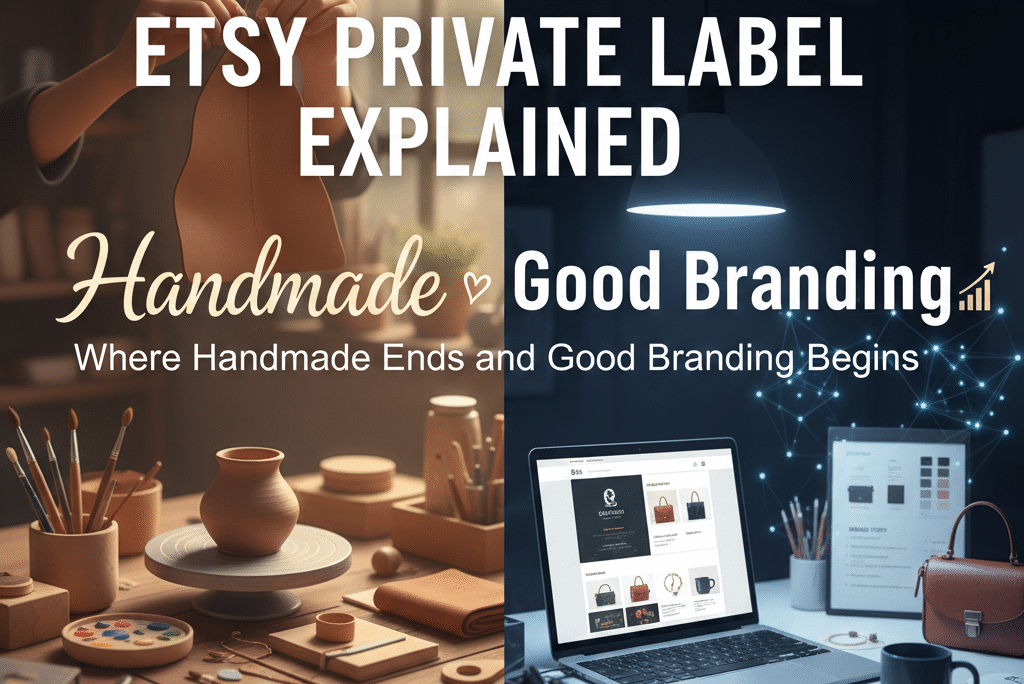
Etsy Private Label Explained: Where Handmade Ends and Branding Begins
Scroll through Etsy long enough and you’ll notice something strange.
Half the marketplace feels like a cozy art fair—ceramic mugs, hand-stitched journals, watercolor prints.
The other half?
Clean branding. Consistent photography. Polished packaging.
Listings that feel less like:
👉 “I made this on my kitchen table”
And more like:
👉 “This is a real brand.”
That second group is where Etsy private label lives.
What Etsy Actually Means by “Handmade”
Etsy doesn’t require every product to be physically made by the seller.
That’s the first misconception.
Etsy’s definition includes:
- Items made by the seller
- Items designed by the seller and produced with partners
- Items customized or artistically transformed
According to Etsy, sellers can work with production partners as long as they maintain creative ownership and clearly disclose how their products are made.
Private label sits right there.
To understand where Etsy draws the line, it helps to look at their official policy. According to Etsy, sellers can work with production partners as long as they are the original designers of the product and clearly disclose how items are made. This means private label is allowed—but only when creative ownership and transparency are part of the business model.
Etsy Private Label vs Reselling (Critical Difference)
This is where most sellers get confused.
Private label:
- You design the product
- You control branding
- You create differentiation
Reselling:
- Generic product
- No creative input
- No brand identity
👉 Etsy allows one. Penalizes the other.
So What Is Etsy Private Label, Really?
Etsy private label is not slapping your logo on a factory product.
That gets shops shut down fast.
Real Etsy private label means:
- You design the product or its key elements
- You control branding and identity
- You may use production partners
- You sell as a brand—not a reseller
It’s not about where it’s made.
👉 It’s about who owns the idea.
Where Handmade Ends (and Why Burnout Begins)
Pure handmade sounds great—until scale kicks in.
Most sellers hit the same wall:
- Orders increase
- Production stays manual
- Time disappears
- Margins shrink
Burnout follows.
Private label exists because sellers want to grow without breaking.
This is where things shift:
- From handcrafted → designed
- From personal → branded
- From fragile → scalable
That shift isn’t selling out.
👉 It’s survival.
Where Branding Begins (and Etsy Rewards You)
Etsy doesn’t reward “handmade” alone.
It rewards:
- Click-through rate
- Conversion rate
- Listing quality
- Customer satisfaction
Branding improves all of them.
When branding enters:
- Listings look cohesive
- Shops feel recognizable
- Photos feel intentional
- Reviews mention your brand
👉 This is why branded shops often outperform purely handmade ones.
Not because Etsy prefers factories.
Because buyers prefer clarity.
What Products Work Best for Etsy Private Label?
Private label works best when creativity is visible.
Strong categories:
- Jewelry with original designs
- Personalized products
- Home décor with a clear style
- Printables and hybrids
- Stationery and lifestyle goods
Weak categories:
- Generic gadgets
- Electronics
- Trend-chasing products
- Anything easily found unmodified elsewhere
👉 If it looks like mass-market, it doesn’t belong.
The Production Partner Line (And Why Transparency Matters)
Etsy allows production partners.
But honesty is non-negotiable.
You must:
- Declare partners
- Explain your design role
- Be transparent about sourcing
Customers don’t care where it’s made.
They care about:
- Design
- Quality
- Experience
Transparency protects all three.
Branding Is Not Just a Logo
Most sellers underestimate this.
Branding includes:
- Visual identity
- Photography style
- Tone of voice
- Packaging
- Shop consistency
When done right:
👉 Customers stop browsing listings
👉 They start trusting your shop
That’s where pricing power begins.
Branding Improves Conversion (Which Improves Visibility)
Branding answers silent questions:
- Is this legit?
- Can I trust this seller?
- Is this worth the price?
Clarity removes doubt.
Doubt kills conversions.
Conversions increase visibility.
That’s how Etsy search actually works.
If you want to take this beyond theory and actually see how branding and keyword behavior translate into performance, you can analyze real search and conversion data.
Our SQP-STR Combo Analyzer helps you connect search terms with actual sales performance, so you can understand which keywords and listings are truly driving growth: 👉 https://ecommate.co.uk/tool-box/sqp-str-combo-analyzer/
Repeat Buyers and Favorites: Long-Term Visibility Fuel
Branding builds memory.
When buyers:
- Favorite your shop
- Return later
- Buy again
Etsy takes notice.
Repeat engagement strengthens your visibility over time.
👉 Memory becomes ranking power.
The Difference Between “Handmade” and “Hobby”
Skill doesn’t rank.
Clarity does.
The difference isn’t budget.
It’s intention.
- Clear positioning
- Consistent visuals
- Cohesive messaging
Etsy doesn’t punish small sellers.
👉 It punishes unclear ones.
Why Copying Top Listings Only Half Works
Copying competitors works… briefly.
Then it stops.
Because Etsy already has that version.
What it doesn’t have:
👉 Your clarity
👉 Your positioning
Branding creates new engagement patterns.
That’s what gets you visibility.
Branding Isn’t Decoration. It’s SEO in Disguise.
Here’s the truth:
👉 Etsy rewards human behavior
👉 Branding shapes human behavior
That’s the system.
Not logos.
Not colors.
Not fonts.
But:
- Trust
- Clarity
- Confidence
- Consistency
Branding creates those.
Final Thought
If you treat branding like aesthetics, SEO will always feel broken.
If you treat branding like performance infrastructure, everything changes.
You stop chasing keywords.
You start building something Etsy wants to show.
Not because it’s pretty.
👉 Because it works.
🚀 Want to Build a Compliant Etsy Brand That Actually Scales?
Building a real Etsy private label brand isn’t about shortcuts.
It’s about:
- Understanding Etsy’s rules
- Owning your creative identity
- Scaling without losing trust
If you want to do it right—from product strategy to branding to compliant growth—
👉 See how we help sellers build Etsy brands that actually scale:
https://ecommate.co.uk/