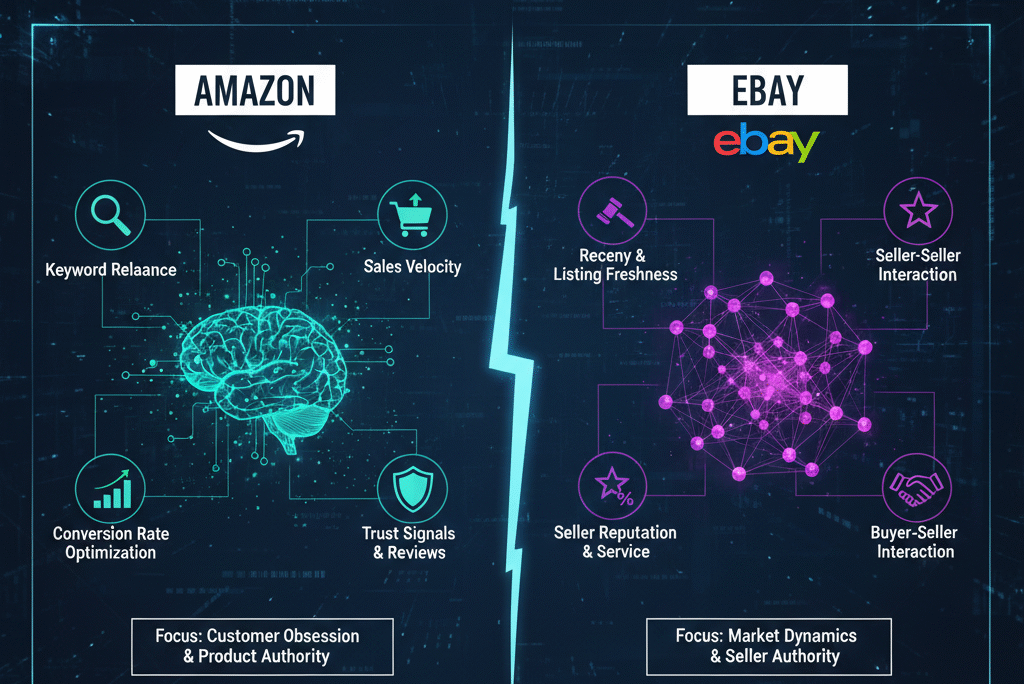
This is for sellers who are active on both platforms — or thinking about it — and can’t figure out why the same product performs completely differently depending on where it’s listed. The answer is almost never the product.
Why the Same Product Behaves Completely Differently on Each Platform
Here’s a situation that confuses a lot of multi-platform sellers: you list the same product on Amazon vs eBay. Same photos, same price, roughly the same copy. On one platform, sales come in steadily. On the other, the listing sits there like it’s invisible.
The instinct is to blame the listing — to tweak titles, adjust pricing, run a promotion. Sometimes that helps. More often, the real problem is something deeper: the seller is treating two fundamentally different ecosystems as if they operate on the same logic.
They don’t. Amazon and eBay were built on different philosophies, reward different seller behaviors, and serve buyers who are in completely different mental states when they open the app. Understanding that difference — genuinely, not just at a surface level — is what separates sellers who perform consistently across both platforms from those who feel like they’re constantly chasing their tail.
This guide breaks down exactly how each algorithm thinks, what each platform actually rewards, and why the strategy that wins on one can quietly sabotage you on the other.
The Core Philosophical Difference (Everything Else Flows from This)
Amazon is a buyer-intent machine. When someone opens Amazon, they already know what they want. They might not have the brand or the specific model locked in, but the category is decided. They’re not browsing — they’re evaluating options against a decision they’ve already mostly made.
eBay is a discovery engine. eBay buyers are hunting. They’re comparing, exploring, looking for deals, sometimes not entirely sure what they want until they see it. The browsing behavior is more casual, more price-aware, and more open to persuasion through value rather than brand confidence.
That single philosophical difference explains almost every downstream contrast between how the two algorithms work. Amazon optimizes for speed and certainty — get the right buyer to the right product and close the sale. eBay optimizes for engagement and exploration — keep buyers active on the platform, discovering things they might buy.
Same product. Completely different context. Completely different strategy required.
How Amazon’s Algorithm Actually Works
Amazon’s ranking system — commonly referred to as A9, with ongoing updates that some refer to as A10 — operates on one overriding principle: will this listing make Amazon money right now?
Not eventually. Not after a brand-building phase. Right now, with the next buyer who sees it.
This means the algorithm is watching buyer behavior constantly and adjusting visibility accordingly. For a technical breakdown of how the ranking system is structured, Jungle Scout’s guide to the Amazon algorithm covers the mechanic in depth — what follows here is focused specifically on what that means for your day-to-day selling decisions.
Conversion Rate Is the Most Important Signal
If buyers click your listing and purchase, Amazon interprets that as evidence that your listing serves its buyers well. Visibility increases. If buyers click and leave without purchasing — they bounce back to search results, they add to cart and abandon, they spend time on the page and then disappear — Amazon interprets that as a mismatch between the listing and buyer expectations. Visibility decreases, sometimes quickly.
The practical implication of this is significant: traffic that doesn’t convert actively hurts you. This is why driving external traffic to an unconverted listing, or running PPC too early before a listing is optimized for conversion, can do more damage than staying quiet. Better images, clear and specific copy, competitive pricing, and review volume all affect conversion rate — and conversion rate affects everything else.
Keyword-to-Sale Alignment, Not Just Keyword Presence
Keywords matter enormously on Amazon, but not in the way many sellers think. Amazon doesn’t reward keyword density or clever placement. It rewards keyword-to-sale alignment — the relationship between what someone searched, what they clicked, and whether they bought.
If your listing ranks for a keyword and consistently converts sales from that keyword, Amazon strengthens that ranking. If your listing ranks for a keyword and buyers consistently don’t purchase after clicking, Amazon quietly removes you from that search result. Sales validate relevance. That’s the mechanic.
This is why new listings sometimes spike and then vanish — they get initial exposure, fail to convert at a strong enough rate, and lose the ranking they temporarily held. It’s also why established listings with strong conversion histories can dominate searches even when newer listings appear better optimized on paper.
Sales Velocity and the Sustainability Trap
Amazon loves momentum. A sudden increase in sales velocity signals to the algorithm that a listing is resonating with buyers, which triggers increased visibility, which creates more sales opportunities. This is the logic behind launch strategies that use PPC, promotions, and external traffic to generate early velocity.
The trap is what happens when that velocity isn’t sustainable. Amazon tests listings constantly. When a velocity-driven spike fades and conversion rates drop back to normal, the algorithm pulls back visibility just as quickly as it extended it. Sellers who launch hard and then coast often find their rankings collapse faster than they built them.
Sustainable sales performance — consistent conversion, steady review accumulation, stable seller metrics — is what Amazon actually rewards over the medium and long term. Velocity is a tool for launching. It’s not a substitute for a listing that genuinely converts.
Seller Performance as a Ranking Factor
Amazon’s algorithm also incorporates seller health signals — late shipment rates, return rates, negative feedback, response times. These don’t directly affect keyword ranking in an obvious way, but they affect overall account health, which affects visibility across all listings.
Amazon wants predictable sellers because unpredictable sellers create bad buyer experiences, which costs Amazon money. Sellers who maintain clean metrics benefit from a baseline of algorithm trust that makes everything else work better. Sellers with deteriorating metrics often find that their rankings suffer even when their listings appear well-optimized.
How eBay’s Algorithm Actually Works
eBay’s algorithm — known internally as Cassini — operates on a different set of priorities. Where Amazon is obsessed with immediate conversion, Cassini is focused on keeping buyers engaged on the platform. It wants listings that attract clicks, generate interest, and keep the browsing experience active.
This creates a meaningfully different set of ranking signals.
Seller Activity as a Direct Signal
On eBay, what you do as a seller affects your visibility in ways that Amazon would never reward. Regularly updating listings, ending and relisting products, adding variations, sending offers to watchers, responding to questions quickly — all of these behaviors signal to Cassini that you’re an active, engaged seller, and active sellers get preferential treatment in search results.
This is counterintuitive for Amazon sellers, where churning through listing changes and relisting products accomplishes nothing and can actually create problems. On eBay, staying active is genuinely rewarded. An eBay store that goes quiet for weeks starts to fade from search visibility even if the listings themselves are technically fine. An active store maintains visibility even without explosive sales numbers.
Price Sensitivity and the “Best Deal” Mindset
eBay buyers ask a fundamentally different question than Amazon buyers. Amazon buyers ask: is this the best product for my needs? eBay buyers ask: is this the best deal available?
Cassini reflects this. Competitive pricing, free shipping, and flexible return policies all improve ranking and click-through rates on eBay. These factors carry more weight in eBay’s algorithm than they do in Amazon’s, because eBay’s buyer base is more price-driven and the platform needs to surface listings that will satisfy that expectation.
This doesn’t mean racing to the bottom on price — it means understanding that on eBay, perceived value relative to price is a ranking factor, not just a buyer psychology factor.
Title Clarity Over Brand Language
eBay’s search system is more literal than Amazon’s. Buyers search for specific descriptive terms — model numbers, material types, exact use cases — and Cassini matches those searches against listing titles with a fairly direct matching logic.
This means eBay titles should be written for clarity and precision, using the exact language buyers use to search, rather than brand-forward copy or clever phrasing. Amazon tolerates and sometimes rewards branded, evocative language in titles. eBay buyers don’t care what your brand story is — they want to immediately confirm they’ve found what they were looking for.
Seller Feedback as a Visible Trust Signal
On Amazon, seller feedback exists but is relatively invisible to buyers during the purchase decision. On eBay, your seller rating is front and center — buyers see it immediately, and many filter specifically for high-rated sellers before they even look at listings.
Cassini mirrors this buyer behavior. Strong seller feedback improves click-through rates, conversion rates, and overall visibility. Weak or negative feedback compounds quickly because it affects both buyer trust and algorithmic ranking simultaneously. Maintaining a strong feedback score on eBay isn’t just about reputation management — it’s a direct ranking factor.
The Biggest Strategic Mistake Multi-Platform Sellers Make
The most common and costly mistake multi-platform sellers make is applying one strategy to both platforms. This takes several forms.
Copying Amazon listings directly to eBay — same titles, same bullet-point descriptions, same pricing logic — produces listings that are optimized for neither platform. Amazon listings are structured around keyword density and conversion-focused copy. eBay buyers respond to clarity, competitive pricing signals, and specific descriptive language. An Amazon-formatted listing on eBay often converts poorly and ranks worse than a simply written alternative.
Using Amazon pricing logic on eBay ignores the fundamentally different buyer psychology. Pricing that works on Amazon — where buyers are willing to pay more for perceived quality and brand confidence — often looks uncompetitive on eBay, where buyers are explicitly shopping for value.
Launching eBay products the way you launch Amazon products — heavy initial ad spend, velocity-focused early sales, rapid scaling — doesn’t translate. eBay rewards sustained activity over time, not explosive short-term velocity. The launch mechanics are completely different.
The solution isn’t to double your workload — it’s to treat each platform as a distinct channel with its own optimization logic, while sharing the underlying inventory and brand infrastructure.
What Winning Looks Like on Amazon Long-Term
Amazon rewards systems, not hacks. The sellers who consistently perform well on Amazon aren’t the ones who found the latest algorithm trick — they’re the ones who built listings and processes that consistently deliver strong buyer experiences.
This means investing heavily in listing quality before driving traffic. Images, copy, pricing, and review accumulation all need to be in place before significant PPC spend, because traffic to an underperforming listing is worse than no traffic. It means using PPC to validate keyword-to-sale alignment rather than to guess at relevance. It means building review velocity early through legitimate means and then maintaining it, because review recency matters alongside review count.
It also means continuous improvement — monitoring conversion rate data, adjusting based on what the algorithm’s behavior is telling you, and treating ranking as something you maintain through ongoing performance rather than something you achieve once and hold.
Understanding which specific search terms are actually driving purchases — not just clicks — is one of the highest-leverage activities an Amazon seller can engage in. The gap between keywords that generate traffic and keywords that generate sales is often surprising, and closing that gap is where significant revenue improvement tends to live.
What Winning Looks Like on eBay Long-Term
eBay rewards presence and adaptability. The sellers who perform consistently on eBay aren’t necessarily the ones with the best products or the most sophisticated listings — they’re the ones who stay active, respond to market signals quickly, and treat the platform as something that requires ongoing engagement rather than a set-and-forget channel.
This means updating listings regularly, even when they’re performing adequately. It means testing pricing frequently, because eBay’s competitive landscape shifts and the algorithm rewards sellers who stay current. It means sending offers to watchers proactively — a feature Amazon doesn’t offer — because buyer intent on eBay often needs a nudge rather than a hard close. It means writing titles that prioritize searchability over brand expression.
The eBay sellers who fail are almost always the ones who set up their store once, upload their listings, and then wait. Waiting on eBay is a slow fade.
How Private Label Changes the Algorithm Equation
Private label sellers have a meaningful structural advantage on both platforms that generic resellers don’t — and it’s directly relevant to how each algorithm works.
On Amazon, a private label product with genuine branding reduces direct price competition. When you’re the only seller on your listing, you control the buy box, you control pricing, and you control the customer experience. This eliminates the race-to-the-bottom dynamic that commodity sellers face constantly. Brand Registry unlocks A+ content and other tools that improve conversion rate, which feeds directly into the ranking signals that matter most.
On eBay, private label creates a similar buffer against price wars — but the mechanism is different. Because eBay buyers are price-sensitive, unique products that can’t be directly price-compared have an inherent advantage. Brand recognition also builds repeat buyer behavior on eBay, which is a more significant revenue driver on that platform than on Amazon, where brand loyalty is harder to cultivate.
Private label aligns with both algorithms rather than fighting them. Generic resellers are always competing against someone willing to go lower. Private label sellers are competing in a market they have some degree of control over.
Why Multi-Platform Selling Is Worth the Complexity
Selling on both Amazon and eBay adds operational complexity — inventory synchronization, platform-specific optimization, separate advertising strategies. Many sellers ask whether it’s worth it.
The answer depends entirely on execution. Sellers who simply duplicate their Amazon operation on eBay get marginal results and justified frustration. Sellers who treat each platform as a distinct channel, optimize for its specific algorithm and buyer psychology, and maintain the operational discipline to keep both active consistently — those sellers access a meaningfully larger market with more resilient revenue.
Amazon sales are generally higher-velocity and more scalable. eBay sales are often more relationship-based and more resistant to competitive pressure from copycats. Together, they create a more stable business than either platform alone.
The key variable is strategy. Without platform-specific strategy, multi-platform selling is double the work for marginal gain. With it, the combination is genuinely powerful.
The Algorithm Myth Worth Killing
“Once you rank, you’re safe.”
Neither Amazon nor eBay works this way, and believing it is expensive.
Both platforms constantly test new sellers, new listings, and new pricing structures against existing ones. Your current ranking reflects your current performance relative to current competition — it’s not a reward for past work that gets preserved indefinitely.
Amazon will test a new listing against yours. If that listing converts better, your visibility decreases. eBay will surface an active, freshly-updated competitor listing above yours if yours has gone stagnant. Rankings on both platforms are rented, not owned.
The only durable defense against ranking erosion is the same on both platforms: strong conversion, consistent seller behavior, and a brand that buyers respond to. Algorithms don’t reward loyalty to sellers — they chase buyer satisfaction. Build something buyers genuinely prefer, and the algorithm reflects that consistently.
The Right Question to Ask About Any Algorithm
Sellers who struggle with Amazon and eBay algorithms tend to ask: how do I beat this? What’s the trick? What does the algorithm want?
Sellers who succeed tend to ask a different question: what does this platform want buyers to experience?
That reframe matters because algorithms aren’t arbitrary. They’re built to optimize buyer satisfaction — because satisfied buyers come back and spend more money, which is ultimately what both platforms are in business to produce. The ranking signals are just measurements of whether buyers are being satisfied.
Fix the buyer experience and the algorithm follows. Create genuine value — better images, clearer copy, competitive pricing, reliable fulfillment, honest product representation — and what the algorithm rewards becomes predictable rather than mysterious.
Sellers who treat algorithms as puzzles to solve keep chasing updates. Sellers who treat them as mirrors of buyer behavior build something that works regardless of what the specific signals are measuring this month.
Final Thought
Amazon and eBay don’t reward effort. They reward alignment — alignment with how buyers behave on each platform, what they expect, and what makes them trust one listing over another.
The sellers who understand this stop feeling like they’re at the mercy of invisible forces. They start making decisions that compound over time: better listings, stronger brands, cleaner seller metrics, more consistent activity. The algorithm becomes predictable. Growth becomes more stable.
If you’re building a private label business on Amazon, on eBay, or across both, and want your strategy built around how these platforms actually work rather than how they’re popularly described, you can see how we approach this at ecommate.co.uk.
This article reflects direct experience working with Amazon and eBay sellers across multiple categories. Platform algorithm behaviors described are based on observed patterns as of 2026 and are subject to change as both marketplaces evolve.