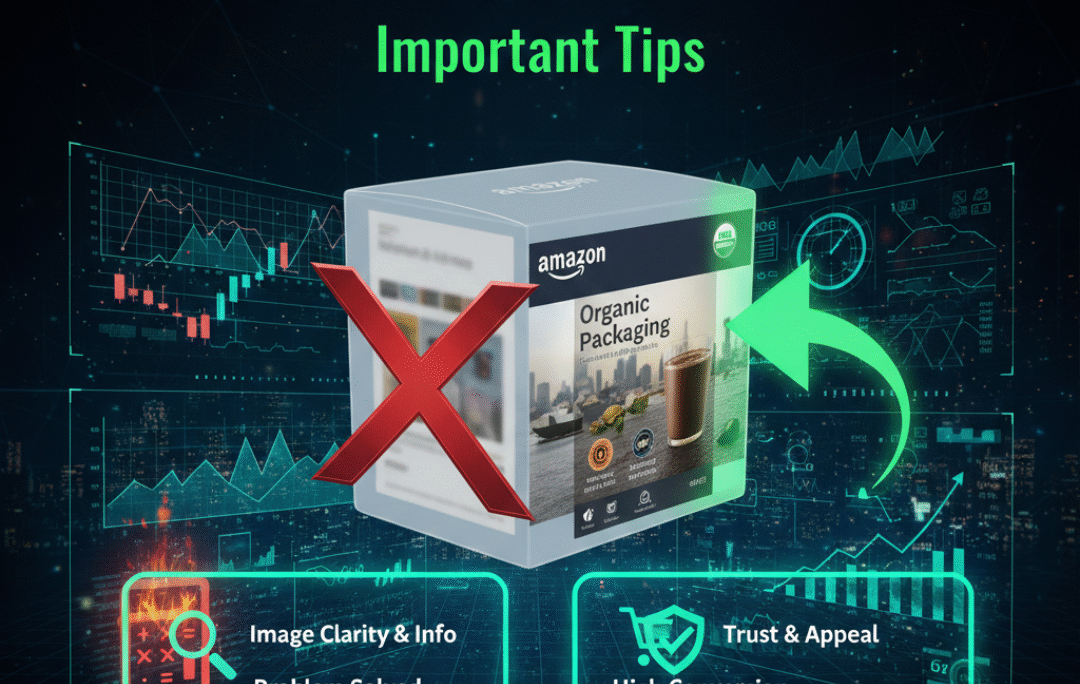
Alright, let’s talk about the most underestimated silent salesperson on Amazon Private Label: packaging.
Not ads. Not keywords. Not even reviews.
Relevant Packaging.
Most sellers treat it like a box you check off at the end. Pick a color, slap a logo on it, ship it to FBA, done. And then they wonder why their listing gets traffic but not sales.
This blog is about why packaging directly affects Amazon conversion rates, how it works psychologically, and why brands that win on Amazon almost never look “generic.”
No fluff. No robot SEO filler. Just the real mechanics.
First: What “Amazon Conversion Rates” Really Means
On Amazon, conversion rate is brutally simple:
How many people who see your listing actually buy.
Amazon tracks this obsessively. If your product converts better than competitors, Amazon shows it more. If it converts poorly, you slowly fade into the void—no matter how good your keywords are.
Here’s the part most people miss:
Amazon conversion doesn’t start when the product arrives. It starts visually.
And packaging is a huge part of that visual judgment.
Packaging Is Part of the Product (Amazon Knows This)
Amazon doesn’t see your product as:
- The item inside the box
Customers don’t either.
They see:
- Main image
- Secondary images
- Lifestyle shots
- Unboxing expectations
- Brand signals
Your packaging appears in:
- Your hero image
- Your infographics
- Your A+ content
- Customer review photos
- Customer unboxing videos
In other words: packaging is permanently attached to your listing, whether you planned for it or not.
If your box looks cheap, rushed, or generic, customers subconsciously assume the product inside is the same.
The 3-Second Judgment Rule
When a customer lands on your listing, you get about three seconds before they decide one of three things:
- “This looks legit”
- “This looks risky”
- “This looks cheap”
Packaging heavily influences which bucket you land in.
Humans are pattern-recognition machines. We’ve been trained by years of shopping that:
- Clean, intentional packaging = real brand
- Messy or generic packaging = random seller
Even if your product is excellent, bad packaging creates doubt. And doubt kills conversions.
Amazon Is a Trust-Deficient Environment
On your own website, customers may trust you because:
- You control the brand
- The site feels cohesive
- There’s no direct competitor next to you
Amazon is the opposite.
You’re surrounded by:
- Near-identical products
- Similar prices
- Similar claims
- Sellers with questionable English
- Sellers with zero brand presence
So customers ask one core question:
“Which of these feels safest?”
Packaging is one of the fastest trust shortcuts available.
Generic Packaging Screams “Private Label… in the Bad Way”
Let’s be honest for a second.
Customers don’t hate private label products. They hate low-effort private label products.
You can spot them instantly:
- Plain white box
- Overcrowded text
- Random icons
- Cheap fonts
- Clipart graphics
- Buzzwords stacked like a pyramid scheme
That kind of packaging says:
“This was made to sell, not to last.”
And customers respond by:
- Not buying
- Buying but not trusting the brand
- Leaving harsher reviews
- Never repurchasing
How Packaging Influences Conversion (Directly)
Let’s break this down into real mechanics, not vibes.
1. Visual Differentiation in Search Results
When someone searches on Amazon, they see:
- A grid of thumbnails
- Mostly white backgrounds
- Similar product shapes
What stands out?
- Color contrast
- Clean branding
- Professional packaging presence
If your packaging:
- Frames the product cleanly
- Adds perceived value
- Looks intentional
You get more clicks. More clicks + decent conversion = Amazon favors you.
2. Perceived Value vs Actual Price
Here’s a psychological cheat code:
People use packaging to guess quality when they can’t touch the product.
If your product costs $29.99 but looks like it came in a $2 box, the price feels wrong.
Good packaging:
- Makes higher prices feel justified
- Reduces price sensitivity
- Increases “this is worth it” reactions
This is why premium brands can charge more for similar functionality.
3. Reduced Buyer Anxiety
Every Amazon buyer is quietly asking:
- Will this arrive broken?
- Will it feel cheap?
- Will it look like the photos?
- Will I regret this?
Strong packaging reduces all of that.
It signals:
- Care
- Quality control
- Professionalism
- Accountability
Which increases conversions before the product even ships.
Packaging and Reviews: The Feedback Loop
Here’s where things get really interesting.
Packaging doesn’t just affect conversion. It affects reviews, which then affect conversion even more.
Well-designed packaging leads to:
- Better unboxing experiences
- More positive emotional reactions
- Customers feeling they got “more than expected”
And customers mention this in reviews:
- “Packaging was great”
- “Felt premium”
- “Perfect for gifting”
- “Arrived well-protected”
Those reviews then influence future buyers.
Bad packaging does the opposite:
- “Box was damaged”
- “Looked cheap”
- “Didn’t feel worth the price”
Even if the product works.
Unboxing Is Marketing You Don’t Control (Unless You Do)
Customers post:
- Photos
- Videos
- TikToks
- Shorts
- Instagram stories
Amazon even features customer images prominently.
If your packaging looks bad, it becomes user-generated anti-marketing.
If it looks good, customers do your marketing for free.
This is especially important in niches like:
- Beauty
- Fitness
- Home goods
- Gifts
- Personal care
- Electronics accessories
Minimal vs Loud Packaging: What Actually Works on Amazon
This is where many sellers get confused.
More design does not mean better design.
On Amazon, packaging that converts tends to be:
- Clean
- Focused
- Easy to understand
- Brand-forward, not text-heavy
Effective packaging usually:
- Shows the product clearly
- Uses 1–2 core colors
- Has strong hierarchy (logo → product → benefit)
- Avoids clutter
Overdesigned packaging looks suspicious. Underdesigned packaging looks cheap.
The sweet spot is confident simplicity.
Packaging Must Match Your Listing Story
One silent conversion killer is mismatch.
If your listing:
- Looks premium
- Uses clean lifestyle images
- Has polished A+ content
But your packaging:
- Looks generic
- Uses different fonts/colors
- Feels rushed
Customers feel cognitive dissonance.
They may not articulate it, but something feels “off.”
That hesitation lowers conversion.
Your packaging, listing images, A+ content, and brand identity should feel like they came from the same brain.
Amazon FBA: Protection Is Part of Conversion
Here’s a boring but critical truth:
Damaged products kill conversion indirectly.
If your packaging:
- Doesn’t protect well
- Gets crushed
- Looks bad on arrival
You get:
- Returns
- Negative reviews
- Lower listing health
- Reduced Buy Box confidence
Smart packaging balances:
- Visual appeal
- Structural integrity
- Shipping efficiency
Pretty boxes that arrive broken are worse than ugly boxes that survive. The best brands do both.
Packaging as a Long-Term Brand Asset
Short-term sellers think:
“How cheap can I make this?”
Long-term brands think:
“How recognizable can I make this?”
Strong packaging builds:
- Brand recall
- Repeat purchases
- Cross-product recognition
When customers recognize your packaging in:
- Their house
- A friend’s place
- A review photo
You stop being “another Amazon seller” and start being a brand.
That increases lifetime value, not just one sale.
Why Amazon Rewards Good Packaging (Quietly)
Amazon never says:
“Nice box, here’s more traffic.”
But Amazon rewards:
- Higher conversion rates
- Lower return rates
- Better reviews
- Higher customer satisfaction
Good packaging improves all four.
Which means:
- Better organic ranking
- More stable sales
- Less reliance on ads
Packaging is not cosmetic. It’s algorithmic leverage.
The Big Mistake: Treating Packaging as an Afterthought
Most sellers:
- Finalize the product
- Finalize the listing
- Then ask for a box design
That’s backwards.
Packaging should be designed with the listing in mind, not after it.
It should:
- Photograph well
- Support your main image
- Reinforce your value proposition
- Match your brand tone
When packaging is intentional, conversion follows naturally.
Final Thought: Packaging Is a Sales Page in Cardboard Form
On Amazon, you don’t get salespeople.
You don’t get demos.
You don’t get personal explanations.
You get visuals and trust signals.
Packaging is one of the strongest ones you control.
If your conversion rate is struggling, don’t just tweak keywords and ads. Look at your packaging and ask honestly:
“If I didn’t know this brand… would I trust it?”
Brands that answer that question well tend to win.
Not overnight.
But consistently.
And on Amazon, consistency beats hype every time.
If your Amazon listing is getting traffic but not converting the way it should, packaging is often the missing piece. A strong product alone isn’t enough anymore—how it’s presented, protected, and perceived matters just as much. Our team helps brands design packaging that doesn’t just look good, but actually sells, aligning visuals, branding, and marketplace strategy into one cohesive system. If you’re serious about building a real Amazon brand instead of just another listing, you can explore our Amazon Private Label services here and see how we turn products into scalable businesses.