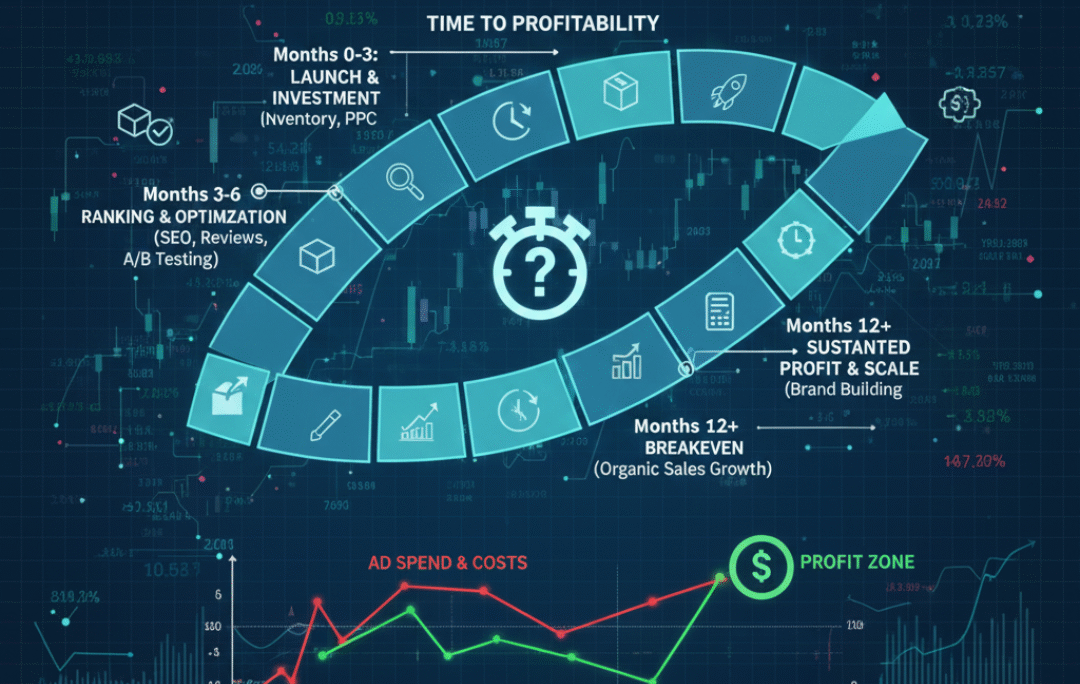
Quick Answer: For a properly executed Amazon Private Label launch, most sellers break even between months 4 and 6, reach consistent profit between months 6 and 9, and hit stable, strong profitability by month 12. According to 2026 seller data, 58% of Amazon sellers become profitable within their first year. The sellers who fail almost always do so because they ran out of capital, had unrealistic expectations, or quit during the launch phase before the numbers had a chance to stabilise.
Why This Private label Question Matters More Than Most People Realise
The Amazon Private Label timeline question is one of the most searched topics in the seller community — and also one of the most dishonestly answered. YouTube thumbnails promise profit in 30 days. Courses sell the dream of passive income within weeks. The reality, for the vast majority of sellers, is considerably less glamorous and considerably more interesting.
The gap between what people expect and what actually happens in the first year is the single biggest reason sellers quit. Not because the business model doesn’t work — it does, for people who give it the time and capital it needs — but because their expectations were built on someone else’s highlight reel rather than an honest account of the process.
It’s also worth noting the scale of the model’s adoption. In 2026, approximately 65% of Amazon third-party sellers operate some form of private label business — some surveys put that figure as high as 73%. That’s not a niche strategy. It’s the dominant approach on the platform. Which means the competition is real, the learning curve is real, and the idea that you can shortcut the timeline everyone else goes through is, with rare exceptions, a fantasy worth discarding early.
This article is the honest account. It walks through the real timeline, month by month, including the phases where nothing feels like it’s working — because those phases are as much a part of the process as the ones where the numbers finally move in the right direction.
What “Profit” Actually Means — And Why Most Sellers Get It Wrong
Before anything else, it’s worth defining what profit actually means in the context of Amazon Private Label, because this is where a lot of the confusion begins.
When a seller says they’re profitable, they usually mean one of three things: their product is selling, Amazon deposited money into their account, or their revenue exceeds what they paid for inventory. None of those things are profit.
Real profit means you have recovered every pound or dollar spent — manufacturing, inbound shipping, Amazon referral fees, FBA fulfilment fees, PPC advertising, return and refund costs, software subscriptions, sample costs, branding and design, and the time cost of setup — and still have money left that you could withdraw from the business without damaging its ability to operate.
That’s a much harder bar to clear than “Amazon paid me this month.” And it’s the bar that matters, because everything else is just cash flowing through the business rather than accumulating in it.
The 2026 fee environment makes this definition even more important to get right upfront. Amazon increased FBA fees by an average of $0.08 per unit from January 2026, and in April 2026 introduced a 3.5% fuel and logistics surcharge averaging around $0.17 per unit on top of standard fulfilment fees. On a $34.99 product, FBA fees alone can absorb 35% of revenue before advertising is even counted. Add PPC spend — which typically consumes another 15–20% during the launch phase — and the margin for error is genuinely slim. Sellers who don’t model these costs accurately before launch routinely believe they’re profitable when they aren’t.
Most sellers who claim early profitability are measuring revenue against product cost alone. They’re not accounting for the full cost stack, and they’re often not accounting for the capital that went into the business before the first sale. When those numbers are included honestly, the timeline shifts — usually to somewhere between six and twelve months for a properly executed launch. Industry data in 2026 shows that most Amazon sellers net between $200 and $5,000 per month in actual profit after all costs, on monthly revenues of $1,000 to $25,000. Those are real numbers, not the highlight-reel figures that circulate in seller communities.
One number worth keeping in mind from the research stage: experienced Amazon analysts consistently recommend a hard minimum net margin threshold of 20% before committing to a product. If the numbers don’t clear that bar under conservative assumptions — with 2026 fee levels, realistic PPC costs, and a return rate allowance — the product isn’t ready to launch.
The Real Timeline, Month by Month
Months 0–1: Research, Setup, and Spending Without Results
The first month of an Amazon Private Label business is entirely an expense. There is no revenue here, and there shouldn’t be — you’re not ready to sell yet.
This phase involves product research across tools like Helium 10, Jungle Scout, and Keepa; competitor analysis; supplier outreach and negotiation; branding and packaging decisions; sample ordering; and Seller Central setup. Every one of those activities costs either money or time, and none of them generate revenue in the short term.
This is the phase where impatient people begin to doubt the decision. The work feels abstract because there’s nothing to show for it yet. But this is also the most important phase in the entire timeline — because the decisions made here, on product selection, margin structure, supplier reliability, and brand positioning, determine whether months 7 to 12 look like profit or like a hard lesson.
One structural change worth knowing for 2026: Amazon ended its FBA prep and labeling services in the United States, meaning sellers are now responsible for all labeling, poly bagging, bundling, and prep work before inventory reaches Amazon’s fulfilment centres. This adds both cost and complexity to the pre-launch phase that wasn’t a factor for sellers who launched even a year ago. Budget for it and build it into your timeline.
Rushing this phase is one of the most expensive things a new private label seller can do.
Months 2–3: Manufacturing, Shipping, and Learning to Wait
By month two, the product decision has been made, the supplier has been chosen, and real money has moved. Manufacturing begins. The waiting starts.
This phase introduces sellers to the emotional reality of a capital-intensive business. You’ve committed. You’ve sent a significant amount of money to a factory, often overseas. You’re checking shipping updates more often than is useful. Supply chain delays — which remain a consistent feature of global trade in 2026, not an exception — introduce stress that no guide fully prepares you for.
There is still no revenue. There are still ongoing expenses — software tools, Seller Central subscription, branding finalisation. The business is consuming capital and returning nothing yet.
This is also the phase where one of the most overlooked cost variables appears: logistics timing. Air freight remains significantly more expensive than sea freight, and the difference during peak shipping windows — particularly approaching Q4 — can be enough to erase the margin on an otherwise sound product. Building realistic shipping timelines into your launch plan, with contingency for delays, is not optional. It’s the kind of planning that separates the sellers who hit their launch window from those who miss it and pay twice — once in shipping costs and once in delayed revenue.
This is not failure. This is exactly what the early phase of any inventory-based business looks like. The sellers who understand this going in treat it as a known cost of building something real. The sellers who didn’t expect it start looking for shortcuts.
Month 4: Launch Month — Sales Begin, but Profit Doesn’t
Inventory arrives at Amazon’s fulfilment centres. The listing goes live. PPC campaigns switch on. The first sales come in.
This moment feels like a breakthrough — and emotionally, it is. But financially, month four is almost universally unprofitable or barely break-even. Advertising costs during launch are at their highest because the campaigns haven’t been optimised yet and the account has no performance history for Amazon to use in determining ad relevance. Reviews are minimal, which suppresses conversion rate. Organic rank is low, which means almost all traffic comes through paid ads.
In 2026, the advertising cost pressure at launch is more pronounced than it has been in previous years. With the fuel surcharge layered on top of existing FBA fee increases, the effective cost-per-unit-sold is higher from day one. Established sellers on competitive keywords are bidding at levels that reflect mature, optimised campaigns — a new entrant competing on the same terms is paying the same cost-per-click without the conversion rate that makes those clicks profitable. This is precisely why launch-phase budgets need to be treated as a research and data investment rather than a profit mechanism.
The instinct at this stage is to interpret early sales as validation and scale spend accordingly. The smarter approach is to treat launch month as a data collection exercise. Every sale, every keyword impression, every click that doesn’t convert is giving you information that the following months will need.
Months 5–6: The Break-Even Zone
This is where the business either begins to show real promise or reveals fundamental problems with the original product decision.
By this point, you have enough data to make informed decisions. You know which keywords are converting and which are consuming budget without producing sales. You have early reviews that tell you whether customers are responding to the product as expected. Your conversion rate is starting to stabilise, and you can compare it meaningfully against category benchmarks.
Smart sellers in this phase are making targeted improvements: refining PPC structure by harvesting converting search terms and cutting wasteful spend, updating listing copy based on what customer language reveals about how they think about the product, fixing images if early data suggests the main image isn’t generating sufficient click-through rate, and adjusting pricing if conversion analysis suggests resistance.
It’s also worth noting a positive development in 2026 for sellers at this stage: Amazon’s New Selection Program, launching July 30, 2026, offers fee credits for newly launched FBA products — reducing effective referral fees to 10% for the first 100 units and 5% for the next 100 units. For sellers in months five and six who are launching additional variations or expanding their product line, this programme can meaningfully improve the margin picture during a period when every percentage point counts.
By the end of month six, many well-executed launches have reached break-even or are showing their first small profit margins. This is also the phase where it becomes clear whether the product fundamentals are sound. High ACoS that won’t come down despite optimisation, conversion rates that remain weak despite listing improvements, or review sentiment that reveals a product quality issue — these are signals that need honest evaluation rather than more ad spend.
Months 7–9: Where Real Profit Begins
For a properly executed private label business with sound product fundamentals, months seven through nine are when the economics start making sense.
Organic rank has built enough to reduce dependence on paid traffic. Reviews have accumulated to a volume that provides meaningful social proof. PPC campaigns have been refined through months of live data and are running more efficiently. The listing has been iterated based on real customer behaviour rather than pre-launch assumptions.
The result is that each unit sold now generates a margin that the launch phase couldn’t produce — lower ad cost per sale, higher conversion rate, and a product that’s established enough in its category to hold rank without constant budget support. A useful benchmark for where you want to be by month seven or eight: a ROAS (Return on Ad Spend) of 2.8:1 to 3.5:1, which is the level established sellers in 2026 typically require to cover COGS, FBA fees, and referral commissions at the same time as running profitable ads. If your ROAS is consistently below that range, the margin improvement you need is more likely to come from listing and product work than from bid adjustments.
This is also the phase where operational discipline starts to matter as much as marketing. Reorders need to be timed correctly — running out of stock at this stage resets organic rank and wastes the momentum built over the previous months. Cash flow management becomes a skill in itself, because reinvesting in inventory while also funding ongoing ads and covering operational costs requires planning rather than intuition.
Managing how long your current stock will last is something that’s easy to get wrong when you’re focused on the sales and marketing side. The Days of Stock Tracker at ecommate.co.uk/tool-box/days-of-stock-tracker calculates exactly how long your inventory will last based on your actual sales rate — so reorder decisions are based on data rather than guesswork, and you don’t lose rank at the moment it matters most.
The broader data supports this timeline. Jungle Scout’s annual Amazon seller survey consistently shows that the majority of private label sellers who stick with the model through the first year reach profitability — but the key phrase is ‘stick with it.’ The sellers who don’t make it typically exit during months two through five, before the economics have had time to work. That 22% of Amazon sellers who never become profitable are almost always concentrated in that early exit window — they leave before the compounding effect of rank, reviews, and optimised ads has had time to change the economics.
Months 10–12: Stability or an Honest Reckoning
By month twelve, the picture is clear. Either the business has a stable, profitable product generating repeatable margin — or the fundamental issues that showed up in months five and six have compounded into something that can’t be optimised away.
Successful sellers at this stage are focused on efficiency: tightening supply chains, reducing ad dependency by pushing more volume through organic rank, improving margins through better supplier terms on reorders, and beginning to think about product line expansion. The business has stopped being a launch and started being an operation. The 2026 data point that rewards this long-view approach: 47% of FBA sellers who have stayed in the game long enough have crossed $100,000 in lifetime profits. That figure doesn’t come from sellers who lasted four months — it comes from the ones who treated month seven or eight as a beginning rather than a finish line.
Sellers who aren’t successful by month twelve usually fall into identifiable patterns: they chose a product with insufficient differentiation and ended up in a race-to-the-bottom price war, they undercapitalised the launch and had to make compromises on ad spend or inventory depth at critical moments, or they had a product quality issue that reviews exposed and they couldn’t fix quickly enough.
Amazon’s marketplace doesn’t reward effort or intention. It rewards systems, consistency, and products that customers genuinely prefer over the alternatives.
Why So Many Sellers Think It Takes Even Longer
The sellers who don’t hit profitability within twelve months often share common patterns.
Underestimating capital requirements is the most consistent one. Private label is capital-intensive throughout the first year — manufacturing, shipping, advertising, and reorders all pull on cash simultaneously. Sellers who launch with tight budgets are forced into compromises that slow every part of the process. Ads get underfunded at the moment they’re generating the most useful data. Reorders get delayed because cash is tied up in other costs. The timeline stretches not because the model doesn’t work but because there wasn’t enough fuel to run it properly. The 2026 fee environment — with FBA increases, the new fuel surcharge, and the removal of Amazon’s prep services — has raised the effective capital floor for a viable launch compared to even two years ago. Sellers who are working from older cost models are systematically under-budgeting.
Generic branding is the second most common factor. A product that looks like a dozen others in its category competes on price by default. Lower price means lower margin. Lower margin means less room to fund ads. Less ad funding means slower rank growth. The vicious cycle runs until either the seller improves the brand positioning or exits the market. Strong, clear, differentiated branding improves click-through rate, improves conversion, reduces cost per acquisition, and builds the kind of customer trust that generates repeat purchases — all of which compress the timeline to profitability.
Treating the business like a passive income project from day one is the third. Amazon Private Label becomes relatively passive after systems are built and products are established. Before that point, it requires active management, data analysis, supplier communication, and regular decision-making. Sellers who approach the early months expecting it to run itself consistently underperform against those who treat it like the real business it is.
Before committing to an inventory order, running your numbers through Amazon’s FBA Revenue Calculator is a non-negotiable step. It gives you the exact fee breakdown for your specific product dimensions and category — including the 2026 fee changes — which is the only way to build a margin model that reflects reality rather than optimistic assumptions. Sellers who calculate fees from memory or from guides written before January 2026 are working with numbers that are no longer accurate.
Can the Timeline Be Shorter?
For some sellers, yes. Experienced operators who bring prior supplier relationships, an existing audience, strong capital reserves, and category-specific knowledge to a launch can sometimes hit profitability in three to four months. They’ve compressed the learning curve because they’ve already been through it.
For a first-time private label seller, chasing that timeline is usually counterproductive. The decisions that produce fast profitability in the hands of an experienced operator — aggressive ad spend, tight inventory positioning, fast product iteration — produce fast losses in the hands of someone who hasn’t yet built the judgement to execute them correctly.
Speed in this business is earned rather than assumed. It comes from accumulated data, refined processes, and a clear understanding of what the numbers are actually telling you. Beginners who try to move at expert speed before building that foundation typically burn capital and lose months they could have spent building properly.
The Mindset That Actually Produces Results
The sellers who build successful Amazon Private Label businesses almost universally share a particular way of thinking about what they’re doing. They’re not trying to extract money from Amazon quickly. They’re building an asset — a brand, a set of customer relationships, a product with genuine market position — and they understand that asset takes time to build properly.
That framing matters because it changes how setbacks get interpreted. A month of break-even trading isn’t failure — it’s a data point that tells you something specific about what needs to change. A slow launch isn’t evidence that the product was a mistake — it’s a signal to look at conversion, at images, at pricing, at competitive positioning, and figure out where the gap is.
The competitive environment in 2026 has made this mindset more necessary than ever. More sellers are competing in more categories, overseas manufacturers are listing directly on Amazon at prices that are difficult to undercut without brand equity to justify a premium, and Amazon’s own fee increases mean that thin-margin products that might have worked in 2022 or 2023 simply don’t have the margin structure to survive a full launch cycle in 2026. The sellers who are winning are the ones who went into the market with differentiated products, adequate capital, and the patience to let the process work — not the ones who moved fastest.
The sellers who treat every difficult month as information to act on rather than evidence to give up almost always outperform those who interpret difficulty as a verdict.
The Honest Summary
For a properly capitalised, well-researched Amazon Private Label launch in 2026, executed with sound product fundamentals and consistent management:
Break-even comes at months 4 to 6. Consistent, repeatable profit shows up at months 6 to 9. Strong, stable profitability — the kind that supports reinvestment and expansion — is a months 9 to 12 reality for most serious operators. The broader data from 2026 seller surveys shows that 58% of Amazon sellers achieve profitability within their first year, with profit margins settling between 10% and 25% depending on category and cost structure. 47% of sellers who stick with the model long enough clear $100,000 in lifetime profits. These are achievable numbers — but they come from sellers who understood the timeline going in and didn’t quit when month three looked like nothing was working.
Anyone promising meaningfully faster results without a specific, credible explanation of how they’re compressing the timeline is telling you what you want to hear rather than what you need to know.
Done right, Amazon Private Label works. The product builds organic rank, ad costs come down, margins improve, and the business starts to compound in a way that very few online business models can match at scale. But it works on its own timeline — not on anyone’s launch day ambitions — and in 2026, with higher fees, more competition, and tighter margins than previous years, respecting that timeline isn’t optional. It’s the prerequisite for everything else.
If you want to build an Amazon Private Label brand with the research, systems, and execution that compress the learning curve without skipping the fundamentals, explore how Ecom Mate approaches it here: ecommate.co.uk