Quick Answer: Which one should you start with? The right private label platform depends on your budget and risk tolerance, not the hype. Low budget with limited capital — start on eBay. Creative, brand-driven, niche-focused — Etsy is your market. Scaling ambitions with real capital and patience — Amazon. The biggest mistake beginners make is choosing based on potential upside rather than what they can actually sustain through the first six to twelve months.
The Question Nobody Answers Honestly
Private label sounds clean in theory. Source a product, put your brand on it, list it online, collect the margin. The formula gets repeated so often it starts to feel like a procedure rather than a business decision.
The reality is more nuanced. Each marketplace has its own algorithm, its own buyer psychology, its own fee structure, its own failure modes, and its own definition of what “private label” even means. Choosing the wrong one for your situation doesn’t just cost money — it costs months of momentum, a garage of inventory you didn’t need to order yet, and the specific kind of burnout that comes from working hard on something that was structurally set up to struggle from day one.
This guide doesn’t tell you which platform is best in the abstract. It tells you which one is best for where you are right now — your capital, your skills, your patience for complexity, and your willingness to play a longer or shorter game.
What “Private Label” Actually Means on Each Platform
The term private label technically means the same thing everywhere: you’re selling a product under your own brand rather than reselling an existing manufacturer’s branded goods. But the way that plays out in practice differs so significantly across Amazon, eBay, and Etsy that you’re essentially looking at three distinct business models wearing the same label.
On Amazon, private label is a data-driven, capital-intensive, algorithm-governed game. Success is built on keyword ranking, conversion rate optimisation, review accumulation, and PPC management. The platform rewards consistency, scale, and systems thinking. It punishes hesitation, thin margins, and anything that looks like corner-cutting.
On eBay, private label is quieter and more flexible. There’s no dominant algorithm forcing you into a narrow lane, and the platform’s tolerance for smaller inventory batches and iterative testing makes it genuinely accessible to sellers who are still figuring out what works. It’s not as glamorous as Amazon, but that’s partly why the opportunity is still there.
On Etsy, private label occupies an entirely different creative and commercial space. Etsy’s buyers come looking for things that feel personal, handmade, or uniquely designed — and the platform’s algorithm and policies reflect that. What works on Amazon (a well-photographed generic product with a brand label) actively gets penalised on Etsy. The sellers who win here are the ones who understand that Etsy is a brand-building environment first and a sales channel second.
Same term. Three completely different games with three completely different rulebooks.
Amazon Private Label: High Capital, High Competition, High Ceiling
Amazon is where the biggest private label businesses are built — and where the most beginners burn out. Understanding which of those outcomes applies to you comes down to honest self-assessment before you commit.
The real budget. Amazon private label is no longer a low-cost entry point. A realistic first launch in 2026 requires manufacturing costs based on your supplier’s minimum order quantity, inbound freight and customs duties, FBA fulfilment fees, referral fees, PPC advertising budget for the launch phase, professional photography and listing optimisation, and a meaningful cash buffer for the inevitable unexpected costs. Pulling all of that together, most serious launches fall between £2,500 and £7,000 before the first sale. Sellers who try to launch on significantly less typically find that the compromises they make on branding, ad spend, or inventory depth undermine the launch before it has a chance to work.
The risk profile. Amazon’s risks are structural and often sudden. Account suspensions can happen quickly and for reasons that aren’t always transparent. Listing hijackers — sellers who attach their inferior products to your listing — are a consistent problem in competitive categories. Review accumulation, which is critical to conversion rate, takes time and cannot be accelerated through legitimate means. PPC costs during the launch phase can drain cash faster than first-time sellers expect, particularly in competitive categories where established sellers are bidding aggressively. And inventory decisions on Amazon lock you in — you’re committing to a specific quantity weeks or months before you have real conversion data to justify it.
The upside, when the fundamentals are right, is genuine scale. Products that hit on Amazon can reach six figures within a year. Seven-figure private label brands built on Amazon are common enough to be a realistic target for sellers who execute well and stay in the game. But that ceiling is earned through tight operational discipline, not reached by accident.
Who Amazon actually suits. Amazon works for sellers who can invest upfront without the financial pressure forcing bad decisions, who think analytically rather than intuitively, who are genuinely interested in data and optimisation rather than tolerating it as a necessary evil, and who are building for the long term rather than expecting a fast return. If you hate working inside rigid systems, find algorithm dependency stressful, or don’t have the capital to absorb a six-month investment period before consistent profit, Amazon will be a painful experience regardless of how good your product is.
eBay Private Label: Underestimated, Flexible, Quietly Profitable
eBay gets dismissed by sellers who are chasing the largest possible upside, and that dismissal is one of the reasons the opportunity on eBay remains consistently accessible. The platform has less competition from sophisticated private label operators than Amazon, lower entry barriers, and a fee structure that allows testing and iteration without the capital commitment that Amazon demands.
The real budget. eBay private label can begin at a scale that Amazon can’t match. Smaller minimum order quantities are viable because the platform doesn’t require FBA-style bulk inventory. Advertising dependency is lower, particularly in the early stages, because eBay’s search algorithm is less pay-to-play than Amazon’s. Many sellers build their initial eBay private label presence for £500 to £2,000 — a fraction of what a comparable Amazon launch would cost — while still achieving healthy margins.
The risk profile. eBay’s risk environment is considerably calmer than Amazon’s. There’s no equivalent to Amazon’s account suspension culture. PPC competition, while present, isn’t the all-consuming tactical challenge it is on Amazon. Listing management is more straightforward. The ability to test products at small scale before committing to larger inventory orders means that mistakes are caught earlier and at lower cost.
The limitation is equally structural: eBay rarely produces explosive growth. Scaling on eBay is slower and more methodical than on Amazon, and the ceiling for a single private label product is generally lower. Sellers who achieve strong results on eBay often describe it as steady rather than dramatic — consistent cash flow, manageable complexity, and a platform that rewards patience rather than aggression.
Who eBay actually suits. eBay is the right starting point for sellers who want to understand private label economics without betting heavily on a single product decision, who prefer controlled cash flow over high-variance outcomes, who value the ability to test and adjust before scaling, and who don’t want their business dependent on advertising spend from month one. It’s also a strong diversification play for sellers who’ve already built on Amazon and want a lower-risk revenue stream alongside it.
Etsy Private Label: Brand-Driven, Creative, Compliance-Sensitive
Etsy is not a gentler version of Amazon. Sellers who approach it with that expectation consistently underperform — because the platform’s algorithm, its buyer base, and its policies are all built around a fundamentally different set of values than any other major marketplace.
Etsy’s buyers are actively seeking products that feel personal, crafted, or uniquely designed. They’re paying a premium, often willingly, for the story behind the product as much as the product itself. This creates genuine opportunity for sellers who understand brand-building — and genuine failure for sellers who treat Etsy as a listing-and-ranking exercise.
The real budget. Etsy’s entry cost is the lowest of the three platforms. Small-batch production, print-on-demand integration, minimal advertising requirements in the early stages, and relatively simple branding needs mean that a first Etsy private label store can be launched for £300 to £1,500. The time investment is higher than the financial investment — great photography, thoughtful shop copy, and consistent branding all take effort rather than budget — but the capital risk is genuinely low.
The risk profile. Etsy’s primary risk isn’t competition in the traditional sense. It’s compliance. Etsy’s 2026 policy overhaul, under new CEO Kruti Patel Goyal, has tightened the rules around what qualifies as handmade significantly. From August 2026, products made with computerised tools must feature the seller’s own original design — templates, commercial licence SVGs, and digitised embroidery files no longer qualify. Shops that don’t adapt face reduced visibility or suspension. The platform also penalises listings that feel mass-produced through its search algorithm, meaning generic private label products that would perform acceptably on Amazon actively underperform on Etsy.
The upside for sellers who operate within Etsy’s model correctly is loyal customers who buy repeatedly, premium pricing that reflects perceived uniqueness, and a brand equity that the platform’s community structure actively amplifies.
Who Etsy actually suits. Etsy works for sellers who genuinely care about design and brand identity, who enjoy the storytelling aspect of positioning a product for a specific niche audience, who are willing to follow platform rules carefully and stay current with policy changes, and who are building for loyal repeat customers rather than high-volume transactional sales. Sellers who treat Etsy like a brand — rather than a product catalogue — consistently outperform those who don’t.
For sellers who want to understand how buyer behaviour and demographics differ across these platforms before committing to one, eBay’s own seller insights and Etsy’s Seller Handbook both publish data on their buyer bases that’s worth reading before you decide. The differences in who’s buying, why they’re buying, and what they’re willing to pay are more significant than most comparison guides acknowledge.
Budget vs Risk: The Honest Side-by-Side
Rather than a table of optimistic projections, here’s what the comparison actually looks like when you factor in realistic costs, typical failure modes, and the type of seller each platform actually rewards.
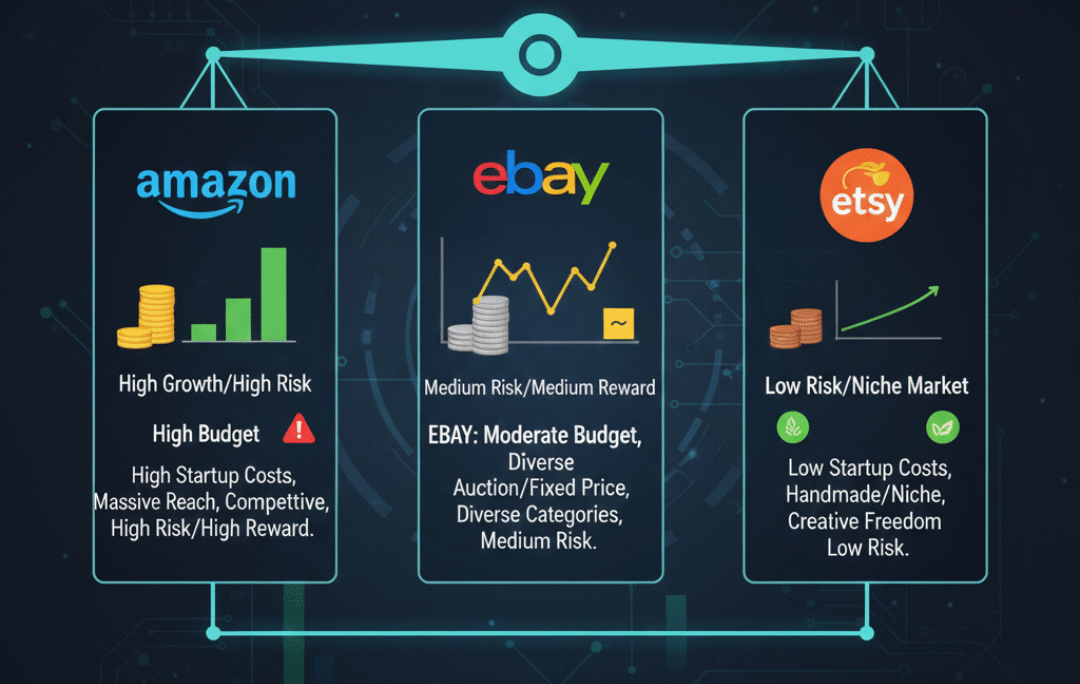
Amazon demands the most upfront — in capital, in time spent learning the system, and in tolerance for a launch phase that is almost universally unprofitable. The reward for that investment, when execution is right, is the highest ceiling of the three platforms and a business that can scale in ways eBay and Etsy cannot match. But the downside is equally proportionate: a poorly researched product, an underfunded launch, or a compliance issue at the wrong moment can produce significant losses in a short time.
eBay demands the least upfront and returns the most predictable outcomes. The growth is slower and the ceiling is lower, but the floor is also higher — the failure modes are gentler and more recoverable. For sellers who are still developing their product research instincts and supplier relationships, eBay is the platform where expensive mistakes are least likely to be catastrophic.
Etsy sits between the two on capital requirements but introduces a different kind of risk: compliance and authenticity risk rather than financial risk. The sellers who struggle on Etsy typically aren’t struggling because the market isn’t there — it’s because their product or their positioning doesn’t fit the platform’s model. Getting that fit right takes genuine creative investment, but the sellers who do it build something on Etsy that neither Amazon nor eBay can replicate: a brand with real emotional resonance among its customers.
The Inventory Problem That Applies to All Three
Regardless of which platform you choose, one of the most consistent ways sellers damage their early momentum is by mismanaging inventory. Ordering too much before you have real conversion data ties up capital that the business needs for advertising, reorders, and operational costs. Running out of stock at the moment you’ve built rank or visibility resets everything you worked to establish.
Managing how long your current stock will last based on your actual sales rate — rather than optimistic forecasts — is a practical skill that separates sellers who scale smoothly from those who constantly feel like they’re behind. The Days of Stock Tracker at ecommate.co.uk/tool-box/days-of-stock-tracker calculates this directly from your real sales data, so reorder decisions are grounded in evidence rather than intuition.
The Biggest Mistake: Choosing Based on Hype
This is the pattern that produces the most avoidable failure in private label: a seller with £800 in available capital reads about a seven-figure Amazon seller and decides to build the same business at a tenth of the budget. Or a seller with no design sensibility chooses Etsy because the entry cost is low, and discovers that the platform’s model requires creative investment they’re not positioned to make. Or a seller who genuinely wants scale chooses eBay and feels frustrated by the ceiling six months in.
Platform choice is psychological as much as financial. The numbers matter, but so does honest self-assessment about what kind of business you’re capable of building right now — not eventually, not after you’ve learned everything, but with the skills, capital, and bandwidth you have at the point of starting.
A seller who chooses eBay because it fits their actual situation and builds a profitable, stable business in twelve months has done something more valuable than a seller who chose Amazon, burned through their capital in four months, and is now rebuilding from scratch. The hype-driven choice feels like ambition. The honest choice feels boring. The honest choice usually wins.
Selling on Multiple Platforms — When and How
The multi-platform question comes up quickly for sellers who start seeing success on their first channel. The short answer is: not yet.
The sellers who try to manage Amazon, eBay, and Etsy simultaneously before they’ve built strong systems on any single platform consistently do all three badly. The operational overhead, the different policies, the different customer service expectations, and the different optimisation requirements compound in ways that overwhelm sellers who are still learning the fundamentals.
The intelligent sequencing is to master one platform before expanding to a second. Amazon sellers who’ve built profitable products often add Etsy to develop brand equity and access customers who wouldn’t find them on Amazon. Etsy sellers who’ve validated a product concept and built a brand identity move to Amazon to access scale. eBay sellers add Amazon or Etsy to diversify their revenue base once their eBay operations are running smoothly.
Each expansion builds on what the previous platform taught rather than diluting it.
If you’re weighing the fee structures across platforms as part of your margin calculations, eBay’s fee calculator is one of the more transparent tools available for understanding what a sale actually costs you before you commit to pricing. Running the numbers on your target selling price before you finalise your supplier costs is a basic step that surprisingly few beginners take.
Which One Should You Start With — The Actual Answer
If you have substantial capital, think analytically, and are building for scale over a multi-year horizon: Amazon. Accept the learning curve, budget for it honestly, and invest in execution rather than shortcuts.
If you have limited capital, want to understand private label economics before committing heavily, and prefer steady and controllable over high-variance: eBay. Build your supplier relationships and product instincts here, then expand.
If you care deeply about brand identity, enjoy creative work, and are targeting a specific niche audience who values uniqueness: Etsy. Invest in design and positioning, follow the platform’s evolving rules carefully, and build for loyal customers rather than transactional volume.
The platform that works is the one that fits where you are right now — not the one with the highest ceiling, the biggest community, or the most YouTube videos made about it.
Private label isn’t dead. It’s selective. When your budget, your skills, and your platform align, the model works. When they don’t, it feels like gambling. The difference between those two outcomes is usually decided before you list a single product.
If you want help making the right decision for your situation — and building the research, branding, and launch strategy that makes the chosen platform actually work — explore how Ecom Mate approaches private label across Amazon, eBay, and Etsy here: ecommate.co.uk