Amazon PPC is usually explained like a mechanical task: pick keywords, set bids, watch ACoS.
That explanation is convenient. It’s also incomplete.
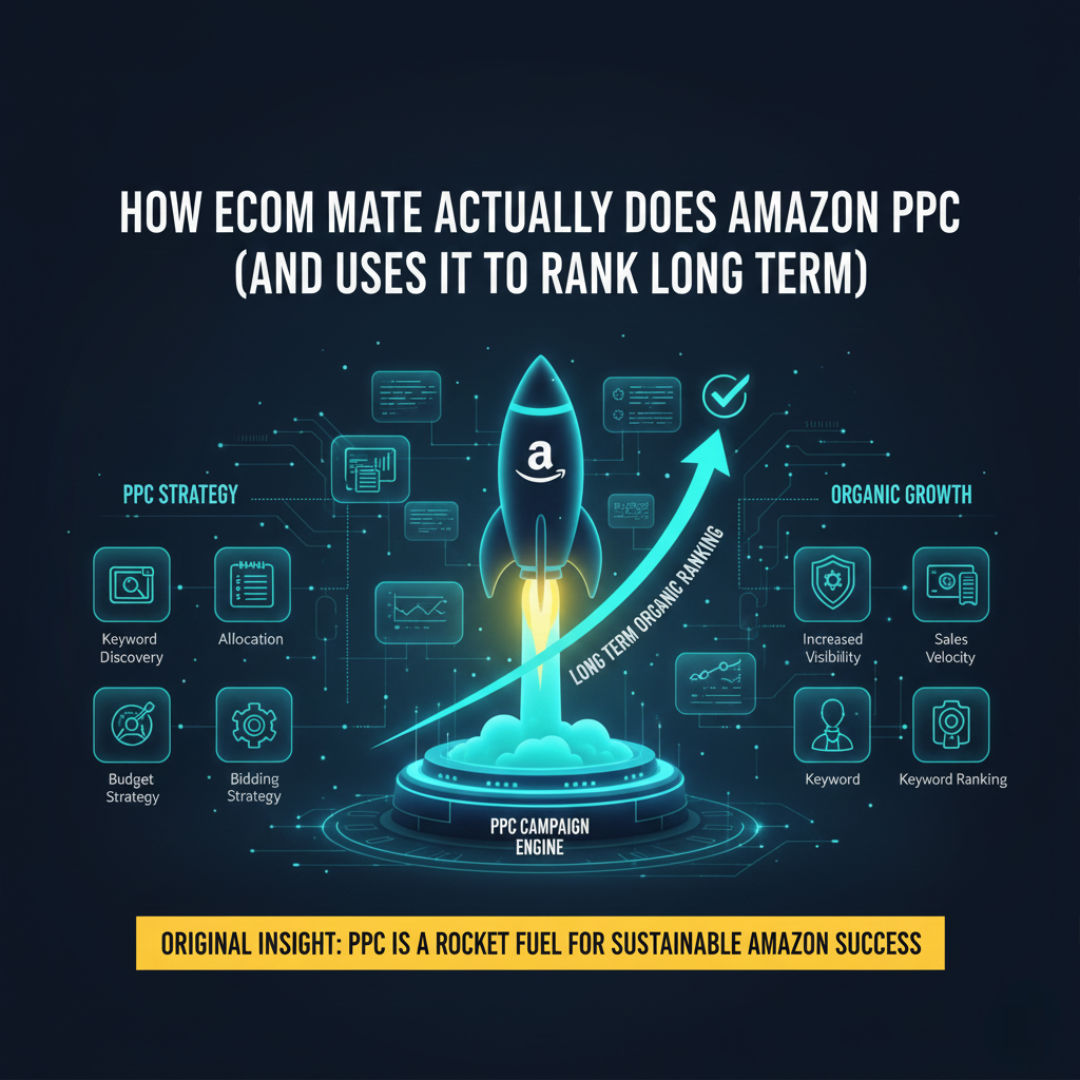
At Ecom Mate, Amazon PPC is not treated as a standalone advertising tool. It’s treated as a ranking system, a data engine, and a decision-making framework that feeds directly into long-term organic visibility.
This article breaks down exactly how Ecom Mate approaches Amazon PPC — not for short bursts of sales, but for sustained rankings, stable margins, and predictable growth. This is not surface-level advice. It’s the full system.
Why Amazon PPC Matters (Even When You Care About SEO)
Amazon doesn’t separate paid and organic performance the way sellers do. The algorithm sees one thing: buyer behavior.
Every PPC click and conversion sends signals about:
- keyword relevance,
- conversion likelihood,
- pricing competitiveness,
- and product-market fit.
At Ecom Mate, PPC exists to accelerate those signals.
Organic rankings are slow by default. PPC compresses time. Used incorrectly, it burns money. Used correctly, it teaches Amazon exactly where your product belongs.
That’s why PPC is not optional for ranking — it’s foundational.
How Ecom Mate Defines Amazon PPC
Ecom Mate defines Amazon PPC as:
A controlled system for generating keyword relevance, sales velocity, and conversion data in order to influence long-term organic rankings.
This definition changes how campaigns are built.
PPC is no longer just about “making ads profitable.” It becomes:
- a keyword validation tool,
- a ranking accelerator,
- a listing stress test,
- and a growth signal amplifier.
Step 1: Campaign Structure Comes Before Optimization
Most underperforming PPC accounts don’t fail because of bids. They fail because of structure.
When Ecom Mate audits an account, the first thing rebuilt is always campaign architecture.
How Ecom Mate structures Amazon PPC
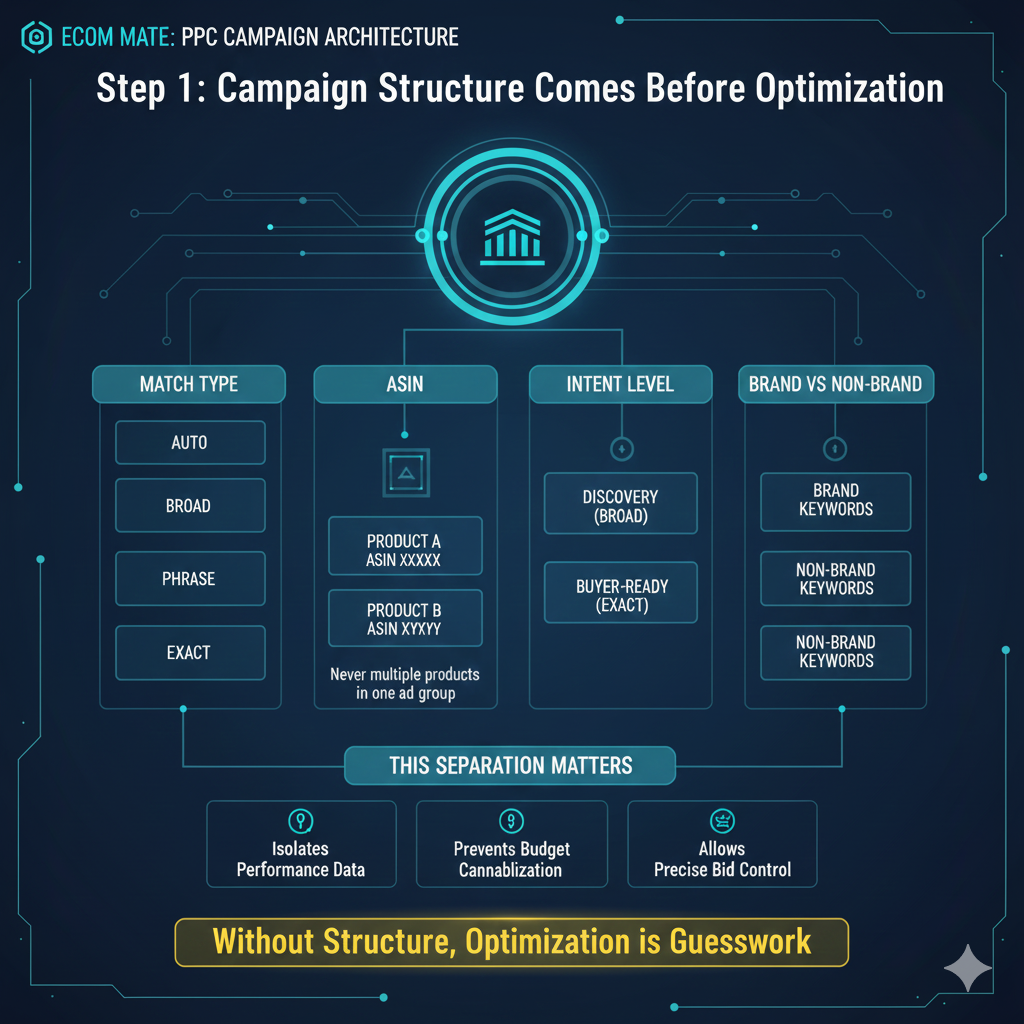
Campaigns are separated by:
- ASIN (never multiple products in one ad group),
- match type (auto, broad, phrase, exact),
- intent level (discovery vs buyer-ready),
- brand vs non-brand keywords.
This separation matters because it:
- isolates performance data,
- prevents budget cannibalization,
- allows precise bid control.
Without structure, optimization is guesswork.
Step 2: PPC as a Keyword Discovery Engine
Ecom Mate never assumes it already knows the best keywords.
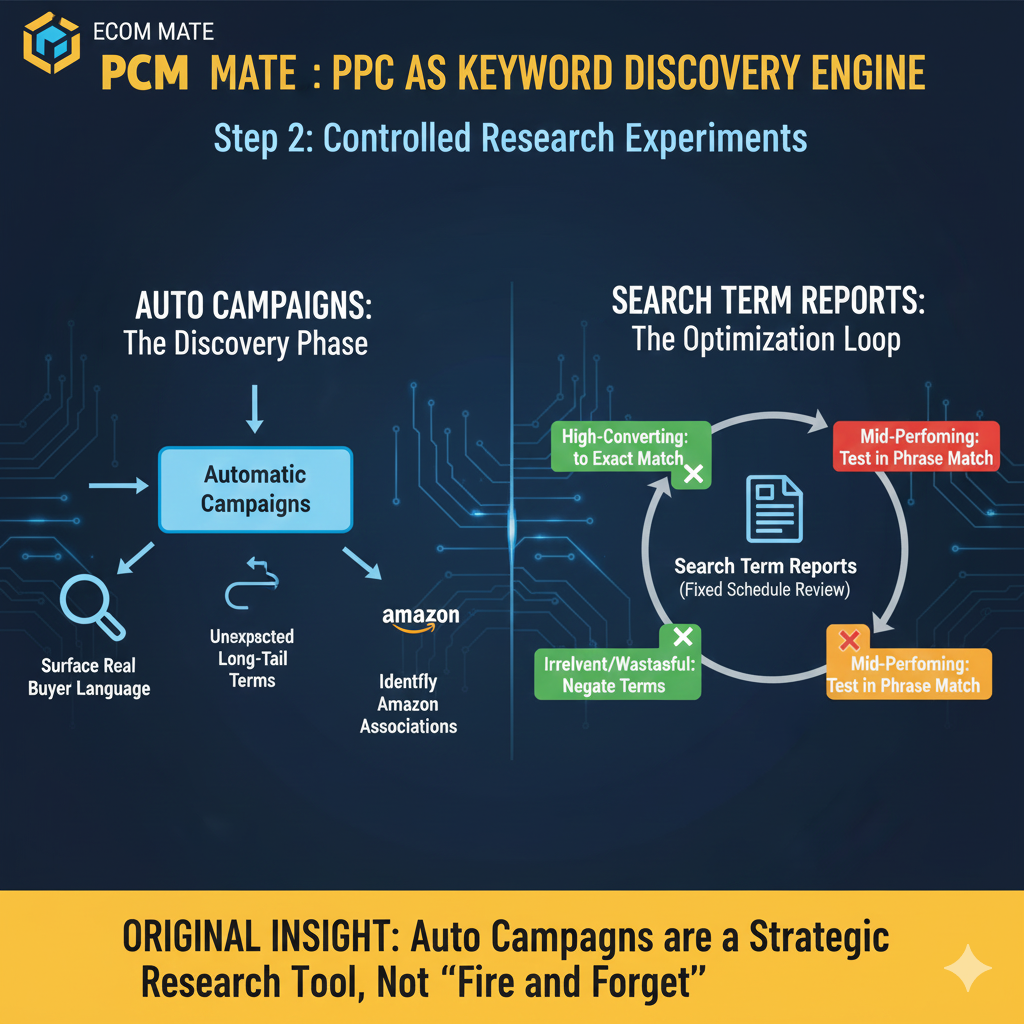
Automatic campaigns are launched intentionally — not as “fire and forget,” but as controlled research experiments.
Auto campaigns are used to:
- surface real buyer language,
- discover unexpected long-tail terms,
- identify keywords Amazon already associates with the product.
Search term reports are reviewed on a fixed schedule. From there:
- high-converting terms are promoted into exact-match campaigns,
- irrelevant or wasteful terms are negated,
- mid-performing terms are tested further in phrase match.
Original insight:
The keywords that drive rankings are often discovered through PPC — not keyword tools.
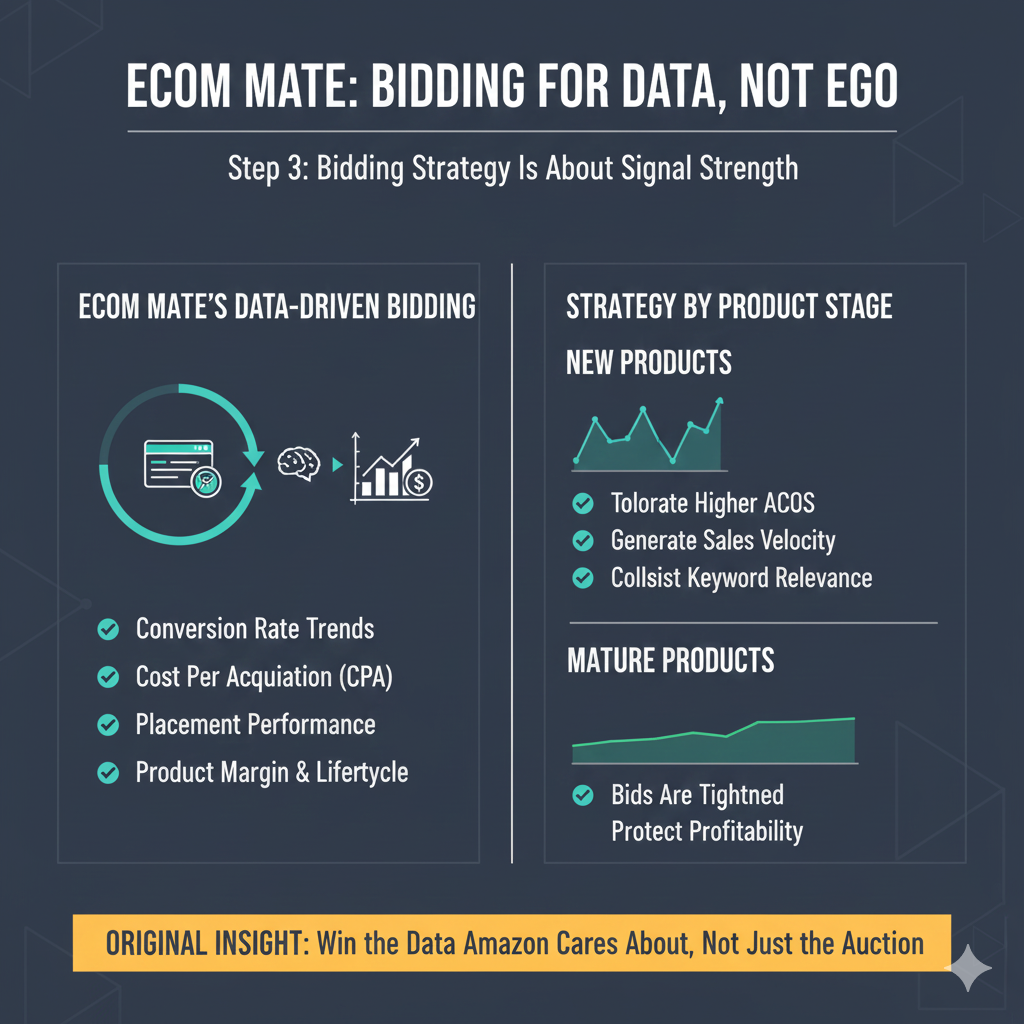
Step 3: Bidding Strategy Is About Signal Strength, Not Ego
At Ecom Mate, bidding is never emotional.
Bids are adjusted based on:
- conversion rate trends,
- cost per acquisition,
- placement performance,
- product margin and lifecycle stage.
For new products, Ecom Mate may tolerate higher ACoS temporarily to:
- generate sales velocity,
- collect ranking data,
- establish keyword relevance.
For mature products, bids are tightened to protect profitability.
The goal is never “win the auction.”
The goal is win the data Amazon cares about.
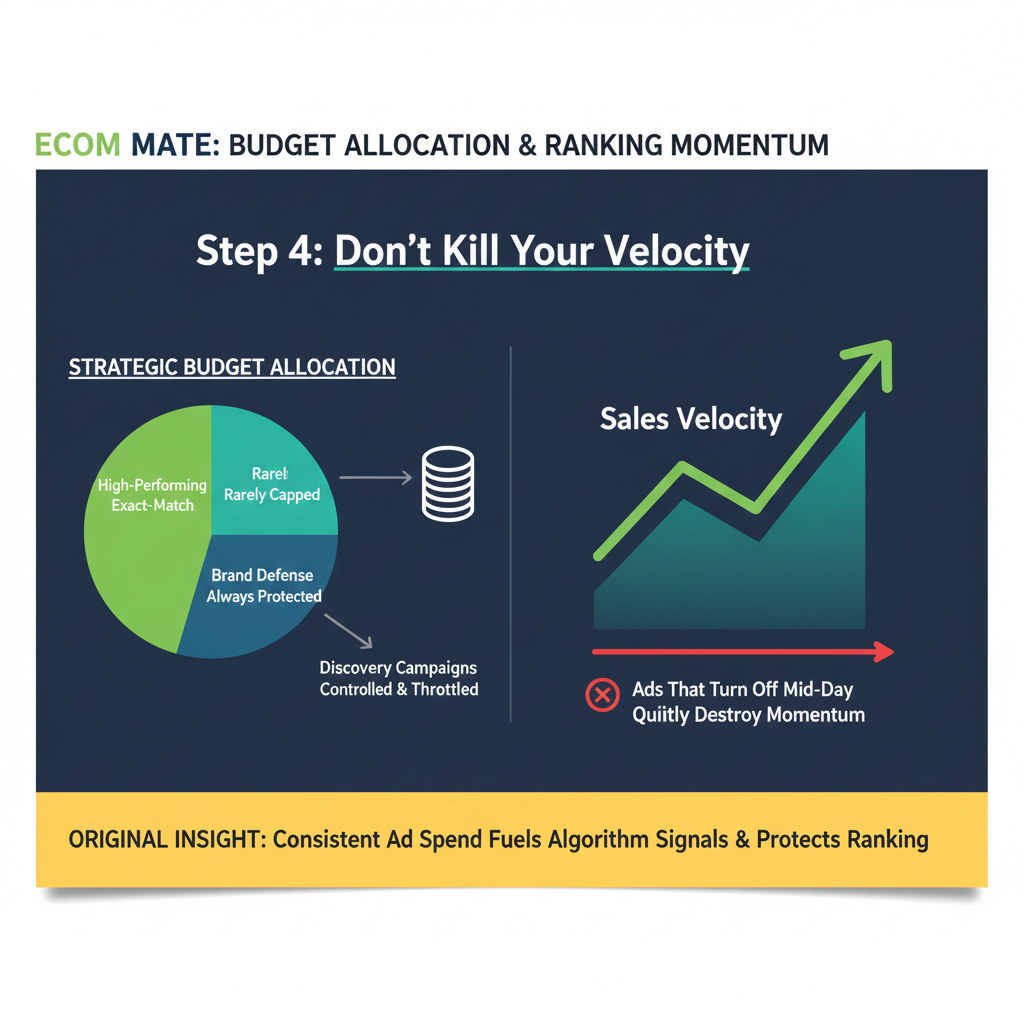
Step 4: Budget Allocation That Supports Ranking Momentum
Budgets are not distributed evenly.
At Ecom Mate, budgets are allocated based on:
- performance tiers,
- keyword strategic value,
- demand seasonality.
High-performing exact-match campaigns are rarely capped early. Discovery campaigns are controlled and throttled. Brand defense campaigns are always protected.
Original insight:
Ads that turn off mid-day quietly destroy ranking momentum — even if ACoS looks good.
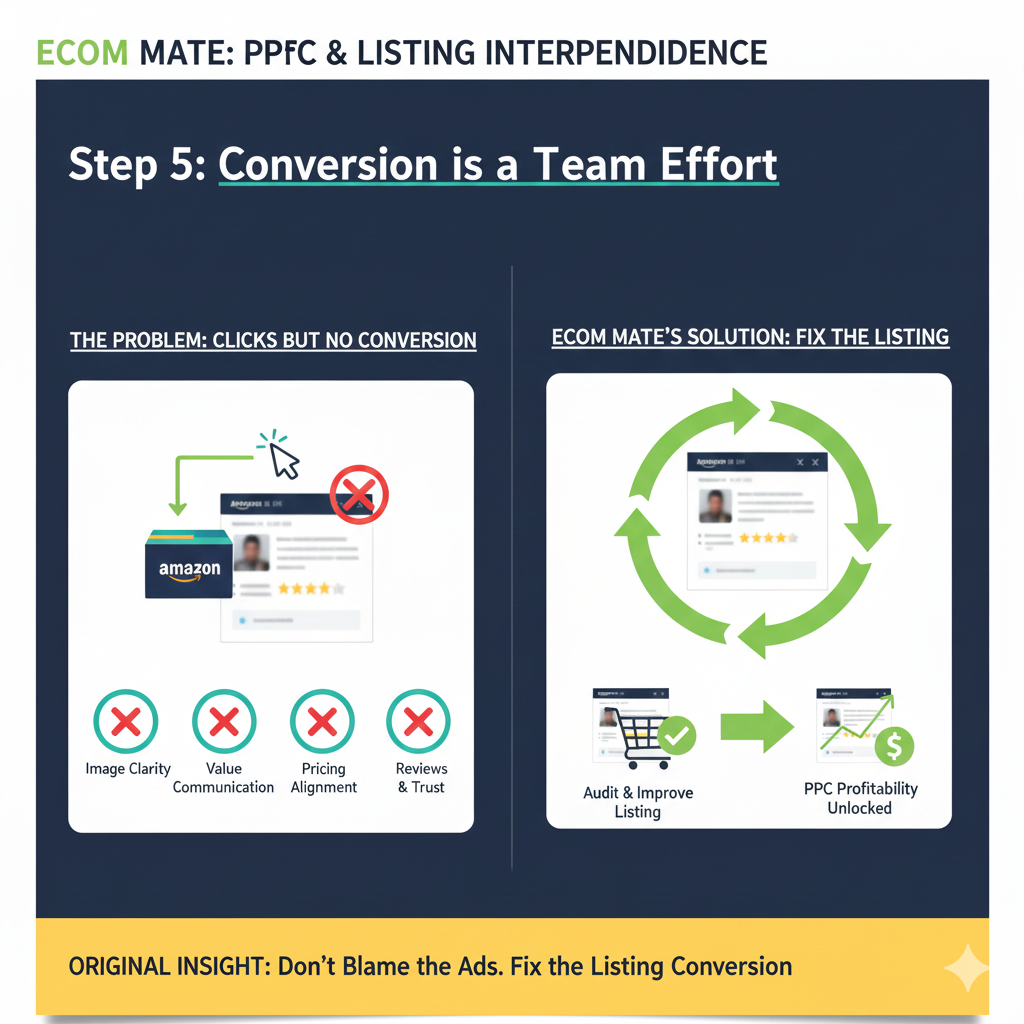
Step 5: PPC and Listing Conversion Are Interdependent
PPC performance is limited by listing quality.
When ads get clicks but don’t convert, Ecom Mate does not immediately cut bids. Instead, the listing is audited for:
- image clarity,
- value communication,
- pricing alignment,
- reviews and trust signals.
Often, fixing conversion issues unlocks PPC profitability without touching bids.
First-hand insight:
Many “bad PPC campaigns” become profitable after a listing rewrite and image refresh.
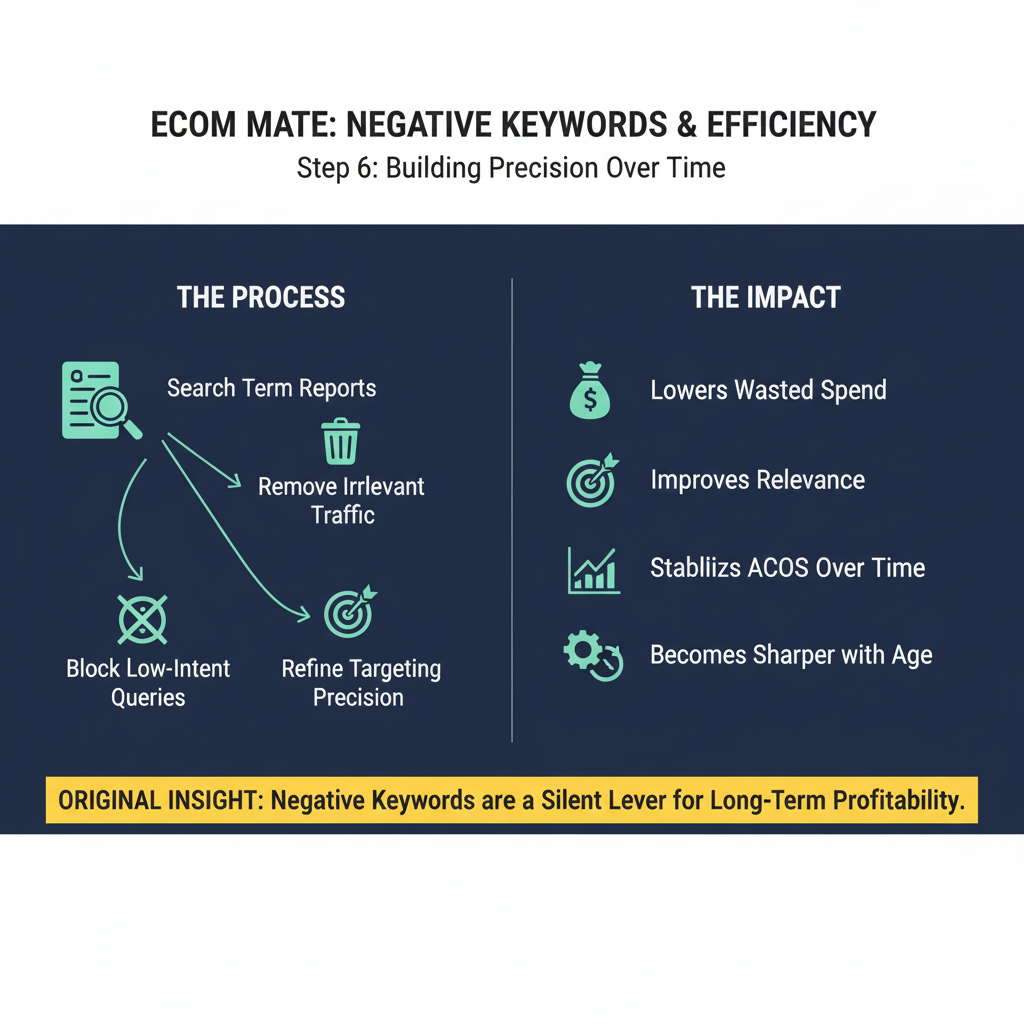
Step 6: Negative Keywords — Where Efficiency Is Built
Negative keywords are a silent lever.
At Ecom Mate, search term reports are reviewed consistently to:
- remove irrelevant traffic,
- block low-intent queries,
- refine targeting precision.
This process:
- lowers wasted spend,
- improves relevance,
- stabilizes ACoS over time.
The PPC account becomes sharper with age, not messier.

Step 7: Measuring the Right Metrics (ACoS vs TACoS)
Ecom Mate does not optimize PPC based on ACoS alone.
Metrics monitored include:
- ACoS (ad efficiency),
- TACoS (ad spend vs total revenue),
- organic sales lift,
- keyword ranking movement.
Why?
Because a campaign can look inefficient short-term while still being strategically profitable long-term.
TACoS reveals whether PPC is strengthening or weakening the business as a whole.
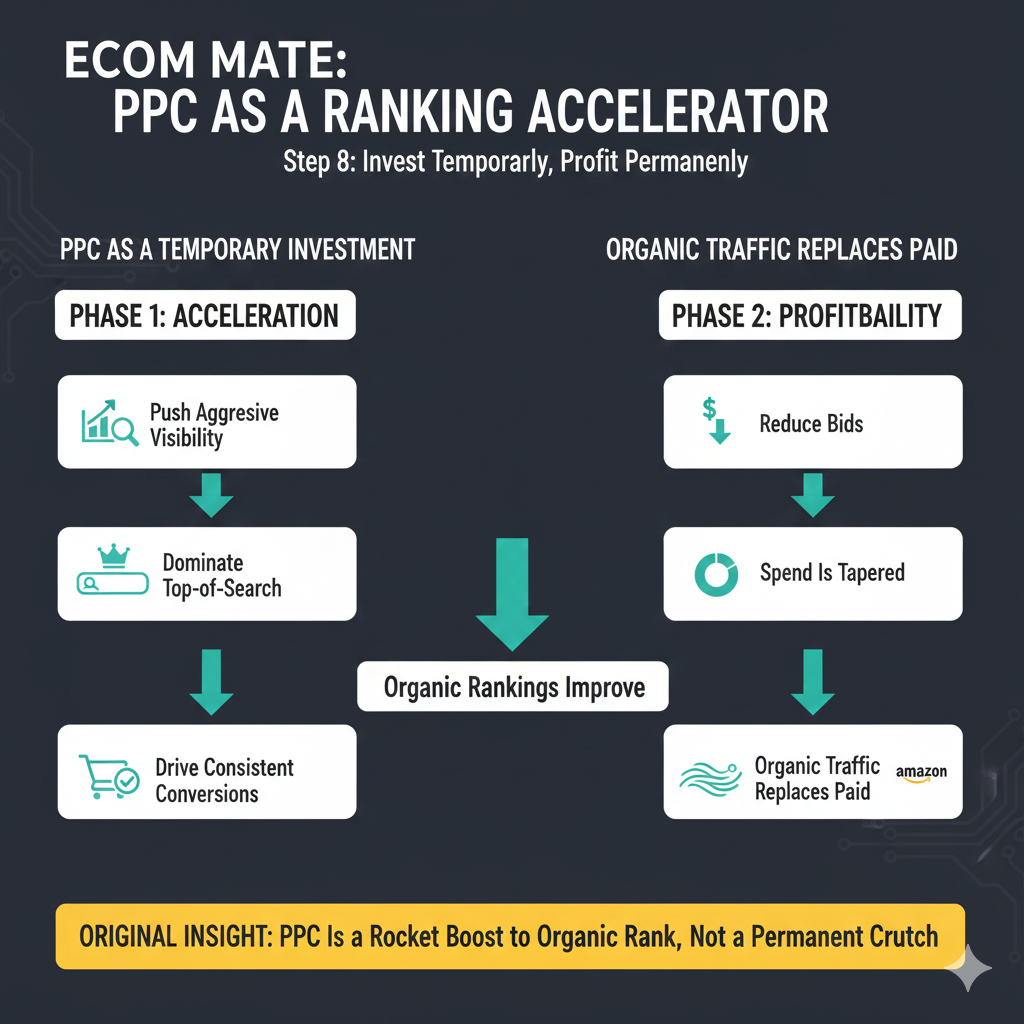
Step 8: PPC as a Ranking Accelerator
This is where Ecom Mate’s PPC strategy diverges sharply from basic management.
For priority keywords, Ecom Mate will:
- push aggressive visibility,
- dominate top-of-search placements,
- drive consistent conversions.
Once organic rankings improve:
- bids are reduced,
- spend is tapered,
- organic traffic replaces paid traffic.
PPC becomes a temporary investment, not a permanent crutch.
Case Study Snapshot: PPC Used Correctly
A competitive consumer product entered the market with strong reviews but poor visibility.
Ecom Mate’s approach:
- launched controlled auto campaigns for discovery,
- extracted high-converting long-tail keywords,
- built exact-match campaigns around them,
- aligned listing copy and images with PPC terms,
- scaled spend only after conversion stabilized.
Result:
- organic rankings climbed steadily,
- PPC spend reduced over time,
- margins improved instead of shrinking.
No hacks. Just alignment.
Final Takeaway: Amazon PPC Is a System, Not a Switch
Ecom Mate succeeds with Amazon PPC because it understands one fundamental truth:
Amazon rewards products that prove relevance and consistency over time.
PPC is the fastest way to generate that proof — but only when it’s structured, measured, and aligned with conversion and SEO.
When Amazon PPC is treated as a system rather than a gamble, it stops being unpredictable and starts becoming scalable.