Amazon SEO is often treated like a box-ticking exercise. Add keywords to a title, stuff a few into bullet points, tweak backend search terms, and hope rankings improve.
That approach feels productive. It’s also why most Amazon listings plateau.
At Ecom Mate, Amazon SEO isn’t a checklist — it’s a system. A system built around buyer intent, conversion behavior, and long-term ranking stability. This article breaks down how Ecom Mate approaches Amazon SEO, why it works, and what separates sustainable rankings from short-lived visibility.
This isn’t surface-level advice. This is the framework on .our ecommerce seo services
Why Amazon SEO Matters (More Than Ads, Tools, or Hacks)
Amazon doesn’t reward effort.
It rewards outcomes.
Every search, click, scroll, and purchase feeds Amazon’s algorithm with behavioral data. Over time, listings that consistently convert traffic into sales earn organic visibility. Listings that don’t slowly lose ground — regardless of how “optimized” they look on paper.
At Ecom Mate, Amazon SEO is treated as the foundation of long-term profitability. Ads can create traffic. Discounts can force velocity. But SEO determines whether a product can survive without constant paid support.
If your product relies on ads forever, your margins aren’t real.
How Ecom Mate Defines Amazon SEO
Ecom Mate defines Amazon SEO as:
The strategic alignment of search intent, listing relevance, and conversion performance to achieve consistent organic visibility.
This definition matters because it reframes SEO away from keyword stuffing and toward buyer behavior.
At Ecom Mate, rankings are not chased — they are earned.
Step 1: Keyword Research Based on Buyer Intent, Not Just Volume
Ecom Mate begins Amazon SEO with deep keyword research using tools like Helium 10, Jungle Scout, Brand Analytics, and internal dashboards. But tools alone don’t create insight.
What matters is how keywords are interpreted.
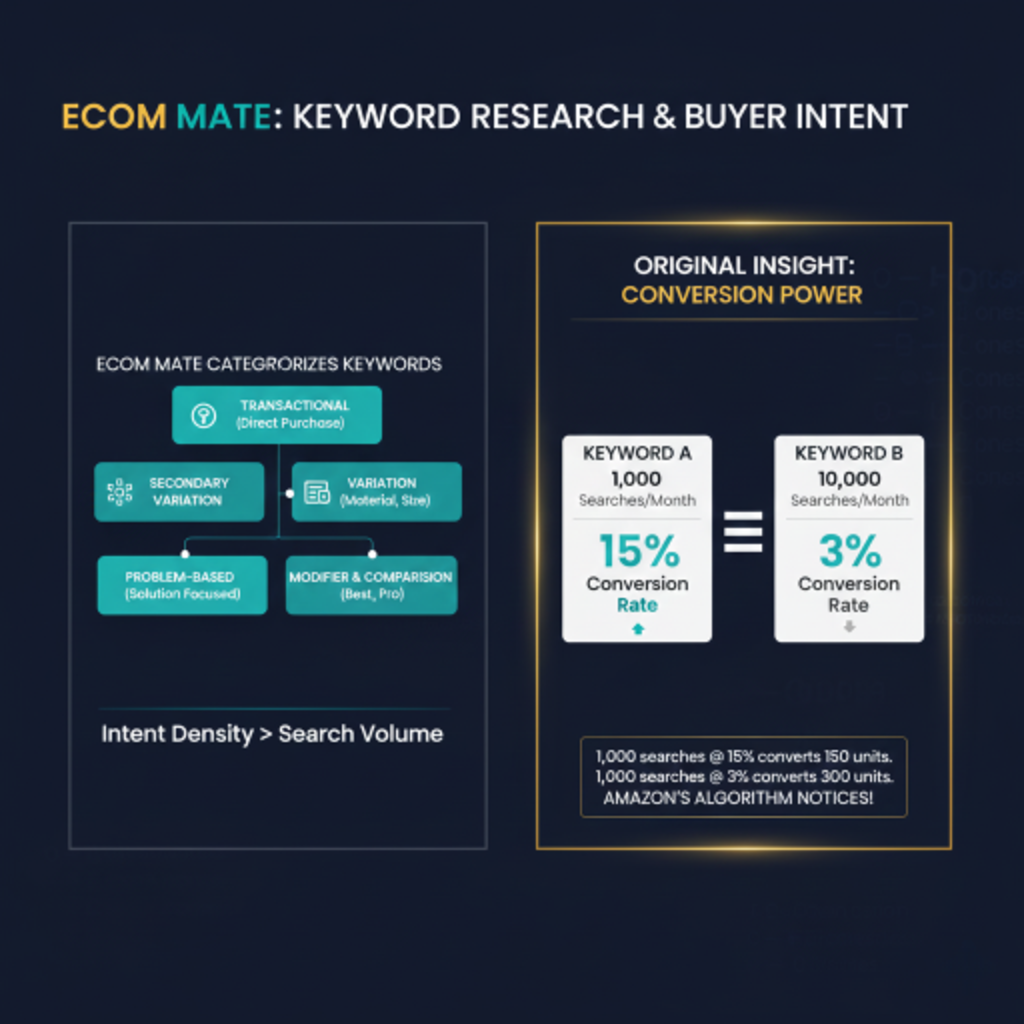
How Ecom Mate categorizes keywords
- Primary transactional keywords (direct purchase intent)
- Secondary variation keywords (materials, sizes, attributes)
- Problem-based keywords (“non-slip,” “for back pain,” “heat resistant”)
- Modifier and comparison terms (“best,” “professional,” “heavy-duty”)
Search volume is only the starting point. Ecom Mate evaluates intent density — how likely a keyword is to convert once clicked.
Original insight:
A keyword with 1,000 searches and a 15% conversion rate is often more valuable than a 10,000-search keyword converting at 3%. Amazon’s algorithm notices the difference.

Step 2: Listing Architecture That Supports Rankings
At Ecom Mate, listings are engineered — not written.
Titles: Structured for Relevance and Clicks
An Ecom Mate-optimized title:
- Leads with the highest-intent keyword
- Clearly communicates product purpose
- Includes one or two real differentiators
- Remains readable on mobile devices
Keyword stuffing is avoided because readability impacts click-through rate, and click-through rate impacts ranking.
Bullet Points: Objection Resolution
Most sellers list features.
Ecom Mate neutralizes objections.
Bullet points are written to answer:
- Who is this for?
- What problem does it solve?
- Why is it better than alternatives?
- Is it worth the price?
Secondary keywords are embedded naturally, without compromising clarity.
Descriptions & A+ Content: Conversion Protection
While descriptions and A+ content aren’t heavily indexed like titles, they play a critical role in:
- increasing time on page,
- /reinforcing buyer confidence,
- stabilizing conversion rates.
Original insight:
A+ content doesn’t push rankings upward directly — it prevents rankings from collapsing when competition increases.
Step 3: Backend Search Terms (Invisible, Strategic SEO)
Backend keywords are invisible to shoppers but highly visible to Amazon’s indexing system.
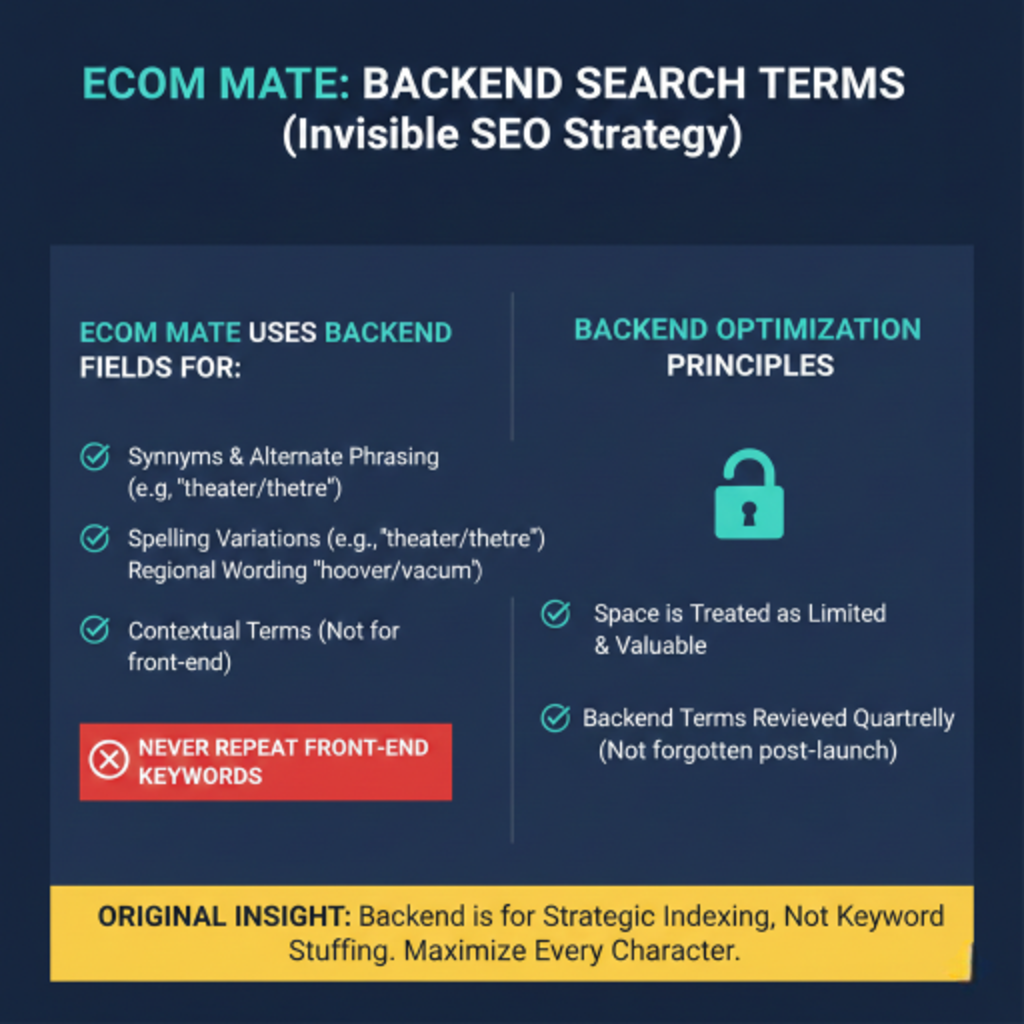
Ecom Mate uses backend fields for:
- synonyms and alternate phrasing,
- spelling variations,
- regional wording differences,
- contextual search terms not suited for front-end placement.
Keywords already present in the visible listing are never repeated. Space is treated as limited and valuable.
Backend terms are reviewed quarterly, not forgotten after launch.
Step 4: Images as a Ranking Lever
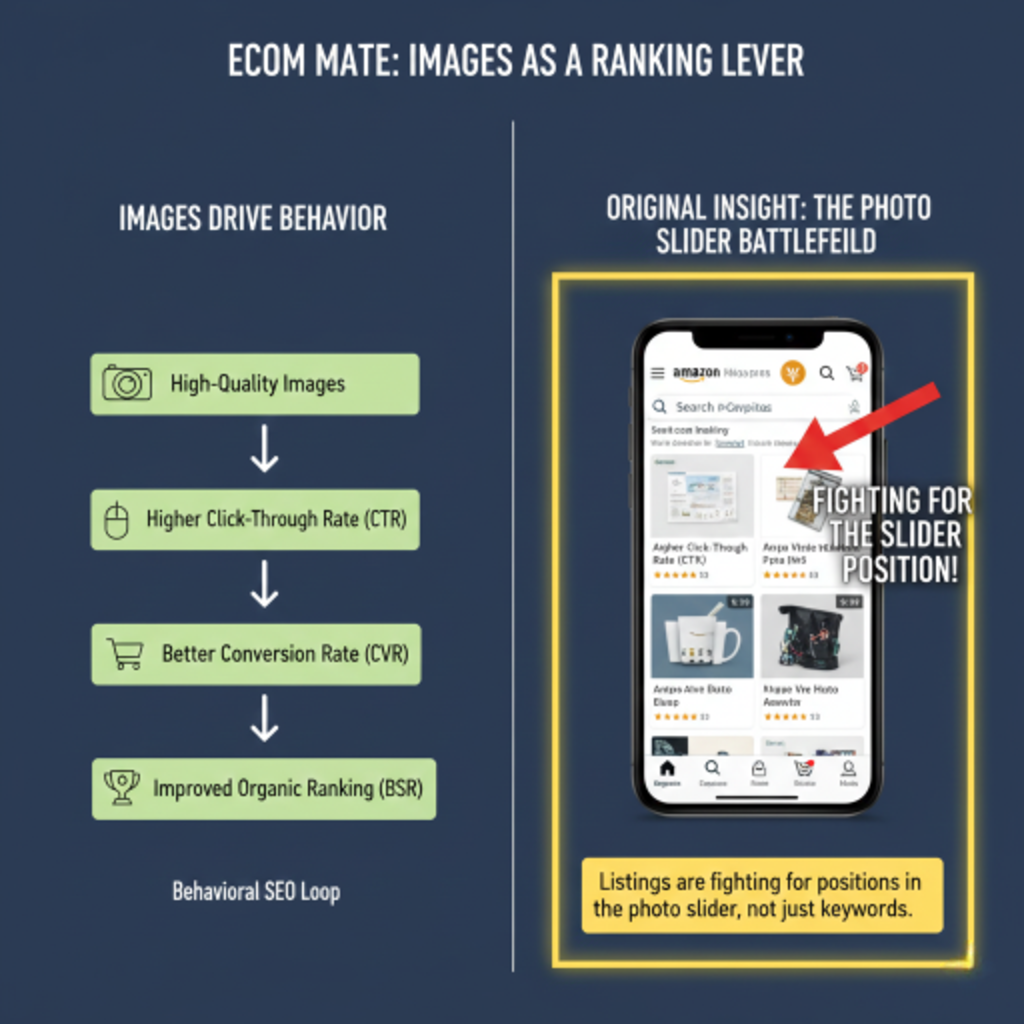
Improved imagery enhances the click-through rate and the conversion rate, which in turn have direct effects on the ranks in the organic search results.
Original insight:
A lot of the listings are fighting for positions in the photo slider rather than the list of keywords.

Step 5 – Reviews Q&A Trust Signals
For Ecom Mate, reviews rank as insuring.
Reviews are assessed in respect of:
- recurring objections,
- unmet expectations,
- confusion points.
After, advertisements are updated based on the raised issues.
Additionally:
- compliant review follow-ups are implemented,
- Q&A Sections Are Actively Managed,
- objections are answered before they become returns.
Amazon finds listings that are most likely to reduce buyer uncertainty preferable.
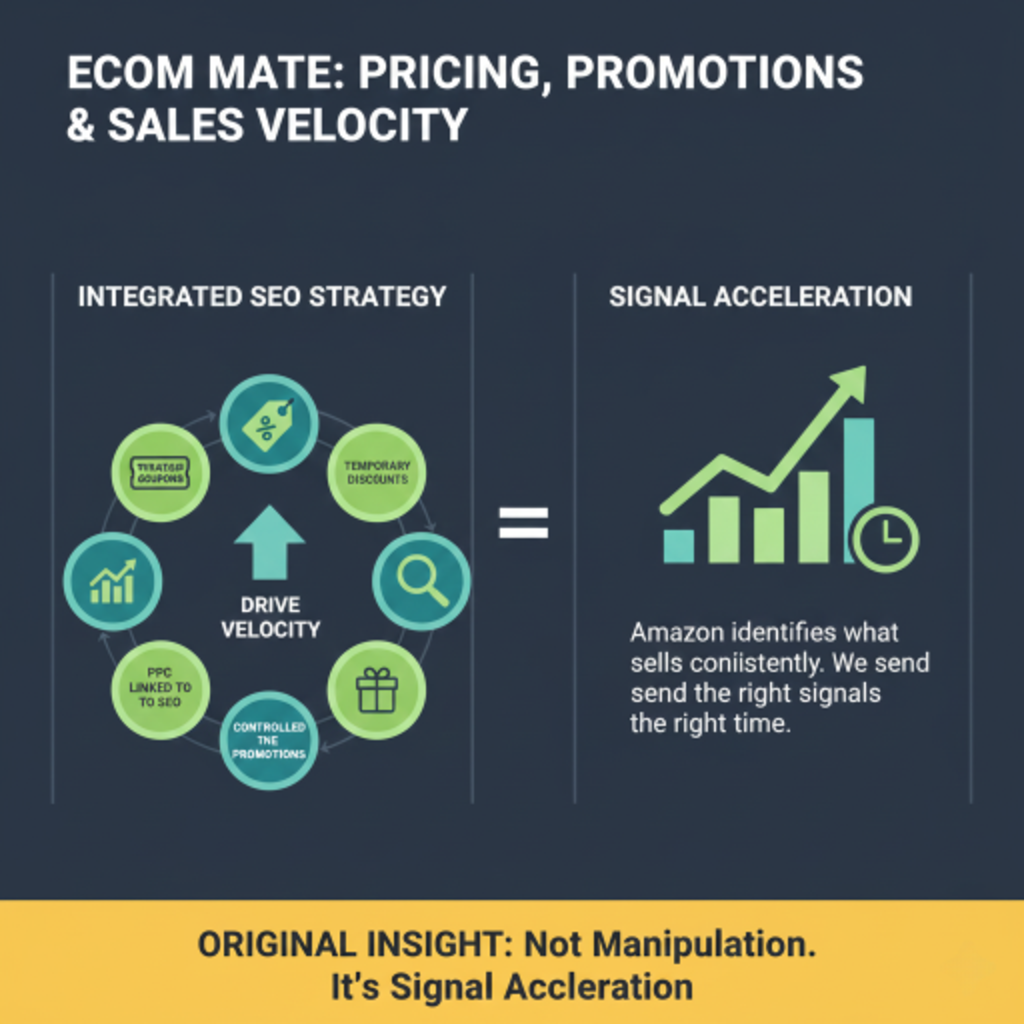
Step 6: Alignment of Pricing, Promotions, and Sales Velocity
These listings do not operate in isolation.
At Ecom Mate, SEO is integrated with:
- strategic coupons,
- temporary launch discounts,
- PPC campaigns linked to SEO keywords,
- controlled promotion programs designed to drive velocity.
It’s not manipulation – it’s signal acceleration.
Amazon identifies what sells on a consistent basis. Ecom Mate makes sure that the right signals are sent at the right time.
Step 7: Continuous Testing and Iteration
This phase ensures long-term SEO performance.
SEO for Ecom Mate is never “set and forget.”
Ongoing optimization activities are:
- weekly keyword rank tracking,
- conversion rate monitoring,
- A/B Testing the title and Image with Amazon experiments,
- competitor listing audits.
Whenever there’s a change in rankings, Ecom Mate identifies the reason for such:
- relevance mismatch,
- conversion drop,
- pricing pressure,
- increased competition.
Case Study Snapshot: Amazon SEO in Action
A home improvement product struggled despite strong ad traffic.
Analysis revealed:
- keywords were indexed,
- traffic was present,
- conversions were weak.
Ecom Mate identified confusion around installation and unclear imagery.
Actions taken:
- rewrote bullet points to clarify use cases,
- added visual installation diagrams,
- adjusted title to match buyer language,
- aligned PPC traffic with SEO keywords.
Result:
- higher conversion rate,
- stabilized organic rankings,
- reduced dependency on ads.
No tricks. Just alignment.
Multimedia & Depth Signals That Build Authority
To ensure this content goes beyond generic advice, Ecom Mate integrates:
- original screenshots of keyword tracking,
- before-and-after listing comparisons,
- custom graphics explaining ranking mechanics,
- short videos testing image performance,
- internal links to guides on PPC, product research, and conversion optimization.
This isn’t filler content.
It’s how trust and authority are built.
Final Takeaway: Amazon SEO Is a System, Not a Tactic
Ecom Mate succeeds at Amazon SEO because it understands a simple truth:
Amazon doesn’t rank keywords.
It ranks products that consistently satisfy buyers.
SEO is the language used to introduce a product to the algorithm — conversion is what convinces it to stay visible.
When Amazon SEO is treated as a system rather than a shortcut, rankings stop being unpredictable and start becoming repeatable.