If you’re building an ecommerce brand, there’s a moment that hits like a brick.
You finally get traction. Sales are consistent. Reviews are rolling in. Your product starts ranking. And then… you see it.
A suspiciously similar listing.
Same angle. Same color palette. Same benefits. Slightly cheaper.
Welcome to the jungle.
Copycats aren’t a possibility in ecommerce — they’re a certainty. Especially on platforms like Amazon, eBay, and Etsy, where barriers to entry are low and inspiration is one right-click away.
So the real question isn’t “How do I stop copycats?”
It’s: How do I build something that copycats can’t kill?
That’s where brand moats come in.
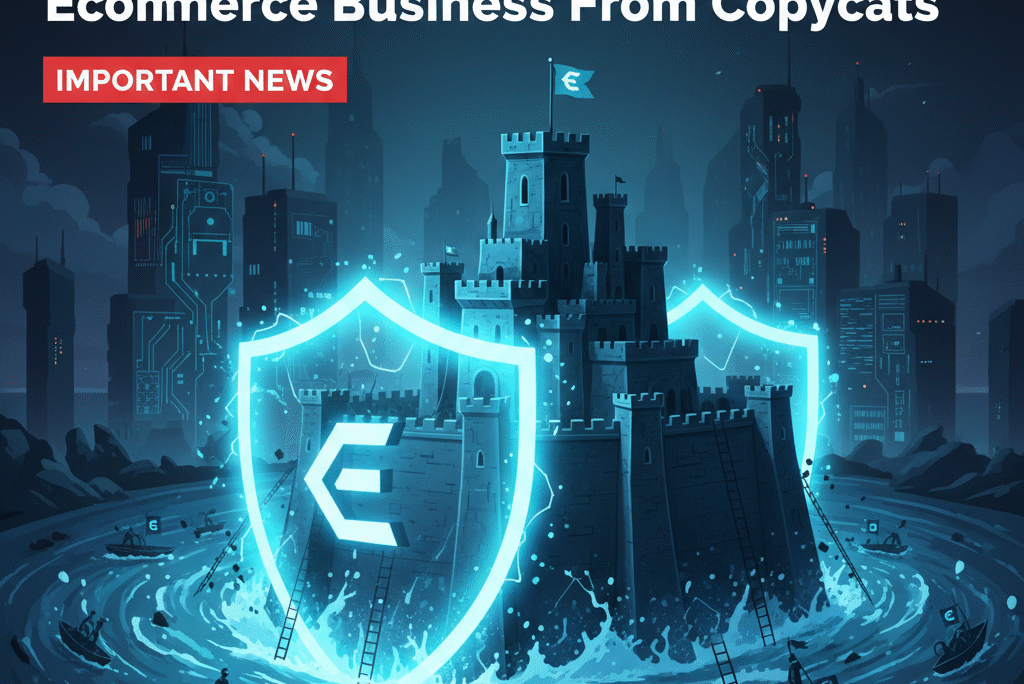
A moat, in business terms, is a structural advantage that protects you from competitors. The term is popularized by investor Warren Buffett, who describes great companies as castles protected by wide, defensible moats.
In ecommerce, your castle isn’t just your product.
It’s everything around it.
Let’s talk about how to build that.
1. The Uncomfortable Truth: Products Are Easy to Copy Without Brand Moats
Your supplier is not your brand moats.
Your product idea is not your brand moats.
Your packaging alone is not your brand moats.
If you found your supplier on Alibaba, someone else can too. If you reverse-engineered a trending product, someone else is watching the same data.
Even patents aren’t invincible unless you’re playing in deep-tech territory — and most ecommerce sellers aren’t building rocket engines.
So if your strategy is:
“Win with product alone.”
You’re building on sand.
The game has shifted from product-first to brand-first.
And brands are much harder to clone.
2. Branding Is More Than a Logo (And Way More Than a Color Scheme)
A copycat can duplicate your product photos.
They can’t duplicate your positioning.
Brand is the emotional story people attach to your product. It’s how they describe you when you’re not in the room. It’s what makes someone choose you at $29.99 instead of a competitor at $22.99.
Ask yourself:
- Do customers remember your name?
- Do they follow you?
- Do they search for your brand directly?
If the answer is no, then you’re not building a moat yet — you’re renting shelf space.
A real brand moat includes:
Clear audience positioning.
Distinct tone and voice.
Consistent visual identity.
Recognizable messaging.
Think about brands outside ecommerce. You could hide the logo and still recognize them by tone alone. That’s power.
In marketplaces, where most listings look like clones of each other, strong brand identity becomes oxygen.
3. Own the Customer Relationship (Not Just the Sale)
Marketplaces are fantastic for traffic. They are terrible for ownership.
When you sell only on Amazon, Amazon owns the customer data. The email. The behavior patterns. The long-term relationship.
That’s convenient — until it isn’t.
A moat forms when you build direct access to your customers.
That means:
- Building your own website.
- Capturing emails.
- Creating post-purchase flows.
- Developing repeat-buy incentives.
When customers return to your website instead of searching generically on Amazon, you’ve shifted from commodity to brand.
Copycats can mimic a listing.
They can’t replicate your customer base.
That’s leverage.
4. Community Is a Defensive Weapon
Community is a moat most sellers ignore.
If your brand has:
- An engaged Instagram following
- A niche Facebook group
- A loyal email list
- Customers who tag you voluntarily
You’ve built something deeper than a product.
You’ve built belonging.
Look at how some Etsy sellers thrive despite massive competition. It’s not because their candles are chemically superior to everyone else’s. It’s because their audience feels connected to the aesthetic, the story, the personality.
People don’t just buy utility. They buy identity.
Copycats can’t fake community. They can’t fake trust built over time.
That trust compounds.
5. Reviews as a Strategic Asset
Reviews are social proof. But they’re also a defensive barrier.
A new competitor may match your price and visuals. But if you have 1,200 reviews and they have 17, the psychological difference is massive.
This is why long-term sellers become harder to displace.
Instead of chasing the next shiny product, many successful brands focus on:
- Improving the existing product
- Increasing review count
- Enhancing customer satisfaction
- Building credibility over time
A copycat can enter quickly.
They cannot replicate your five-year reputation overnight.
Reputation is a moat built slowly — and defended through consistency.
6. Operational Excellence Is an Invisible Moat
Here’s one most people underestimate: execution.
Fast shipping.
Low defect rates.
Clean inventory forecasting.
Professional customer service.
These don’t show up in flashy marketing posts. But they protect your brand.
Because when copycats race to the bottom on price, they often cut corners.
And customers remember bad experiences.
If your brand becomes known for reliability — not just aesthetics — you build resilience.
Operational discipline is boring.
It’s also powerful.
7. Content as a Long-Term Shield
Here’s where most ecommerce brands leave money on the table.
They focus only on marketplaces.
But when you build SEO content, educational blogs, buying guides, and authority-driven pages, you start ranking outside the marketplace ecosystem.
Now you’re not just competing on Amazon search results.
You’re showing up on Google.
You’re being discovered through research-based intent.
Content builds discoverability that copycats can’t instantly hijack.
A competitor can duplicate your listing.
They can’t duplicate 50 high-ranking articles overnight.
This is where long-term strategy beats short-term hustle.
8. Innovation Over Imitation Cycles
Here’s something interesting about copycats.
They follow.
By definition, they’re reactive.
If your brand builds a system for continuous improvement — product enhancements, packaging upgrades, accessory bundles, feature expansion — you stay one step ahead.
The goal isn’t to create a product and freeze it in time.
The goal is evolution.
If your product improves every 6–12 months, copycats are always chasing yesterday’s version.
And you’re building tomorrow’s.
That gap compounds.
9. Legal Protection (Yes, It Matters)
Let’s be practical.
Trademarks matter. Brand registry matters. Design protections matter.
On Amazon, brand registry gives you tools to report infringements. That alone can eliminate lazy imitators.
Will legal protection stop everyone? No.
But it raises the barrier.
And moats are about barriers.
The harder you are to copy, the fewer people will try.
10. The Real Moat: Brand Perception
Here’s the core idea.
If customers view your product as interchangeable with others, you have no moat.
If customers view your brand as distinct, trustworthy, and emotionally resonant, you’re protected.
The strongest ecommerce brands don’t win because they’re the cheapest.
They win because they’re chosen.
There’s a difference.
One is transactional.
The other is relational.
And relationships are much harder to steal.
The Strategic Shift Most Sellers Avoid
Many ecommerce entrepreneurs think in terms of:
“What product should I launch next?”
Fewer ask:
“How do I make this brand irreplaceable?”
That second question changes everything.
It shifts focus from short-term wins to long-term positioning.
It moves you from chasing trends to building equity.
It forces you to think like a brand architect instead of a product flipper.
Copycats thrive in shallow waters.
Build depth.
Build recognition.
Build relationships.
Build systems.
When your moat is wide enough, competitors can show up… and it barely matters.
Because at that point, you’re not fighting over listings.
You’re running a brand.
And brands — real ones — don’t disappear just because someone cloned a product photo.
They adapt. They grow. They compound.
That’s the game worth playing.
If you’re ready to stop worrying about copycats and start building a brand that lasts, we can help. At Eccommate, we specialize in creating strong, defensible ecommerce brands through expert private labeling, branding, and full-service growth strategies. Learn more about our services here and start turning your products into a brand that competitors can’t touch.
To really grasp the idea of a brand moat, it helps to look at how business strategists and investors use the term economic moat — a metaphor that likens a company’s competitive advantage to the defensive water-filled barrier around a castle. This concept, popularized in finance and business strategy, describes advantages that make it difficult for competitors to erode your market position over time. A strong brand is one of the key sources of such a moat because it builds trust, loyalty, and pricing power that copycats struggle to replicate authentically. For a concise and well‑rounded definition of this idea in a broader business context, you can read about economic moats on Wikipedia.