Quick Answer: The Amazon Brand Referral Bonus is a credit Amazon gives brand owners when their marketing outside Amazon, such as social media or email, sends shoppers who buy. Amazon says it averages 10% of qualifying sales and applies it against future referral fees. You need Brand Registry and Amazon Attribution tags, and Amazon describes eligibility in terms of its US store.
Run ads on Meta, Google or email and send the clicks to Amazon, and there is a program that pays part of your referral fees back. It only counts traffic that carries a tracking tag. A brand that markets without tags earns nothing from it.
That program is the Amazon Brand Referral Bonus. It is neither advertising nor a fee change, so it is easy to overlook. For a brand sending real volume from outside Amazon, though, it can change whether a channel makes money.
This guide covers what the Amazon Brand Referral Bonus is, how much it pays according to Amazon, who is eligible, how Amazon Attribution tags earn it, whether the maths holds on a real product, and how it answers the question most sellers start with: does social media help Amazon sales?
What is the Amazon Brand Referral Bonus?
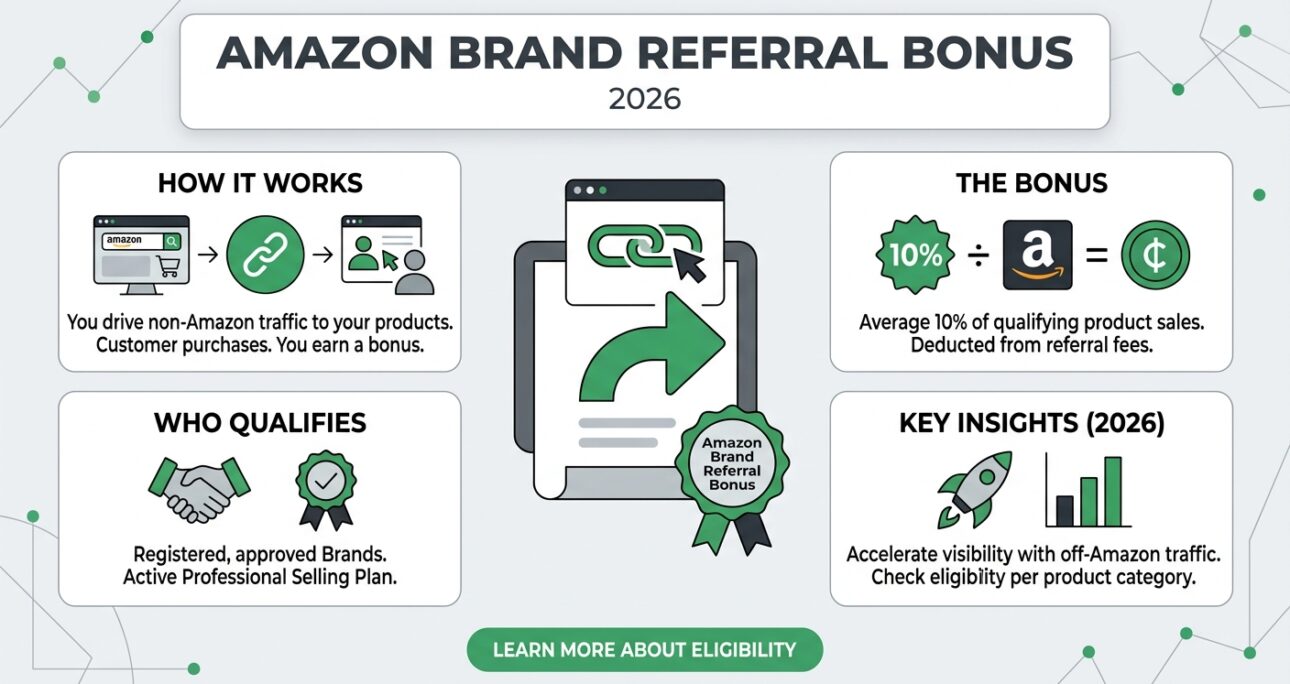
The Amazon Brand Referral Bonus is a credit for brand owners whose marketing outside the Amazon store sends shoppers who buy. Amazon’s own guide to the Brand Referral Bonus describes a bonus averaging 10% of qualifying sales, earned when you drive traffic from search, social media and other sources.
The credit does not arrive as cash. It builds up and offsets the referral fees on your future sales, and it only builds up when the traffic carries a tracking tag from Amazon Attribution. No tag, no bonus.
It also has a clear boundary. Amazon’s own advertising, meaning sponsored and video ads, does not earn it. Social media campaigns, search and display ads, email and other marketing outside the store can. Read plainly, it is Amazon rewarding you for sending it shoppers from outside its own store.
How much is the Amazon Brand Referral Bonus?
Amazon says the bonus averages 10% of qualifying sales. It also says the amount moves with price, category, and charges like shipping and gift wrap. So 10% is an average and not a rate.
Amazon gives two estimated rates as examples. Clothing is 11%. Furniture is 10% on the first $200 of the sale price and 7% on anything above that. The full list by category sits on the Brand Referral Bonus help page in Seller Central, and that is the page to read before you plan anything. Look up your own category. Do not plan around the average.
Amazon’s own worked example does not use 10% either. It takes a $100 backpack with a 14% referral fee and says a sale through the program might earn a 7% credit. Applied to a later sale, that would lift what the seller keeps on the product from $86 to $93, before any other cost. Seven percent is a more careful number to plan with until you have seen your own category’s rate.
Three details decide how useful the bonus is.
It is a credit, not a payment. Bonuses build up as credits against referral fees on future sales. In Amazon’s example, a $7 bonus applied to a $5 fee wipes that fee out, and the leftover $2 goes against the next one, so a $6 fee falls to $4.
It waits. In general the full bonus is credited after a two month wait, which allows for returns and cancellations. A return or a cancellation can reduce what you earn.
It excludes Amazon’s own advertising. Sponsored and video ads do not earn it, so your Sponsored Products spend does not count toward it.
Platforms disagree about who should pay for outside traffic. Amazon rewards the seller who sends it. Etsy goes the other way and charges a fee when its own offsite advertising leads to a sale, as set out in Etsy’s fees and payments policy. If you sell on both, the economics of outside traffic are different on each, and one blended assumption will be wrong on both.
Brand Referral Bonus eligibility: who can use it
Amazon’s description of eligibility is specific. The seller needs to be in the US store, on a Professional selling plan, and enrolled in Amazon Brand Registry. Brand Registry needs an active or pending trademark. If you do not have one yet, Amazon points to its IP Accelerator program as a way in.
If you are not the brand owner, the bonus is not for you. Amazon’s page suggests its Associates program instead, which pays commissions of up to 10% on qualifying purchases you help generate.
One point matters if you sell outside the US. Amazon’s eligibility wording refers to sellers in its US store and does not mention the UK or any other store. If you sell on Amazon UK, do not plan around the Brand Referral Bonus until Seller Central confirms it is open to you. The tracking side may still be useful on its own, but confirm that for your store too. Amazon published its guide in October 2023, and programs change, so everything in this section is the US store as Amazon describes it.
How Amazon Attribution tags earn the bonus
Amazon Attribution is the measurement tool behind the bonus. You use it to create a tag, which is a tracking link that points to a product detail page or your Amazon storefront. You put that link in a social ad, an email, a search campaign or any other marketing that lives outside Amazon. Amazon then reports the clicks, detail page views and sales that came through it.
Access runs through an Amazon Ads account, and tags are created per ad group. Amazon’s guidance is one unique tag for each ad, or for each link or button inside an ad when there is more than one. Never share a tag between ads. If two ads carry the same tag, the report cannot tell you which one earned the sale.
That makes tagging a habit more than a setting. The easy mistake is tagging the paid campaign and forgetting everything else: the link in your bio, the footer of your email, the link a creator pastes under their video. Each of those is traffic you earned or paid for and cannot measure.
Is the Amazon Brand Referral Bonus worth it? The maths
Here is a simple way to test any outside channel against your own numbers. The figures below are made up and round. They show the arithmetic, and they are not benchmarks. Swap in your own.
Say a product sells for $30. Landed cost is $9, the referral fee is 15% ($4.50) and the fulfilment fee is $5. Before any marketing, a sale leaves you $11.50.
If that sale earns a bonus at Amazon’s 10% average, you get a $3 credit against future fees. Your effective margin is $14.50.
Now suppose a paid social campaign costs $9 for each sale it produces, which is total ad spend divided by attributed sales. Without the bonus you keep $2.50 a sale. With it you keep $5.50. The bonus more than doubled the profit, though the credit shows up about two months later and only as a reduction in fees.
Now the uncomfortable half. If the same campaign costs $15 per sale, you lose $3.50 a sale without the bonus and still lose $0.50 with it. The Amazon Brand Referral Bonus can tip a marginal channel into profit. It cannot rescue one that loses money. Work out your cost per attributed sale first, then judge the channel against $11.50 or $14.50, not against how the posts feel.
Does social media help Amazon sales?
The bonus is a payback mechanism. The bigger question underneath it is whether outside traffic, and social media in particular, is worth sending in the first place.
Social media can put your product in front of people who were never searching for it on Amazon. That is the whole job. A shopper who found you through a video has already seen the product working, which is a different starting point from someone typing a keyword and comparing six near-identical results.
It cannot repair a weak listing. If the page converts badly, outside traffic is just a more expensive way of finding that out. We covered what makes a page convert in the guide to writing an Amazon listing that converts rather than just ranks. Fix that before you buy a click from anywhere else.
One claim needs careful handling. Plenty of guides say outside traffic improves your organic ranking inside Amazon. We looked for Amazon saying that in its own seller pages and did not find it. A listing that sells more may well rank better, and that is a fair thing to assume. It is still an assumption. Anyone quoting you a ranking boost as a number is guessing, so build your economics to work without it.
The parts of a social media strategy that matter when the sale lands on Amazon
Most guides to social media strategy give the same list: goals, audience, platforms, content, consistency, analytics. Nothing on it is wrong. It just stops before the part that decides whether an Amazon seller makes money, which is what happens after the click. Here is how each piece changes.
A goal you can read in Attribution. Followers and likes do not pay fees. Pick one number Amazon reports, either detail page views, attributed sales or cost per attributed sale, and judge every post and ad against it.
A listing worth the click. Images, bullets and price decide whether a visitor buys. Send traffic to a listing that already converts, not one you plan to fix later.
A platform that matches how the product is bought. Ask where a buyer would first see this thing being used. Something that demonstrates in ten seconds suits short video. Something people research before buying suits search and longer content. A replenishable product suits email. That is our judgement from the work, not a rule.
Content that shows the product doing its job. In our view, demonstrations, comparisons and before and after shots do more for a first-time buyer than polished brand films. Keep the look consistent so people recognise you from one post to the next. That is the job of brand identity and design work.
Tracking from the first post. One unique tag for every ad and every link, set up before anything goes live, not after you notice the numbers are blank.
A spending ceiling set from your margin. Work out what a sale leaves you before marketing, add the bonus if you are eligible, and never pay more than that to win a sale through a campaign. Social media marketing sits inside our SEO, GEO and SMM service, and we plan it backward from this number.
How to set up the Amazon Brand Referral Bonus, step by step
This is the order we work through when we set it up as part of Amazon account management. Start with one product whose listing already converts.
- Confirm you are eligible. Brand Registry, a Professional selling plan, and the US store. If you sell elsewhere, check Seller Central before going further.
- Open the Brand Referral Bonus help page in Seller Central and note the estimated rate for your category.
- Sign up for an Amazon Ads account. Amazon says you need one to reach Attribution.
- Create an ad group in Amazon Attribution for each ad, or for each link or button inside an ad. Generate a unique tag for each one. The destination can be a product detail page or your storefront.
- Paste the tag into the destination URL in the platform’s campaign manager: the social ad tool, your email platform, your creator’s link. One tag per ad or link.
- Launch, then watch Attribution for clicks, detail page views and sales. Bonuses show up in Seller Central as they build.
- Review after the two month wait. Compare the credits earned with your cost per attributed sale. Keep what pays. Cut what does not.
What not to do
Do not plan an Amazon UK business around the Brand Referral Bonus. Amazon’s wording refers to the US store. Confirm in Seller Central first.
Do not use the 10% average as your rate. Your category has its own estimated rate, and Amazon’s own example used 7%.
Do not send traffic through untagged links. Nothing gets measured, and nothing counts toward a bonus.
Do not expect Sponsored Products or other Amazon ads to earn it. They are excluded.
Do not judge the bonus in week two. Sales data arrives quickly. The credit does not.
Do not post before the brand looks like one thing. Mixed colours, fonts and tone make it harder for a stranger to remember you. Our guide to what brand identity means covers the basics.
If you sell a handful of units a day, this is not your first job. Tagging and tracking will not move a small account. The listing and your Amazon advertising will, so start there.
Frequently asked questions
What is the Amazon Brand Referral Bonus?
It is a credit Amazon gives brand owners when their marketing outside Amazon sends shoppers who buy. The credit offsets referral fees on future sales rather than paying out cash. It needs Amazon Brand Registry and tracking tags from Amazon Attribution, and Amazon describes eligibility in terms of its US store. Sponsored and video ads on Amazon do not earn it.
How much is the Amazon Brand Referral Bonus?
Amazon says it averages 10% of qualifying sales, varying by price, category and charges like shipping and gift wrap. Its examples show 11% for clothing, 10% on the first $200 of furniture and 7% above that, and a 7% credit in its backpack illustration. Check the category list on the help page in Seller Central rather than assuming the average.
Who is eligible for the Brand Referral Bonus?
Amazon describes sellers in its US store on a Professional selling plan who enroll their brand in Amazon Brand Registry, which requires an active or pending trademark. You also need Amazon Attribution tags on your outside marketing. If you are not the brand owner, Amazon points to its Associates program instead, which pays commissions of up to 10% on qualifying purchases.
Is the Brand Referral Bonus available on Amazon UK?
Amazon’s published eligibility refers to sellers in its US store and does not mention the UK. We could not confirm availability for other stores from the pages we could access. If you sell on Amazon UK, check Seller Central or ask Amazon support before building a plan around it, and treat any claim that it applies everywhere as unverified.
Do Sponsored Products ads earn the Brand Referral Bonus?
No. Amazon says the bonus is not available for its own advertising, including sponsored and video ads. It is for marketing outside the Amazon store, such as social media campaigns, search and display ads, and email. Traffic from those sources needs an Amazon Attribution tag to count.
Do organic social media posts earn the Brand Referral Bonus?
Amazon’s guide describes earning the bonus through non-Amazon advertising and marketing that carries an Attribution tag. It does not clearly say whether an organic post counts, and an untagged link counts for nothing. Read the help page in Seller Central for the current rules, and tag every link you control either way.
Does social media help Amazon sales?
It can, and you can only prove it with tracking. Social media puts the product in front of people who were not searching for it, and Amazon Attribution tags show the clicks, detail page views and sales each link produced. Whether outside traffic raises your organic ranking is something Amazon has not confirmed in the pages we checked, so do not budget on it.
Where this leaves you
The Amazon Brand Referral Bonus is worth knowing about if you send outside traffic to a registered brand in the US store. Tag every link, work out your cost per attributed sale against your real margin, and read your own category’s rate before you count on any number, including the 10% average.
It can tip a marginal campaign into profit. It will not rescue one that loses money. If you are not sure what your numbers look like, request a free audit and we will work out your margin per unit, what a tagged campaign could cost you, and whether the listing is ready for the traffic.