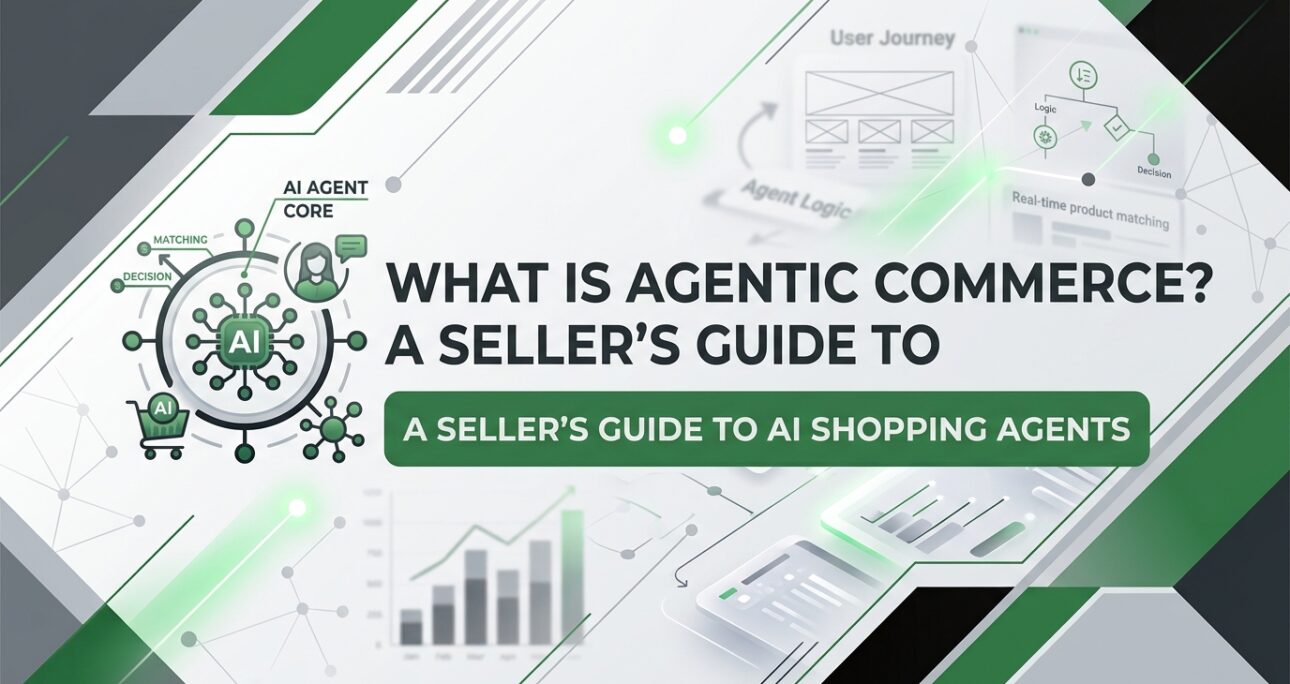
What is Agentic Commerce? Quick Answer: Agentic commerce is when an AI agent handles shopping on a person’s behalf. The shopper states a goal and constraints, and the agent searches, compares, checks stock and price, and in some cases completes the purchase. For sellers it changes who reads your product data. Agents do not look at your hero image or your brand story. They read structured data, specifications, price and availability.
Someone tells an assistant to find a cordless drill under £150 that arrives by Friday. The assistant checks several retailers, compares specifications and delivery windows, and either hands back a shortlist or buys one.
That shopper never saw your homepage. They never read your reviews. They never noticed your packaging.
This is the part of the shift that matters commercially, and it is not really about AI. It is about the fact that the thing choosing between you and your competitor is now reading a structured feed rather than looking at a page. Everything you spent money on to persuade a human is invisible to it.
What follows is what agentic commerce actually is, how the plumbing works, why the hype is currently ahead of the revenue, and the two quite different jobs involved in getting found, depending on whether you sell on your own site or on Amazon.
What is Agentic Commerce
The term covers a spectrum, and most confusion comes from people arguing about different points on it.
At the mild end, an AI assistant helps with research. It reads reviews, summarises differences between two products, tells you which one suits your use case. The human still clicks buy. This is common now and has been for a while.
At the sharp end, the agent transacts. It holds payment authorisation within limits the shopper has set, selects a product against stated constraints, and completes checkout without the shopper visiting a product page at all.
The middle is where most real activity sits in 2026. Agents do discovery and comparison well. They hand off to a merchant site or app for the actual purchase. Full autonomous checkout exists, works, and is still a small share of transactions.
For a brand owner, the useful distinction is not how autonomous the agent is. It is whether your product data is legible to it. An agent that only recommends still needs to find you, understand your specifications, and trust your stock and price. That requirement is identical whether it completes the purchase or hands off.
How an agent actually buys something
Three overlapping standards emerged across 2025 and 2026, and they stack rather than compete.
ACP, the Agentic Commerce Protocol. Published by OpenAI with Stripe in September 2025, alongside Instant Checkout in ChatGPT. It handles the payment execution step inside an AI surface.
UCP, the Universal Commerce Protocol. Google published this in January 2026, co-developed with Shopify, Etsy, Target, Walmart and Wayfair, with endorsement from payment providers including Stripe, Visa, Mastercard and Adyen. UCP is broader than ACP, covering discovery, cart, checkout, orders and post-purchase. Merchants and agents advertise their capabilities through a JSON manifest at a well-known address on the domain, as documented in Google’s developer write-up on UCP.
AP2, the Agent Payments Protocol. This answers a different question: who authorised this. It uses signed mandates covering intent, cart and payment, so a merchant or bank can verify that an agent genuinely acted with the shopper’s consent rather than going off on its own.
Read together, the architecture is: UCP describes what is for sale and how to build a cart, ACP executes a payment inside an AI surface, AP2 proves the purchase was authorised. Payment providers have started shipping adapters that support several at once, which tells you the industry expects more than one standard to survive.
The practical takeaway for a merchant is smaller than the acronym count suggests. If you are on a major platform, most of this is handled for you. Shopify made UCP available across its merchant base, with self-serve agent registration from mid-2026. If you are on a custom build, this becomes a development project.
The hype is ahead of the revenue
Worth saying plainly, because a lot of agencies are selling urgency on this.
OpenAI launched Instant Checkout in ChatGPT in September 2025, starting with US Etsy sellers and with a large number of Shopify merchants expected to follow. It was retired around March 2026. Reporting suggests only a small number of merchants ever shipped against it and transaction volume was minimal. The protocol survived; the in-chat checkout product did not.
That is not a reason to ignore agentic commerce. It is a reason to be sceptical of anyone quoting you a number.
On that: you will see adoption statistics everywhere in this space. Percentages of consumers already shopping through AI, trillion-pound market forecasts, four-figure percentage growth in AI referral traffic. We have deliberately not repeated any of them here, because when we traced them, most led to a summary of a summary rather than a published study with a methodology. Some may well be accurate. We are not going to assert them on that basis.
What is verifiable is structural, and structural is enough to act on: the protocols exist and are published, major platforms have implemented them, payment networks have built for them, and the largest retailer in the world went to court over who gets to use them.
Amazon is going the opposite way
This is the part most guides miss, and it changes what you should actually do.
Google, OpenAI and Shopify are building open protocols so that agents can shop across merchants. Amazon has spent two years trying to keep external agents out, while building its own.
The sequence is documented. Amazon warned Perplexity repeatedly about its Comet browser, deployed a technical block in August 2025, and watched Perplexity work around it within a day. In November 2025 Amazon sued Perplexity, alleging Comet disguised itself as an ordinary Chrome browser and made purchases on behalf of users without authorisation. Amazon also updated its Business Solutions Agreement, effective 4 March 2026, to require AI agents to identify themselves.
In March 2026 a federal judge granted Amazon a preliminary injunction, finding Amazon had shown strong evidence that Comet accessed its site without authorisation. The reasoning was the interesting part. As GeekWire reported, the judge drew a distinction between access with the user’s permission and access with Amazon’s authorisation, and held that the first does not substitute for the second. Perplexity argued Amazon’s real concern was that agents skip the advertising it shows human shoppers.
Then in August 2026 the Ninth Circuit vacated that injunction. The court’s reasoning was narrow and tied to how Comet is built: because the agent runs on the user’s own machine, Perplexity itself never accessed Amazon’s systems, so the computer fraud statute Amazon relied on did not fit. The case was remanded rather than resolved, and the court was explicit that this is not a blanket ruling that all shopping agents are untouchable.
So the position today is unsettled, and the direction of travel is not. Amazon’s legal wall turned out to be less solid than it looked in March, and the underlying incentive has not changed. Amazon’s advertising business is enormous, and agents that skip sponsored placements threaten it directly. Amazon’s own CEO has said agentic commerce could be good for ecommerce while arguing that agents are not yet good enough at personalisation and pricing accuracy.
Meanwhile Amazon builds its own. Rufus answers shopper questions inside Amazon. Buy for Me reaches outward, letting shoppers buy from other retailers inside Amazon’s app. Amazon is not against agents. It is against agents it does not own.
What agents actually read
Strip away the protocols and the question for a seller is simple. When an agent compares your product against three others, what is it looking at?
Not your lifestyle photography. Not your founder story. Not your carefully art-directed A+ content.
It reads the structured attributes: title, specifications, dimensions, materials, compatibility, price, availability, delivery estimate, returns terms, and the aggregate of your reviews. Where structured data is available it prefers it, because parsing a field is more reliable than interpreting a paragraph.
This has a consequence worth sitting with. Agentic discovery rewards accuracy and completeness over persuasion. A brand with mediocre design and immaculate product data will beat a beautiful brand whose dimensions are wrong and whose stock status is stale. That is a genuine shift, and it happens to favour smaller sellers who are willing to do unglamorous work.
It also means the failure mode is silent. You do not get a notification saying an agent excluded you because your weight field was blank. You just do not appear.
Getting found: your own site
If you sell on Shopify, WooCommerce or a custom build, the work splits into three layers.
- Fix the product data first. Every attribute a buyer might filter on should be populated and correct: dimensions, weight, materials, compatibility, variant-level pricing, real stock status. Blank and wrong are equally fatal, and wrong is worse because it erodes trust once an agent has surfaced you.
- Implement structured data properly. Product schema with offers, price, currency, availability and aggregate rating. Organisation schema. This is the same schema work that has fed rich results for years, which is why the sites that took SEO seriously are further ahead than they realise.
- Make the site crawlable by AI agents. Check your robots.txt is not blocking assistants you would actually want traffic from. Server-rendered content beats client-side rendering, since anything requiring JavaScript execution is a risk with tooling you do not control.
- Publish the boring information. Delivery timeframes, returns windows, warranty terms, sizing guidance. Agents are asked to satisfy constraints like “arrives by Friday” and “free returns”. If your policy is a PDF or buried in a footer modal, it may as well not exist.
- Handle the protocol layer according to your platform. On Shopify this is largely a settings-level decision. On a custom build it is a development project, and it is worth scoping honestly rather than committing to it because a competitor announced they had.
None of that is separate from good SEO. It is the same discipline pointed at a different reader, which is why we treat it as one workstream in our SEO, GEO and AEO service rather than as a new product. If you want the wider framing first, our guide to what GEO means covers how generative engines pick sources.
For sites where the platform itself is the constraint, the honest answer is sometimes a rebuild, which is a website design and development conversation rather than an optimisation one.
Getting found: Amazon
Different job entirely, and this is where the generic checklists mislead people.
You are not optimising for ACP or UCP on Amazon. Amazon has not adopted them. You are optimising for Rufus, which sits inside Amazon and answers shopper questions using your listing content, your reviews, and your Q&A.
Practically, that means:
Answer real questions in your bullets and A+ content. Rufus fields questions like “is this safe for a gas hob” and “will this fit a 40cm shelf”. If the answer appears in your listing, you can be surfaced. If it only exists in your reviews, you are relying on Amazon to find it.
Populate every attribute in the backend. Material, dimensions, compatibility, care instructions, certifications. Sellers treat these fields as optional. They are the structured data Amazon’s own assistant reads.
Take your Q&A section seriously. It is a direct source of question-and-answer pairs, and most brands ignore it entirely.
Watch what reviews actually say. Recurring complaints become the basis on which an assistant steers a shopper elsewhere.
This is conventional listing quality work, which is the point. It overlaps heavily with what already drives conversion, and we covered the fundamentals in the guide to writing an Amazon listing that converts rather than just ranks. The ongoing version is part of Amazon account management.
What not to do
Do not rebuild your site for agentic commerce this quarter. The standards are moving, one major surface already launched and retired a checkout product, and anything you hard-code now may be obsolete by spring. Fix your product data, which is valuable regardless of what the protocols do.
Do not pay for an “agentic readiness” package that is schema markup with a new name. Ask any agency selling this exactly which protocol they are implementing and what the deliverable is. If the answer is structured data and clean feeds, that is useful work, but it is SEO and it should be priced as SEO.
Do not assume Amazon will stay closed. The August ruling weakened the legal basis for keeping agents out, and Amazon’s own leadership has hinted at partnerships on Amazon’s terms. Build listing data that would serve an external agent well, because it serves Rufus well today either way.
Do not neglect brand because agents ignore it. Shoppers still ask for products by name, and a named request is the one instruction an agent cannot substitute a cheaper alternative for. Brand recognition is arguably worth more in an agentic world, not less.
And if you sell one product to a niche audience with almost no organic traffic, this is not your priority. Being legible to agents does not help if nothing is asking about your category yet.
Frequently asked questions
Is agentic commerce actually happening or is it hype?
Both. The infrastructure is real: published protocols, platform adoption, payment network support, and litigation over access. Actual transaction volume through fully autonomous checkout is still small, and OpenAI retired its in-chat checkout product in early 2026 after a few months. Treat it as a genuine shift on a slower timeline than the marketing suggests.
What is the difference between ACP and UCP?
ACP came from OpenAI and Stripe in September 2025 and focuses on executing payment inside an AI surface. UCP came from Google in January 2026, co-developed with Shopify, Etsy, Target, Walmart and Wayfair, and covers the wider journey from discovery through post-purchase. They are designed to stack rather than replace each other, and several payment providers now support both.
Can AI agents buy from Amazon?
It is contested. Amazon sued Perplexity in November 2025 over its Comet browser, won a preliminary injunction in March 2026, then had it vacated by the Ninth Circuit in August 2026 on reasoning specific to how Comet is built. The case was remanded rather than settled. Amazon runs its own assistants, Rufus and Buy for Me, and requires AI agents to identify themselves under its seller agreement.
How do I optimise my product listings for AI shopping agents?
Complete and correct structured attributes first: dimensions, weight, materials, compatibility, price, stock status, delivery and returns terms. Add proper Product schema on your own site. On Amazon, populate every backend attribute and answer real buyer questions in your bullets, A+ content and Q&A. Agents read fields, not persuasion.
Does agentic commerce favour big brands?
Less than traditional search does, at least in principle. Agents weigh specifications, price, availability and reviews rather than ad budget or brand familiarity, which can favour a smaller seller with better data. In practice, big brands also tend to have cleaner feeds and more reviews, so the advantage is not automatic.
Should I block AI agents from my website?
Generally no, if you sell direct to consumers. An agent you block cannot recommend you. The calculation differs for marketplaces and publishers with their own advertising models, which is exactly the tension behind Amazon’s position, but most brand owners want to be found.
Where this leaves you
Agentic commerce is a real change in who reads your product information, arriving more slowly and more messily than the coverage implies. The standards are still competing. One major checkout product has already launched and closed. The biggest retailer in the world is fighting the whole idea in court while shipping its own version.
What survives all of that uncertainty is unglamorous and worth doing now: accurate, complete, structured product data, published policies, and listings that answer the questions buyers actually ask. That work pays off in conventional search today, in AI answers today, and in whatever the agents settle into next year.
If you want to know how legible your products currently are to an agent, request a free audit and we will check your structured data, feed completeness and listing coverage, and tell you what is actually missing.