Everyone asks, ‘How Do SMM Panels Work?‘ If you’ve spent any serious time in social media marketing — whether managing accounts for clients, building your own brand, or just trying to understand the industry tools people are actually using — you’ve encountered the term SMM panel. You might have a rough idea of what it is. What you probably don’t have is a clear picture of the full mechanics: how orders actually move from a dashboard click to delivered engagement, what the industry’s supply chain looks like behind the scenes, where the risks genuinely sit, and what separates a panel worth using from one that will take your money and disappear.
That’s what this SMM guide covers. No upselling, no glossing over the uncomfortable parts, no vague reassurances. Just how it actually works.
How Do SMM Panels Work? What an SMM Panel Is — and What It Isn’t?
SMM stands for Social Media Marketing. An SMM panel is an online platform — essentially an e-commerce dashboard — where you can purchase social media services: followers, likes, views, comments, shares, saves, story views, profile visits, and a range of other engagement metrics across major platforms including Instagram, TikTok, YouTube, Facebook, Twitter/X, Spotify, Telegram, LinkedIn, and others.
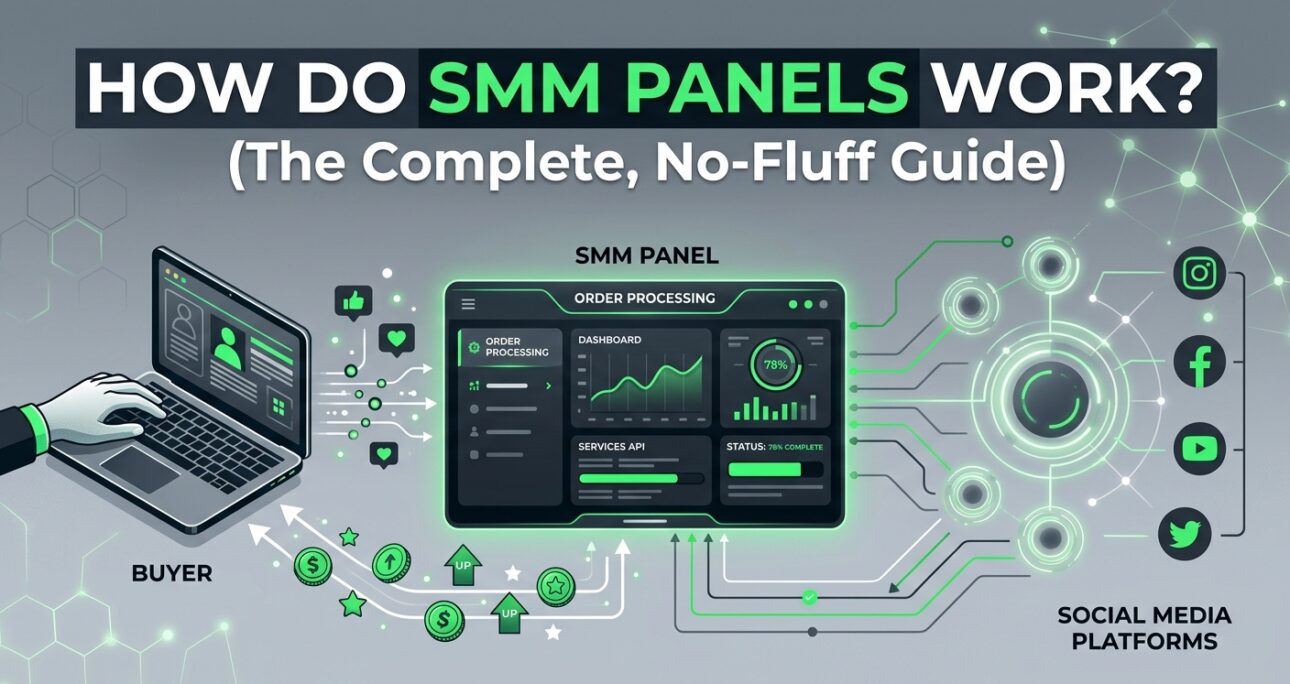
The “panel” terminology comes from the dashboard interface these platforms provide. You log in, see a list of available services with pricing and specifications, select what you need, submit your target URL and quantity, and the order processes automatically. It looks and functions more like buying from a digital marketplace than anything that requires technical knowledge.
The business model behind it is a straightforward reseller model. SMM panels source services from wholesale providers — often at fractions of a cent per unit — and mark them up when selling to end users. The markup funds the platform’s operating costs and profit margin. The wholesale provider, in turn, may be sourcing from a primary provider who actually manages the delivery infrastructure. This layered model is why prices can be as low as $0.10–$0.30 per 1,000 units for some services: the original cost is extremely low, and the margin at each layer is modest.
What an SMM panel is not: it is not an advertising platform, it is not affiliated with or sanctioned by the social media platforms it serves, and it is not a guaranteed path to genuine audience growth. Understanding these distinctions matters for using any of these tools with accurate expectations.
The Complete Order Journey: What Happens When You Click Submit
Most explanations of SMM panels stop at “you buy followers and they appear.” The actual mechanics are more interesting and more important to understand — especially if you’re evaluating whether a panel is legitimate, or if you’re thinking about running one yourself.
Account Creation and Wallet Funding
The entry point to any SMM panel is a simple account registration. You provide an email address and create a password. That’s typically all that’s required. Reputable panels never ask for your social media account credentials — they don’t need them. All the platform-facing work happens on their end using the target URL you provide, which only needs to be a publicly accessible link.
Once registered, you fund your account wallet. Payment options vary by panel but commonly include credit and debit cards processed through Stripe or PayPal, cryptocurrency (Bitcoin and USDT are most widely accepted), local payment gateways for specific regions, and sometimes bank transfer for larger deposits. Minimum deposits are typically very low — often $1 to $5 — which is intentional. The low barrier exists so buyers can test service quality without significant financial commitment before scaling up.
Browsing Services and Understanding What You’re Buying
The service catalogue is where most buyers spend the least time and should spend the most. Services are organised by platform and then by category, and within each category there are usually multiple tiers that differ significantly in quality, delivery speed, drop rate, and price.
A typical Instagram followers section might list ten or more different services at different price points. Understanding what those differences mean is important:
Instant delivery, bot-sourced services are the cheapest option. These typically use accounts that were created programmatically, often in bulk, and maintained at scale. They deliver quickly — sometimes within minutes — but carry the highest drop rate over time as platforms identify and remove inauthentic accounts through their regular integrity sweeps. The “followers” from these services rarely engage with future content.
Mixed quality services use a combination of older, more established accounts alongside some lower-quality accounts. Delivery is slightly slower and prices are higher. The drop rate is lower than pure bot services but still meaningful over a 30–90 day period.
High retention services use accounts with genuine activity history — real users who have been incentivised to follow accounts (through cashback apps, engagement exchange systems, or similar mechanisms). These services are more expensive, deliver more slowly, and produce followers who are real people, though their organic engagement with your content is still limited because they followed for incentive rather than genuine interest.
Real engagement services involve actual active users engaging with content — typically through engagement exchange networks where users earn credits by engaging with others’ content and spend those credits getting engagement on their own. These deliver the most authentic-looking activity but are the most expensive and slowest to fulfil.
Service listings should specify which type you’re getting. Vague descriptions with superlatives but no specifics (“BEST QUALITY REAL FOLLOWERS!!!”) are a reliable indicator of a seller who doesn’t want you asking detailed questions. A transparent panel tells you the delivery speed estimate, the start time, whether the service has refill protection and for how long, and any limitations on the service.
The Order Submission
Once you’ve selected a service, you enter two pieces of information: the target link (your profile URL, a specific post URL, a video link — whatever the service applies to) and the quantity you want. The dashboard calculates the total cost based on the service’s per-thousand pricing and deducts it from your wallet balance immediately upon submission. The order enters the queue.
How the API Connection Actually Works
This is the part that most explanations of SMM panels skip over, because it requires explaining some technical infrastructure. But it’s central to understanding why panels can process thousands of orders automatically with minimal human involvement, and it’s important context for evaluating whether a panel is real or fraudulent.
API stands for Application Programming Interface. In plain terms, an API is a defined communication protocol that allows two software systems to exchange information automatically — one system sends a structured request, the other processes it and sends back a structured response. You interact with APIs constantly without knowing it: when a website shows you current weather data, or when you log into an app using your Google account, an API is handling that communication in the background.
In the SMM panel context, the API works like this:
When you submit an order, your panel’s software sends an HTTP request to the backend provider’s API endpoint. That request contains: an authentication key (which identifies your panel as a legitimate client of the provider), the service ID (which tells the provider which specific service to deliver), the target URL, and the quantity. The provider’s system receives this request, validates the authentication, and queues the order into its own fulfillment system.
The provider’s system then sends back a response confirming that the order was received and assigning it an order ID. Your panel stores that order ID and uses it for all subsequent communication about that order’s status. At intervals, your panel pings the provider’s API with that order ID to check on status — the response comes back as “pending,” “in progress,” or “completed,” along with how many units have been delivered so far. This is how your panel dashboard shows you live order progress without any human manually updating it.
When an order completes, the final API response confirms delivery. If an order fails for any reason — the URL was invalid, the provider couldn’t process it, or the service had a technical issue — the API response indicates the failure reason and your panel can automatically trigger a refund to your wallet.
The entire chain from order submission to delivery to status update to completion runs automatically through this API communication layer. It’s why a functional panel can process thousands of orders daily with a small team. The human intervention, when it exists at all, is in customer support and in managing the provider relationships — not in manually processing individual orders.
The Delivery Itself
What happens on the social media platform side during delivery varies significantly by service type. For follower services, accounts that the provider controls — whether those are programmatically managed accounts, incentivised real accounts, or something in between — navigate to your profile and follow it. For like services, those accounts interact with your specified post. For view services on YouTube or TikTok, traffic is directed to your video through various mechanisms.
The time between order submission and visible delivery depends on the service. Instant services can begin within minutes. Services marketed as “gradual delivery” spread the delivery over hours or days to appear more organic. High-quality real-user services may take 24–72 hours to begin because they depend on actual user behaviour rather than automated account action.
The Supply Chain: Who’s Actually Behind Your Order
Understanding the layered structure of the SMM industry helps you make better decisions about where you spend money and what you can realistically expect.
Primary providers sit at the top of the supply chain. These are companies — sometimes large operations, sometimes smaller specialists in specific platforms — that actually manage the delivery infrastructure. They invest in account networks, traffic systems, engagement exchange mechanisms, or relationships with real users who participate in their platforms. A relatively small number of primary providers power a disproportionately large share of global SMM volume.
Wholesale panels connect to primary providers via API and resell their services at a markup to other businesses rather than directly to consumers. If a primary provider offers YouTube views at $0.05 per 1,000, a wholesale panel might resell them at $0.12 per 1,000 to retail panels. The wholesale panel’s value add is aggregating multiple providers, handling API integration, and offering pricing stability.
Retail panels are what most end users interact with. They connect to wholesale providers (or sometimes directly to primary providers), set their own customer-facing prices, manage the user experience, handle customer support, and run the marketing that attracts buyers. A retail panel buying views at $0.12 per 1,000 from a wholesale source might price them at $0.35–$0.80 per 1,000 depending on their positioning and market.
The practical implication of this chain is that the quality of what you receive is ultimately determined by the primary provider — not by the retail panel you’re buying from. A retail panel that uses low-quality primary providers will deliver low-quality services no matter how professional their website looks. A retail panel that has invested in relationships with better primary providers can deliver meaningfully better results at a higher price.
This is why price is an imperfect quality indicator but not a useless one. Rock-bottom prices at the retail level almost always reflect rock-bottom sourcing — you can’t sell quality services profitably at margins that assume cheap sourcing. Panels priced significantly above average may or may not be using better sources. Asking about their provider relationships and checking independent reviews is the only way to distinguish legitimate premium pricing from inflated margins on the same quality service.
Service Types Across Platforms: What Works Differently Where
The SMM panel experience isn’t uniform across platforms. Each social media network has different algorithmic behaviour, different enforcement capabilities, and different sensitivity to artificial engagement — which affects both what’s available and what’s risky.
Instagram is one of the most heavily served platforms in the SMM industry and also one of the most inconsistent in enforcement. The platform’s integrity systems have improved significantly since 2018’s “Operation Clean Network” sweeps, but they remain imperfect. Follower services carry moderate drop risk; like services carry lower risk because individual like removal is less systematic. Story view services are widely used by agencies because they’re low-risk and create the impression of active audience attention.
Instagram’s algorithm does factor engagement rate into content distribution — content from accounts with high follower counts but low engagement rates can see organic reach suppressed. This means follower services that don’t bring real engagement can actually hurt your organic performance by lowering your engagement rate ratio.
YouTube
YouTube is the most aggressively enforcing platform in the SMM space. Google’s backend systems are sophisticated, and the platform has a long history of conducting “view purges” that remove artificially generated views in bulk. In documented cases, channels have had view counts reduced by millions during these sweeps. More seriously, YouTube can and does terminate channels for artificial engagement manipulation, particularly when monetization is involved.
Views that use real browser sessions with meaningful watch time are significantly harder to detect and remove than low-quality click-through views with no watch duration. This is why YouTube view services vary enormously in price — you’re effectively paying for a more convincing simulation of genuine viewing behavior, which requires more infrastructure.
TikTok
TikTok has tightened enforcement significantly in the last two to three years, with enforcement particularly focused on follower inflation on accounts attempting to enter monetisation programs. View services remain more widely used and carry lower enforcement risk than follower or like services.
TikTok’s algorithm is notably more reliant on engagement metrics for distribution than Instagram or YouTube — a video’s early engagement rate within the first few hours strongly influences whether the algorithm pushes it to a broader audience. This has made TikTok view and like services particularly popular among creators trying to break through the algorithm’s initial evaluation window.
Spotify and Music Streaming Platforms
Spotify has become an increasingly significant category in the SMM panel space, particularly for independent artists trying to meet streaming thresholds for editorial consideration or distributor requirements. Stream services on SMM panels vary widely in quality — streams from real (but incentivised) listeners count differently to Spotify’s royalty system than bot streams, and Spotify has removed royalty payments for tracks with detected artificial streaming while leaving the stream counts intact in some cases.
Twitter/X
The Twitter/X engagement market has changed significantly since Elon Musk’s acquisition and the subsequent changes to the platform’s verification and API access systems. Follower services remain available but the platform’s infrastructure changes have affected what types of accounts are in provider networks.
What Separates a Reliable SMM Panel From a Fraudulent One
The SMM panel market contains genuinely useful services alongside outright scams. The signals that separate them are specific enough to evaluate methodically.
Refill guarantees with clear terms. Followers and likes can drop as platforms remove inauthentic accounts. A reliable panel offers refill protection for a defined period — typically 30, 60, or 90 days — and the refill happens automatically or through a simple claim process. The key is whether the terms are clearly stated: what qualifies as a drop worth refilling, what’s the minimum drop threshold, how quickly does the refill process, and are there any service categories excluded from refill protection. Vague refill promises without specific terms are worth treating as no refill guarantee at all.
Transparent service specifications. Every service listing should tell you what you’re actually buying. Delivery speed range (minimum and maximum time), start time estimate, service quality category, any limitations on target account type or minimum follower count, and drop protection terms. If you’re looking at a service listing with only a name, a price, and a minimum order quantity, the seller is either hiding something or doesn’t know what they’re selling.
No credential requirements. A legitimate SMM panel needs two pieces of information from you: a public URL and a quantity. It does not need your social media username, email address, or password. If any panel asks for your account login credentials for any reason, stop immediately. The delivery mechanism works through publicly accessible URLs — your credentials are never required for any legitimate service.
Working customer support with reasonable response times. Panel support can be evaluated before you spend money. Submit a pre-sales question through the support channel and observe the response time and quality. A panel that responds to a basic enquiry within a few hours with a helpful, specific answer is probably managing its customer relationships. One that takes days, responds with a templated non-answer, or doesn’t respond at all is showing you its operating standards before you’ve committed any money.
Established reputation with independently verifiable reviews. Reviews on the panel’s own website are meaningless for evaluation purposes — they’re easily fabricated. Look for the panel’s reputation on independent forums: SMMDevs.com, BlackHatWorld, and Warrior Forum all have communities discussing specific panels with real user experiences. Reddit threads, particularly in r/socialmedia and r/socialmediamarketing, also contain candid discussions. A panel with years of consistent positive reviews across multiple independent sources is a much safer bet than a new panel with only on-site testimonials.
API access for resellers. Panels that offer documented API access for reseller integration are almost always more serious and better maintained than panels that don’t. Building reseller API access requires sustained technical investment — it’s not something a fly-by-night operation bothers with. The existence of API documentation, maintained and functional, is a signal that the panel is built for long-term operation.
Secure, recognisable payment processing. Payments should be processed through recognised gateways — Stripe, PayPal, or named cryptocurrency platforms. Panels asking for payment via direct bank transfer to a personal account, Western Union, gift cards, or unofficial channels are almost certainly scams. The payment method tells you as much about the panel’s legitimacy as anything else about it.
The Risks: What Can Actually Go Wrong and How Likely It Is
This section matters more than most guides acknowledge. SMM panels operate outside the terms of service of every major social media platform, and the consequences of that vary by platform, service type, and how it’s used.
Platform Terms of Service Violations
Instagram’s Terms of Use, YouTube’s Terms of Service, TikTok’s Community Guidelines, and equivalent policies on every major platform explicitly prohibit using third-party services to artificially inflate engagement metrics. These aren’t buried provisions — they’re front-of-policy restrictions that the platforms actively enforce.
The enforcement consequences exist on a spectrum. At the minor end: engagement freezes, where a platform temporarily stops counting new engagement on an account it suspects of manipulation. Then: reduced organic reach, where the algorithm suppresses distribution of your content to genuine audiences. More seriously: action against specific posts — removal of artificially inflated likes or views, or content taken down for policy violations. Most seriously: account restriction or permanent termination, which is relatively rare for first-time violations but well-documented in cases of sustained, large-scale, or obvious manipulation, particularly on YouTube and in cases where monetisation fraud is involved.
The risk isn’t distributed uniformly. Platform and service type both matter significantly.
View and impression services generally carry lower enforcement risk than follower and like services, because views are more difficult for platforms to definitively attribute to artificial sources without also catching organic viewers with similar behavioural patterns.
Follower services carry moderate risk on most platforms — detection depends heavily on how the followers’ accounts behave after following, and genuine-looking accounts with real activity history are harder to flag than obvious bot accounts.
Verification-adjacent services — trying to use SMM services to meet monetisation thresholds (YouTube Partner Program, TikTok Series, Instagram Creator program requirements) — carry the highest risk, because platforms scrutinise these accounts most carefully at the threshold point and the consequences of detected manipulation include being banned from monetisation programs.
Social Media Examiner covers platform algorithm updates and policy enforcement changes in detail and is a useful resource for tracking how enforcement is evolving across platforms — particularly as AI-powered detection systems become more capable.
Drop Risk and Metric Volatility
The social media platforms conduct regular integrity sweeps — automated processes that identify and remove accounts flagged as inauthentic. When these sweeps remove accounts that followed you, liked your posts, or viewed your videos as part of an SMM order, your numbers drop accordingly.
The frequency and scope of these sweeps varies by platform and is impossible to predict from outside. Instagram has historically run sweeps several times per year, with the most significant ones in Q1 (January–February) when the platform updates its detection models after the holiday period. YouTube’s sweeps are more frequent and more surgical, often targeting specific provider networks when they’re identified.
Drop risk is partly manageable through service selection. High-retention services using real-user accounts drop less than bot-sourced services because real users aren’t removed in the same sweeps. Refill guarantees compensate for drops when panels honour them — which reputable panels do and fraudulent ones don’t.
Quality Variance Within Stated Service Tiers
Even within a stated service tier, there’s meaningful variance in what different providers deliver. Two panels selling “high-quality Instagram followers” at similar prices may be sourcing from providers with significantly different account quality levels. The only way to evaluate this before committing to a significant order is to test with a small quantity first — which the industry’s low minimum order sizes accommodate — and then observe the account quality (age, activity history, profile completeness) of the followers delivered and their persistence over the following weeks.
Financial Risks in the Panel Market
The SMM panel market has a meaningful proportion of fraudulent operations — websites designed to collect payments and deliver nothing or substandard service. The signals of fraudulent panels are usually identifiable: very recent domain registration (checkable through WHOIS), no independent reputation anywhere online, payment methods that offer no buyer protection, pricing too far below market rates to be credible, no functional customer support, and terms of service that are absent or clearly template text with placeholder information.
Sticking to recognised payment methods provides some protection — PayPal purchases in particular offer dispute resolution that gives you recourse if a service isn’t delivered. Cryptocurrency payments to an unknown panel offer essentially no recourse if something goes wrong.
Who Uses SMM Panels and What They’re Actually Trying to Accomplish
The user base is wider and more professionally mainstream than most public discussions of SMM panels suggest.
Digital marketing agencies are among the most consistent users of SMM panels, particularly for client account launches. The practical challenge agencies face is that organic social media growth is slow, variable, and difficult to demonstrate value through in the early months of an engagement. A client who pays a retainer for social media management and sees their follower count go from 180 to 350 over three months of good work may not renew, even if those 350 followers are genuinely engaged. Agencies use panels to establish a credible baseline number that allows organic content strategy to demonstrate its value through engagement rate rather than absolute follower count.
Independent content creators face what’s commonly called the cold-start problem: no one shares your content because you have no audience, but you struggle to build an audience without shares and algorithmic distribution. Early social proof — a view count, a follower count, a like count — changes how new viewers evaluate whether content is worth watching. A video with 40 views signals that nobody cares. The same video with 2,000 views signals that it’s worth checking. SMM panels are often used specifically to provide this initial social proof while organic growth is finding its footing.
Small business owners establishing social media presence for their business face the trust asymmetry between an empty-looking social presence and one with visible following. A local restaurant with 150 Instagram followers occupies a different trust position than one with 4,000 followers, even though neither number tells the browser anything meaningful about food quality. The number acts as a shorthand signal of legitimacy. Business owners use panels to accelerate past the point where an empty-looking presence actively works against them.
SMM resellers — people who run their own panels as a business — represent a significant portion of panel purchase volume. Many small panels buy from larger wholesale panels rather than directly from primary providers, and professional resellers at every level in the chain are active buyers.
Social media researchers and competitors also occasionally use panels — sometimes to test how platforms respond to artificial engagement, sometimes in more problematic competitive contexts (reporting competitors for using panels, or temporarily inflating competitors’ metrics to trigger platform flags). These are edge cases, but they’re documented.
Building Your Own SMM Panel: The Reseller Business Model
One of the significant use cases for understanding SMM panels is running one. The barrier to entry is lower than most people assume, and the business model is straightforward — though succeeding in a competitive market requires more than just setting up a website.
The Technical Setup
The core infrastructure components for a retail SMM panel are: a domain and hosting, a panel software platform, API connections to provider(s), and payment gateway integrations.
Panel software platforms — either self-hosted scripts or white-label panel services — handle the dashboard interface, order processing, wallet management, and API communication automatically. Well-established options include PerfectPanel, Just Another Panel (JustAnotherPanel / JAP), and similar platforms built specifically for this purpose. These come with the technical architecture already built; you’re configuring them for your providers and payment methods rather than building from scratch.
Connecting to a provider’s API requires obtaining an API key from the provider — essentially an authentication token that your panel includes in every API request to prove it’s you — and entering the provider’s API endpoint and key into your panel’s provider settings. Most panel software platforms support multiple provider connections simultaneously, which allows you to source different services from different providers based on where each provider has the best quality and pricing.
Payment gateway integration depends on which gateways the panel software supports and which your target market uses. For international markets, PayPal and Stripe combined cover most buyers. Adding a cryptocurrency option (commonly handled through NowPayments, CoinPayments, or similar) reaches buyers who prefer not to use bank-linked payment methods.
Economics of Running a Panel
The margins in SMM reselling are thin per unit, which makes volume the primary driver of profitability. A realistic margin structure for a retail panel might look like this: buying TikTok views at $0.15 per 1,000 from a wholesale provider, selling them at $0.60 per 1,000 to customers — a $0.45 gross margin per 1,000 views, or $0.00045 per view. An order for 50,000 views generates $22.50 in revenue and $7.50 in gross margin. That’s before payment processing fees (typically 2.9% + $0.30 for card transactions), any customer support time, and platform operating costs.
At low volume, the numbers don’t look compelling. At meaningful volume — thousands of orders per month — they add up. Successful resellers typically combine reasonable margins with volume efficiency: automated fulfillment that requires minimal human intervention, low customer acquisition costs through SEO and community marketing, and differentiation through service quality or specialisation rather than margin compression.
Differentiation in a Commoditised Market
The SMM panel market is highly competitive, with hundreds of retail panels offering overlapping services at similar prices. Differentiation that works:
Platform or niche specialisation. A panel that focuses specifically on Spotify and music streaming services can build domain expertise — better provider relationships, better service descriptions, more useful customer guidance — that a generalist panel spreading attention across twenty platforms can’t match.
Quality tier focus. Positioning as a premium panel with higher prices but better quality, refill reliability, and customer support attracts a different customer than a race-to-the-bottom pricing strategy. Premium positioning requires genuinely better service to sustain, but it commands better margins and generates less support volume from unsatisfied customers.
Exceptional support. In a market where most panels have mediocre support, a panel with fast, helpful, knowledgeable support creates word-of-mouth and repeat business. This sounds obvious but is genuinely rare in practice.
Community presence. Active, helpful participation in SMM forums and communities — not promotional spam, but genuine contribution — builds reputation and trust more durably than advertising spend.
SMM Panels vs. Social Media Advertising: Understanding the Difference
The two are sometimes confused or conflated. They’re fundamentally different tools with different risk profiles, different outcomes, and different appropriate applications.
Social media advertising — Meta Ads, TikTok Ads, YouTube Ads, Twitter/X Ads — is paid promotion operated within the platform itself. You pay the platform directly for defined reach to targeted audiences. The engagement you receive is from real users with genuine interest in the content they interacted with (at least in theory, subject to ad fraud considerations that exist in the legitimate advertising market as well). The entire arrangement is compliant with platform terms — it’s literally how the platforms want you to spend money with them. Outcomes are trackable through native analytics, attributable to specific campaigns, and reportable to clients or stakeholders with full platform support.
SMM panels operate entirely outside the platforms. You’re paying a third party for engagement that the platform hasn’t sanctioned. The engagement numbers change, but the underlying audience doesn’t — the followers you bought from a panel aren’t people who are interested in your content, they’re accounts that followed you for reasons unrelated to your actual work. The arrangement is against platform terms, untrackable through native analytics in a meaningful way, and unattributable through any compliant reporting system.
The practical difference in outcome: advertising drives real people to your content who may become genuine followers, customers, or brand advocates. SMM services change numbers that function as social proof signals but don’t deliver people with any organic interest in what you’re doing.
Many experienced operators use both deliberately: SMM panels to establish the social proof baseline that makes advertising spend more efficient (because landing pages and profiles with visible engagement convert better than empty ones), and advertising to drive actual audience and revenue. If you’re looking to integrate both approaches within a broader digital marketing strategy, our SMM and SEO services are built around that combined approach.
The distinction matters for setting accurate expectations. SMM panels are a numbers tool, not an audience tool. Treating them as an audience tool leads to disappointment. Understanding what they actually do allows you to use them for the specific purpose they serve effectively.
How Platform Detection Systems Work
Understanding how platforms detect artificial engagement is useful context for the risk assessment that any SMM panel user or reseller should be making.
Major platforms use machine learning models trained on enormous datasets of account behaviour to identify patterns inconsistent with organic activity. The signals these models evaluate include:
Velocity anomalies. A post that goes from 50 likes to 5,000 likes in four minutes has a velocity pattern inconsistent with organic viral spread. Even viral content spreads through sharing and discovery chains that have temporal signatures — SMM delivery that’s too fast and too linear stands out statistically.
Account behaviour patterns. Accounts that follow in batches, that follow without interacting with content, that have no history of the platform-normal behavior that characterises real users, are flagged. More sophisticated detection looks at device fingerprinting (accounts operating from the same IP ranges or device clusters), session patterns (accounts that become active simultaneously or in sequences), and account age relative to activity patterns.
Network analysis. Platforms map the relationship networks between accounts. A group of accounts that follows each other, that all followed the same sequence of profiles, or that all exhibit similar activity patterns across the platform forms a detectable cluster even when individual accounts look superficially legitimate.
Engagement ratio analysis. A profile with 50,000 followers but consistently receiving 45 likes and 3 comments per post has an engagement rate that doesn’t match its follower count. Platforms factor this discrepancy into how content is distributed and into whether the account receives scrutiny from integrity systems.
The practical implication: the more convincingly a service mimics real organic behavior — gradual delivery, real-account engagement, natural velocity — the harder it is to detect and the lower the risk of enforcement action. This is why quality variation in SMM services matters practically, not just aesthetically.
Frequently Asked Questions about SMM Panels
Is it possible to use an SMM panel without any risk?
No service from an SMM panel is technically risk-free, because all of them operate outside platform terms of service. The risk level varies considerably, however. View services on most platforms carry lower risk than follower services. Using gradual delivery carries lower risk than instant delivery. Using high-retention real-user services carries lower risk than bot services. Starting with smaller quantities to observe how a platform responds is lower risk than placing large orders immediately. Managing risk means understanding it, not assuming it doesn’t exist.
Can platforms tell when someone bought followers or likes?
Yes, often — though not always. Detection capability varies by platform (YouTube’s systems are more sophisticated than most others), by the quality of the service used (real-account services are much harder to detect than bot accounts), and by how the service is used (large sudden deliveries are more detectable than gradual ones). The honest answer is that getting away with it is possible, but it’s not guaranteed, and relying on detection failure as a risk management strategy is poor planning.
What happens to the money if an order fails?
On reputable panels with automated order management, the amount is returned to your wallet balance when an order fails or is cancelled. This should happen automatically or within a short time window. Getting confirmation that this is a panel’s policy before placing significant orders is sensible. On fraudulent or poorly run panels, failed order refunds are one of the first things that stop working. Use a panel’s handling of small test orders to evaluate this before committing to larger purchases.
Do followers from SMM panels ever engage with content?
For incentivised real-user services, some organic engagement can happen — the followers are real people and occasionally interact genuinely. For bot or programmatic account services, the answer is essentially no. The accounts that followed are managed at scale for the purpose of following, not for genuine content interaction. Don’t expect organic engagement from followers that weren’t organically acquired.
How do I know if a panel is connected to quality providers or cheap ones?
Testing with small orders is the most reliable method. Look at the account quality of followers delivered — profile completeness, account age, posting history, follower-to-following ratios. Compare drop rates over 30–60 days against the panel’s stated retention. Check the panel’s reputation on independent forums rather than trusting on-site reviews. Ask the panel directly what they can tell you about their service sources — a panel confident in their providers will give you a more specific answer than a panel hiding behind vague quality claims.
Is running an SMM reseller panel legal?
The legality varies by jurisdiction and business model. Running a panel as a business, collecting payment for services, and operating an automated platform involves real business obligations — tax registration, consumer protection compliance, payment processing compliance, and in some jurisdictions, specific regulations around automated account activity. It’s worth taking legal and tax advice appropriate to your jurisdiction before operating at any meaningful scale. The operation of SMM services as a business is not inherently illegal in most jurisdictions, but running it without appropriate business registration and compliance infrastructure creates real legal risk.
What’s the minimum I should spend to test a SMM panel properly?
Testing a panel meaningfully requires evaluating at least two or three different service types, observing delivery quality and drop rate over 30 days, and interacting with customer support at least once. This can typically be done for $15–$30 total, depending on the panel’s pricing. The $30 spent on a proper evaluation before committing significant budget is worth considerably more than the alternative of discovering quality issues after a larger order.
The Bottom Line for SMM Panels
SMM panels are a real, widely used category of marketing tool with a specific function: delivering social media engagement metrics at scale, quickly, and at low cost. They’re used by agencies, creators, small business owners, and resellers — not just by people looking for shortcuts, but by professionals who understand what these tools actually do and use them within a broader strategy accordingly.
The mechanics are straightforward once you understand them: a layered reseller model, API-automated order processing, provider networks that manage delivery, and a quality spectrum that directly correlates with price and risk level. The risks are real and worth taking seriously — platform enforcement exists, drop rates are a genuine operational consideration, and the market contains enough fraudulent operators that due diligence before spending money is not optional.
What separates effective use from ineffective use is accurate expectations. SMM panels deliver numbers, not audiences. They establish social proof, not genuine communities. Used to complement a real content strategy and genuine community building, they can make those efforts more efficient. Used as a substitute for them, they produce metrics without substance — which is eventually visible in engagement rates, conversion rates, and the absence of the organic growth that real audiences produce.
The SMM panels you choose, the services you select, and the strategy you embed them in determine whether the tool serves your actual goals. That’s what makes understanding how they actually work more valuable than just knowing that they exist.