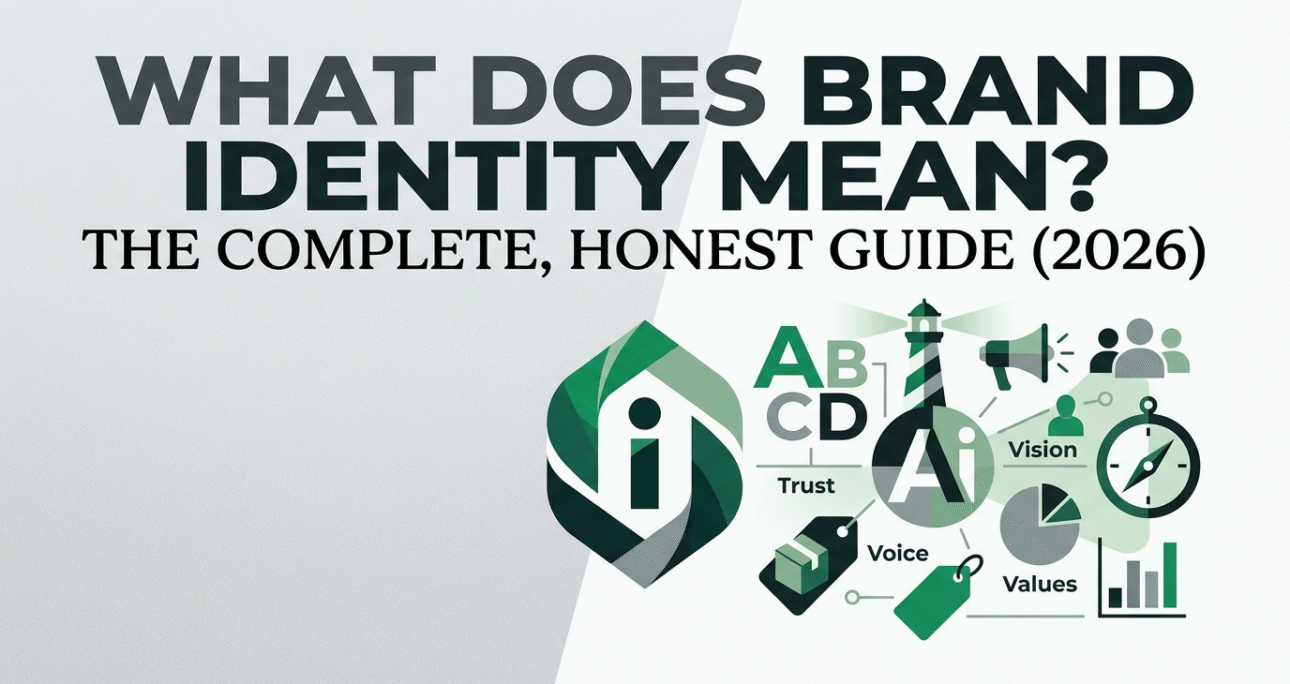
Brand identity is the complete system of visual, verbal, and emotional elements a business uses to express who it is and how it wants to be perceived — including its logo, colour palette, typography, tone of voice, messaging, and the consistent experience delivered across every customer touchpoint. It is distinct from brand image, which is the perception customers form, and from branding, which is the ongoing process of managing that perception. A strong brand identity is built on a strategic foundation — defining purpose, values, positioning, and personality — before any design work begins. Research shows consistent brand presentation increases revenue by an average of 23%, and consumers need 5 to 7 brand impressions before they remember a business.
Most people think brand identity means a logo. A colour palette. Maybe a nice font. And while those things are part of it, reducing brand identity to visual design is like saying a person’s identity is just their clothes. It misses almost everything that actually matters.
Brand identity is one of the most misunderstood concepts in business — and one of the most consequential. Get it right, and customers recognise you instantly, trust you faster, and choose you over cheaper competitors. Get it wrong, or ignore it entirely, and you’re competing on price forever.
This guide explains what brand identity actually means, what it includes, why it matters more in 2026 than it ever has, and how to build one that works.
What Does Brand Identity Mean?
Brand identity is the collection of visual, verbal, and emotional elements that a business uses to express who it is, what it stands for, and how it wants to be perceived — consistently, across every touchpoint where a customer encounters it.
It is not your brand. Your brand is what other people think and feel about your business — it lives in their minds. Brand identity is what you create and control: the deliberate signals you send out into the world to shape that perception.
Think of it this way. Your brand is your reputation. Your brand identity is everything you do to earn and influence that reputation.
A strong brand identity answers three questions without the customer having to ask them:
- Who are you?
- What do you stand for?
- Why should I trust you over someone else?
Simple definition: Brand identity is the complete system of visual, verbal, and emotional elements a business uses to present itself consistently and build recognition, trust, and loyalty with its audience.
Brand Identity vs. Brand Image vs. Branding: Clearing Up the Confusion
These three terms get used interchangeably all the time. They mean different things.
Brand identity is what you put out — the deliberate, designed expression of your brand. You control this.
Brand image is what people receive — the perception your audience forms based on everything they experience. You influence this, but you don’t fully control it.
Branding is the active process of building and managing both — the ongoing work of shaping how your business is perceived over time.
A simple analogy: if your business were a person, brand identity would be how they choose to dress, speak, and carry themselves. Brand image would be how others actually see and describe them. Branding would be the lifelong work of building a reputation worth having.
What Brand Identity Actually Includes
This is where most guides either go too shallow or too academic. Here is what a complete brand identity system genuinely consists of:
1. Brand Strategy Foundation
Before any design begins, the most important work happens at the strategic level. This includes:
Brand purpose — Why does your business exist beyond making money? What problem do you genuinely solve, and why does that matter?
Brand values — The principles that guide every decision your business makes. Not aspirational words on a wall, but values that actually show up in how you behave, hire, and serve customers.
Brand positioning — Where you sit in the market relative to competitors. Who you are for, who you are not for, and what makes you the right choice for your specific audience.
Brand personality — If your brand were a person, how would they speak? What would they care about? Are they warm and approachable, or authoritative and precise? Playful or serious? This personality should be consistent everywhere.
Target audience — A clear, specific understanding of who your ideal customer is — not just demographics, but their motivations, frustrations, aspirations, and the language they use.
2. Visual Identity
This is the part most people think of when they hear “brand identity.” It includes:
Logo — The primary mark that represents your brand visually. A strong logo is distinctive, scalable (works at any size), and appropriate for the category. It should work in black and white before it works in colour.
Colour palette — A defined set of primary and secondary colours used consistently across all materials. Colour is one of the most powerful tools in brand recognition — research consistently shows that colour increases brand recognition by up to 80%.
Typography — The specific typefaces (fonts) chosen to represent the brand. Typography communicates personality before a single word is read. A serif font signals tradition and authority. A geometric sans-serif signals modernity and clarity. The right choice is deliberate, not default.
Imagery style — The visual language used in photography, illustration, or graphics. This includes the tone of photography (bright and airy vs. dark and editorial), whether you use illustration, and what kinds of people or environments you show.
Iconography and graphic elements — Recurring visual motifs, patterns, icons, or design elements that appear across brand materials and reinforce recognition beyond the logo alone.
Brand guidelines — The rulebook that documents all of the above and explains how each element should and should not be used. Without guidelines, visual consistency breaks down the moment more than one person is creating content.
3. Verbal Identity
Equally important and far more often neglected:
Brand name — The most repeated element of your brand identity. Strong brand names are distinctive, easy to remember, easy to spell, and available as a trademark and domain.
Tagline or strapline — A short phrase that captures the brand’s essence or promise. Not every brand needs one, but when done well, it’s extraordinarily sticky.
Tone of voice — The consistent personality expressed through language. How your brand writes emails, social media posts, product descriptions, website copy, customer service responses — all of it should feel like it comes from the same voice. Formal or casual? Warm or professional? Direct or storytelling-led?
Messaging framework — The core messages your brand returns to again and again. What you say about who you are, what you do, and why it matters — in consistent language that your whole team uses.
4. Brand Experience
The often-overlooked third dimension of brand identity:
Customer touchpoints — Every moment a customer interacts with your business is a brand experience: your website, packaging, social media, email, the hold music on your phone line, how your team greets people. Brand identity only becomes a brand when it’s consistently expressed across all of these.
Packaging — For product businesses, packaging is one of the most powerful brand identity expressions available. It’s the moment a customer physically holds your brand for the first time.
Digital presence — Your website, social media profiles, email templates, and digital advertising all need to feel like they come from the same identity system.
Why Brand Identity Matters More in 2026 Than Ever Before
The noise has never been louder. More businesses are competing for the same attention, on more platforms, with more tools than at any point in history. AI-generated content has flooded the internet with competent but indistinct material. Consumers are more sceptical, more distracted, and more capable of recognising inauthenticity than they’ve ever been.
In that environment, a clear, consistent, and genuinely distinctive brand identity is not a luxury — it is a competitive necessity.
Here’s what the evidence shows:
Consistent brand presentation across all platforms increases revenue by an average of 23%, according to research from Lucidpress — making brand identity one of the highest-leverage investments a business can make. A strong visual identity accelerates that recognition dramatically. 81% of consumers say they need to trust a brand before they’ll buy from it — and trust is built through consistency. You cannot be consistent without a defined identity.
In 2026, two additional forces have made brand identity even more critical:
AI commoditisation. As AI tools make it easier and cheaper to produce content, products, and services, the brands that win will be those with a distinct, human, and clearly expressed identity — something AI cannot manufacture. Authenticity has become a genuine competitive advantage.
Platform fragmentation. Customers encounter brands across more touchpoints than ever — Instagram, TikTok, Google Search, email, physical packaging, in-store, word of mouth. Without a coherent identity system, a brand simply dissolves into inconsistency as it spreads across channels.
The Difference Between a Strong Brand Identity and a Weak One
A weak brand identity looks different on every platform. Uses three different logos depending on who made the asset. Has no defined tone of voice, so every email sounds like it was written by a different person. Chose colours because the founder liked them, not because they communicate anything intentional. Has a tagline nobody internally can remember, let alone customers.
A strong brand identity is instantly recognisable even without the logo present — because the colours, the typography, the image style, and the language all work together as a system. It attracts the right customers and quietly repels the wrong ones. It makes premium pricing defensible because perception of value has been built. It gives the whole team — from marketing to customer service — a shared language for how to represent the company.
The brands most people admire — Apple, Patagonia, Oatly, Gymshark, Innocent — are not admired because they have pretty logos. They’re admired because every element of their brand identity, from visual design to the way they write a refund email, expresses the same coherent point of view.
How to Build a Brand Identity: Where to Actually Start
Start with strategy, not design. The most common mistake is commissioning a logo before answering the strategic questions. Who are you for? What do you stand for? What makes you genuinely different? Design without strategy produces pretty assets that don’t communicate anything useful.
Know your audience before you design for them. Your brand identity should resonate with your specific customer, not with your personal taste. Research your audience. Understand what they value, what they distrust, and what visual and verbal language feels right to them.
Look at your competitors deliberately. Not to copy them — to find the gaps. If every competitor in your category uses dark, authoritative colours and formal language, there may be a real opportunity in being warm and approachable. Brand positioning is partly about differentiation.
Invest in professional design. A DIY logo from a free tool is not a brand identity. It’s a placeholder. Professional brand identity work — strategy, visual identity, and verbal guidelines — typically costs £2,000–£15,000 for small to medium businesses in 2026, and significantly more for larger organisations. It is one of the highest-ROI investments a growing business can make, because everything else — marketing, packaging, website, content — performs better when the identity is strong.
Document everything in brand guidelines. A brand identity that only exists in one designer’s head will not survive growth. Guidelines don’t need to be a 200-page document — even a clear 10-page PDF covering logo usage, colours, typography, and tone of voice is transformative for consistency.
Apply it consistently, everywhere, immediately. Brand identity only works through repetition. Every touchpoint, every time. The power of brand identity is cumulative — each consistent impression builds on the last.
Common Brand Identity Mistakes to Avoid
Confusing a logo with a brand identity. A logo is one element of a brand identity system. On its own, it’s a mark — not a strategy, not a personality, not a voice.
Designing for yourself, not your customer. Your personal aesthetic preferences are irrelevant if they don’t resonate with the people you’re trying to sell to.
Inconsistency across platforms. Using different colours on Instagram than on your website, or a different tone in emails than in your ads, erodes the cumulative recognition you’re trying to build.
Rebranding too often. Some businesses treat their brand identity like a seasonal wardrobe. Consistency over time is what builds recognition. Rebranding should happen when the business has fundamentally changed — not because someone got bored of the current logo.
Copying competitors. Derivative brand identities compete on the same terms as the brand they imitate. Differentiation is the point. If you look and sound like your competitors, price becomes the only differentiator — and that’s a race to the bottom.
Need Help Building Your Brand Identity?
If you know what your business does but struggle to express it clearly and consistently, working with a specialist agency can make an enormous difference. Ecom Mate is a UK-based agency that offers full brand identity and graphic design services — from logo creation and colour systems to complete brand guidelines. They work with businesses from startup through to established brands that need a refresh, and their work is rooted in both creative design and commercial strategy. Worth exploring if you’re serious about building a brand that stands out.
Frequently Asked Questions
What does brand identity mean in simple terms? Brand identity is everything a business deliberately creates to express who it is and how it wants to be perceived — including its logo, colours, typography, tone of voice, and the consistent experience it delivers to customers across every touchpoint.
What is the difference between brand identity and branding? Brand identity is the system of elements you create — logo, colours, voice, messaging. Branding is the ongoing process of building and managing how your business is perceived over time. Identity is the toolkit; branding is how you use it.
What are the main elements of brand identity? The core elements are: brand strategy (purpose, values, positioning, personality), visual identity (logo, colours, typography, imagery), verbal identity (name, tone of voice, messaging), and brand experience (how the identity is expressed at every customer touchpoint).
How much does brand identity design cost in 2026? For small to medium businesses, professional brand identity work typically costs £2,000–£15,000 depending on scope. This usually includes logo design, colour palette, typography, and basic brand guidelines. Larger organisations or full brand strategy engagements can cost significantly more.
Why is brand identity important? Because consistent brand presentation increases revenue by an average of 23%, customers need 5–7 impressions before they remember a brand, and 81% of consumers say trust is required before they’ll buy. Brand identity is the system that builds all three.
Can a small business have a strong brand identity? Absolutely. Some of the most distinctive brand identities belong to small businesses. Strong brand identity is about clarity and consistency, not budget. A small business with a well-defined personality, a clear visual system, and a consistent voice will outperform a larger competitor with an inconsistent, unfocused identity.
Final Thoughts
Brand identity is not a cosmetic exercise. It is one of the most strategic investments a business can make — because it shapes every customer’s first impression, every repeat encounter, and every purchasing decision influenced by trust and recognition.
The businesses that win in 2026 are not necessarily the ones with the biggest budgets or the most products. They’re the ones that are clearest about who they are, most consistent in how they express it, and most disciplined about applying that identity everywhere their customers find them.
Clarity is the foundation. Consistency is the strategy. Over time, both become recognition — and recognition becomes the thing that makes customers choose you without even stopping to compare.
Last updated: May 2026. Reflects current brand identity practices and design industry standards as of Q2 2026.
Rohann is a brand strategist and writer covering identity, design, and digital marketing. All content is independently researched.